Key Takeaways:
- 2028 Production Target: Tesla aims to begin Roadster production in 2028.
- Flying Technology: The prototype uses 10 nozzles and high-pressure air tanks for airborne maneuvers.
- Engineering Challenges: Flight range, safety, and road legality remain unproven.
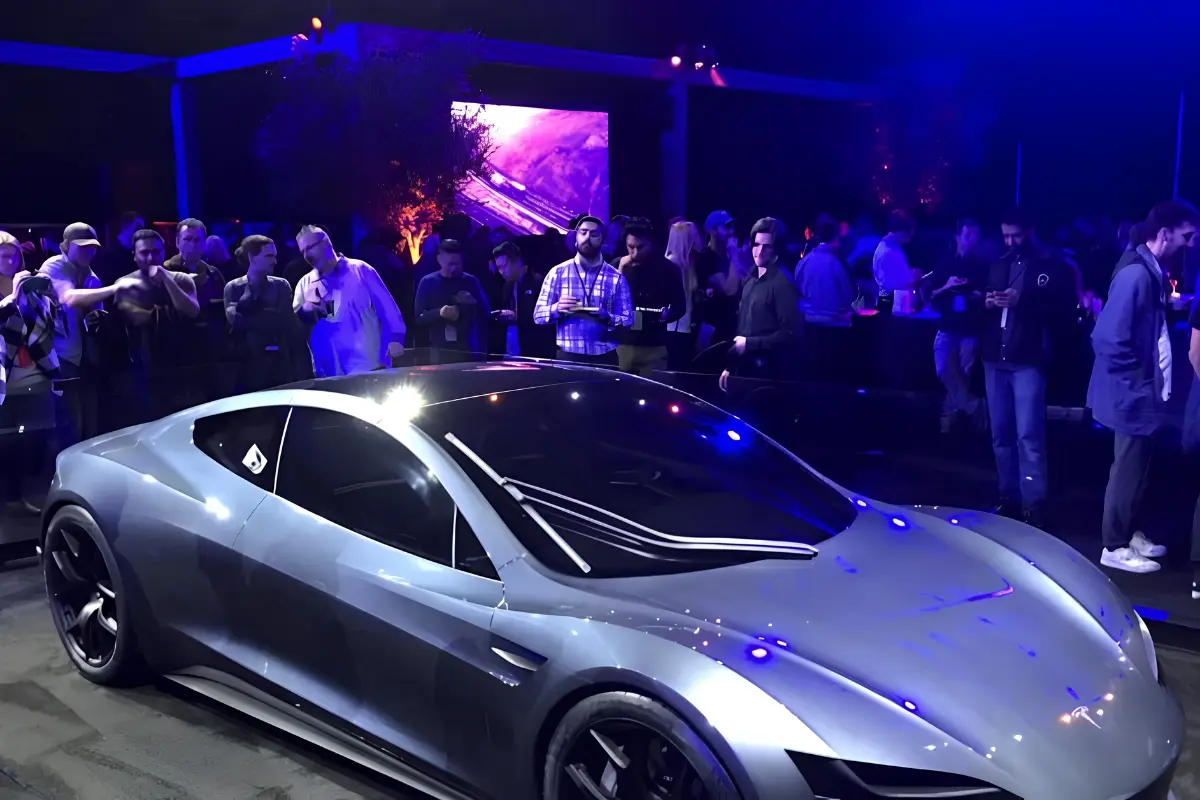
Tesla CEO Elon Musk unveiled the Tesla flying Roadster at a Texas event Thursday, demonstrating air-powered stunts while targeting 2028 production amid engineering and safety questions.
Tesla Demonstrates Roadster’s Air-Powered Stunts
The two-seat Tesla flying Roadster performed a series of dramatic maneuvers at a SpaceX test facility in Texas. Musk said the vehicle could accelerate from zero to 60 mph in less than a second and use suction to climb a steep ramp, hang upside down, and launch into the air before landing with air jets.
The demonstration did not establish whether the Roadster could sustain flight or travel long distances. The vehicle performed the demonstration without a driver, which Musk said was a safety precaution.
“To make sure we don’t kill anyone,” Musk told the audience, explaining why nobody was inside the car during the stunt. He also acknowledged the uncertainty surrounding the demonstration, saying, “Success is not guaranteed.”
Musk said the Tesla flying Roadster uses 10 nozzles and ultra-high-pressure air tanks to propel itself both on the ground and in the air. He described the technology as a collaboration between Tesla, the electric vehicle maker, and SpaceX, his aerospace company.
Musk said production could begin in 2028. However, Tesla has repeatedly missed timelines for previously announced products and technologies, raising questions about whether the company can meet its latest target.
Experts Question Whether the Car Can Truly Fly
The demonstration has renewed questions about the feasibility of combining a road vehicle with aircraft capabilities. Engineers must balance competing requirements, including vehicle weight, crash protection, stability, and the ability to generate enough lift.
Roger Connor, curator for vertical flight at the Smithsonian’s National Air and Space Museum, questioned whether a road-legal vehicle could perform like a practical aircraft. Speaking to CNN before the event, he said combining the two technologies could result in a vehicle that performs poorly in both roles and costs significantly more.
Aircraft must remain lightweight to achieve efficient flight, while road vehicles require protective structures, including bumpers and crumple zones, to protect occupants during collisions. Those competing demands make it difficult to develop a vehicle that can safely operate on roads and fly efficiently.
Connor also cautioned against interpreting a brief airborne stunt as evidence of practical flight capability. “We’re not talking about sustained flight,” he said. “We are literally talking about hopping.”
The demonstration did not establish whether the Roadster could transition safely from vertical lift to forward flight, a major engineering challenge for vehicles designed to take off and land vertically.
Flying-Car Developers Face Major Engineering Challenges
Several companies are developing electric vertical takeoff and landing aircraft, commonly known as eVTOLs. Although some prototypes have flown, making these vehicles practical, safe, and road-legal remains a major challenge.
California startup Alef has developed a flying-car prototype with eight propellers: four at the front and four at the rear. The vehicle weighs about 254 pounds and can carry one person, who must weigh less than the vehicle itself, according to the report.
Alef CEO Jim Dukhovny told CNN before Tesla’s event that he would not be surprised if the Roadster managed to leave the ground. However, he emphasized that achieving sustained and controlled flight presents a much greater challenge.
“The hardest part on all eVTOLs, and for us, it’s a transition from (rising) vertical to (moving) forward,” Dukhovny said. He explained that the vehicle must maintain lift and stability throughout the transition.
Tesla’s demonstration offered a glimpse of Musk’s vision for a sports car that can perform airborne maneuvers. However, questions remain about its flight range, safety, road legality, and production readiness.
Until Tesla demonstrates sustained, controlled flight under realistic operating conditions, the Roadster’s flying capabilities remain unproven beyond the stunts shown at the event.