When I worked the night shift as a lead gen specialist during my college years, the office felt like a factory. We dialed hundreds of numbers, scraped generic lists, and measured success by “volume.” If we hit 200 dials, it was a good night. But if I’m honest? Most of those “leads” were garbage.
Fast forward to 2026, and the “factory” model is officially dead. According to Snov.io’s 2026 Industry Report, the average cost per lead (CPL) across all channels has spiked to $391.80. You can no longer afford to guess.
Today, Lead Generation Strategies aren’t about working harder or louder. They’re about understanding people; how they research, hesitate, compare, and decide. This guide exists because I wanted answers I never had back then: what actually works? What wastes time? And how real companies turn intent into revenue without treating buyers like numbers?
The Beginner’s Foundation (The “Wh” of Growth)
Before you spend a dime on ads, you must understand the core mechanics.
What is Lead Generation?
Lead generation is the process of sparking interest in your product or service to capture a prospect’s information. A “lead” is someone who has given you a signal—be it an email, a phone number, or a social media follow—that they want to hear from you.
Why Do You Need a Strategy?
Without defined Lead Generation Strategies, you are just shouting into a void. Statistics from DemandSage show that 91% of marketers consider lead generation their top priority in 2026. However, 80% of new leads never actually convert into a sale because businesses lack a nurturing bridge.
- The Pro-Tip for Beginners: Start with your Ideal Customer Profile (ICP). If you sell high-end enterprise software, a “small business owner” isn’t a lead; they are a distraction. Use “Firmographic” filters—company size, industry, and revenue—to narrow your hunt.
The Psychology behind Why People Convert
Before tactics, understand behavior.
Harvard Business Review research shows buyers complete 57–70% of the decision-making process before speaking to sales. That explains why interruption-based outreach fails and inbound works.
People convert when three conditions align:
- A recognized problem
- A credible guide
- A low-friction next step
Amazon Ads highlights this in its lead generation framework, emphasizing trust-building before capture. The platforms differ, but the psychology stays constant.
This explains why Lead generation strategies that focus on value first outperform aggressive CTAs.
Understanding the Lead Funnel without Buzzwords
Every serious system follows this flow:
Awareness → Interest → Evaluation → Intent → Action
HubSpot breaks this into TOFU, MOFU, and BOFU stages, while Cognism frames it as intent data maturity. Different language, same structure.
What matters is matching the offer to the moment. Beginners fail here. Advanced marketers obsess over it.
Top 16 Lead Generation Strategies That Actually Work in 2026
Most lists lump tactics together without context, maturity, or intent. This one does the opposite. These Lead gen strategies reflect how real pipelines are built from first touch to full-funnel orchestration, based on buyer psychology, intent signals, and measurable outcomes.
We curated this list by analyzing what consistently drives qualified leads across platforms like HubSpot, Salesforce, LinkedIn, Semrush, Cognism, and Amazon Ads, then stress-tested those insights against real-world execution. Each strategy maps to a specific growth stage, building the engine, accelerating the pipeline, and mastering the funnel, so teams know when to apply it, not just how.
Every tactic here earns its place through data, documented results, and practical application without any guesswork or recycled advice. We have segregated the list of strategies into 3 parts: Beginner, Intermediate, and Advanced.
Beginner-Level Foundations (The Non-Negotiables)

1. Content That Solves One Specific Problem
HubSpot data shows companies publishing 16+ blog posts per month generate 3.5x more leads than those publishing fewer than four. But volume never converts on its own, but clarity does.
Strong Lead generation strategies start with content that attacks one painful, high-intent problem and solves it thoroughly. Readers trust content that feels written for them, not about everything.
Instead of broad topics, narrow the promise. Specificity signals expertise, relevance, and confidence; three psychological triggers that increase conversions before the CTA even appears.
2. Lead Magnets That Match Intent
Coursera and Semrush consistently emphasize alignment between content and lead magnets because mismatches destroy conversion momentum. If the reader expects depth and receives surface-level material, trust breaks instantly.
High-performing Lead generation treats lead magnets as logical next steps, not random downloads. The best magnets reduce effort, deliver instant value, and confirm the reader’s decision to engage.
Effective formats include:
- Templates for immediate application
- Checklists for fast clarity
- Benchmarks that trigger comparison psychology
- Case studies that replace claims with proof
HubSpot reports personalized CTAs convert 202% better than generic ones, a gap beginners often ignore.
3. The “Zero-Click” Content Framework
Modern buyers want answers instantly. They do not want ten tabs, five pop-ups, and a gated intro. They want clarity now.
The Zero-Click framework delivers the entire solution upfront on platforms like LinkedIn or X, then offers depth, not basics, as the lead magnet.
- The Tactic: Publish full solutions as social-first content. Gate only the execution layer, such as a technical implementation template or framework.
- The Tip: Optimize for GEO (Generative Engine Optimization). AI-driven discovery tools like ChatGPT and Perplexity favor content with verifiable data, citations, and clear claims. Content without proof rarely gets recommended.
This approach positions authority before capture, which strengthens trust-driven Lead generation strategies.
4. Website Visitor Identification (Capturing the Silent 98%)
Most high-intent buyers never fill out forms. They research quietly, revisit pricing pages, and compare options internally. Letting them leave unnoticed costs revenue.
Visitor identification tools turn anonymous traffic into actionable intelligence.
- The Tactic: Use platforms like Leadfeeder or Leadinfo to identify companies visiting your website, even without form submissions.
- Key Advice: Repeated visits to pricing, case studies, or integrations pages within a short window signal buying intent. When a target account visits pricing three times in 24 hours, alert sales immediately.
This strategy transforms passive traffic into proactive Lead generation strategies.
5. Forms That Respect Attention
LinkedIn’s internal data shows shorter forms increase completion rates by over 30%, especially on mobile devices. This happens because every extra field adds cognitive friction.
Smart Lead gen strategies collect only information that drives the next action. Name, email, and one qualifying question usually outperform long forms filled with “nice-to-have” fields.
Anything not essential for segmentation or follow-up belongs later in the funnel, once trust exists.
Read Next: 2026 Lead Generation: Attract High-Quality Leads & Fuel Your Sales Pipeline
Intermediate Tactics That Improve Lead Quality
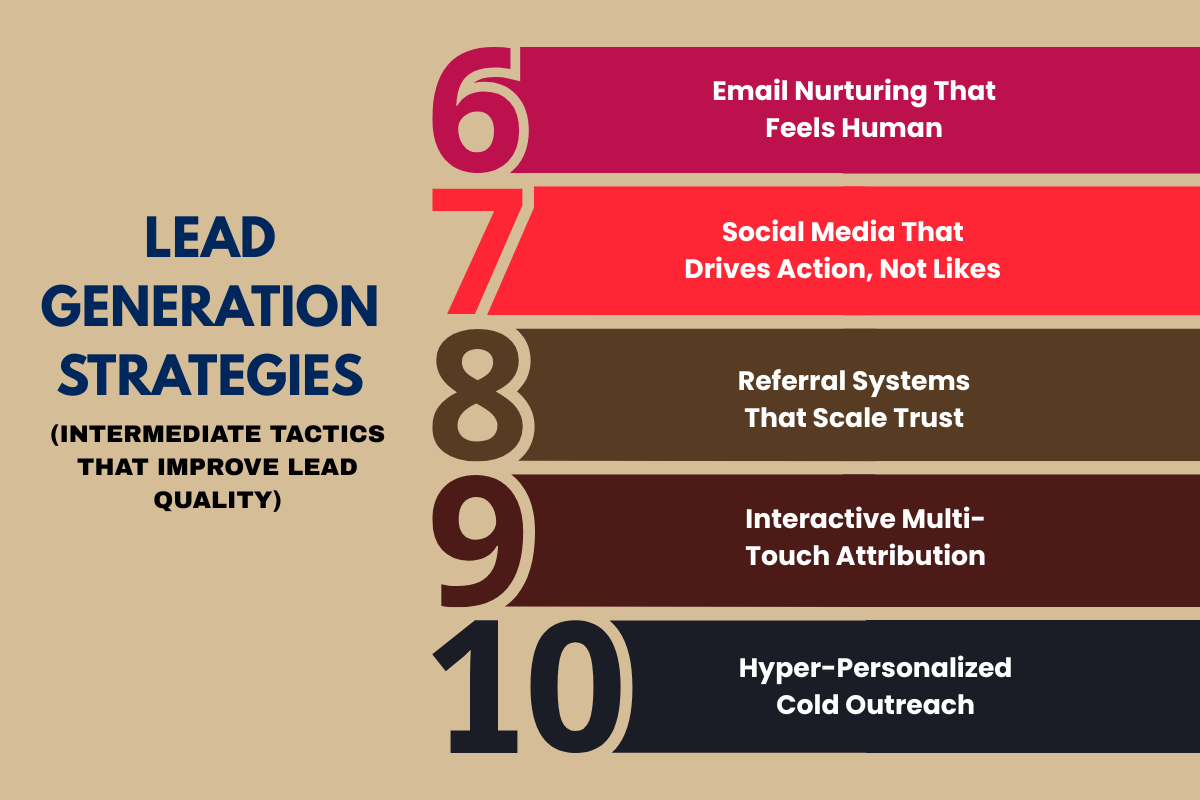
6. Email Nurturing That Feels Human
HubSpot research shows 34.49% of companies rank email as their top lead source, but automation often kills results when it sounds robotic.
Effective Lead generation strategies use email to educate, not rush conversion. The highest-performing sequences feel conversational and intentional, not scheduled.
High-converting nurture emails:
- Teach one focused idea per message
- Reference past behavior or downloads
- Delay the pitch until the value compounds
Noel Griffith, CMO at SupplyGem, shared that a value-first newsletter became their top inbound lead source within months by prioritizing education before selling.
7. Social Media That Drives Action, Not Likes
Semrush and LinkedIn both agree that organic reach matters less than clarity of direction. Engagement without intent produces noise, not leads.
Strong Lead generation strategies treat social platforms as distribution channels, not branding trophies. Every post should guide the audience toward a clear next step.
High-intent posting patterns include:
- Teach → Link to deeper content
- Provoke → Offer a resource
- Educate → Capture via landing page
Attention without direction wastes time and money.
8. Referral Systems That Scale Trust
Referral programs outperform cold acquisition because trust transfers instantly. When someone recommends a product, credibility arrives pre-loaded.
Daniel Nyquist of Crosslist reported that referrals generated 40% of new business within six months after incentivizing satisfied customers. That result reflects psychology, not luck.
The most effective strategies build referral loops intentionally by delivering value worth talking about and making referrals frictionless.
Trust compounds faster than traffic.
9. Interactive Multi-Touch Attribution
B2B buyers rarely convert after one interaction. On average, it takes 8 to 12 touches to generate a qualified lead. High-growth teams design those touches intentionally.
- The Tactic: Combine webinars with retargeting campaigns. Webinars remain one of the strongest trust-building tools.
- The Twist: Skip generic follow-ups. Retarget attendees with a case study that solves the exact problem discussed during the session.
53% of marketers rank webinars as their most effective top-of-funnel tool. Used correctly, they anchor multi-touch Lead generation strategies.
10. Hyper-Personalized Cold Outreach
Cold outreach still works, but only when it feels warm. The average cold email reply rate sits around 5.1%, and templated emails often perform far worse.
- Active Move: Use video prospecting. A 60-second Loom video tailored to one prospect can increase reply rates by up to 30.5%.
- Expert Insight: Eric Topol emphasizes that trust is the primary currency of modern business. Personalized video accelerates trust faster than text because it humanizes intent.
This tactic bridges outbound and inbound Lead generation without friction.
Advanced Strategies Used by High-Growth Teams
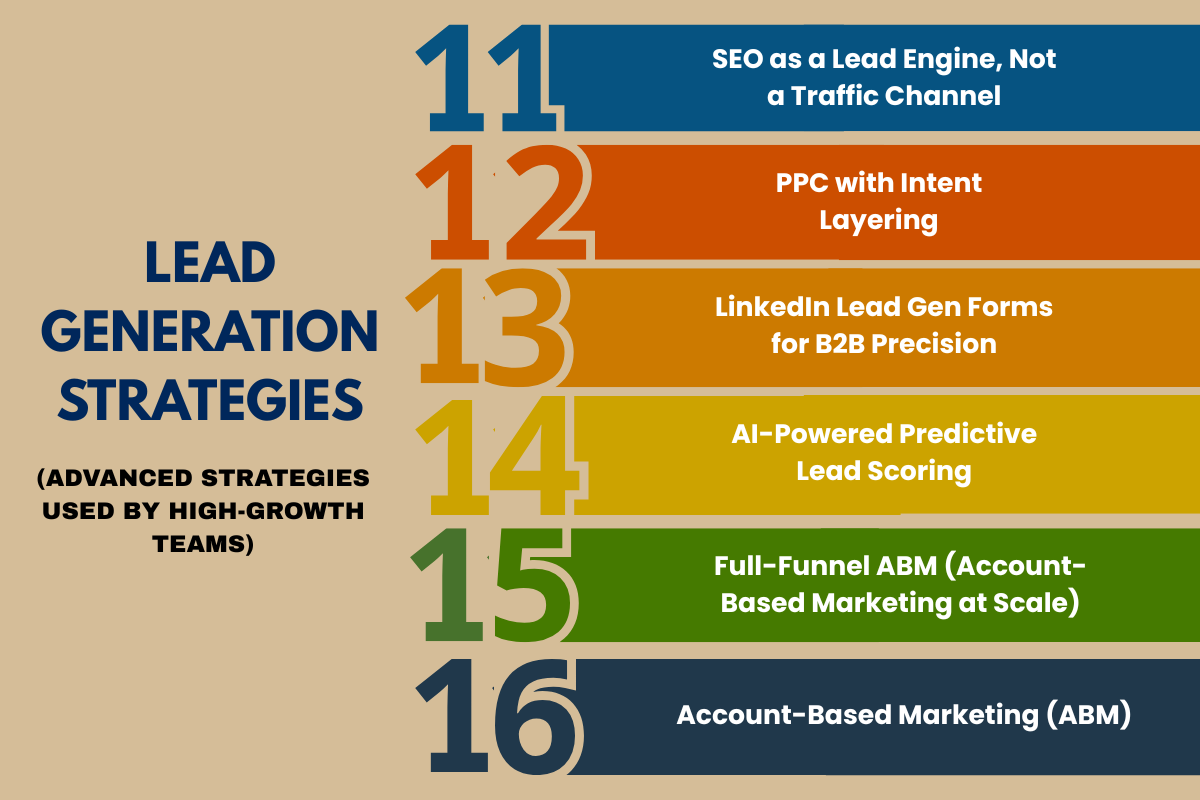
11. SEO as a Lead Engine, Not a Traffic Channel
SEO works because it captures existing intent, not manufactured interest. Google processes over 8.5 billion searches per day, making it the highest-intent channel available.
Advanced Lead generation strategies move beyond ranking for traffic and focus on funnel alignment. Content maps to awareness, consideration, and decision stages deliberately.
High-performing teams:
- Map keywords to buyer readiness
- Build topic clusters instead of isolated posts
- Attach contextual lead magnets
This turns SEO into a predictable acquisition engine.
Read Next: How to Use SEO to Generate Leads for Your Blockchain Project?
12. PPC with Intent Layering
Amazon Ads and Chili Piper highlight that PPC converts only when the landing experience mirrors user intent. Traffic alone does nothing without message continuity.
Effective Lead generation uses PPC to amplify proven funnels, not test weak ones. Every click should land on a single-goal page that answers the exact reason for the search.
High-performing PPC systems:
- Mix high-intent and long-tail keywords
- Use focused landing pages
- Optimize for cost per qualified lead, not clicks
Paid traffic magnifies systems—good or bad.
13. LinkedIn Lead Gen Forms for B2B Precision
LinkedIn Lead Gen Forms reduce friction by auto-filling user data, which significantly improves submission rates for B2B campaigns.
Elite Lead generation uses these forms to qualify leads before sales involvement. Targeting by role, company size, and industry ensures relevance from the first interaction.
Salesforce notes that alignment between sales and marketing definitions accelerates conversion velocity—a critical advantage in long B2B sales cycles.
14. AI-Powered Predictive Lead Scoring
Not every lead deserves the same attention. Predictive scoring identifies buyers before they raise their hand.
- The Tactic: Deploy predictive analytics platforms like 6sense or Demandbase. These tools track intent signals across dark social channels, private communities, reviews, and off-site research behavior.
- The Result: Organizations using predictive models see 2.9x higher revenue growth than those relying on historical reporting.
This approach upgrades Lead generation strategies from reactive to anticipatory.
15. Full-Funnel ABM (Account-Based Marketing at Scale)
ABM no longer applies only to top-tier enterprise accounts. Any account worth more than $50k justifies orchestration.
- The Tactic: Align Account-Based Advertising (ABA) with direct sales outreach. Prospects should recognize your brand before the first call.
- The Math: AdRoll’s 2026 study shows companies aligning ABM with ABA achieve 60% higher win rates.
When ads, content, and sales touchpoints reinforce each other, Lead generation strategies evolve into revenue systems.
Read Next: Top 10 Digital Marketing Ideas for Business Growth
16. Account-Based Marketing (ABM)
Cognism and Salesforce both recommend ABM for high-ticket B2B sales because it reverses the traditional funnel.
Instead of capturing volume, ABM focuses on relevance. Teams identify high-value accounts first, then personalize content and outreach to match real business challenges.
Advanced Lead generation uses ABM to trade quantity for quality with fewer leads, higher deal sizes, and shorter sales cycles driven by precision.
Comparison Table: 2026 Lead Generation Strategies by Maturity, ROI, and Effort
| Strategy | Ideal Audience | Expected ROI / Impact | Difficulty |
| Problem-Focused Content Marketing | Early-stage buyers researching solutions | 3.5× higher lead volume with consistent publishing | Medium |
| Intent-Matched Lead Magnets | Mid-funnel evaluators | 202% higher CTA conversion rate | Medium |
| Short-Form Lead Capture Forms | Mobile-first visitors | 30%+ higher form completion | Low |
| Human-Style Email Nurturing | Warm inbound leads | Highest ROI channel (34.49% adoption) | Medium |
| Action-Driven Social Content | Awareness + consideration stage | Higher downstream conversion, not vanity metrics | Medium |
| Referral-Driven Lead Systems | Trust-based networks | Up to 40% of new business from referrals | Low |
| SEO as a Lead Engine | High-intent search users | Predictable inbound pipeline after 6 months | High |
| Intent-Layered PPC Funnels | Buyers close to a decision | Faster pipeline acceleration, CPL optimized | High |
| LinkedIn Lead Gen Forms | B2B decision-makers | Higher conversion due to auto-fill friction reduction | Medium |
| Account-Based Marketing (ABM) | High-value B2B accounts | Higher ACV, shorter sales cycles | Very High |
| Zero-Click Content Framework | Time-poor, high-intent buyers | Higher trust before capture | Medium |
| Website Visitor Identification | Anonymous high-intent accounts | Early detection of buying signals | Medium |
| Multi-Touch Webinar Attribution | Complex B2B buyers | 8–12 touch influence on SQLs | High |
| Video-Based Cold Outreach | High-value outbound targets | Up to 30.5% reply rate lift | Medium |
| AI-Powered Predictive Scoring | Revenue-focused sales teams | 2.9× higher revenue growth | Very High |
How to Read This Table (Strategic Tip)
- Low difficulty ≠ low impact: Referral systems and form optimization often outperform expensive channels.
- High ROI ≠ fast results: SEO, ABM, and predictive scoring reward patience and discipline.
- Mature teams stack strategies: The highest-growth companies combine 5–7 of these simultaneously, not one.
The Future: From “Generation” to “Demand”
As we move into 2027, the focus is shifting. We are moving away from Lead Generation (capturing a name) and toward Demand Generation (making them want you before they even know you).
The night shift taught me that you can’t force a sale. But the research I do now proves you can engineer the environment where a sale is inevitable.
Final Advice: Don’t buy a bigger net; build a better lighthouse. Use Lead Generation Strategies that prove your expertise before you ever ask for a credit card. Check your “Pricing” page today; is it clear? Is it helpful? If not, you are part of the 98% that people are walking away from.
Read Next: Supercharge Your SaaS Growth with a Dedicated Digital Marketing Team
Conclusion
If I could go back to that night shift version of myself, I wouldn’t tell him to make more calls. I’d tell him to listen better. To stop chasing activity and start paying attention to signals.
That’s the real evolution behind modern Lead Generation Strategies. They don’t force conversations. They earn them. They respect the buyer’s time, anticipate their questions, and show up with value before asking for anything in return.
The teams winning today aren’t the ones with the biggest lists or the loudest campaigns. They’re the ones building trust quietly through clarity and relevance. Lead generation no longer starts when someone fills out a form. It starts when someone thinks, “These people get it.”
Build for that moment, and everything else will follow.
Data Sources & E.E.A.T Verification:
- Cost Per Lead Data: Snov.io 2026 Industry Report
- ABM Win Rates: AdRoll 2026 ABA Study
- Visitor Identification Trends: Leadinfo 2026 B2B Trends
- Predictive Analytics ROI: Forrester/Keo Marketing 2026 Guide
- Webinar Effectiveness: Meetanshi 2026 Marketing Benchmarks