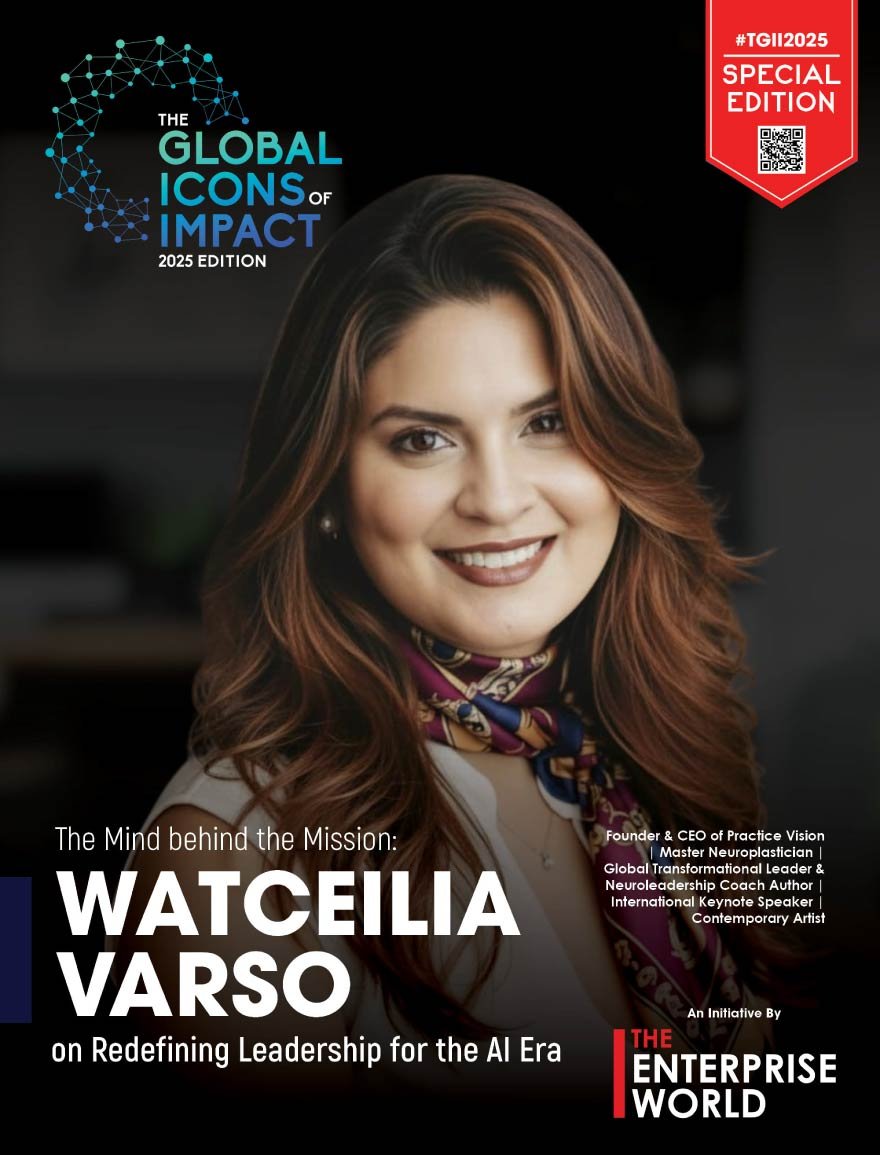
What if your next leadership breakthrough came not from acquiring more tools, but from understanding your own brain? What if adaptability, empathy, and neural resilience became the new competitive edge in business and not just desirable soft skills?
This is the work of Watceilia Varso, Founder & CEO of Practice Vision and creator of the NeuroRegenesis™ framework.
A global executive coach, keynote speaker, psychotherapist, and leadership pioneer, she has combined business management, human resources, and neuroscience to redefine how organisations rewire from within, helping leaders move from performance to purpose, from reaction to regeneration.
But what were the moments that steered her purpose into this domain? How did leadership shapeshift for her from strategy to self-awareness and what does she believe the future demands of every leader hoping to thrive in uncertainty? Let’s explore the journey, philosophies, and vision that define Watceilia Varso’s regenerative approach to leadership.
1. Can you walk us through your early journey and what experiences shaped your leadership path?
My leadership journey has been one of evolution anchored first in Business Management, expanded through Human Resources, and ultimately deepened through Psychology.
I began my education and work experience in business management, where I developed a strong grounding in systems thinking, performance, and organisational strategy. As I progressed into global HR leadership roles, I found myself drawn not only to structures and outcomes but to the human stories behind them, the emotions, motivations, and cognitive patterns that shape performance.
That curiosity led me into the world of psychology, where I later trained and practised as a psychotherapist and executive coach. This gave me profound insight into the neural and emotional mechanisms behind leadership behaviour. Over time, my work became about connecting these dots, how the science of the brain informs the art of leadership.
That convergence became Practice Vision and later, NeuroRegenesis™, a brain-based, regenerative leadership framework designed to help leaders and organisations rewire, restore, and rise.
2. Who or what inspired you to pursue your current career direction?
My career direction evolved through curiosity and contrast. I began as a HR executive, focused on strategy, systems, and results. But as my HR journey deepened, I realised that strategy alone wasn’t enough; success depended on human alignment.
It was my later immersion into psychology and psychotherapy that changed everything. I began to understand that every organisational challenge has a neural root, leaders don’t just manage teams, they manage energy, emotion, and neural patterns.
That realisation inspired me to bridge the disciplines of business, neuroscience, and human transformation. It culminated in the creation of the NeuroRegenesis™ Framework, which integrates neural rewiring, emotional agility, and regenerative growth principles to create sustainable, human-centred leadership.
3. Looking back, what was a defining moment that gave you clarity about your purpose as a leader?
That clarity came during a series of major organisational mergers I led in my HR career. These were large, cross-border integrations, complex in structure but even more complex in human dynamics.
While the mergers looked successful on paper, what I witnessed behind the scenes told a different story like cultures colliding, values dissolving, and leaders burning out under invisible strain. The drive for performance often overshadowed purpose. People who were once confident and connected began to operate from fear, uncertainty, and survival.
Those experiences became my greatest classroom. They revealed a crucial truth that no strategy, system, or structure can sustain itself if the human brain and behaviour beneath it remain misaligned.
It was in those moments of cultural chaos that NeuroRegenesis™ began to take form in my mind, a framework to help leaders rewire from within, so they could guide teams through uncertainty without losing humanity.
That was the turning point. I realised my purpose was not just to lead transformation but to humanise it, to bring neuroscience and emotional agility into how we navigate change, culture, and collective growth.
4. How do you define leadership in today’s rapidly changing world?
Leadership today is no longer positional, it’s neural.
It’s about how leaders think, feel, and regulate themselves in the face of complexity. In the AI era, intelligence is abundant, but consciousness is rare. True leadership is the ability to stay grounded, emotionally agile, and regenerative amidst volatility.
The most effective leaders of tomorrow will be those who are self-wired for awareness and adaptability.
5. What core values or principles guide your decision-making and leadership style?
My leadership philosophy is grounded in the REGENESIS™ Pillars, which represent the nine stages of conscious transformation that guide both my life and my work:
- Rewire limiting beliefs
- Embody authenticity
- Ground in ethical clarity
- Emerge through emotional agility
- Nurture collective growth
- Expand neural adaptability
- Sustain transformation
- Integrate wholeness
- Synergize impact
These pillars form the neural and ethical architecture of how I lead, anchored in coherence, compassion, and conscious growth. They are not just a framework; they are a way of being.
At Practice Vision, and in everything I create under the NeuroRegenesis™ umbrella, these values come alive through my personal tagline and registered philosophy,
“Leading with Purpose. Transforming with Passion.®”
It’s more than words, it’s the heartbeat of how I show up as a leader, a coach, and a human being. Every decision, every initiative, and every relationship begins with that intention, to lead with purpose and to transform with passion.
6. In your view, how has leadership evolved with the rise of AI and digital transformation?
AI has accelerated everything but it’s also exposed the limits of automation. Based on the current situation, Machines can replicate logic, but not emotional intelligence or ethical awareness.
Leadership in the digital age now requires neural literacy, understanding how our brains respond to uncertainty, how emotions influence decisions, and how psychological safety drives creativity.
NeuroRegenesis™ was designed for this shift: to help leaders rewire their internal systems so they can lead regenerative change in an increasingly algorithmic world.
7. What unique leadership philosophy or framework have you developed over the years?
The NeuroRegenesis™ Framework is my signature contribution to modern leadership. It merges neuroscience, psychotherapy, and systems leadership to help organisations diagnose culture, shift behaviour, and build high-impact teams.
It’s a practical compass that moves leaders from reactivity to regeneration, helping them turn stress into strategy, and burnout into brain-based resilience.
8. Could you share one milestone or achievement that you’re particularly proud of?
I’m deeply proud of seeing NeuroRegenesis™ evolve into a global movement, one that empowers leaders to integrate science, soul, and strategy in the way they think, lead, and create impact. What began as a brain-based framework has now become a regenerative philosophy influencing leaders and organisations across continents.
In 2025, I was honoured to be invited as a Keynote Speaker at the World Woman Forum and to receive the World Woman Leadership Award, recognising my contribution to advancing conscious leadership through neuroscience. Being named among the 25 Most Transformative Entrepreneurs globally and receiving the Global Woman of Influence Award 2025 were also humbling acknowledgements of this mission’s resonance worldwide.
But beyond the recognition, the true reward lies in witnessing transformation in action, seeing leaders shift from survival mode to regenerative leadership, where they lead not just for growth, but for global good.
9. What has been your toughest leadership challenge, and how did you overcome it?
The toughest challenge has been guiding people through resistance to change. Neuroscience and psychotherapy taught me that resistance isn’t personal, it’s neurological. It’s how the brain protects the familiar.
By creating safety and awareness, I learned to transform resistance into reflection. Once people feel seen and supported, they begin to rewire willingly. That shift is where true transformation begins.
10. How do you balance long-term vision with short-term business realities?
For me, balance begins with neural pacing, the art of harmonising strategic ambition with emotional regulation and awareness. As a Neuropastician, and executive coach, I’ve learned that the balance between vision and reality is not a fixed state, it’s a dynamic rhythm.
Running multiple ventures means constantly shifting between high-level vision and day-to-day decision-making. I do this by staying attuned to my own strengths and blind spots, understanding when to accelerate and when to pause. Working closely with leaders from diverse industries has taught me that every working style has its own neural rhythm, and part of my role, both in business and in coaching is to recognise and regulate those rhythms, including my own.
At Practice Vision, we’ve embedded this philosophy into how we operate. We build reflective pauses, debrief cycles, and feedback loops into every project so that short-term actions always serve long-term rewiring.
Ultimately, it comes down to consistency and resilience, showing up each day with clarity, even amidst uncertainty. It’s about pacing the mind as much as the mission, and remembering that long-term success is simply the outcome of daily alignment.
11. What excites you most about the future of your industry?
We’re entering an era where leadership development will no longer be just about skills, it will be about states of mind. The future of leadership lies in how consciously we can think, adapt, and evolve amidst constant change.
The AI era is transforming the landscape every single day. Technology is rewriting how we work, decide, and even connect. But amid this disruption, the real question becomes, are we ready to embrace it positively? AI can accelerate intelligence but it cannot replicate awareness, empathy, or ethical discernment.
What excites me is the opportunity to help leaders become future-ready to use neuroscience as their compass in navigating disruption with clarity, calm, and confidence. Through NeuroRegenesis™ and Practice Vision, my work now focuses on helping leaders build neural agility, emotional resilience, and regenerative thinking so they can partner with technology without losing humanity.
The future of leadership will be regenerative, inclusive, and consciousness-driven, a space where science and soul converge. That’s the world I’m most excited to help shape.
12. What role do you think leaders must play in shaping responsible and sustainable growth?
Leaders today must evolve from being drivers of growth to stewards of regeneration. The old success model was built on acceleration and exhaustion, it no longer sustains people, purpose, or planet.
True sustainability begins when leadership becomes a cultural pattern, not a personal effort. It’s not enough for one leader to act responsibly; the organisation itself must be rewired to think regeneratively. That means embedding conscious decision-making, empathy, and long-term thinking into the DNA of the company on how teams collaborate, innovate, and measure success.
Regenerative leadership is both an ethical and a neural responsibility. It calls for leaders and their cultures to think beyond just profits, to build systems that renew rather than deplete.
It starts from within:
“Rewire the Brain. Renew the Leader. Reimagine the Future.” That is how conscious leaders create cultures and companies that last.
13. What advice would you give to the next generation of leaders aspiring to create global impact?
Understand your inner self and how you are wired before you attempt to change the world.
Self-regulation is the foundation of true influence. Learn to master your mind, emotions, and biases, because leadership isn’t what you do to others; it’s what you awaken in them.
The next generation of leaders must lead from awareness, authenticity, and alignment, recognising that transformation begins within before it can expand outward. When you rewire your mind, you rewire how you lead, decide, and connect.
But beyond personal mastery, leadership today also demands cultural consciousness.
Great leaders don’t just inspire people, they build cultures that think regeneratively, act ethically, and grow sustainably. Every conversation, every policy, every decision becomes a neural imprint on the culture.
So, lead not only for progress but for coherence, where individual growth and organisational purpose evolve together. The future will belong to those who create not just successful companies, but regenerative cultures that empower people to rise collectively.
14. What does being featured as a keynote speaker at The Global Icons of Impact 2025 mean to you personally and professionally?
It’s both an honour and a reflection of a journey that’s come full circle from studying Business Management, evolving through Human Resources, and deepening into Psychology and Neuroscience.
Professionally, it amplifies the mission of Practice Vision to help leaders and organisations rewire how they think, lead, and connect through the power of neuroscience and regenerative leadership. It’s a validation of years of research, innovation, and commitment to transforming leadership from the inside out.
On a personal front, it represents gratitude, growth, and grounded purpose. It’s a reminder that every challenge, uncertainty, and setback has been part of a larger calling, to elevate human potential and make science accessible to the heart of leadership.
It’s also something I hope my children will see and understand that resilience is not built in comfort, but through the courage to keep moving when the path is unclear. That uncertainty is never an end, it’s a new beginning.
Standing on that global stage is therefore not just a professional milestone, it’s a personal legacy of hope, showing that when you lead with purpose and transform with passion, you can rise through any season of change.
End Note:
In an era where algorithms evolve faster than emotions and disruption outpaces decision-making, leaders like Watceilia Varso remind the world that progress without consciousness is unsustainable. Through NeuroRegenesis™ and Practice Vision, she is redefining leadership not as a race for innovation, but as a return to intention — where awareness becomes strategy, and the human brain becomes the ultimate frontier of transformation.
Her philosophy is both simple and revolutionary: when leaders rewire from within, they create cultures that not only perform but also regenerate. In doing so, they move beyond survival toward sustained impact — leading with purpose, transforming with passion, and shaping organizations that thrive in both complexity and conscience.
As the world stands on the edge of the AI revolution, Watceilia’s message echoes with clarity — the leaders of tomorrow will not be the ones who outthink machines, but the ones who outgrow their own limitations. The future, it seems, will belong to the rewired mind.