“When you speak to everyone, you speak to no one.” — Meredith Hill.
Nearly 42% of startups fail because there’s no real market need for their product, according to CB Insights. Even more striking, research from HubSpot shows that personalized marketing campaigns can increase conversion rates by over 200%. The gap between brands that scale and brands that stall often comes down to one critical factor: understanding exactly who they are talking to.
Yet many businesses still fall into the same trap: they market broadly, hoping to attract everyone. In reality, unfocused messaging leads to weak engagement, wasted ad spend, and low conversion rates. This is where the fundamental question arises: What is a marketing audience?
At its core, a marketing audience isn’t just a random group of potential buyers. It is a clearly defined segment of people who share specific characteristics, behaviors, needs, and purchasing intent. When businesses define their marketing audience accurately, they create sharper messaging, stronger brand positioning, and measurable growth.
In today’s data-driven digital economy powered by AI segmentation, first-party data strategies, and hyper-personalization, understanding what a marketing audience is no longer optional. It is a strategic necessity.
In this guide, you’ll discover:
- A clear and simple definition of a marketing audience
- Why does it directly impact ROI and conversions
- The different types of marketing audiences
- How to identify and segment the right audience
- Common mistakes that cost businesses growth
If you want your marketing to convert instead of just create noise, it all begins with knowing exactly who you are speaking to.
What Is a Marketing Audience?
A marketing audience is a clearly defined group of people a business targets with a specific message, campaign, or offer based on shared characteristics like demographics, interests, behaviors, and purchase intent. In simple terms, it’s the group most likely to care about what you’re selling.
And this matters more than ever. According to McKinsey, companies that leverage customer behavior insights outperform peers by 85% in sales growth. Meanwhile, personalized campaigns can reduce acquisition costs by up to 50%. That level of performance isn’t accidental; it comes from knowing exactly who the message is for.
A target audience is not the same as “the general public.” It’s not even your entire target market. It’s a refined segment within that market, the people most likely to engage, convert, and stay loyal.
To define a marketing audience accurately, businesses rely on four core data pillars:
- Demographics: These are measurable traits such as age, gender, income, education, job role, and location. For example, a fintech app may target salaried professionals aged 25–35 in urban cities earning above a certain income threshold.
- Psychographics: This goes deeper, into values, lifestyle, motivations, and attitudes. Two people may earn the same salary, but one prioritizes travel and experiences while the other focuses on investments. Their purchasing decisions will differ, and so should the messaging.
- Behavioral Data: This is where modern marketing becomes powerful. Website visits, time spent on pages, past purchases, search patterns, and email engagement all reveal intent. In fact, behavioral targeting has been shown to increase conversion rates significantly compared to demographic targeting alone.
Understanding what a marketing audience is also means recognizing that it changes based on the campaign. A skincare brand promoting anti-acne solutions will speak to teenagers differently than when marketing anti-aging products to working professionals. Same brand. Different audience. Different message.
At its core, a target audience is about relevance. It ensures your message reaches the right people at the right time instead of being ignored by the wrong ones.
Now that the definition is clear and grounded in data, the next step is understanding why defining your marketing audience directly impacts growth, ROI, and long-term brand success.
Why Is a Marketing Audience Important?
Research from HubSpot shows that segmented email campaigns generate up to 760% more revenue than non-segmented campaigns. Similarly, businesses that use advanced audience targeting in paid ads often see significantly higher click-through and conversion rates compared to broad targeting.
The difference isn’t creativity. It’s precision.
Here’s how defining your marketing audience directly impacts business results:
1. Higher Conversion Rates
When messaging aligns with specific pain points and motivations, engagement increases naturally. A generic ad might get impressions. A targeted ad gets action. For example, a skincare brand marketing “hydration solutions for dry office environments” will convert better among corporate professionals than a broad “best moisturizer” message. The clearer the audience, the stronger the conversion.
2. Better Return on Ad Spend (ROAS)
Digital advertising costs are rising every year. Without a defined target audience, businesses waste money showing ads to people who will never buy.
Precise audience targeting:
- Reduces irrelevant impressions
- Improves click quality
- Lowers cost per acquisition
In competitive industries like SaaS or e-commerce, even a small improvement in audience targeting can significantly improve profitability.
3. Stronger Brand Positioning
Brands that understand their marketing audience don’t just sell products; they build identity. When a fitness brand targets busy professionals with “20-minute efficient workouts,” it positions itself differently from a brand targeting competitive athletes. The audience defines the narrative.
“Clear audience = Clear brand voice.”
4. Smarter Content Strategy
Content performs better when it speaks directly to a defined group. Blogs, videos, social posts, and email campaigns become more relevant and less generic.
For example:
- A B2B SaaS company targeting startup founders will create content about scaling teams.
- The same company targeting enterprise executives will focus on compliance, integration, and ROI metrics.
Both belong to the broader market but represent completely different marketing audiences.
5. Long-Term Customer Loyalty
When customers feel understood, they stay. Personalization and relevance build trust, and trust drives repeat purchases. Understanding what a marketing audience is isn’t just about acquiring customers. It’s about building relationships with the right ones.
In short, defining your marketing audience affects everything:
- Messaging
- Advertising
- Product positioning
- Customer experience
- Revenue growth
It’s not a tactical decision. It’s a strategic one. Now that we understand its importance, let’s break down the different types of target audiences and how they fit into the buyer journey.
Types of Marketing Audiences
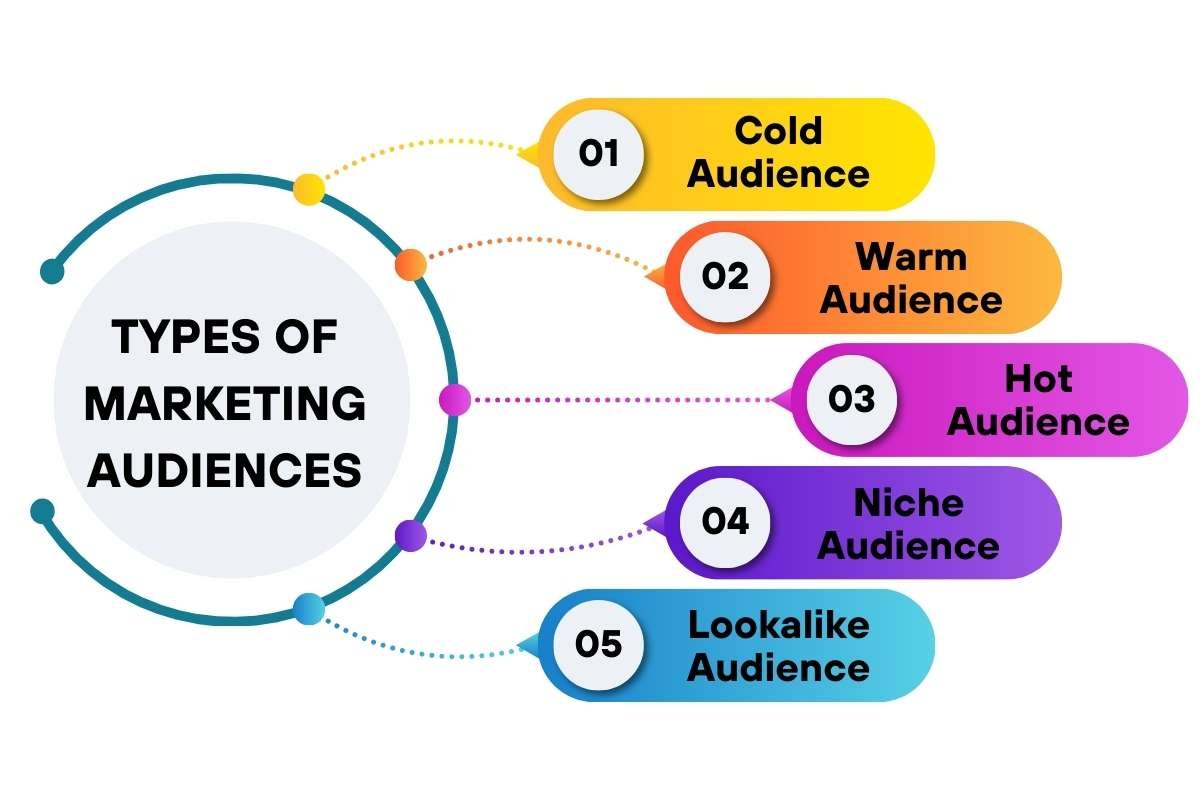
Now that we understand what a marketing audience is and why it directly impacts ROI, the next step is knowing that not all audiences are the same. In fact, one of the biggest mistakes businesses make is speaking to every audience in the same way.
A marketing audience changes depending on where someone is in the buyer journey. Let’s break it down chronologically.
1. Cold Audience
| Buyer Stage | Awareness |
| Awareness Level | Unaware or Problem-Aware |
| Primary Goal | Build awareness & trust |
| Best Strategy | Educational content, value ads |
| Key Metrics | Reach, engagement, video views |
A cold audience is discovering a topic, not necessarily your brand. They are curious, browsing, and often consuming content passively through social media, search engines, or video platforms. At this stage, your job is to spark interest and position yourself as helpful, not to push a hard sell. Think storytelling, relatable problems, and simple insights that make them feel understood.
2. Warm Audience
| Buyer Stage | Consideration |
| Awareness Level | Solution-Aware |
| Primary Goal | Build credibility |
| Best Strategy | Retargeting, case studies, comparisons |
| Key Metrics | CTR, email opens, time on site |
A warm audience already recognizes your brand and is evaluating whether you’re the right choice. They are comparing options, checking reviews, and weighing credibility signals. This is where consistency matters. Your messaging should reinforce trust and show expertise. The tone shifts from introduction to reassurance, helping them feel confident about moving forward.
3. Hot Audience
| Buyer Stage | Decision |
| Awareness Level | Product-Aware |
| Primary Goal | Drive conversions |
| Best Strategy | Offers, urgency, guarantees |
| Key Metrics | Conversion rate, CPA, sales |
A hot audience is emotionally and logically close to making a decision. They don’t need convincing about the problem; they need confidence in the outcome. At this stage, friction becomes your biggest enemy. Complicated checkout flows, unclear pricing, or missing details can cost conversions. Clear communication, transparency, and strong calls-to-action make all the difference here.
4. Niche Audience
| Buyer Stage | Any Stage |
| Awareness Level | Highly Specific |
| Primary Goal | Deep personalization |
| Best Strategy | Tailored messaging |
| Key Metrics | Engagement rate, retention |
A niche audience values specificity. They want to feel seen, not categorized broadly. Because their needs are distinct, they respond strongly to messaging that reflects their identity, challenges, and goals. When brands communicate with precision, niche audiences often show higher engagement and long-term loyalty.
5. Lookalike Audience
| Buyer Stage | Expansion |
| Awareness Level | Similar to Buyers |
| Primary Goal | Scale acquisition |
| Best Strategy | AI-based targeting |
| Key Metrics | ROAS, acquisition cost |
A lookalike audience represents growth potential. These individuals resemble your best customers but haven’t interacted with you yet. They often respond well because your messaging already aligns with behavioral patterns similar to your existing buyers. This is where data-driven marketing transforms insight into scalable expansion.
Marketing Audience vs Target Market vs Target Customer
Many people use “marketing audience,” “target market,” and “target customer” interchangeably, but they are not the same. Understanding the distinction improves clarity, strategy, and campaign precision.
Here’s a simple comparison:
| Term | What It Means | Scope |
| Target Market | The broad group a business aims to serve | Strategic, long-term |
| Marketing Audience | A specific segment within the target market for a campaign | Tactical, campaign-based |
| Target Customer | A detailed representation of an ideal individual buyer (buyer persona) | Highly specific |
Now let’s break this down naturally.
- Target Market: A target market is the bigger picture. It defines the overall category of people your product is designed for. For example, a fitness brand may define its target market as “health-conscious adults in metro cities.” This helps guide product development, pricing, and brand positioning.
- Marketing Audience: A marketing audience, however, is more focused. It is the specific segment you are speaking to in a particular campaign. If that same fitness brand launches a campaign for busy corporate professionals, that subgroup becomes the target audience for that campaign. The product may stay the same, but the messaging changes.
- Target Customer: A target customer goes even deeper. It represents an individual persona with name, job role, income level, motivations, and pain points. This level of detail helps personalize messaging and refine content tone.
Here’s the key difference in one line:
- The target market defines who your business serves overall.
- The marketing audience defines who your campaign speaks to right now.
- The target customer defines what your ideal buyer looks like in detail.
Clarity here strengthens strategic decision-making. When businesses misunderstand these terms, they either market too broadly or create disconnected messaging. Understanding this distinction strengthens your grasp of what a marketing audience is and how it fits into the bigger marketing ecosystem.
Read More:
- Boost Conversions with These Proven SEO Audience Targeting Techniques
- How to Create Targeted Marketing Campaigns for E-commerce?
How to Identify Your Marketing Audience (Step-by-Step Framework)
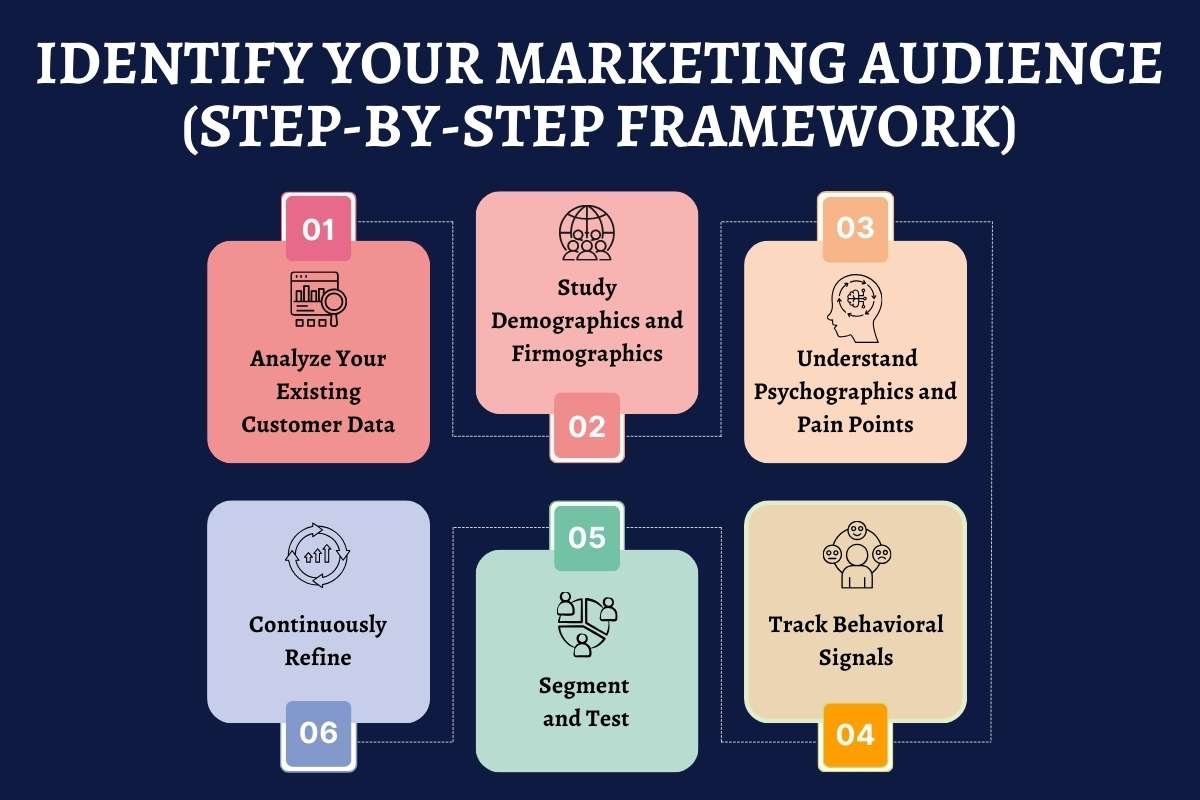
Now that you clearly understand what a marketing audience is and how it differs from a target market or target customer, the next step is practical: how do you actually identify yours? The answer isn’t guesswork. It’s data, structured thinking, and validation.
Here’s a practical, EEAT-aligned framework you can follow.
Step 1: Analyze Your Existing Customer Data
Your current customers are your strongest starting point. Look at purchase history, repeat buying patterns, average order value, and customer lifetime value.
Ask:
- Who buys most frequently?
- Who spends the most?
- Which segment churns the least?
Tools like CRM dashboards, ecommerce analytics, and subscription metrics can reveal patterns you may have overlooked. Often, your highest-value customers are not who you initially assumed.
Step 2: Study Demographics and Firmographics
Once you identify patterns, zoom into measurable attributes:
- Age
- Location
- Income bracket
- Occupation
- Industry (for B2B)
- Company size (for B2B)
For example, a SaaS platform may discover that startups convert faster, but enterprise clients generate higher long-term revenue. That insight alone reshapes the target audience for different campaigns.
Step 3: Understand Psychographics and Pain Points
This is where surface-level segmentation turns into strategic insight.
Conduct:
- Customer surveys
- Interviews
- Feedback forms
- Review analysis
Look for recurring frustrations, motivations, and goals. Two customers may share demographics but differ completely in intent. A marketing audience built only on age and income is incomplete; motivations drive decisions.
Step 4: Track Behavioral Signals
Behavior often predicts purchase intent more accurately than demographics.
Monitor:
- Website pages visited
- Time spent on product pages
- Email engagement
- Cart activity
- Content downloads
For example, someone reading multiple comparison blogs is signaling stronger buying intent than someone casually scrolling through social media posts.
Step 5: Segment and Test
Once you gather data, group users into meaningful segments. Then test messaging tailored to each segment.
Run:
- A/B ad tests
- Different landing page versions
- Segmented email campaigns
Measure performance differences. If one segment shows higher click-through rates and conversions, you’ve likely identified a stronger marketing audience for that specific campaign.
Step 6: Continuously Refine
Markets evolve. Consumer behavior shifts. Platforms change algorithms. Your marketing audience today may not perform the same way next year. Regular data review ensures you stay aligned with reality, not outdated assumptions.
Real-World Examples of Marketing Audiences Across Industries
Understanding what is a marketing audience becomes much clearer when you see how different industries apply it in practice. While the core concept remains the same, the way businesses define and activate their target audience varies significantly depending on their product, pricing model, and buyer intent.
Let’s look at how this works in real scenarios.
1. E-commerce Fashion Brand
A fashion e-commerce company selling premium athleisure wear may define its broader target market as urban millennials. However, for a new product launch, the marketing audience could shift to fitness-focused women aged 25–35 who follow wellness influencers and frequently purchase activewear online.
Instead of generic style messaging, the campaign highlights comfort during workouts, breathable fabric technology, and influencer testimonials. The specificity improves engagement because the messaging aligns directly with lifestyle and intent.
2. EdTech Platform
An online education platform offering data analytics certifications may target working professionals overall. But when launching a beginner-friendly course, the marketing audience might be recent graduates seeking career transitions.
In this case, messaging focuses on affordability, flexible schedules, and job placement assistance rather than advanced technical depth. The same product category, but a different marketing audience, changes the positioning entirely.
3. Fitness App
A fitness app might have multiple marketing audiences simultaneously:
- Beginners looking for weight loss guidance
- Busy professionals seeking short home workouts
- Advanced athletes tracking performance metrics
Each audience receives different communication. Beginners see motivational transformation stories. Professionals see time-efficient workout plans. Athletes see performance analytics and tracking features.
The product stays the same, the messaging adapts.
Common Mistakes Businesses Make When Defining a Marketing Audience

Even after understanding what is a marketing audience, many businesses still struggle with execution. The concept is simple in theory but mistakes in definition and segmentation can quietly damage performance, inflate ad costs, and reduce conversions.
Here are the most common errors and why they matter.
1. Targeting Too Broadly
One of the biggest mistakes is defining the audience too vaguely.
Statements like:
- “People who want to grow their business”
- “Anyone interested in fitness”
- “Working professionals”
These descriptions lack precision. Broad targeting leads to diluted messaging and weak engagement because the content doesn’t feel specific to anyone. The more generic the audience, the more generic the results.
2. Relying Only on Demographics
Age, gender, and location are useful but incomplete. Two 30-year-olds living in the same city may have entirely different motivations, income levels, and purchase triggers. Businesses that ignore psychographics and behavioral data often create campaigns that look targeted on paper but fail in performance. Understanding intent is more powerful than knowing age alone.
3. Ignoring Behavioral Data
Many brands focus heavily on who their customers are but overlook how they behave. Website activity, cart abandonment, email engagement, and repeat visits provide strong signals about readiness to buy. Ignoring these signals means treating high-intent users the same as casual browsers, a costly mistake in paid advertising.
Behavior often predicts action more accurately than static traits.
4. Failing to Update the Audience
Markets evolve. Trends shift. Consumer expectations change. A target audience that performed well two years ago may not respond the same way today. Businesses that don’t review performance data regularly risk running outdated messaging to segments that have moved on. Audience refinement is not a one-time activity it’s ongoing optimization.
5. Copying Competitors Blindly
Just because a competitor targets a certain audience doesn’t mean it’s right for your brand. Their pricing, positioning, brand voice, and product strengths may differ significantly. Effective audience strategy comes from analyzing your own data, not replicating someone else’s targeting assumptions.
How Marketing Audiences Are Changing in 2026?

Understanding what is a marketing audience today looks very different from what it meant even five years ago. The digital ecosystem has shifted driven by AI, privacy regulations, and changing consumer expectations.
Audience targeting is no longer just about demographics. It’s becoming predictive, behavior-driven, and privacy-conscious.
Here’s how things are evolving.
1. AI-Powered Segmentation Is Becoming Standard
Artificial intelligence is transforming how businesses identify and refine their marketing audience. Instead of manually grouping users by age or location, AI analyzes patterns in browsing behavior, purchase history, and engagement signals to predict intent.
Platforms like Google and Meta now optimize campaigns dynamically, identifying micro-segments that marketers may not manually detect. This means businesses can move beyond static targeting and toward real-time adaptive messaging.
The future of a marketing audience is predictive not just descriptive.
2. First-Party Data Is Now Critical
With increasing privacy regulations and the decline of third-party cookies, brands are relying more heavily on first-party data information collected directly from customers through websites, apps, email lists, and CRM systems.
This shift changes how businesses answer what is a marketing audience in practice. Instead of renting audience access through platforms, companies are building their own data ecosystems.
Brands that invest in email lists, community building, and customer feedback loops gain stronger control over audience insights.
3. Hyper-Personalization Is Expected
Consumers now expect relevant content. Generic messaging feels outdated.
Personalized product recommendations, dynamic website content, segmented email journeys — these are no longer competitive advantages. They are baseline expectations.
A well-defined marketing audience allows businesses to deliver tailored experiences at scale without feeling intrusive.
4. Intent-Based Targeting Is Replacing Interest-Based Targeting
In the past, marketers relied heavily on interest categories, fitness enthusiasts, travel lovers, tech fans.
Today, intent signals matter more:
- Recent search queries
- Comparison page visits
- Repeated product views
- Pricing page interactions
Behavior shows readiness more clearly than declared interests. The shift toward intent-based targeting is redefining how businesses think about their target audience.
5. Community-Driven Audiences Are Growing
Brands are increasingly building owned communities private groups, subscriber lists, creator ecosystems, and brand forums.
Instead of constantly chasing new leads, companies nurture engaged micro-audiences who advocate for them organically. This reduces reliance on algorithm changes and increases long-term brand stability.
Read More:
- Key Insights for Effective Implementation of Marketing Strategy
- Mastering Digital Marketing Strategies for Brand Growth Success
Conclusion
At its core, understanding what is a marketing audience is about clarity. Clarity in who you are speaking to. Clarity in what problem you are solving. And clarity in how your message should be positioned.
Throughout this guide, we’ve seen that a marketing audience is not the same as a broad target market. It is a focused, data-backed segment defined by behavior, intent, and relevance. When businesses invest time in identifying and refining their target audience, they reduce wasted spend, improve engagement, and increase conversion rates.
In today’s AI-driven, privacy-focused digital environment, guessing is expensive. Precision is profitable. Brands that win are not necessarily the loudest they are the most relevant.
If you’re still asking, what is a marketing audience? The simplest answer is this: it’s the difference between marketing that interrupts and marketing that resonates.
Define it well, refine it consistently, and your entire marketing strategy becomes sharper, smarter, and significantly more effective.