Inside a Zara store, racks shift with startling speed. Mannequins wear sharp silhouettes in muted tones; new arrivals slide onto rails before last week’s pieces disappear. The air feels curated, minimal, deliberate. This is the pulse of Zara, Inditex’s flagship, founded by Amancio Ortega in 1975 in A Coruña, Spain.
Fifty years on, the anniversary invites a pause. Zara reset fashion’s clock, replacing distant seasonal drops with a rhythm of weekly renewal that keeps shoppers alert and returning. Its story rests on three pillars: customers as co-authors of the rack, operational precision that turns sketches into store stock in days, and disciplined global expansion that balances ambition with control.
The Blueprint of a Faster Fashion System
A modest shop in Galicia sparked a disciplined retail experiment. It soon reshaped how fashion was produced and placed before customers.
1. 1975: First Store Opens in A Coruña
A modest shop in Galicia reflects Amancio Ortega’s apprenticeship in retail. Early collections present accessible interpretations of refined European fashion. Vertical integration is chosen deliberately to secure control over production and distribution.
2. 1985: Creation of Inditex
Inditex forms as a holding structure designed to coordinate multiple brands under one disciplined framework. Zara becomes the testing ground for rapid response retail.
3. 1990s: International Expansion
Entry into new markets follows a measured strategy, placing stores in prominent urban districts while maintaining operational consistency.
4. 2000s: Logistics Centralization
A tightly managed distribution system consolidates operations, linking design, manufacturing, and retail into a single continuous loop.
5. 2010s: Digital Integration
Technology connects inventory visibility across channels, refining allocation decisions.
6. 2025: 50-Year Milestone
Half a century marks a legacy built on precision and restraint.
With this disciplined system in place, the next force to shape Zara’s story stood waiting on the shop floor: the customer.
Related:
- How Allbirds Became a Beloved Choice for Customers in a Crowded Sneaker Market?
- Allen Solly: How a Heritage Brand Rewrote Its Growth Story?
The Customer as Co-Creator
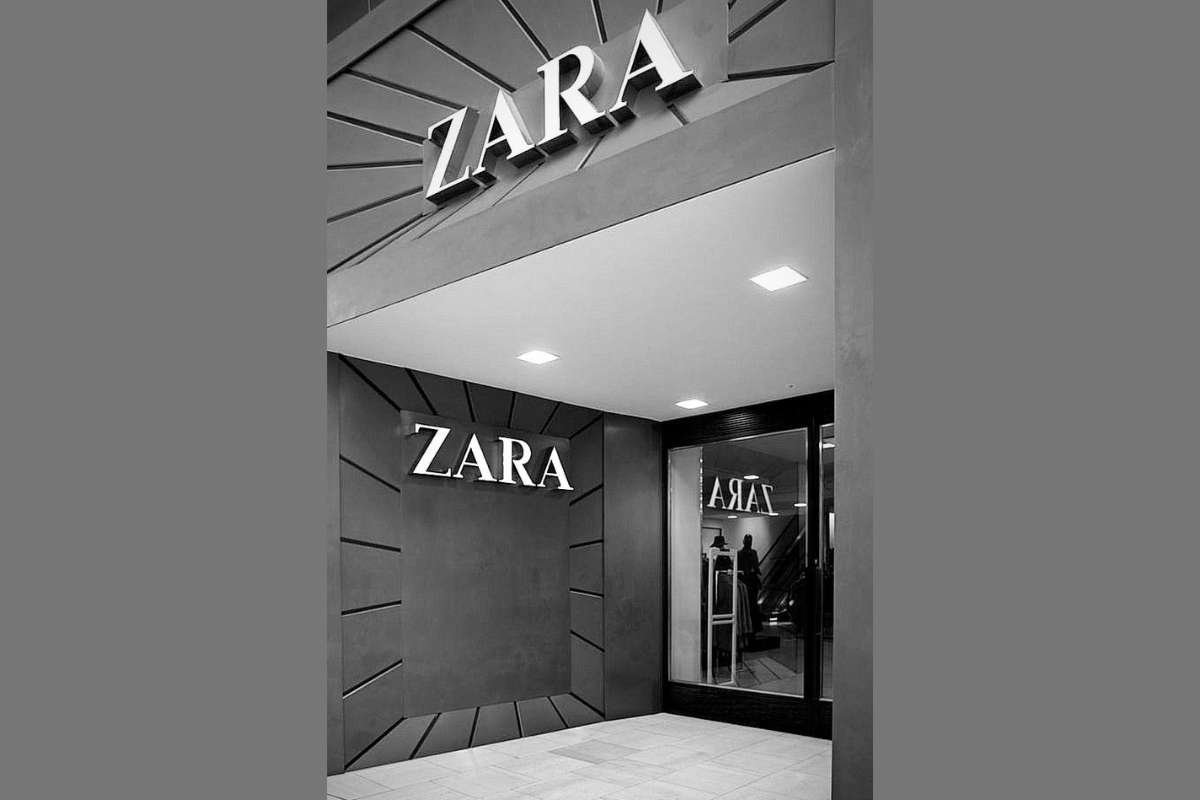
Inside each Zara store, managers act as alert information nodes, tracking what customers touch, try, question, or ignore. Conversations in fitting rooms become data points. Every day, retail teams relay precise observations to designers at headquarters, creating a steady exchange between the shop floor and the studio. Customer reactions reshape silhouettes, influence fabric choices, and determine which pieces return for restock.
Brand strategist Martin Roll has described this system as a culture of customer co-creation. The shopper becomes part of the design equation, shaping collections through behavior rather than formal surveys. Instead of forecasting trends and seasons in advance, design teams interpret demand signals in near real time. This constant calibration limits excess production and reduces unsold inventory.
Short production cycles keep momentum high. Limited runs introduce scarcity that encourages quick decisions. Urgency arises through availability rather than advertising spend, allowing speed and precision to function as the brand’s quiet persuaders.
The Inditex Operating Engine
Beneath each curated collection operates a system calibrated with exacting discipline. Every garment advances through a controlled sequence shaped by timing, coordination, and scale.
Design Brief: A concept emerges within an integrated structure where creative teams work under tight coordination. Vertical integration grants immediate oversight, ensuring each sketch aligns with capacity and timing.
Production Allocation: Speed-sensitive styles move to proximity factories in Europe for rapid execution and careful supervision. Other pieces are assigned to trusted external partners, preserving flexibility without diluting control.
Distribution Hub: Finished garments pass through centralized centers in Spain, where sorting and routing follow strict schedules. Shipments leave twice weekly, maintaining a disciplined global cadence.
Store Delivery: Collections arrive in measured quantities, keeping inventory lean and assortments fresh. Limited volumes reduce surplus and encourage attentive buying decisions.
Data Feedback Loop: Real-time inventory tracking records sales patterns with accuracy. Replenishment responds to clear demand signals, while stock allocation distributes merchandise across international markets with a calculated balance.
In this system, precision is not a feature but the quiet rule that governs every stitch.
Scaling the World, Keeping the Signature
A disciplined blueprint carried the brand across continents without compromising its identity.
Europe: The first wave of expansion builds density across key capitals. Prime retail corridors anchor visibility, while consistent store aesthetics protect brand identity. Local assortments reflect climate and purchasing patterns without altering core design language.
Asia: Urban centers welcome large-format flagships positioned in prestigious shopping districts. Product edits respond to regional preferences, maintaining relevance within a standardized retail environment.
Americas: Major cities host high-profile stores that signal scale and ambition. Location strategy reinforces status while operational systems mirror global standards.
Also read:
- Frames that Changed the Game: The Warby Parker Story
- Harry Winston: The Boy Who Became “The King of Diamonds”
Multi-Brand Strategy Framework:
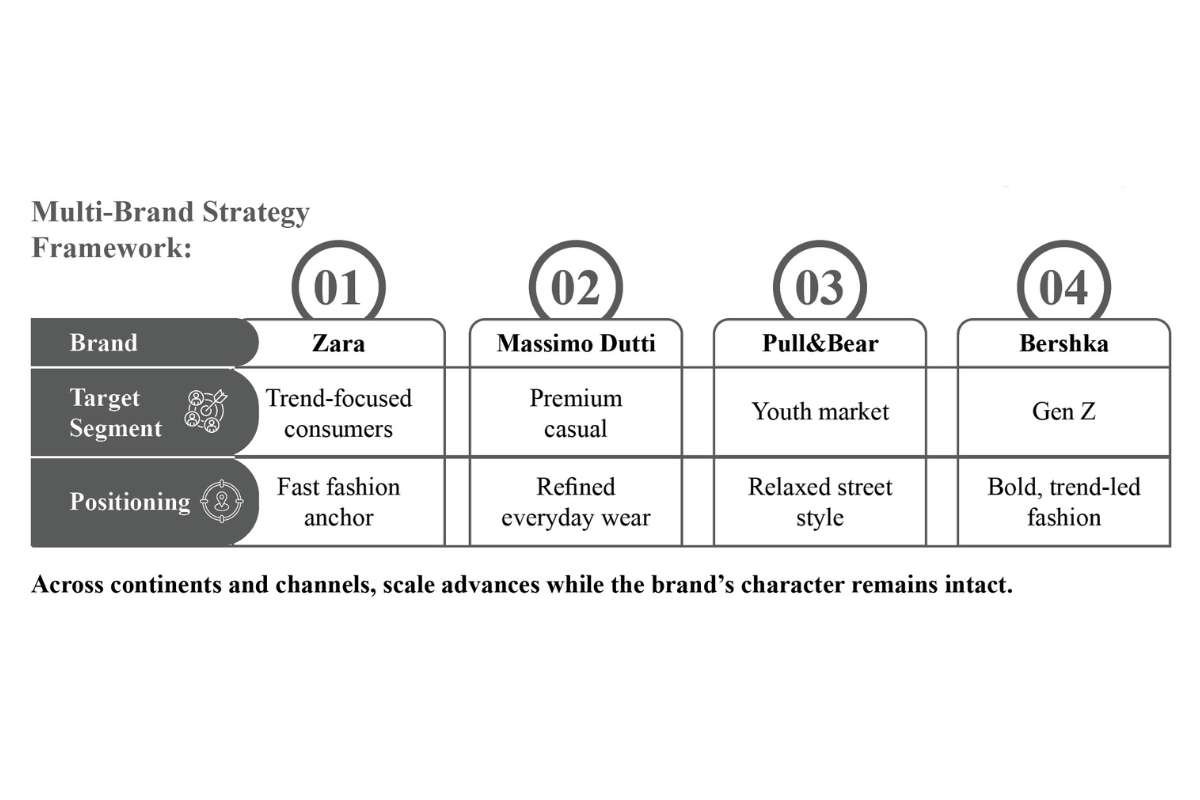
| Brand | Target Segment | Positioning |
| Zara | Trend-focused consumers | Fast fashion anchor |
| Massimo Dutti | Premium casual | Refined everyday wear |
| Pull&Bear | Youth market | Relaxed street style |
| Bershka | Gen Z | Bold, trend-led fashion |
Across continents and channels, scale advances while the brand’s character remains intact.
Zara in Context: Capability, Competition, and Challenges
At fifty, Zara stands as a study in disciplined scale, measured risk, and competitive tension.
1. SWOT Snapshot at 50
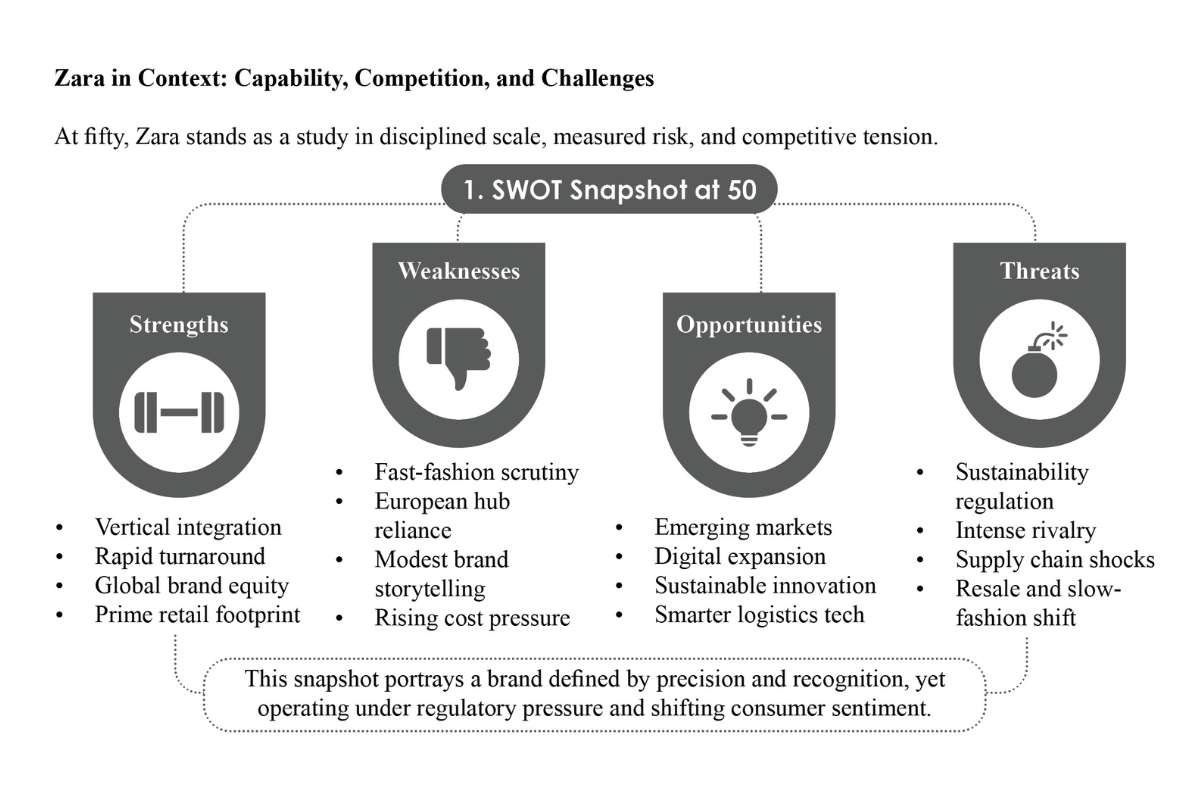
| Strengths | Weaknesses | Opportunities | Threats |
| Vertical integration | Fast-fashion scrutiny | Emerging markets | Sustainability regulation |
| Rapid turnaround | European hub reliance | Digital expansion | Intense rivalry |
| Global brand equity | Modest brand storytelling | Sustainable innovation | Supply chain shocks |
| Prime retail footprint | Rising cost pressure | Smarter logistics tech | Resale and slow-fashion shift |
This snapshot portrays a brand defined by precision and recognition, yet operating under regulatory pressure and shifting consumer sentiment.
2. Competitive Market Analysis
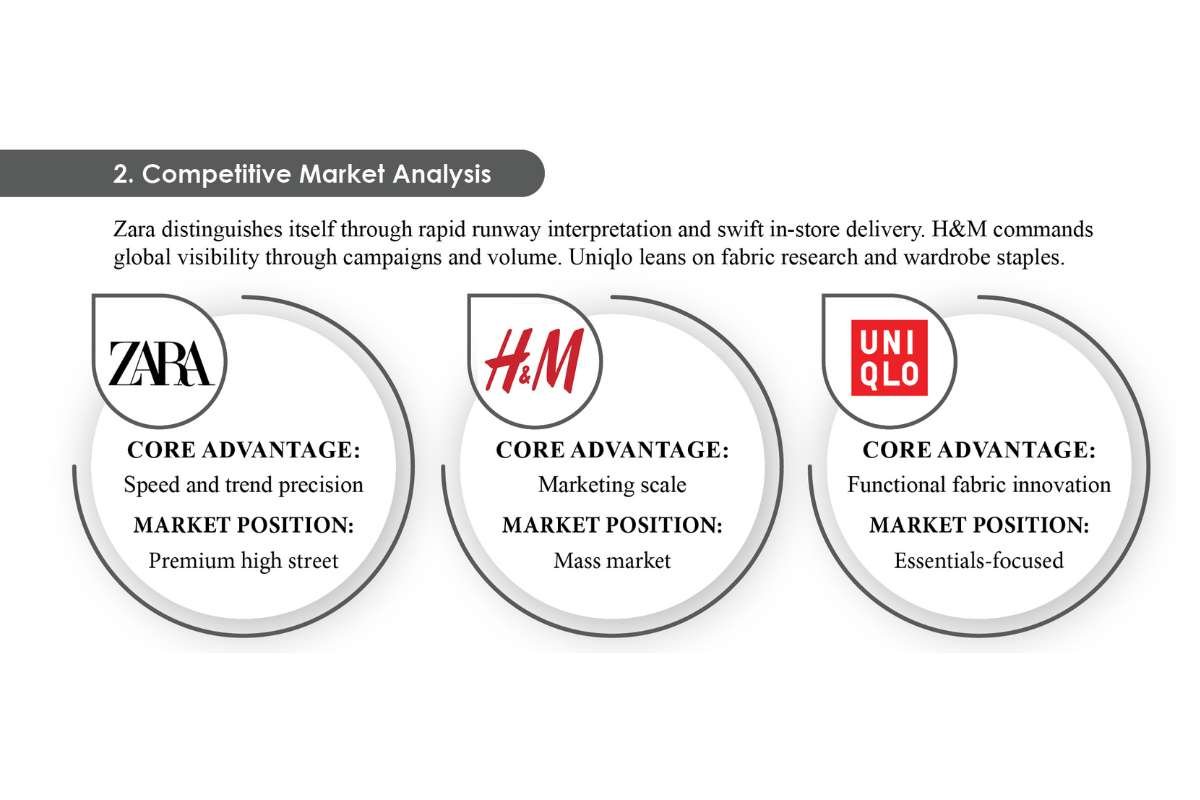
Zara distinguishes itself through rapid runway interpretation and swift in-store delivery. H&M commands global visibility through campaigns and volume. Uniqlo leans on fabric research and wardrobe staples.
| Brand | Core Advantage | Market Position |
| Zara | Speed and trend precision | Premium high street |
| H&M | Marketing scale | Mass market |
| Uniqlo | Functional fabric innovation | Essentials-focused |
Market Tension:
Digital-native entrants compress price points and production timelines. Sustainability debates intensify across markets, placing established players under regulatory and consumer pressure.
3. Key Strategies
Key strategies reveal how discipline, scarcity, and speed shape the brand’s enduring advantage.
Strategy 1: Speed as Structure
A compressed design-to-store rhythm defines the model.
- Short production cycles
- Small batch output
- Ongoing assortment refresh
Strategy 2: Scarcity Model
Limited quantities encourage decisive purchasing.
- Controlled stock per design
- Frequent store visits
- Reduced markdown reliance
Strategy 3: Operational Investment
Capital favors infrastructure over spectacle.
- Logistics-focused spending
- Elevated store presentation
- Minimal traditional advertising
Strategy 4: Sustainability Integration
Commitments respond to public scrutiny.
- Responsible sourcing targets
- Increased use of sustainable fabrics
- Circular and recycling initiatives
At fifty, the model remains clear: control the system, respect the clock, and let the product speak.
Speed Under Scrutiny: Responsibility at Scale
Speed defines the business model, yet environmental responsibility demands restraint. Zara attempts to reconcile commercial rhythm with material reform, seeking efficiency without excess.
Corporate Commitments: Inditex has set formal sustainability targets with defined timelines, expanded its use of certified lower-impact materials, invested in energy-efficient stores and logistics, and reinforced supplier audits alongside public reporting for accountability.
Industry Criticism: Despite these measures, fast fashion faces persistent concerns about overproduction and textile waste. Global supply chains remain under scrutiny, and consumer skepticism continues to test credibility. Regulatory pressure in major markets adds another layer of accountability, keeping the debate active and visible.
The tension remains visible, shaped by consumer expectations and public accountability as the next chapter unfolds.
The Human Architecture of Zara
Leadership at Zara reflects Amancio Ortega’s operational mindset, shaped by hands-on retail experience and close attention to customer behavior. He prioritized execution over publicity, focusing on store performance rather than personal visibility. Decisions emphasized accuracy, timing, and disciplined follow-through.
The structure blends decentralization with coordination. Store managers act as empowered decision-makers within their markets, while headquarters ensures alignment in standards and processes across regions.
Responsiveness shapes daily practice. Agility is embedded in routines, supported by real-time data and direct store feedback. Ongoing recalibration keeps collections aligned with demand, linking leadership and culture through shared clarity.
You may also like:
- The Complete Look: Shiseido’s 150-Year Journey Blending Art, Science, and Identity
- From Trench Coats to Runway: The Evolution of Burberry
The Final Stitch
Fifty years after a modest opening in A Coruña, Zara stands as a disciplined study in timing, control, and commercial instinct. Its stores still pulse with urgency, yet beneath the movement lies method. Customers influence design, logistics obey strict rhythm, and leadership prizes execution over spectacle. As scrutiny intensifies and expectations rise, the brand’s future will depend on how carefully it balances speed with responsibility.