Choosing a private driver in Milan is no longer just a matter of prestige; it is a practical decision that affects travel time, comfort and even the overall efficiency of a business trip or a family holiday. Between congested traffic, stringent environmental rules and a high density of events and fairs, the type of vehicle – sedan or van – can radically change the experience.
The theme is particularly relevant for international business travellers, event planners, families and small groups who need to move around Milan and its airports with reliability and comfort. Understanding when a sedan is sufficient and when a van is the more rational option is essential to avoid stress, extra costs and logistical bottlenecks, especially in a city that has become one of the main European hubs for trade shows, fashion weeks and corporate meetings.
The evolving context of private driver services in Milan
Over the last decade, Milan has consolidated its role as a European capital for finance, fashion, design and trade fairs. According to data from the Municipality of Milan and regional tourism observatories, the metropolitan area has been welcoming, in recent years, several million visitors per year, with a strong incidence of international guests linked to business, events and high-end tourism. This constant flow has transformed the demand for mobility, pushing many travellers to prefer private driver services over traditional taxis or public transport, especially for airport transfers and multi-stop itineraries.
The service defined as private driver in Milan has therefore assumed a strategic role: not only point-to-point transfer, but also hourly disposal, meetings itinerary management, and connections between the city and strategic locations such as Lake Como, the main lakes in Northern Italy and other cities in Lombardy. Within this context, the choice between sedan and van has become a structural element of travel planning, rather than a mere stylistic preference.
On the supply side, many operators have diversified their fleets, offering a combination of high-end sedans (often plug-in hybrid or mild hybrid, to comply with local environmental regulations) and spacious, business-oriented vans. At the same time, Milan’s traffic restrictions – such as low-emission zones and congestion areas – have encouraged the renewal of fleets towards more efficient and comfortable vehicles, with increasing attention to on-board experience (Wi-Fi, USB chargers, privacy glass, climate control for each row).
Data, trends and how they influence the sedan vs van choice
To understand when a sedan is really enough and when a van is preferable, it is useful to look at some structural data on travel behaviour and the physical constraints of vehicles, especially in relation to luggage and comfort.
In European business travel, several industry surveys report that a significant share of travellers – often above 50% – combine a carry-on with at least one checked bag for trips longer than 3 days. For Milan, a city with a strong incidence of international travel, this translates into a frequent need to manage passengers carrying bulky luggage, business materials, sample collections or technical equipment for fairs and events.
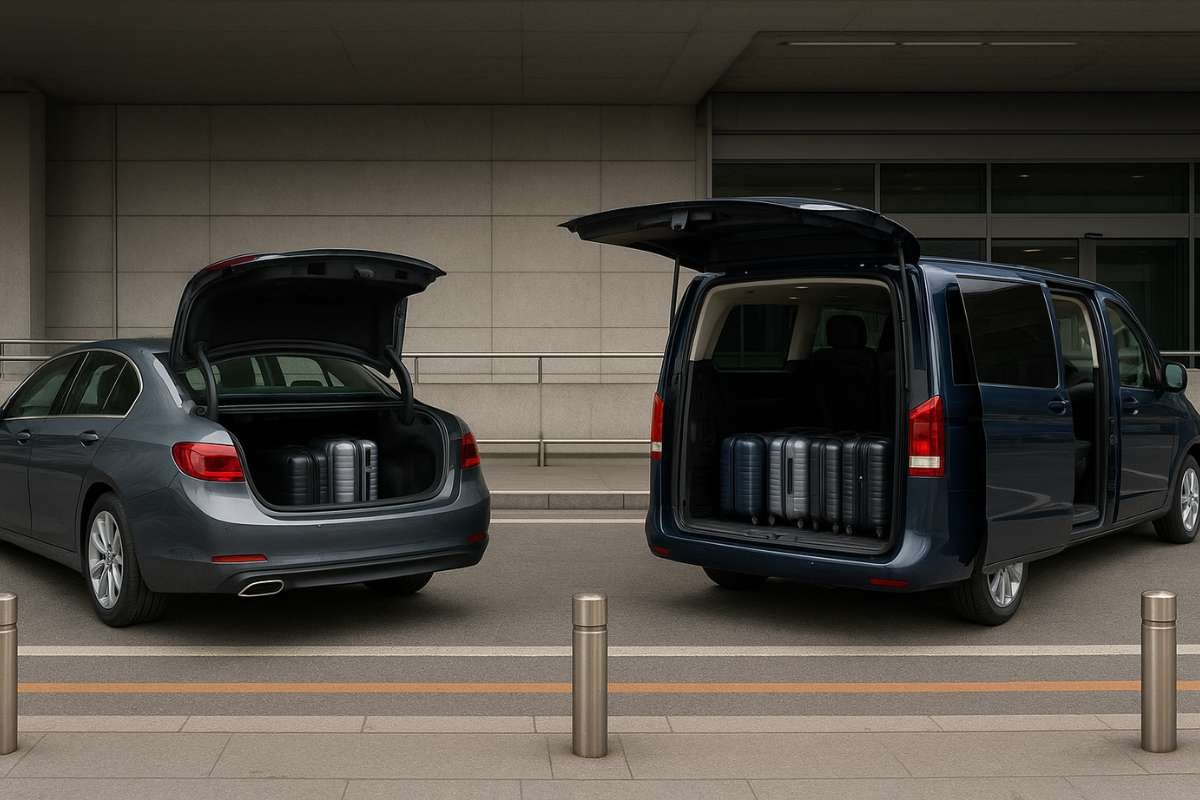
From a purely volumetric perspective, the difference between a sedan and a van is decisive. A typical executive sedan can comfortably accommodate 2–3 medium suitcases in the trunk, extending to 4 only if sizes are moderate and loading is carefully optimised. A premium van, on the other hand, can often manage 6–8 standard suitcases or a mix of large suitcases and hand luggage while still leaving passengers with a comfortable seat and legroom. For groups of 4 travellers, this difference can mark the boundary between a smooth transfer and an uncomfortable journey with bags placed between seats or at passengers’ feet.
Another structural trend is the growth of group and bleisure travel (the combination of business and leisure). Data from international travel associations show that a growing share of travellers extends business trips to include family or colleagues, transforming a classic individual transfer into a micro-group movement. This trend directly encourages the use of vans or people carriers, since it is more rational – both economically and logistically – to consolidate passengers into a single, comfortable vehicle.
The demand for comfort and on-board services is also increasing. Studies on passenger satisfaction in premium mobility services indicate that legroom, ease of access (especially for elderly or less mobile passengers) and cabin height are now almost as important as transfer time. These dimensions are intrinsically more favourable to vans, which offer easier boarding, more space to move inside the vehicle and, in many cases, flexible modular seating.
How to technically assess luggage and comfort needs?

The decision between sedan and van for a private driver in Milan should be approached with a technical, almost engineering mindset, even when the goal is simply to go from the airport to the hotel without complications. There are three main variables to consider: number of passengers, type and volume of luggage, and required level of comfort.
For number of passengers, the threshold is not just the legal seat limit. A sedan may legally accommodate four passengers, but in the context of a premium transfer it is usually recommended not to exceed three, especially on longer routes or when there is more than one large suitcase. The additional central rear seat can be acceptable for short urban routes, but for transfers of over 40–50 minutes (for example Malpensa – city centre, or city – Lake Como), the loss of comfort becomes tangible.
For luggage, the analysis must be qualitative, not only quantitative. A single large hard-shell suitcase can occupy nearly half the trunk of a sedan, especially if the traveller also carries a cabin trolley or a laptop backpack. On routes typically used by business travellers, such as airport–Fiera Milano or hotel–congress centre, there is often an implicit requirement to transport displays, folders, samples or marketing materials; these elements are bulky, irregular in shape and often fragile. In such cases, a van offers both volume and flexibility: it is easier to load boxes, garment bags, long items or sports equipment without forcing and without compromising rear visibility.
For comfort, the analysis includes several parameters: legroom, ability to work on board (using a laptop, making calls without feeling cramped), privacy and noise level. Vans may surprise those who still associate them with the idea of a tourism minibus: the latest generation models offer individual or conference-style seating, USB ports in each row, sliding doors for easier boarding in tight spaces and a more vertical seating position that many passengers find less tiring, especially on longer routes.
In many real-world scenarios, the rational matrix is as follows:
- 1–2 passengers with light luggage (one medium suitcase or carry-on each): sedan generally sufficient.
- 3 passengers with medium/large luggage: van strongly advisable for comfort and safety.
- 4–7 passengers, even with light luggage: van almost mandatory if aiming for a premium experience.
In Milan, where travel times can be extended by traffic, choosing a configuration that is only “barely sufficient” on paper can translate into a clearly suboptimal experience in practice.
Scenarios: airports, fairs, business meetings and leisure trips
The sedan vs van decision takes on different nuances depending on the specific use case, route and context of use of the private driver in Milan.
For airport transfers (Malpensa, Linate, Orio al Serio), the determining factors are luggage and expected waiting times. After a long flight, passengers in economy or business class typically arrive with at least one piece of hold luggage. For a couple with two large suitcases and two carry-ons, a sedan can manage, but it is at its limit. For families with children, strollers and extra bags, the van becomes a logical choice not only for space, but also for ease of boarding and disembarking: sliding doors, higher seats and more internal room make handling children and bags more manageable.
For trade fairs and congresses (Fiera Milano Rho, MiCo, fashion shows, design week), the van is usually the most coherent solution. Delegations, exhibitors and speakers often travel with roll-ups, samples, technical equipment or fragile materials. A sedan trunk, although well-organised, quickly becomes inadequate or forces creative but unsafe stacking. Vans allow both luggage and passengers to be accommodated without compromises. Furthermore, if the group travels together, a single van simplifies coordination and arrival times.
For city business meetings, especially within Milan’s central areas, the sedan can remain a valid choice, especially for solo travellers or pairs of executives who move quickly between appointments. However, when the day includes several meetings at different locations and the need to work during transfers, a van configured with “lounge” style seats can transform travel time into productive time, enabling laptop use, comfortable note-taking and more reserved conversations.
For leisure trips and excursions (for example towards Lake Como, Franciacorta, or outlet villages), travel time and the desire for a relaxed experience become central variables. Couples seeking a more intimate atmosphere may prefer a sedan, while families or groups of friends benefit from the social set-up and space of the van, which allows for more comfortable seating, space for shopping bags on the way back and more freedom of movement inside the cabin.
Risks and critical issues of a wrong vehicle choice

Underestimating the importance of choosing between sedan and van in the context of a private driver in Milan can lead to a series of practical and reputational issues, especially for companies and professionals who host clients or partners.
The first and most obvious risk is objective discomfort. Passengers forced to share a cramped rear bench with bags at their feet or between seats will start their day with a sense of stress that can affect the perception of the entire trip or event. In a business context, the comfort of transfers is perceived – explicitly or implicitly – as a proxy for organisational attention and respect towards guests.
The second risk is time loss. If, at pick-up, it turns out that luggage does not fit in the chosen vehicle, the operator may need to call an additional car or upgrade to a different vehicle, with inevitable delays and possible extra costs. In a city with time-sensitive agendas such as Milan, a 20–30 minute delay can create a domino effect on meetings, slots for trade fair access or restaurant reservations.
There is also a safety and compliance dimension. Overloading a sedan’s trunk, obstructing the driver’s rear visibility or placing heavy objects in the passenger compartment without securing them properly can create dangerous situations in the event of sudden braking. Professional drivers are generally attentive to these aspects, but the root of the problem often lies in an incorrect initial assessment of needs by the client or travel organiser.
Finally, there is a reputational risk for companies that organise transfers for their guests. A poorly organised journey – especially if combined with other minor inefficiencies – can contribute to an overall impression of approximation, which can affect the perception of the brand, the event or the meeting quality.
Opportunities and advantages of a correct sedan vs van strategy
On the other hand, a thoughtful, structured approach to choosing between sedan and van can generate tangible advantages, both for individual travellers and for companies and institutions that frequently use private drivers in Milan.
Firstly, there is a clear increase in comfort and satisfaction. Travellers who find a spacious and suitable vehicle for their needs are more likely to arrive at their destination relaxed, ready to work or enjoy the experience. In the business world, this can translate into better quality of meetings, increased concentration and a general perception of professional care.
Secondly, there is a theme of efficiency and cost rationalisation. While a van has a higher cost than a sedan on a single transfer basis, it often becomes more economical per passenger for groups of three or more. Instead of booking two sedans for three or four guests, a single van can accommodate everyone, reducing coordination complexity, arrival time variability and the number of pick-ups and drop-offs to manage.
A third advantage is logistical simplification. Having all participants in the same vehicle allows for sharing last-minute information, aligning on the agenda during the journey and responding more flexibly to changes in plans (for example, an unplanned but convenient stop between two meetings).
Finally, the van can become a mobile extension of the meeting space. In scenarios of intense schedules or distances that make transfers of 45–60 minutes necessary, a well-equipped van offers an environment where it is possible to hold preparatory briefings, debriefings or informal conversations that would be impossible in a more constrained sedan set-up.
Regulatory and urban aspects to keep in mind in Milan
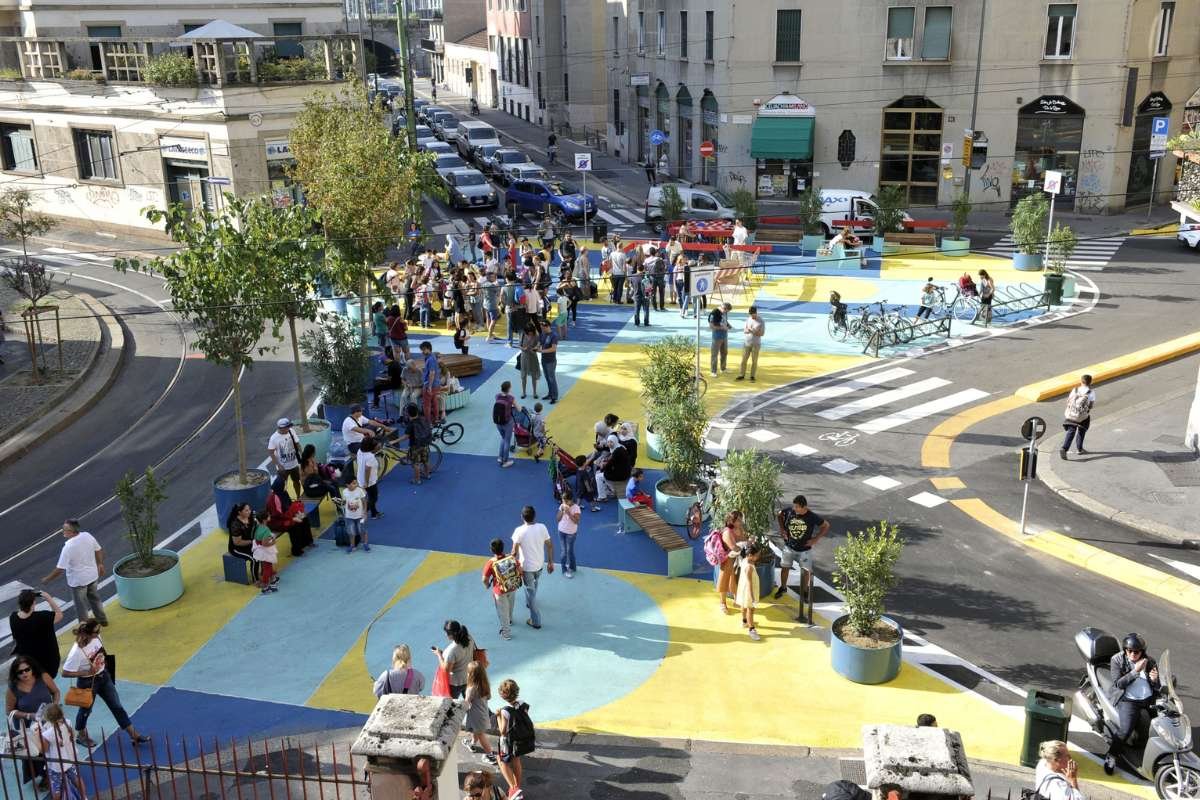
In Milan, choosing between sedan and van is partially influenced by the regulatory context and urban planning. The city has introduced over time several measures aimed at reducing congestion and pollution, including restricted traffic areas and low-emission zones, particularly in the central area.
Professional private drivers must operate vehicles that comply with current environmental classes to access these zones. For the client, this means that both sedans and vans offered by reputable operators will generally be aligned with the rules, but it is useful to be aware that larger, more powerful or older vehicles may be subject to limitations or additional charges.
The practical implication is that it is advisable to favour operators who maintain a modern, low-emission fleet, both for legal compliance and for the possibility of accessing all relevant urban areas without restrictions. Vans, in particular, have undergone a significant transformation in recent years: the latest models combine capacity with increasing levels of efficiency and reduced emissions, making them compatible with the environmental policies of Milan and other major European cities.
Another aspect concerns boarding and disembarking dynamics in urban spaces. Many streets in central Milan offer limited room for stopping or parking, even for short times. Vans with sliding doors and higher ground clearance simplify the process, especially when passengers have bulky luggage or reduced mobility. Sedans, on the other hand, can be easier to position and manoeuvre in very tight spaces, but may offer less agility when passengers need more time to get in and out.
How to decide: a practical framework for travellers and organisers
To translate all these considerations into a concrete decision, it can be useful to adopt a simple decision framework when booking a private driver in Milan, whether as a traveller or as an organiser for colleagues and guests.
First, quantify passengers and luggage with as much precision as possible. Instead of indicating generic “2 bags”, specify approximate sizes (“two large suitcases plus two cabin trolleys”). If bags contain fragile or bulky items (samples, roll-ups, instruments), it is better to overestimate space needs.
Second, evaluate route and journey duration. A 15-minute transfer within the city is one thing; a 60-minute route with possible traffic is another. For times above 30–40 minutes, comfort becomes a structural requirement, not a luxury. In these cases, for three or more passengers, the van usually proves to be the more rational choice.
Third, consider mobility and specific needs of passengers. Elderly guests, people with reduced mobility, children, or simply tall or larger people benefit significantly from the interior height and easier access of vans. In these scenarios, a sedan, even if technically sufficient, may not represent the best option.
Fourth, integrate the decision into the overall image one wishes to convey. For high-level guests, a high-end sedan can send a strong signal of prestige and attention to detail, but a modern, well-configured van can communicate equal or even greater care, particularly if the need for space and comfort is evident.
FAQ: practical questions on sedan vs van choice
1. How many suitcases can a sedan realistically carry for a private transfer in Milan?
In practice, an executive sedan can comfortably accommodate two medium or large suitcases and two small bags or backpacks. Exceeding this quantity is possible only by sacrificing comfort or visibility, which is not advisable for a premium transfer. For three passengers with at least one large suitcase each, it is generally better to consider a van.
2. Is a van really necessary for only three people?
Not always, but often yes if the journey is longer than 30–40 minutes or if luggage is more than one medium suitcase per person. For three passengers with standard luggage on urban routes, a sedan can be sufficient; however, for airport transfers, journeys to trade fairs or routes outside the city, a van usually offers a decisively superior experience.
3. Does a van give a less “elegant” image than a sedan?
Modern premium vans are designed exactly for business and high-end tourism, with refined interiors, privacy glass, individual climate control and high comfort standards. In many situations – for example delegations, families or groups of colleagues – the van actually communicates greater attention to guests’ well-being and practical needs than a sedan that is objectively too tight for luggage and passengers.
Conclusion: choosing the right vehicle as a strategic decision
For those who use a private driver in Milan, learning to decide consciously between sedan and van means transforming a potential source of stress into a lever of efficiency and well-being. The vehicle is no longer just a means of getting from one point to another, but an integral piece of the travel experience – a space where work can be completed, where guests can feel welcomed, where a day of meetings can begin or end in a relaxed way.
Evaluating number of passengers, type of luggage, travel time and the symbolic dimension of comfort allows a rational, data-informed choice, beyond stereotypes. For individuals, this means more pleasant journeys and fewer surprises. For companies, event organisers and professionals who frequently host guests in Milan, it becomes part of the broader quality system of the services offered, with direct effects on perceived professionalism and satisfaction.
Before booking the next transfer, it is therefore worth pausing for a moment on these variables and deciding not only “which service” to choose, but “which vehicle” is most coherent with real needs. The difference, in everyday practice, is far from marginal.