A Digital Shift Waiting to Occur
In the early 2000s, the world was beginning its digital awakening, social habits were shifting online, conversations were moving to screens, and personal expression was finding new mediums. Yet professional life remained stubbornly analog. Resumes lived in filing cabinets. Job seekers circled classifieds in newspapers. Networking meant shaking hands in hotel conference rooms or waiting for introductions at alumni dinners. It was a slow, proximity-bound world.
And then, quietly, almost modestly, LinkedIn appeared.
It didn’t storm in as a disruptor; it arrived as a belief, a belief that every professional deserved a digital identity, a place where opportunity wasn’t limited by where you lived or who you already knew. At a time when uploading your personal details online felt strange and even risky, LinkedIn’s founders held onto a simple truth: careers are built not just on talent, but on connections. And if those connections could be digitized, mapped, and scaled, the walls around professional growth could fall.
This early vision, subtle yet radical, became the seed of a global shift. It laid the foundation for how LinkedIn would transform professional networking, turning an analog ritual into a digital ecosystem of opportunity.
Building the First Professional Graph
LinkedIn’s early phase was characterized by slow but steady growth. It attracted users curious enough to experiment with a new way of representing their professional lives online. Each user added a new node to the growing professional graph, a digital reconstruction of industries, relationships, and career paths.
Even in these early days, the platform was laying the foundation for how LinkedIn would transform professional networking by creating a structured, searchable map of global talent.
What began as a simple platform for digital resumés gradually evolved into something far more dynamic. Professionals did not merely want to list their credentials; they wanted to expand beyond their immediate circles and access a world of experts, mentors, and opportunities they would never meet in person. LinkedIn answered this need by adding features that made professional identities more interactive. Recommendations brought credibility.
Endorsements added skill validation. Company pages offered windows into global workplaces. Through each enhancement, LinkedIn demonstrated another facet of how LinkedIn transformed professional networking into a richer, more transparent ecosystem.
A Thriving Ecosystem of Ideas, Insights, and Professional Conversations
A quiet revolution unfolded in 2012 with the arrival of the LinkedIn feed. Overnight, the platform shifted from a digital directory of profiles to a living, breathing ecosystem of ideas, insights, and conversations. It marked a turning point in LinkedIn’s evolution from a place that simply recorded who you were to a community that showcased what you knew, believed, and were building.
Suddenly, professionals weren’t just updating resumes; they were sharing reflections, documenting journeys, and engaging in real-time dialogue with the world. Voices that once echoed only within office walls found a global audience. Entrepreneurs offered wisdom, mid-level managers shared lessons, and young graduates sparked discussions. Leadership no longer belonged to corner offices; it flowed from everyday professionals with something to say.
In this new landscape, influence became democratized. The feed didn’t just enable participation, it empowered it. It transformed networking from a passive act into an active exchange, ensuring that every professional had the chance not only to observe the conversation, but to shape it.
From Showcasing Experience to Expanding It
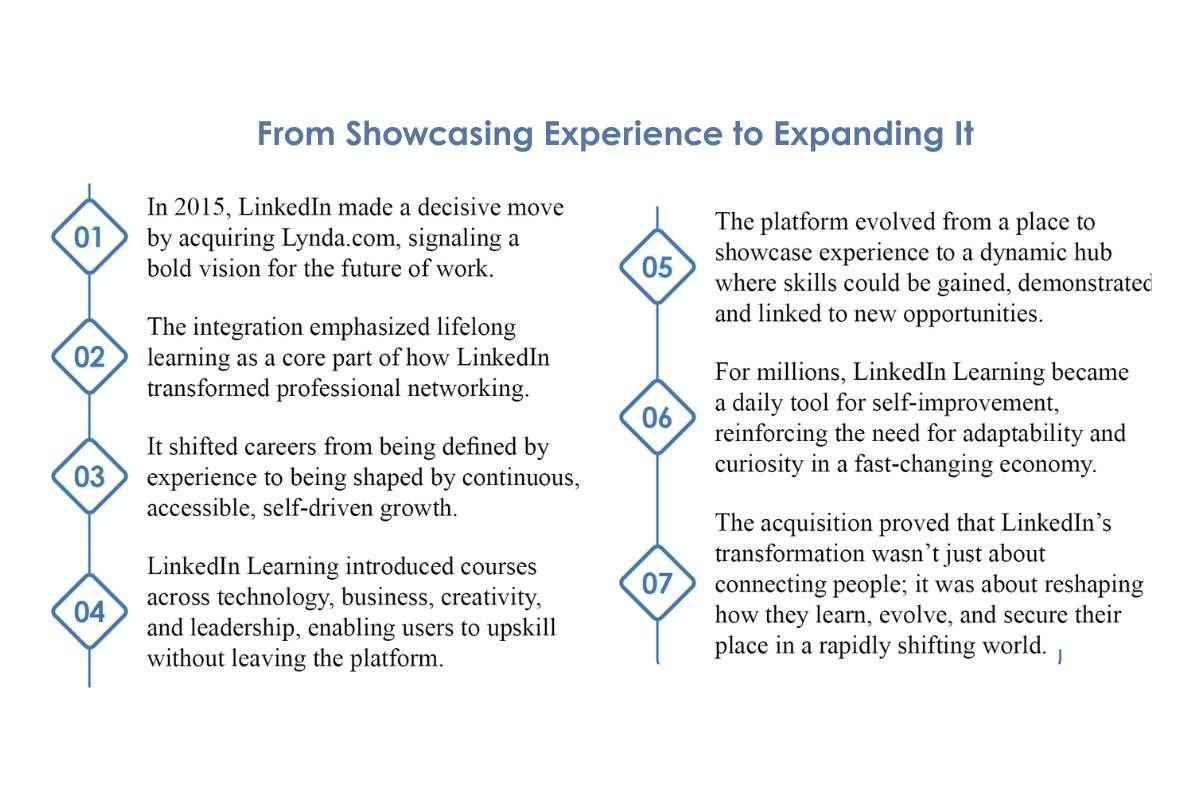
- In 2015, LinkedIn made a decisive move by acquiring Lynda.com, signaling a bold vision for the future of work.
- The integration emphasized lifelong learning as a core part of how LinkedIn transformed professional networking.
- It shifted careers from being defined by experience to being shaped by continuous, accessible, self-driven growth.
- LinkedIn Learning introduced courses across technology, business, creativity, and leadership, enabling users to upskill without leaving the platform.
- The platform evolved from a place to showcase experience to a dynamic hub where skills could be gained, demonstrated, and linked to new opportunities.
- For millions, LinkedIn Learning became a daily tool for self-improvement, reinforcing the need for adaptability and curiosity in a fast-changing economy.
- The acquisition proved that LinkedIn’s transformation wasn’t just about connecting people; it was about reshaping how they learn, evolve, and secure their place in a rapidly shifting world.
A Data-Rich, Borderless Discovery Engine for Talent
A new talent economy didn’t appear overnight; it unfolded as LinkedIn subtly rewired the professional world from two powerful angles: how talent is found, and how talent shows up.
For years, recruitment lived in a narrow box of résumés, job fairs, and local talent pools. Then LinkedIn blew that box open, with LinkedIn Recruiter, hiring shifted from reactive to strategic. Companies could map skills, track potential, and reach exceptional professionals who weren’t even looking. The “perfect candidate” was no longer hidden; they were discoverable through data, insight, and intention.
At the same time, another quiet revolution was taking shape. As the creator economy surged, LinkedIn introduced Creator Mode, transforming profiles from static summaries into storytelling stages. Professionals began building identities not just through roles but through ideas. Engineers educated thousands. Designers shaped communities. Founders sparked global conversations. Networking became less about rooms and events, and more about stories that travelled, resonated, and influenced.
Together, these forces reshaped the modern professional ecosystem. Talent became both visible and vocal. Opportunities moved faster than résumés. Voices crossed borders long before business cards did.
This is the new talent economy, strategic, expressive, global, and powered by the unmistakable pulse of LinkedIn.
Read Next: LinkedIn Summary Examples for Freshers: A Guide to Crafting Your Perfect Profile
The Intelligence Behind the Experience: Algorithmic Relevance
Behind LinkedIn’s user experience lies a sophisticated algorithm that prioritizes relevance over virality. Unlike many platforms that prioritize sensational content, LinkedIn prioritizes professional value. This algorithmic intelligence is a key pillar of how LinkedIn transformed professional networking, ensuring that meaningful insights reach the right audiences.
A single post from a mid-level professional can reach thousands if its message resonates. A recruiter searching for a niche skill can find precisely the right candidate. A student exploring a new field may discover relevant voices and learning paths. By personalizing discovery, LinkedIn transformed the randomness of networking into something intentional and merit-driven.
A Global Impact Beyond Borders
Today, LinkedIn’s presence spans more than 200 countries, serving hundreds of millions of professionals across industries, cultures, and levels of experience. It has become the first profile new graduates create and the primary digital identity for experienced professionals. In emerging markets, it offers a bridge to global opportunity, helping talent transcend geography, economic constraints, and traditional barriers to entry. In developed economies, it accelerates innovation, mobility, and skill-based hiring, reshaping how organizations discover, nurture, and engage talent.
This global influence is the most visible expression of how LinkedIn transformed professional networking, as it equalized access to information and opportunity on a scale once unimaginable. What used to depend on proximity or privilege is now democratized through a platform that connects ambition with possibility, allowing professionals everywhere to participate in a shared, borderless economy of ideas and opportunities.
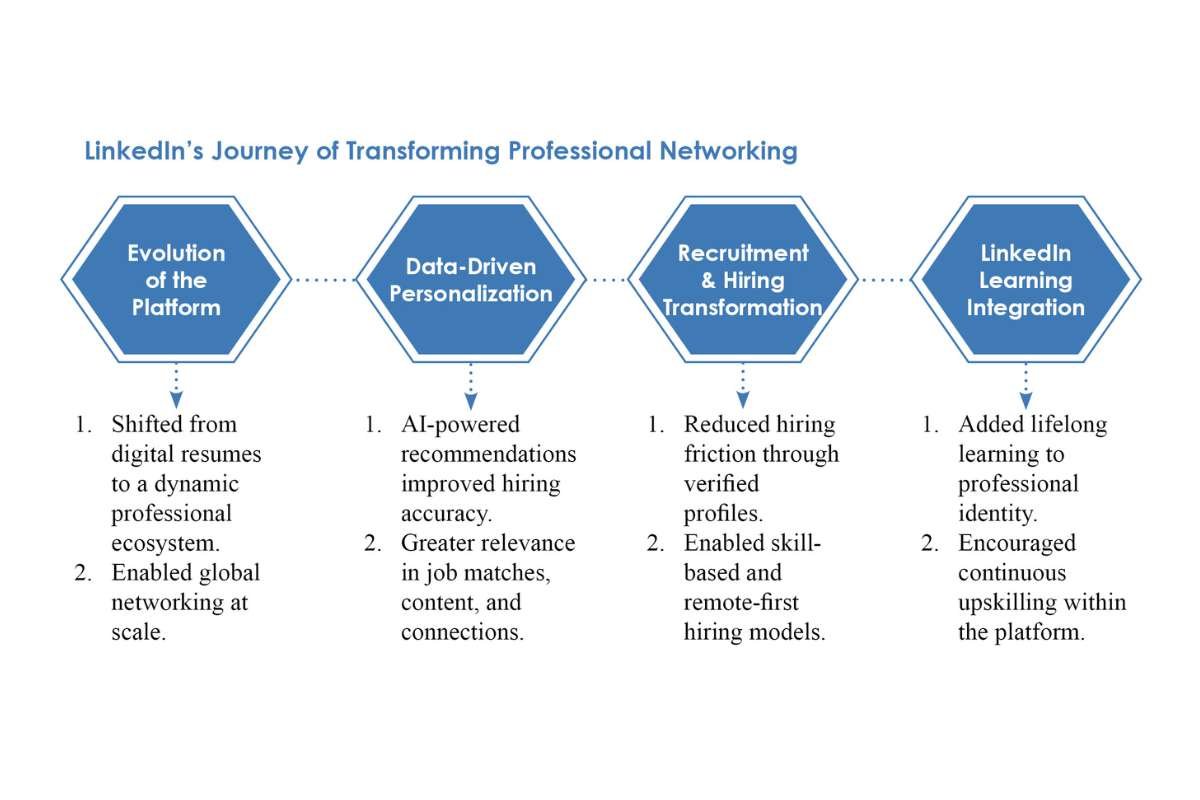
| LinkedIn’s Journey of Transforming Professional Networking | |
|---|---|
| Theme | Key Insights |
| Evolution of the Platform | • Shifted from digital resumes to a dynamic professional ecosystem.• Enabled global networking at scale. |
| Data-Driven Personalization | • AI-powered recommendations improved hiring accuracy.• Greater relevance in job matches, content, and connections. |
| Recruitment & HiringTransformation | • Reduced hiring friction through verified profiles.• Enabled skill-based and remote-first hiring models. |
| LinkedIn Learning Integration | • Added lifelong learning to professional identity.• Encouraged continuous upskilling within the platform. |
A Platform Built on Human Aspirations
- LinkedIn’s evolution is ultimately a human story grounded in real aspirations and personal transformation.
- It empowers job seekers with confidence, sometimes sparked by a single supportive message.
- Entrepreneurs can find partners across borders, expanding possibilities far beyond traditional networks.
- Students discover skills that reshape their career trajectories, turning curiosity into opportunity.
- Professionals build communities through authentic storytelling, finding their voice and influence.
- These individual narratives highlight how LinkedIn transformed professional networking into a medium for human progress, not just a digital system.
- The platform connects people not only to companies but to new possibilities, ambitions, and career paths.
- It gives visibility to ambition, credibility to skills, and global reach to ideas.
- LinkedIn makes networking personal, accessible, and actionable for everyone.
- What was once a privilege is now democratized, enabling professionals from any background to imagine more, pursue more, and become more.
Redefining Professional Identity for the Future of Work
Networking once depended on who you knew, where you lived, and which circles you could physically access. LinkedIn dismantled this paradigm. It digitized trust, visibility, and reputation, reshaping the very definition of professional identity. This philosophical shift remains central to how LinkedIn transformed professional networking, empowering individuals to present not just resumés but their stories, values, insights, and evolving expertise.
As work shifts toward hybrid models, AI-powered hiring, and borderless collaboration, LinkedIn sits at the center of these transformations. The coming decade will deepen this impact with smarter recommendations, AI guidance, enhanced learning pathways, and a more interconnected global talent marketplace. With every innovation, from skills-first talent matching to personalized learning ecosystems, LinkedIn continues to blur the boundaries between opportunity and access.
LinkedIn is no longer simply preparing professionals for the future; it is actively building that future, shaping how individuals grow, connect, and define their place in an ever-evolving world of work.
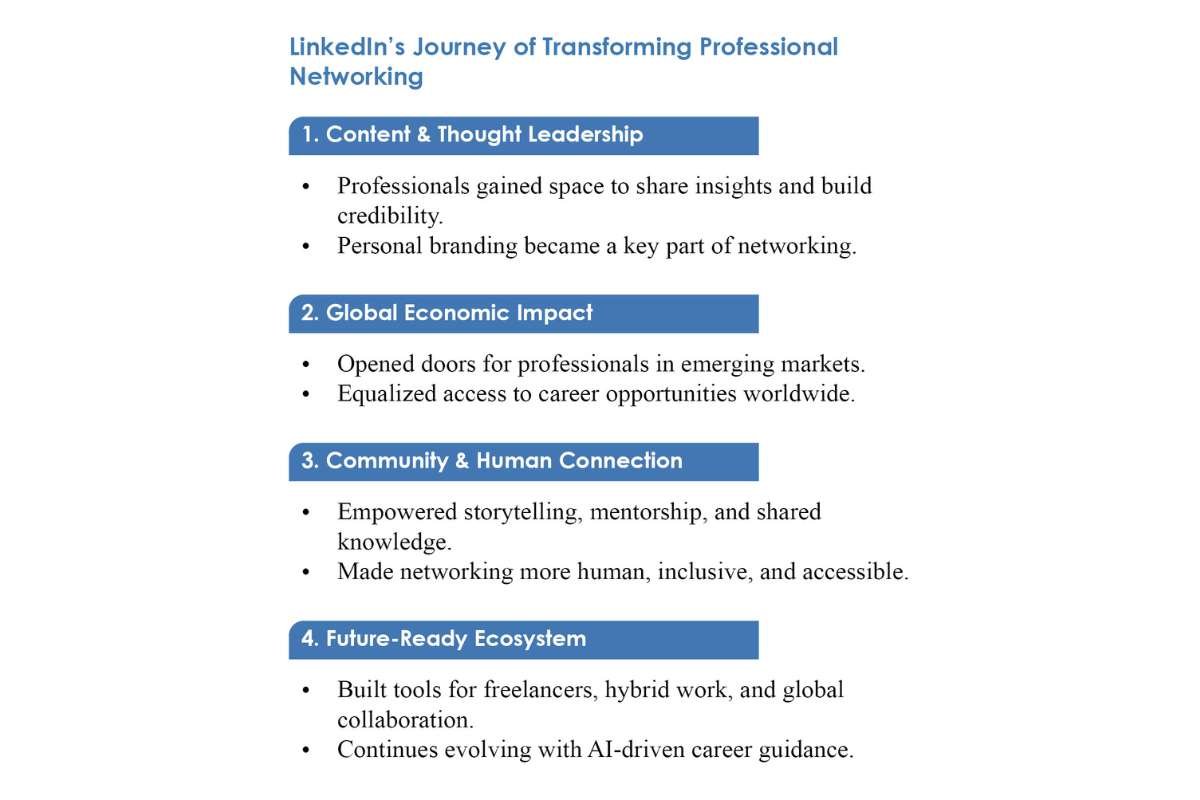
| LinkedIn’s Journey of Transforming Professional Networking | |
|---|---|
| Content & Thought Leadership | • Professionals gained space to share insights and build credibility.• Personal branding became a key part of networking. |
| Global Economic Impact | • Opened doors for professionals in emerging markets.• Equalized access to career opportunities worldwide. |
| Community & HumanConnection | • Empowered storytelling, mentorship, and shared knowledge.• Made networking more human, inclusive, and accessible. |
| Future-Ready Ecosystem | • Built tools for freelancers, hybrid work, and global collaboration.• Continues evolving with AI-driven career guidance. |
Read Next: How to Choose the Right Linkedin Post Generator for Your Content Strategy?
Conclusion: More Than a Platform, A Movement
From its origins as a basic digital résumé site to its current role as a global opportunity engine, LinkedIn has reshaped how the world works, connects, learns, and evolves. It has shown the world how LinkedIn transformed professional networking through steady reinvention rooted in the belief that progress should be accessible to all.
Its journey is a testament to what happens when technology aligns with human ambition. LinkedIn did not just digitize professional life; it reimagined it. And in a world where work keeps redefining itself, LinkedIn remains the constant, quietly rewriting the rules of professional life for millions across the globe.