Back in 2008, two roommates in San Francisco couldn’t pay their rent. Instead of panicking, they bought three air mattresses and rented them out to travelers who couldn’t find a hotel room. That tiny gamble turned into Airbnb because they had the guts to solve a personal problem with a creative fix. This ability to spot a gap and fill it is the heart of entrepreneurship skills, and it usually starts with a simple “what if.”
When a young girl in Texas started selling lemonade to save honeybees, she wasn’t thinking about boardrooms or stocks. She was just using her entrepreneurship skills to turn a childhood hobby into a way to help the planet.
You don’t need a suit or a fancy degree to make a difference. You just need to look at the world around you, find something that feels broken, and decide that you are the one who will fix it.
In this blog, we will go through some of these skills that every entrepreneur must learn. They are not the sauce for success, but they definitely make the journey easier.
Why Entrepreneurship Skills Matter Beyond Starting a Business?
They are the tools you use to spot a problem and fix it. They are not just for business owners. They are ways of thinking and doing that help you get things done. When you have these skills, you do not wait for a boss to tell you what to move next. You look at what is missing, and you find a way to fill that gap.
At their core, entrepreneurship skills are about taking action. They involve a mix of staying calm when things go wrong and being smart with your time. They help you turn a small thought into a real result. You use them to gather what you need, like money or help from friends, to reach a goal.
To keep it simple, look at these skills as three main habits:
- Finding the Gap: This is the act of seeing where something is broken. It is the move from saying “this is bad” to saying “I can fix this.”
- Getting Ready: This is about picking the right tools. You plan your day, watch your costs, and talk to people to get them on your side.
- Taking a Chance: This is not about being wild. It is about looking at a risk and deciding if the win is worth the work.
Why These Skills Help You?
You can use these skills at home, at school, or at a job. They change you from a watcher to a builder. Using your skills means you take charge of your own path. It turns a “maybe” into a “yes.”
35 Entrepreneurship Skills That Separate Builders From Dreamers
Entrepreneurs must be multi-talented. Now, some of you might say, “No one wants to be a jack of all trades and master of none.” But remember, they are often better than a master of one.
In the world we live in, being a jack of all trades is better for business than being an expert in one. And with that, here are 35 skills every entrepreneur must learn and how you can implement them.
Personal Mindset Skills
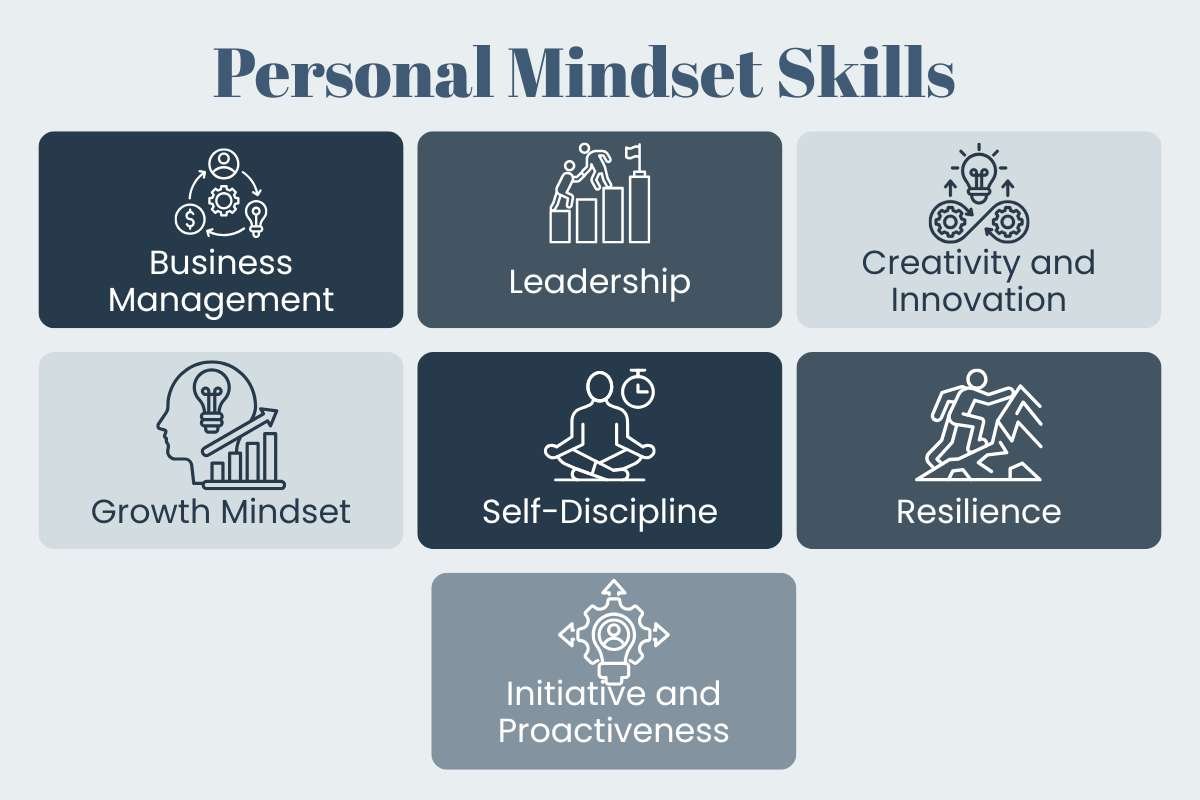
Before we focus on the working of business, here are 7 personal skills that you must learn:
1. Business Management
This is the art of keeping the engine running in entrepreneurship skills. You look at your day, your tools, and your goals to make sure they fit together perfectly. It is the move from being busy to being truly effective. You basically ensure your project stays healthy and scales.
Why it matters: Good management acts as a safety net. When you plan your time and tools, you stop reacting to crises and start leading your day. It lowers your stress because you always know exactly what you have left to work with.
Example: Jeff Bezos optimized Amazon’s early operations by personally handling warehouse logistics, scaling from books to everything via data-driven inventory systems.
- Audit your time: Track your day for 72 hours to see where your energy leaks out.
- Set one big goal: Pick the most important task and finish it before you check your email.
- Watch your resources: Keep a simple list of your money and tools so you never run out by surprise.
- Write a simple plan: Spend ten minutes every night listing the three things you must do tomorrow.
2. Leadership
Real leadership is about making people want to help you. You don’t just give orders; you set a tone that makes others feel safe and excited to do their best work. It is the art of aligning your team’s heart with the mission. When you lead this way, you build high morale and deep loyalty.
Why it matters: Leadership builds trust. When people feel safe to speak up and take risks, they work harder and stay happier. It turns a group of strangers into a team that can solve hard problems together.
Example: Indra Nooyi at PepsiCo inspired global teams through “Performance with Purpose,” blending profit goals with sustainability to boost morale and stock value during her tenure.
- Listen first: Wait three seconds after someone finishes talking before you reply.
- Give credit away: Publicly thank the person who did the hard work on a project.
- Explain the “why”: Always tell your team how their small task fits into the big picture.
- Be the example: If you want a positive culture, be the first person to offer help when things get hard.
3. Creativity and Innovation
This is the act of looking at an old tool and finding a new use for it. It is about being curious enough to ask “what if?” instead of just doing what everyone else does. This spark of innovation turns plain tasks into fresh wins and helps you stand out in a busy world.
Why it matters: Innovation keeps you relevant. The world changes fast, and the ability to connect unrelated ideas allows you to find fresh paths when the old ones close. It turns a “dead end” into a new starting line.
Example: James Dyson prototyped 5,126 vacuum iterations over 15 years, rejecting bag tech for cyclone suction, birthing a $10B+ brand.
- Mix two ideas: Take two things that don’t belong together and try to find a link.
- Ask for bad ideas: Write down five “terrible” solutions to a problem to lower your stress and find hidden gems.
- Change your view: Work from a park or a cafe to give your brain new things to look at.
- Keep an idea log: Write down every “what if” thought you have during the day in a small book.
4. Growth Mindset
A growth mindset is the belief that you can get better at anything with practice. You don’t see a “no” as a wall; you see it as a sign to try a different door. This habit turns every failure into a lesson, ensuring your skills never stop growing as you pursue new goals.
Why it matters: This mindset is the ultimate shield against burnout. If you believe your skills can grow, you see a failure as a lesson rather than a sign that you aren’t “good enough.” It keeps you moving when others quit.
Example: J.K. Rowling rewrote Harry Potter 12 times after 12 rejections, viewing feedback as refinement to sell 500M+ copies.
- Change your words: Instead of saying “I can’t,” say “I can’t do this yet.”
- Review your day: Ask yourself, “What is one thing I learned today that I didn’t know yesterday?”
- Seek hard tasks: Pick one small thing you find difficult and practice it for ten minutes.
- Ask for feedback: Ask a friend to tell you one thing you could do better next time.
5. Self-Discipline
In entrepreneurship skills, self-discipline is the power to keep a promise you made to yourself. It means you do the work even when you don’t feel like it and even when no one is watching. This inner drive turns your long-term goals into reality and builds a deep sense of self-trust.
Why it matters: Self-discipline is what turns a dream into a reality. It is the “muscle” that lets you choose long-term wins over short-term fun. It builds a sense of self-trust that no one can take away from you.
Example: Jack Ma handwrote English dictionaries daily as a poor teacher, sustaining habits that fueled Alibaba’s rise to $500B+ valuation.
- Start small: Commit to just five minutes of work. Getting started is the hardest part.
- Hide distractions: Put your phone in another room when you need to focus.
- Use a timer: Work for 25 minutes, then take a 5-minute break to stay fresh.
- Build a routine: Do your hardest task at the same time every single day.
6. Resilience
Life will knock you down, but resilience is the spring that helps you jump back up. It is the ability to feel the sting of a loss but keep moving forward anyway. This grit ensures you stay in the game long enough to win, turning setbacks into the fuel for your growth.
Why it matters: Resilience determines how far you can go. Success is rarely a straight line. Being able to bounce back from a “no” or a lost deal means you stay in the game long enough to eventually win.
Example: Walt Disney bounced from bankruptcy (1920s) and Oswald theft to create Mickey Mouse, enduring 300+ bank rejections before Disneyland’s success.
- Take a breath: When things go wrong, stop and count to ten before you say a word.
- Focus on the next step: Don’t worry about the whole mess; just find the one tiny thing you can fix now.
- Look for the lesson: Ask, “What did this mistake teach me so I don’t do it again?”
- Talk it out: Share your setback with a mentor to get a fresh take on the situation.
7. Initiative and Proactiveness
Being proactive means you move well before you are forced to act. You do not wait for a fire to start; instead, you clear the clutter before you even see a spark. This habit allows you to control your day and stop problems while they are still very small.
Why it matters: Taking the lead gives you a sense of control over your own life. Proactive people don’t just wait for things to happen to them; they shape their own future. This leads to more pride in your work and more open doors.
Example: Brian Chesky sold custom cereal boxes at $40K profit during Airbnb’s near-failure in 2008, funding the pivot to $100B+ valuation.
- Anticipate needs: If you know a friend will need help tomorrow, offer it today.
- Solve small bugs: Fix a tiny problem you see right now instead of waiting for it to get big.
- Ask “what’s next?”: When you finish a task, look for the next useful thing to do without being told.
- Set your own deadlines: Try to finish a job two days before it is actually due.
Communication and Interpersonal Skills

Communication matters, and here are 6 entrepreneurship skills necessary for it:
8. Communication
Communication is the art of moving a vision from your mind into someone else’s. It requires you to speak with clarity and listen with your full attention. When you master this, you show others why your ideas truly matter. It bridges the gap between a thought and a real, shared goal.
Why it matters: Good communication stops mistakes before they happen. When you speak simply and listen well, you build trust. It ensures that everyone is moving in the same direction and feels heard, which cuts down on frustration and wasted effort.
Example: Elon Musk’s Twitter Spaces and emails explain complex rockets plainly, rallying Tesla investors during “production hell.”
- The 3-second rule: After someone finishes speaking, wait three seconds before you reply to ensure they are actually done.
- Write it simply: Before sending a long email, try to summarize your main point in just one sentence at the very top.
- Use “we” instead of “I”: When trying to persuade someone, talk about how the idea helps the whole group.
- Ask open questions: Instead of “Do you understand?” ask “What part of this plan seems most challenging to you?”
9. Networking
Networking means building a circle of partners and mentors with a clear purpose. It is about growing your social capital so you have experts to call when you hit a wall. By forming these deep ties, you gain access to new advice and paths that help your work grow much faster.
Why it matters: No one succeeds alone. A strong network gives you access to information and opportunities that you won’t find on a job board. It turns a “cold” world into a community of people who want to see you win.
Example: Reid Hoffman leveraged LinkedIn’s own platform to connect PayPal Mafia peers, spawning successes such as YouTube and Yelp.
- Offer help first: When you meet someone new, ask, “Is there anything you are working on that I can help with?”
- The 24-hour follow-up: If you meet someone interesting, send a short “nice to meet you” note within one day.
- Be a connector: If you know two people who could help each other, introduce them without being asked.
- Share your “why”: Tell people what you are passionate about, not just what your job title is.
10. Delegation
This is the power to let go. It means you trust other people to handle parts of a project so you can focus on the big picture. In the end, entrepreneurship skills teach you to move from being the person who does everything to the person who leads everything.
Why it matters: You only have 24 hours in a day. Delegation is the only way to grow a project beyond what one person can handle. It also makes your team feel valued because you are trusting them with real responsibility.
Example: Richard Branson assigns Virgin Group ventures to trusted lieutenants, overseeing 400+ companies without micromanaging.
- Define the “what,” not the “how”: Tell the person what the finished result should look like, but let them choose the path to get there.
- Start with low stakes: Give away a small, simple task first to build your trust in the other person.
- Set check-in points: Don’t wait until the deadline; ask for a quick update halfway through.
- Provide the tools: Before you hand over a task, make sure the person has everything they need to succeed.
11. Talent Spotting
This skill lets you see a person’s spark beyond a simple resume. You look for high potential and a strong cultural fit. It is about finding those with the right drive to match your team’s vibe. By picking people for their grit and spirit, you build a loyal, winning crew.
Why it matters: A project is only as good as the people working on it. Finding the right person the first time saves you months of stress and keeps the team spirit high. It allows you to build a “dream team” where everyone’s strengths cover someone else’s gaps.
Example: Google’s Larry Page hired Sheryl Sandberg for ops, spotting her Meta-scaling potential early.
- Look for “grit”: Ask people about a time they failed and how they handled it; their answer tells you more than their grades.
- Watch for curiosity: The best people are usually the ones asking the most questions.
- Check the “vibe”: Imagine being stuck in an airport for five hours with this person; if that sounds like a nightmare, they might not be a fit.
- Hire for potential: Sometimes a person with a great attitude and no experience is better than an expert with a bad attitude.
12. Coaching and Mentoring
Coaching moves you from being a “boss” to being a “teacher.” You stop giving orders and start helping your team find their own answers. This long-term skill transfer builds their confidence. By acting as a guide, you help your staff grow so they can handle much bigger tasks on their own.
Why it matters: When you help others get better, your own job gets easier. A team that learns is a team that stays. It turns your workspace into a place where people feel they are building a career, not just clocking in for a paycheck.
Example: Oprah Winfrey built a media empire by mentoring protégés like Dr. Phil into stars.
- Ask, don’t tell: When a teammate has a problem, ask “What do you think the first step should be?” instead of answering.
- Celebrate the “wins”: Catch people doing something right and tell them exactly what they did well.
- Share your mistakes: Tell your team about times you messed up so they feel safe admitting their own errors.
- Set growth goals: Ask your team members where they want to be in a year and help them find a path to get there.
13. Conflict Resolution
Fights will happen when people work together. This skill helps you fix the root cause without hurting the bond. You must stay calm and listen to both sides. By finding a fair path forward, you turn a bad rift into a way to build a much stronger, more open team.
Why it matters: Unsolved fights act like poison for a team. Handling them quickly and fairly keeps the air clear and prevents small grumbles from turning into big explosions. It shows that you value the person more than the argument.
Example: Satya Nadella at Microsoft unified feuding teams post-Ballmer, fostering Azure’s cloud growth via empathy.
- Focus on the problem, not the person: Don’t say “You are always late.” Say “When the work starts late, it makes the whole day harder for us.”
- Find common ground: Start the talk by mentioning one thing you both agree on.
- Use “I” statements: Say “I feel frustrated when…” instead of “You make me feel…” to lower the other person’s defenses.
- Ask for a solution: Ask the other person, “What can we both do differently next time to avoid this?”
Financial and Strategic Skills
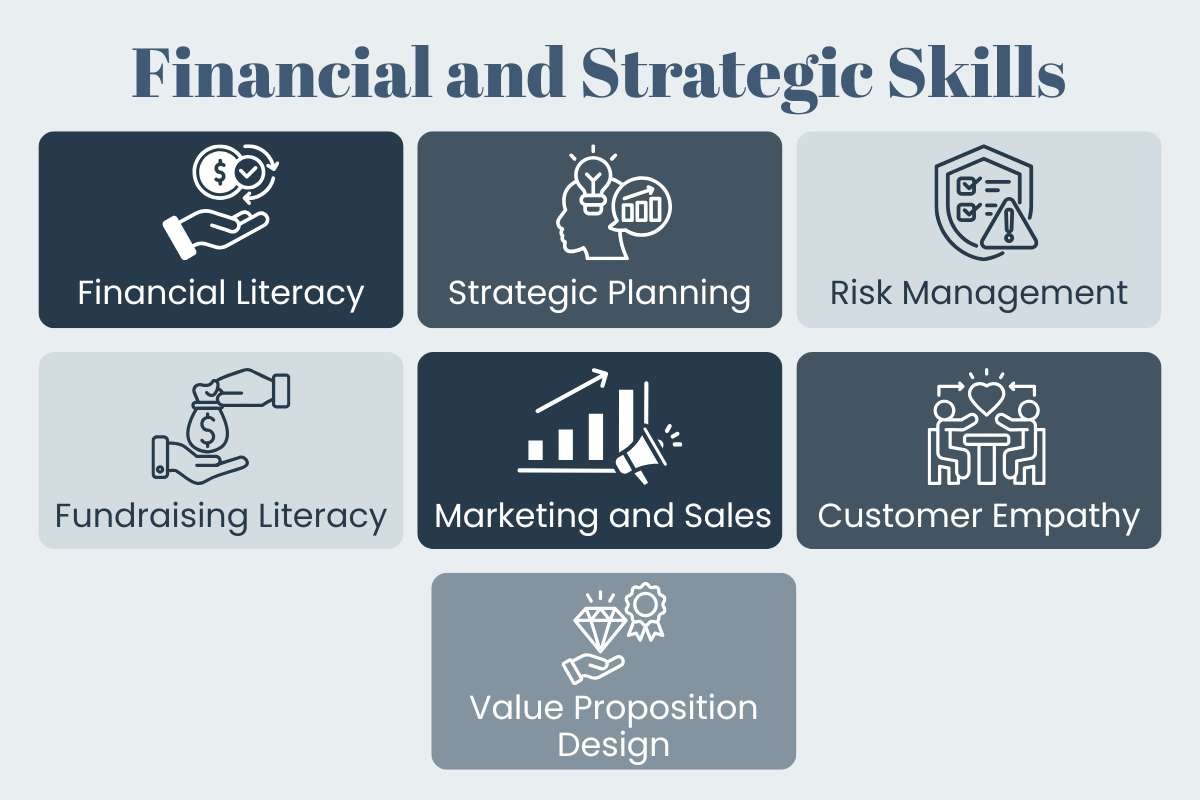
These four financial and strategic skills are a must learn for every businessman:
14. Financial Literacy
This is about knowing where every cent comes from and where it goes. It involves making a plan for your spending, finding ways to get the money you need, and making sure you have enough cash on hand to pay the bills each month.
Why it matters: Money is the fuel for your ideas. Even a great idea will stop moving if you run out of cash. Understanding these numbers lets you make smart choices about when to grow and when to save, ensuring your project stays healthy for the long haul.
Example: Warren Buffett reads 500-page annual reports daily, compounding Berkshire Hathaway at 19.9% CAGR for decades.
- Track every cost: Write down every single thing you buy for your project for one month.
- Build a “rainy day” fund: Try to save enough to cover your basic costs for three months.
- Check your cash daily: Spend five minutes every morning looking at your bank balance to avoid surprises.
- Keep work and life apart: Use a separate bank account for your project so the numbers don’t get messy.
15. Strategic Planning
This is the act of looking at the big picture. You set clear goals, look at what other people in your field are doing, and decide where you want to be in a year or five years. It is about choosing a destination before you start driving.
Why it matters: Without a plan, you are just reacting to whatever happens next. Strategic planning helps you stay focused on what really moves the needle. It saves you from wasting time on small tasks that don’t help you reach your big dream.
Example: Reed Hastings pivoted Netflix from DVDs to streaming in 2007, foreseeing cord-cutting for 300M+ subscribers.
- Pick three “Big Wins”: Write down the three most important things you want to achieve this year.
- Look at the neighbors: Check out three other people doing similar work and see what they do well.
- Set “No” rules: List three things you will not spend time on this month to stay focused.
- Review every Sunday: Spend twenty minutes at the end of the week checking if you moved closer to your goals.
16. Risk Management
This is about being a “smart gambler.” You look at the things that could go wrong, figure out how likely they are to happen, and make a plan to handle them if they do. It is about making choices based on facts rather than just hope.
Why it matters: Every new path has risks, but you don’t have to walk them blindly. Managing risk means you won’t be wiped out by a single mistake. It gives you the confidence to take big leaps because you already know how you will land if things don’t go perfectly.
Example: Ray Dalio’s principles at Bridgewater hedged 2008 crash bets, preserving client trillions.
- List your “What Ifs”: Write down the three biggest things that could go wrong next month.
- Have a Plan B: For each “What If,” write one simple step you would take to fix it.
- Start small: Test a new idea with a tiny bit of money or time before you go all in.
- Ask the experts: Talk to someone who has done this before and ask them what their biggest mistake was.
17. Fundraising Literacy
This is the skill of talking to people who have the money you need to grow. It involves learning how investors think, understanding the basic rules of a deal, and knowing how much your idea is actually worth in the real world.
Why it matters: Sometimes you need more than just your own savings to make a big impact. Knowing how to talk about money helps you find the right partners who believe in your vision. Developing your entrepreneurship skills here helps you turn a handshake into a real partnership.
Example: Melanie Perkins pitched Canva 100+ times, securing $3M seed to hit $40B valuation.
- Learn the lingo: Spend ten minutes a day reading about one new term, like “equity” or “valuation.”
- Tell a story: Practice explaining your project in two minutes, focusing on why it helps people.
- Know your worth: Research what similar projects have been able to raise to get a realistic number.
- Build the “Ask”: Practice asking a friend for a small favor to get comfortable with asking for help.
Marketing and Customer Skills
Marketing brings customers, but your customer skills keep them. Here’s what you need to know:
18. Marketing and Sales
This is how you tell the world you exist. It involves building a “look” for your project, finding new people to buy what you offer, and talking through deals so everyone feels like they won. It is the bridge between your hard work and a happy customer.
Why it matters: Even the best product in the world won’t sell if no one knows it is there. Good marketing builds a name people can trust. Mastering this part of your entrepreneurship skills turns a quiet hobby into a loud, growing success.
Example: Sara Blakely demoed Spanx door-to-door, landing at Neiman Marcus via in-store trials.
- Find your “vibe”: Pick three words that describe how you want people to feel when they see your work.
- Go where they are: Post your ideas on the social apps or in the local shops where your buyers already hang out.
- Ask for the sale: When someone says they like your work, don’t be shy; ask if they would like to buy one today.
- Practice the “trade”: Try to swap a small skill or item with a friend to get comfortable with making deals.
19. Customer Empathy
This is the act of stepping into someone else’s shoes. You look past what people say they want and try to feel what they are actually struggling with. It is about being a good listener and a kind observer of the people you serve.
Why it matters: If you don’t understand the “itch,” you can’t provide the “scratch.” When you truly get why someone is frustrated or tired, you can build something that actually makes their life easier. It stops you from wasting time on features people don’t care about and helps you build things people love.
Example: Tony Hsieh at Zappos offered a free returns policy after calls revealed fit fears, driving $1B revenue.
- Watch in silence: Spend twenty minutes watching how people use a product similar to yours without saying a word.
- Ask “tell me about a time”: Instead of asking if they like an idea, ask them to tell a story about the last time they had a specific problem.
- Write a “day in the life”: List every step your customer takes from the moment they wake up to see where their day gets hard.
- Listen to the grumbles: Pay close attention when people complain; every complaint is a hidden map to a new solution.
20. Value Proposition Design
This is the skill of making a promise you can keep. You take your deep understanding of a problem and turn it into a clear, simple offer. It is the way you say, “I know what’s wrong, and here is exactly how I am going to fix it for you.”
Why it matters: People don’t buy “things”; they buy “better versions of themselves.” A clear offer cuts through the noise and tells a buyer exactly what they get for their time and money. It makes it easy for someone to say “yes” because they can see the value of your work right away.
Example: Dollar Shave Club’s viral video pitched “shave time, save money,” exploding to $1B Unilever buyout.
- Use the “so what?” test: Every time you list a feature, ask yourself, “So what?” until you find the real benefit for the buyer.
- Keep it to one sentence: Try to explain what you do using this format: “I help [who] do [what] by [how].”
- Test your headline: Show your offer to a friend for five seconds, hide it, and ask them if they remember what you are selling.
- Solve one thing well: Instead of trying to fix everything, pick the single biggest pain point and focus your whole offer on that.
Operational and Analytical Skills

Knowing how to analyze and operate are some of the most important entrepreneurship skills. Here are 6 you have to develop:
21. Problem-solving
This is the habit of looking at a roadblock and finding a way around it. Instead of getting stuck, you break a big mess down into small pieces and test different ways to fix them. It is about being a detective who enjoys finding the answer.
Why it matters: Problems are the only constant when you build something new. If you can solve them without losing your cool, you become the person everyone relies on. It turns a “stop” sign into a “detour” sign, keeping your project moving when others would give up.
Example: Toyota’s Taiichi Ohno invented lean manufacturing via “5 Whys,” slashing waste 90%.
- State the real problem: Write down exactly what is wrong in one sentence to make sure you aren’t fixing the wrong thing.
- The “Five Whys”: Ask “why?” five times in a row to get to the root of a mistake.
- Brainstorm alone first: Write down ten quick fixes by yourself before you ask others for help.
- Pick the simplest fix: Always try the cheapest and fastest solution first to see if it works.
22. Project Management
This is how you turn a giant dream into a list of daily chores. You take a goal, set a date for it, and decide who is responsible for each part. It is the art of making sure “one day” becomes “today.”
Why it matters: Ideas are easy, but finishing them is hard. Good management ensures that nothing falls through the cracks. It gives your team a clear map so they don’t have to guess what to do when they wake up.
Example: NASA’s Apollo teams used Gantt charts to land humans on the moon in 8 years.
- Break it down: Take a big goal and list every single tiny step needed to finish it.
- Set a “Done” date: Give every task a deadline so it doesn’t drift forever.
- Assign an owner: Even if it is just you, write down who is in charge of each specific task.
- Use a visual board: Put your tasks on sticky notes so you can see them move from “To Do” to “Done.”
23. Process Design
This is the act of writing down a “recipe” for your work. You create a set of steps for things you do often, like welcoming a new customer or fixing a bug. It means you don’t have to reinvent the wheel every single morning.
Why it matters: Doing things by memory leads to mistakes and stress. A clear process allows you to work faster and makes it easy to teach someone else how to help you. It is how you scale a project from a one-person show to a smooth machine.
Example: McDonald’s Ray Kroc standardized burgers into assembly lines for global scalability.
- Record yourself: Film yourself doing a common task once so you have a guide for next time.
- The “Newbie” test: Give your written steps to a friend; if they can do the task without asking you a question, the process is perfect.
- Cut the fat: Look at your steps and remove any part that doesn’t actually help you reach the goal.
- Checklists are king: Make a simple “yes/no” list for important jobs to ensure you never miss a step.
24. Data Analysis
This is the skill of looking at facts and numbers to see what is actually happening. You look at how many people visit your site, how many stay, and where they leave. It is like having an X-ray for your project.
Why it matters: Feelings can lie, but numbers usually tell the truth. Data helps you stop arguing about opinions and start making choices based on what is real. It shows you exactly where to spend your time to get the best results.
Example: Netflix’s A/B tests personalize 80% of views, retaining subscribers.
- Watch the “Drop-off”: Find the exact spot where people stop using your service and focus your energy there.
- Compare groups: Look at how people who joined last month act compared to people who joined this month.
- Keep a simple sheet: Record your three most important numbers in a spreadsheet once a week.
- Look for patterns: Don’t react to one bad day; look for trends that happen over several weeks.
25. KPI Design
KPI stands for “Key Performance Indicator,” which is just a fancy way of saying “the numbers that matter most.” This skill is about picking the right few things to track so you don’t get buried in useless data.
Why it matters: If you track everything, you see nothing. Picking the right metrics tells you if your project is healthy or if it is in trouble. It keeps you focused on growth and prevents you from being distracted by “vanity” numbers that look good but don’t pay the bills.
Example: Airbnb tracks nights booked and LTV: CAC ratios to prioritize listings.
- Pick the “North Star”: Find the one number that, if it goes up, means everything else is winning.
- Avoid “Vain” stats: Don’t just track likes or views if they don’t lead to real sales or sign-ups.
- Make them “Smart”: Ensure your goals are specific and have a clear “pass/fail” mark.
- Check them often: Put your top three metrics on a wall or a phone screen where you see them every day.
26. Time and Stress Management
This is about being the boss of your own energy. You choose which tasks are most important, and you find ways to stay calm when the pressure is high. It is the core of your entrepreneurship skills because it keeps you from burning out.
Why it matters: You are the most important tool in your project. If you are tired or overwhelmed, everything else will slow down. Managing your time and stress ensures you can stay in the game for years, not just weeks.
Example: Arianna Huffington post-collapse enforced sleep KPIs, boosting Huffington Post traffic.
- Eat the frog: Do the hardest, scariest task first thing in the morning when your brain is fresh.
- The 2-minute rule: If a task takes less than two minutes, do it immediately instead of writing it down.
- Schedule “Off” time: Put your breaks on your calendar just like a meeting and stick to them.
- Say “No” more: If a task doesn’t help your main goal, permit yourself to skip it.
Product and Growth Skills
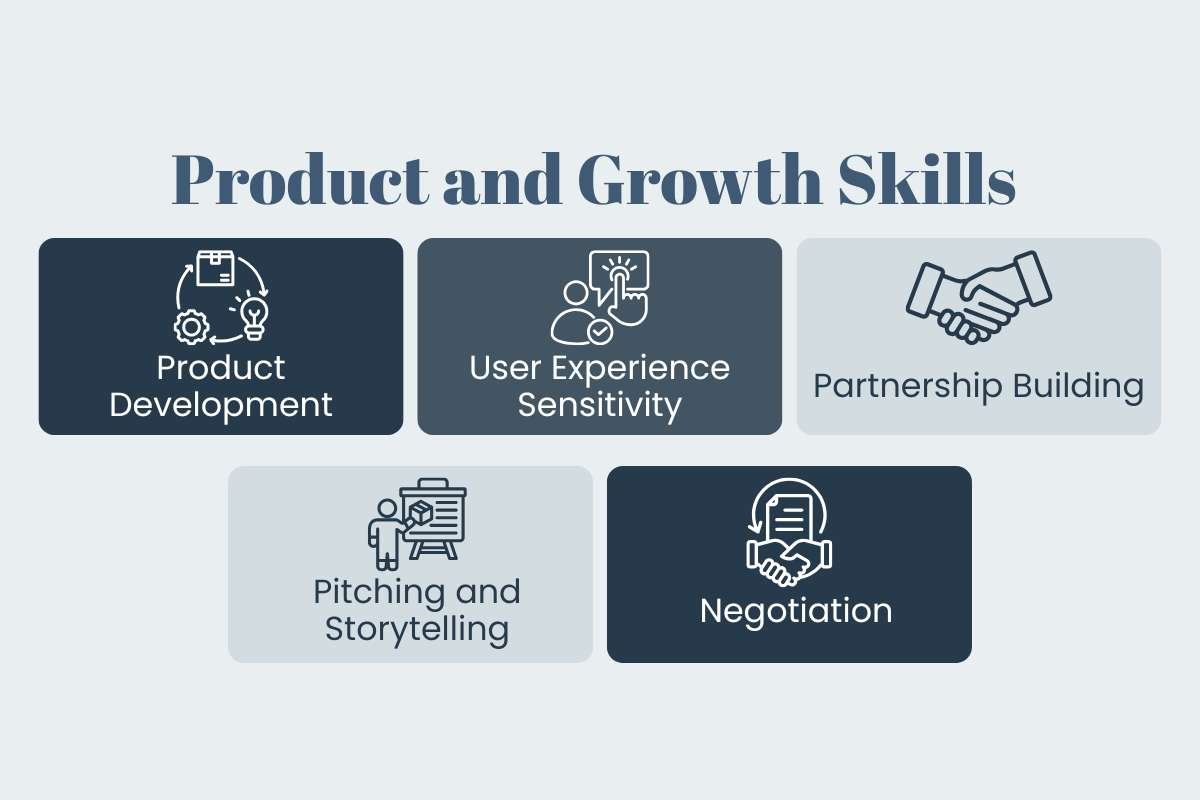
These five skills come in handy when you are trying to grow your brand.
27. Product Development
This is the journey of turning a rough draft into a polished tool. You start with a “Minimum Viable Product” (MVP), the simplest version of your idea, and use real feedback to make it better. It is about building, testing, and changing until you have something people truly love.
Why it matters: You can’t guess what people want. Starting small saves you money and time. By listening to users early on, you ensure that you are building a solution that actually fits their lives. It is a vital part of your entrepreneurship skills to know when to stick to your plan and when to pivot.
Example: Slack iterated from a gaming side-project, Glitch, via user feedback loops.
- Build to learn: Create the simplest version of your idea and get it into someone’s hands this week.
- Ask for the “bad” news: Ask users what they hate most about your product so you know what to fix first.
- Release often: Don’t wait for perfection; make small updates every week rather than one big update every year.
- Focus on the core: If a feature doesn’t solve the main problem, cut it out to keep the product simple.
28. User Experience Sensitivity
This is the skill of noticing the “hiccups” in your product. You watch how someone uses your tool and spot the moments where they look confused, frustrated, or slow. It is about having a sharp eye for the tiny details that make a big difference.
Why it matters: If a tool is hard to use, people will stop using it. Noticing where people get stuck allows you to smooth out the path. A smooth experience makes users feel smart and happy, which keeps them coming back and telling their friends about you.
Example: Steve Jobs was obsessed with pixel-perfect iPhone interfaces, creating an intuitive touch.
- Silent observation: Watch a friend use your product without giving them any hints or help.
- Count the clicks: See how many steps it takes for a user to reach their goal and try to cut that number in half.
- Read the “misses”: Look for where people click on things that aren’t buttons; this tells you what they expect to happen.
- Check the “first minute”: Focus heavily on the very first minute a person uses your tool to make sure they aren’t lost immediately.
29. Partnership Building
This is about finding other people or businesses who can help you grow while you help them. You look for “win-win” deals where both sides get something valuable. It is about building a bridge between your goals and theirs.
Why it matters: You don’t have to do everything yourself. The right partner can give you access to new customers, better tools, or expert advice. It allows you to grow much faster than you could on your own by sharing the work and the rewards.
Example: Starbucks’ Howard Schultz allied with Pepsi for bottled Frappuccinos, doubling revenue streams.
- Find the “overlap”: List three businesses that serve the same people you do but offer a different product.
- Give more than you take: In your first meeting, offer a way to help the partner before you ask for anything.
- Keep it simple: Start with a small, one-time project together to see if you work well as a team.
- Write it down: Even for a small partnership, create a simple one-page note about who does what.
30. Pitching and Storytelling
This is the power to make others see what you see. You take your big vision and turn it into a story that moves people. It is about being clear, honest, and exciting so that investors, partners, or customers want to join your journey.
Why it matters: Facts are important, but stories are what people remember. A good pitch can get you the funding or the help you need to survive. It turns a boring business plan into a mission that people want to be a part of.
Example: Airbnb’s founders pitched cereal profits to Y Combinator, framing scrappiness as a strength.
- Start with the “Why”: Don’t start with what you do; start with why the problem you are solving matters.
- Use real names: Instead of saying “customers feel sad,” tell a story about “Sarah,” a real person who used your tool.
- The “Elevator” test: Practice explaining your whole idea in the time it takes to ride an elevator (about 30 seconds).
- Ask for one thing: End every pitch with a clear “next step” so the listener knows exactly how to help.
31. Negotiation
Negotiation is the art of reaching a fair deal. You look at contracts and terms to make sure they protect your interests while still being fair to the other side. It is about staying calm and knowing your worth when you are talking about money or rules.
Why it matters: A bad deal can haunt you for years. Negotiation ensures that you don’t give away too much and that you have the resources you need to succeed. It is a key part of your entrepreneurship skills because it protects the future of your project and builds professional respect.
Example: Herb Kelleher bartered Southwest Airlines routes for free goats in lore, honing deal-making.
- Know your “Walk Away” point: Before you start talking, decide the lowest offer you are willing to take.
- Ask “What if?”: When you see a rule you don’t like, ask “What if we changed this to…?” to see how flexible they are.
- Listen for the “No”: When someone says no, ask “Why?” to understand what they are actually afraid of.
- Get it in writing: Never leave a deal as just a “handshake”; send a quick email summarizing what you both agreed on.
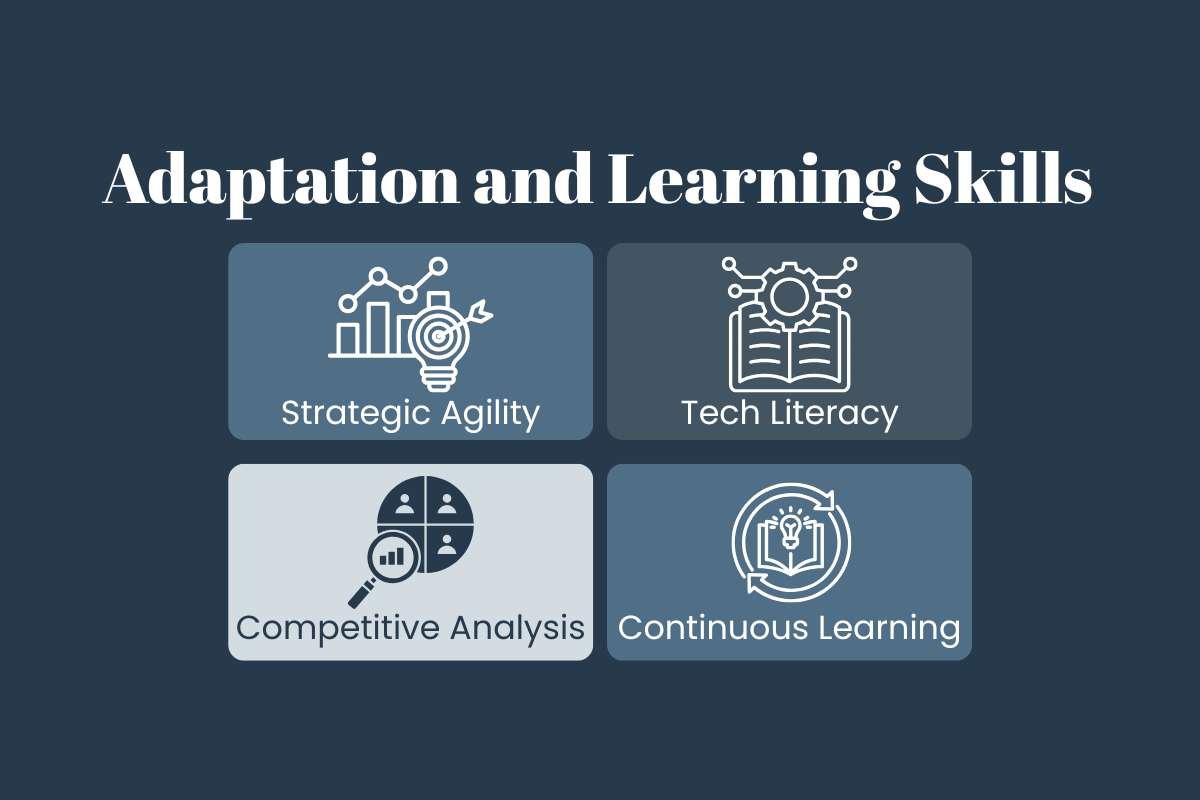
Adaptation and Learning Skills
“Improvise, Adapt, Overcome!”
Bear Grylls
A leader must know how to adapt and improvise. Here are 3 skills to develop:
32. Strategic Agility
This is the ability to change direction without losing your balance. When a new tool comes out, or your customers start asking for something different, you don’t get stuck in your old ways. You look at the new facts and move your plan to fit the new world. It is about being fast on your feet.
Why it matters: The world moves quickly. If you hold onto an old plan for too long, you might get left behind. Strategic agility ensures you can turn a surprise change into a fresh start. Using your skills to pivot means you see a shift in the market as a door opening, not a door closing.
Example: IBM pivoted from hardware to AI services under Arvind Krishna, reversing declines.
- Check the “Why”: Every month, ask yourself if your main goal still makes sense with the new news you have.
- Keep “Pivot” money: Try to keep a small bit of your budget free so you can test a new idea quickly.
- Talk to “Ex-Customers”: Ask people why they stopped using your service to see if the world has moved on.
- Set “Wait and See” dates: If you see a new trend, set a date two weeks away to decide if you should jump in or stay put.
33. Tech Literacy
This is about being comfortable with the digital world. You don’t need to be a computer expert, but you should know which apps and tools can do the heavy lifting for you. It involves using software to handle boring tasks and knowing the basics of how your product actually works.
Why it matters: Technology is a “force multiplier.” It lets one person do the work of ten. Being tech-literate saves you from doing things the hard way and allows you to communicate better with the people who build your tools. It is a core part of your entrepreneurship skills because it gives you more time to focus on the big ideas.
Example: Jack Dorsey coded Twitter’s prototype solo, scaling to 500M users.
- Automate the boring stuff: Find one task you do every day and find a simple tool that can do it for you.
- Learn the “Guts”: Spend thirty minutes a week learning how one part of your website or app actually functions.
- Try new tools: Once a month, play with a new app for fifteen minutes to see if it makes your life easier.
- Ask “Is there an app for this?”: Before you start a long manual task, do a quick search to see if a tool already exists.
34. Competitive Analysis
This is the act of keeping an eye on the “other guys.” You study what your rivals are doing, what they charge, and where they are failing. It isn’t about copying them; it’s about finding a way to be different so that you stand out in the crowd.
Why it matters: If you don’t know what else is out there, you won’t know why a customer should pick you. Knowing your rivals helps you find the “gaps” they missed. It allows you to offer something special that no one else has, making it much easier for people to choose your project.
Example: Samsung dissected iPhone teardowns to launch Galaxy rivals.
- Be a “Mystery Shopper”: Try out a rival’s product to see exactly what the experience feels like from a customer’s view.
- Read the reviews: Look at the one-star reviews of your rivals to see what people are complaining about.
- Track their “News”: Follow your top three rivals on social media to see when they launch something new.
- Find your “Only”: Complete this sentence: “I am the only one who provides [this] to [these people] by [that].”
35. Continuous Learning
This is the habit of being a “forever student.” You don’t stop learning once you finish school. You use books, short courses, and talks with mentors to keep your brain sharp and your skills fresh. It is about staying curious and never assuming you know everything.
Why it matters: Your project can only grow as much as you do. If you stop learning, your ideas will eventually grow stale. Systematic learning keeps you ahead of the curve and gives you new tools to solve old problems. It is the secret fuel for all your other entrepreneurship skills.
Example: Bill Gates’ “Think Weeks” birthed pivots like the internet focus in 1995.
- The 15-minute habit: Spend the first fifteen minutes of your day reading an article or book about your field.
- Find a “Step-Ahead” mentor: Talk to someone who is just one or two steps ahead of where you want to be.
- Teach to learn: Try to explain a new thing you learned to a friend; if you can explain it simply, you truly know it.
- Take a mini-course: Set a goal to finish one short online course every three months to add a new skill to your kit.
Conclusion:
Mastering these entrepreneurship skills is about more than just checking boxes; it is about building a solid base for your future. When you mix clear goals with the grit to keep going, you turn a simple idea into a lasting success.
So, keep learning, stay flexible, and trust your own growth. By focusing on these core habits every day, you will lead with heart and build a project that truly stands out in the world.
FAQs
1. How can I practice these entrepreneurship skills if I don’t have a business yet?
You can practice in your daily life. Try “project management” by planning a trip or a home fix. Use “negotiation” when talking about plans with friends. Even “data analysis” can be used by tracking your own habits or budget. These habits work the same way in a big office as they do in your own home.
2. Do I need to be a tech expert to succeed today?
No, you do not need to code. You just need “tech literacy,” which means knowing which tools can help you work faster. Focus on understanding how your product works and how to use basic apps to automate your chores. This lets you talk to experts without feeling lost, while you focus on the big vision.
3. How do I know if I have a Growth Mindset?
Check how you feel after a mistake. If you think, “I am bad at this,” that is a fixed view. If you think, “I haven’t learned this yet,” that is a growth mindset. It is the belief that your brain is like a muscle that gets stronger with every hard task you try to solve.