April Miller built Sand Dollar Bookkeeping to run entirely on remote workflows using accounting cloud hosting. Her Southwest Florida firm serves clients nationwide, and the whole model depends on being able to use the tools that make remote advisory work possible.
So when her cloud hosting provider started blocking those tools, and a dedicated alternative kept coming up in every peer conversation, it wasn’t a minor annoyance. Rightworks, the accounting cloud platform she had signed on with, wouldn’t let her use Loom to record client walkthrough videos.
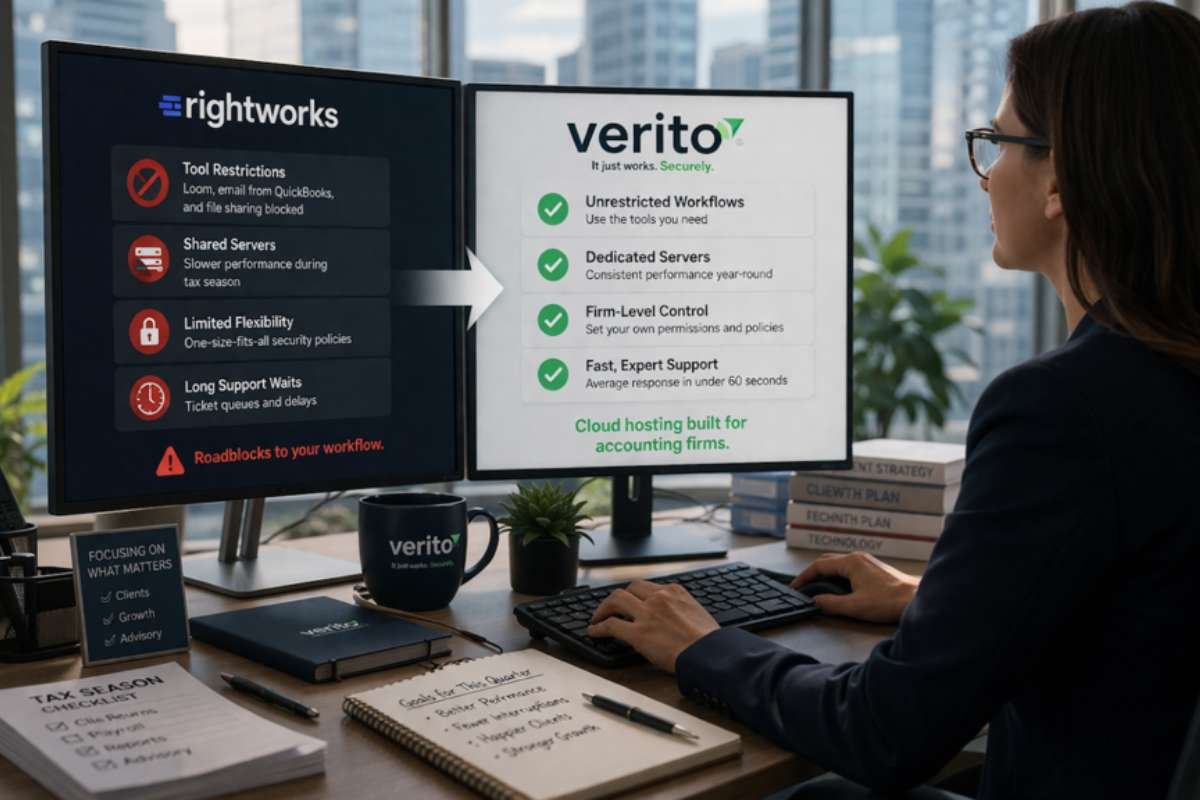
It flagged shared file systems for individual clients as a security violation. It prevented her from emailing reports directly out of QuickBooks. Every time she asked why, the answer was the same: security policy. For a firm built on flexibility, these weren’t quirks to work around. They were structural barriers, and they were baked into the platform.
She is far from the only firm owner who has had this conversation.
Miller eventually switched to Verito, a dedicated Accounting Cloud Hosting provider built exclusively for tax and accounting firms. Within days of migrating, every workflow Rightworks had blocked was restored.
“Now I can send reports out of Verito. I can email what I need. I can record a video if I need to,” she said. When issues do arise, Verito’s support team responds in under 60 seconds on average, which is a direct contrast to the ticket queues she experienced before. She has been with Verito for over five years and has since referred other firms through the same transition.
What April experienced is part of a broader and increasingly visible shift happening across the accounting profession. Firms that adopted cloud hosting early, often through Rightworks (formerly Right Networks), are now running into the ceiling of what shared cloud infrastructure was designed to do.
The problem is not that these platforms are poorly built. The problem is that the architecture they are built on creates predictable limitations that become most painful at exactly the wrong moment: the middle of tax season, when a blocked tool or a sluggish server is not an inconvenience but an operational crisis.
This article breaks down why that shift is happening, what is structurally driving it, and what accounting firms should actually evaluate when they start looking for alternatives. If you have noticed performance issues during filing season, hit restrictions on tools your workflow depends on, or simply started asking whether there is a better fit for the way your firm operates today, the answer to that question starts with understanding the architecture underneath your current platform.
Key Takeaways
- Accounting and bookkeeping firms are leaving Rightworks because of two compounding factors: architectural limitations in shared cloud infrastructure and pricing. Dedicated independent providers now offer private server hosting starting at $69 per user per month, often at a lower all-in cost than Rightworks’ $89 per user per month pricing.
- Shared servers create unpredictable performance slowdowns during peak tax season, a structural problem called the noisy-neighbor effect, and restrict third-party tool access at the platform level for every tenant simultaneously
- Dedicated accounting cloud hosting gives each firm isolated server resources, consistent year-round performance, and firm-level control over workflow tools and permissions.
- Before switching providers, firms should evaluate server architecture, uptime guarantees, software compatibility, support response times, and compliance documentation.
A Pattern Firms are Starting to Notice

Rightworks is the dominant name in accounting cloud hosting, and that position was earned. For many firms, it was the first cloud solution they ever used, and for years, it delivered what they needed.
The frustration showing up in accounting forums, peer networks, and technology discussions today is not about Rightworks being a bad product. It is about something more specific: a predictable gap between what shared cloud infrastructure can offer and what modern accounting practices now require.
Tax season creates the clearest version of this problem. From January through April, every firm on the platform is running simultaneously: filing, processing payroll, generating reports, and pulling client data all at once.
On a shared server architecture, that concurrent demand draws from a common physical resource pool. When one tenant’s workload spikes, the available resources for every other tenant on the same server cluster are reduced. IT professionals call this the noisy-neighbor effect. It is not a bug. It is not a configuration error.
Shared vs. Dedicated Cloud Hosting: What the Difference Looks Like in Practice
| Criteria | Shared Cloud Hosting | Dedicated Cloud Hosting |
| Server resources | Pooled across all tenants simultaneously | Isolated instance allocated to your firm only |
| Tax season performance | Degrades as concurrent demand increases | Consistent year-round regardless of other firms’ workloads |
| Third-party tool access | Governed by platform-wide policy applied to all tenants | Configurable at the firm level independently |
| Compliance documentation | Provider-level controls assumed to cover all tenants | Firm-level controls verifiable and independently documented |
| Support for firm-specific issues | Resolved within platform policy limits | Resolved within your firm’s isolated environment |
It is the natural outcome of how shared accounting cloud hosting infrastructure is engineered to function, and it is most visible at exactly the moment firms can least afford a slowdown.
The slower, quieter operational risks, including performance degradation during filing season, tend to be architectural rather than behavioral. Shared hosting is one of the clearest examples of a design decision that works well at moderate demand and creates compounding friction at peak demand.
The challenge for firms is that this distinction rarely appears in a platform’s marketing materials. It surfaces in practice, usually during the third week of March.
Sand Dollar Bookkeeping: When the Platform Becomes the Problem
April Miller is not someone who struggles with technology. She chose a remote-first model deliberately, built her client base around asynchronous communication, and designed every part of her workflow around tools that make distributed collaboration efficient within her accounting cloud hosting environment.
Rightworks broke most of those tools.
Loom, which she used to walk clients through financial reports and bookkeeping updates, was blocked outright. The platform’s uniform security policy applied to every tenant on the shared infrastructure, which meant Miller’s firm couldn’t get a firm-level exemption regardless of how she structured her own security practices.
Shared file environments for individual clients, another piece of her standard client delivery process, weren’t configurable. Emailing reports directly from QuickBooks within the platform produced errors instead of sending messages. Each restriction was explained as a security measure, and that explanation was technically accurate.
In a shared accounting cloud hosting environment, the provider must enforce policies that protect every client simultaneously. The problem is that those policies can’t be customized at the firm level because the underlying architecture doesn’t support it. Individual firms don’t have isolated environments where permissions can be adjusted independently. They are tenants on a shared system governed by the lowest common denominator of what the provider can safely allow for everyone.
Miller eventually switched to Verito. The workflow blocks disappeared immediately. Verito’s VeritCertified support engineers (trained specifically on accounting software, including QuickBooks, Drake Tax, and Lacerte) resolved issues on the first call in 92% of cases.
She has been on Verito’s dedicated VeritSpace platform for over five years and has since referred other firms to make the same transition.
Her experience puts a concrete face on something that accounting technology discussions often describe in the abstract: the difference between a cloud platform that gives your firm a workspace and one that gives you a slot in someone else’s shared environment.
The Architecture Behind the Difference

The term “cloud hosting” is used loosely enough in the accounting technology space that many firm owners don’t realize they are comparing meaningfully different things when they evaluate providers.
Shared Accounting Cloud Hosting is a model in which multiple firms access cloud-hosted accounting software from a common pool of server resources. Storage, processing capacity, and memory are distributed across all clients running on the platform at any given moment. This model is cost-efficient to build and operate, which is why it became the default for the first generation of accounting cloud providers. The tradeoff is that no single firm has a guaranteed, defined allocation of resources.
Dedicated cloud hosting, by contrast, gives each firm an isolated server instance with resources allocated exclusively to that client. A firm’s performance during the busiest week of tax season is identical to its performance in August, because the resources belong to that firm alone. Third-party tools and software integrations can be approved and configured at the firm level rather than being governed by a platform-wide policy.
This architectural distinction has a compliance dimension that firms are beginning to take seriously. Under the FTC Safeguards Rule, tax preparers and accounting firms are classified as financial institutions under the Gramm-Leach-Bliley Act, which means they are legally required to maintain documented data security controls.
IRS Publication 4557 goes further, requiring any preparer who files electronically to have a Written Information Security Plan (WISP) and implement specific technical controls, including encrypted storage and multi-factor authentication.
IBM Security’s 2024 Cost of a Data Breach Report found the average cost of a data breach had reached $4.88 million, a figure that continues to set records annually.
Verito’s accounting cloud hosting infrastructure is built around these requirements by design. VeritSpace runs on SOC 2 Type II certified infrastructure through its data center partner Deft, with AES-256 encryption at rest and in transit, MFA enforced on every login, and 100% uptime backed by an SLA and a track record since 2016.
For firms that need documented compliance, Verito’s VeritGuard Pro and Elite plans include custom WISP documentation aligned with IRS Publication 4557 and the FTC Safeguards Rule, and for firms that want a standalone option, VeritShield WISP delivers a fully audit-ready Written Information Security Plan for a one-time flat fee.
For a small or mid-sized CPA firm, while a potential breach might not be of the same scale, it still can cause immense damage to the firm’s operations, and possibly, cease their existence.
The accounting cloud hosting infrastructure a firm hosts on directly determines whether the controls required by the FTC and IRS can be verified and enforced at the firm level, or whether they are being assumed to hold across a shared environment the firm doesn’t fully control.
What to Evaluate Before Switching Platforms
The practical barrier to switching accounting cloud hosting providers is usually lower than firms expect. Most dedicated hosting providers designed for accounting practices handle the full migration, and the data transfer for a typical small firm is completed within 24 to 48 hours.
Full operational transition, including testing and validation, generally takes 3 to 5 business days with no interruption to firm operations.
Before committing to a new platform, run through these five questions with any provider you are evaluating:
1. Server Architecture
Dedicated accounting cloud hosting means isolation. Any answer that requires clarification is a shared environment described differently.
Is each firm on an isolated dedicated instance, or is the environment shared across multiple tenants? Ask directly and request documentation. The answer should require no hedging.
Verito’s Dedicated-Isolation Architecture gives each firm a completely private server: dedicated vCPUs, RAM, and NVMe storage with no shared resources of any kind.
2. Uptime SLA
A published SLA number means nothing without a documented track record. Ask for both.
What does the service level agreement guarantee, and what is the provider’s documented track record? A 99.99% SLA still allows for more than 50 minutes of potential downtime per year. Know what is actually guaranteed before tax season.
Verito guarantees 100% uptime and has delivered it without interruption since 2016.
3. Software Compatibility
Do not assume. Get written confirmation for every application in your stack before signing.
Confirm that every application currently in use, including Drake Tax, Lacerte, ProSeries, UltraTax, and QuickBooks Desktop, will run in the new environment without additional licensing requirements or configuration changes.
4. Support Response Time
September response times are not April response times. Verify what the SLA guarantees during filing season, specifically in your accounting cloud hosting environment
What is the average first-response time, and is live support available 24/7, including during filing deadlines? A response time that works in September may not be sufficient in early April.
5. Compliance Documentation
Ask for the document, not the assurance. If they cannot produce it, they do not have it.
Does the provider offer WISP documentation, and does the platform formally align with FTC Safeguards Rule requirements and IRS Publication 4557? Ask for specifics, not assurances.
The distinction between shared and dedicated infrastructure is also where pricing conversations tend to get clarified. The assumption that dedicated hosting costs more than a shared platform does not always hold.
Independent dedicated providers like Verito, built specifically for accounting firms, have brought entry-level pricing to $69 per user per month, and that figure typically includes 24/7 support, compliance documentation, and nightly backups as standard rather than as paid add-ons. This is a lower all-in cost compared to Rightworks’ Cloud Hosting that starts from $85 per user per month.
A direct comparison of Rightworks vs. dedicated cloud hosting for accounting firms often looks different from what firms expect once the full cost picture is on the table.
The accounting profession has always been deliberate about risk, including the risks embedded in the tools and infrastructure the profession relies on. What is changing is how clearly those infrastructure risks are being understood.
As accounting cloud hosting, especially dedicated cloud hosting, has become more accessible and more purpose-built for accounting workflows, firms are treating the question of server architecture the same way they treat the question of which audit software to use or which compliance framework to adopt. The bar has moved. The question is no longer whether to run in the cloud. It is whether the cloud you are running on was actually built for the way your firm works.
Verito has spent nine years building exactly that: dedicated private cloud hosting and managed IT designed from the ground up for tax and accounting professionals, with 1,000+ firms, a 4.9/5 G2 rating, and a 100% uptime track record to show for it.
Frequently Asked Questions
1. Why are accounting firms moving away from Rightworks (formerly Right Networks)?
The most consistently cited reasons are performance slowdowns during peak tax season filing periods and restrictions on third-party tools and workflow integrations. Both issues trace back to the platform’s shared cloud infrastructure, where resources are distributed across all tenants simultaneously, and security policies are applied at the platform level rather than the individual firm level. These are not isolated complaints; they reflect a predictable architectural constraint.
2. What is the difference between shared and dedicated cloud hosting for accounting firms?
Shared cloud hosting means multiple firms draw processing power, memory, and storage from the same physical server pool at the same time. Dedicated cloud hosting means each firm operates on an isolated server instance with resources allocated exclusively to that client. In practice, dedicated hosting delivers consistent performance regardless of what other firms on the provider’s platform are doing, and it allows each firm to configure tool permissions independently rather than accepting whatever the shared environment allows for all tenants.
3. How long does it take to switch from Rightworks to a new cloud hosting provider?
For most small and mid-sized accounting firms, data migration is completed within 24 to 48 hours. Full operational transition, including testing, validation, and staff onboarding, typically takes three to five business days. Most dedicated hosting providers built for accounting practices manage the migration entirely, including coordinating the cutover so that the firm’s old environment remains active until the new one is fully confirmed.
4. What compliance requirements should accounting firms look for when evaluating a cloud hosting provider?
At minimum, look for SOC 2 Type II certification for the data center infrastructure, documented alignment with the FTC Safeguards Rule (which requires firms classified as financial institutions under the Gramm-Leach-Bliley Act to maintain written data security controls), IRS Publication 4557 (which mandates a WISP, encrypted storage, and multi-factor authentication for preparers filing electronically), and SOC 2 Type II certification for the data center infrastructure. Ask the provider to show documentation, not just affirm that they are compliant.
5. Can accounting firms use tools like Loom or other third-party software on dedicated cloud hosting?
In most dedicated hosting environments, yes. Because each firm’s server instance is isolated, the hosting provider can configure and approve third-party tools at the firm level rather than applying a blanket restriction across all clients. The ability to use productivity and client-communication tools that shared platforms commonly block is one of the most frequently cited improvements reported by firms that have made the transition to dedicated hosting.