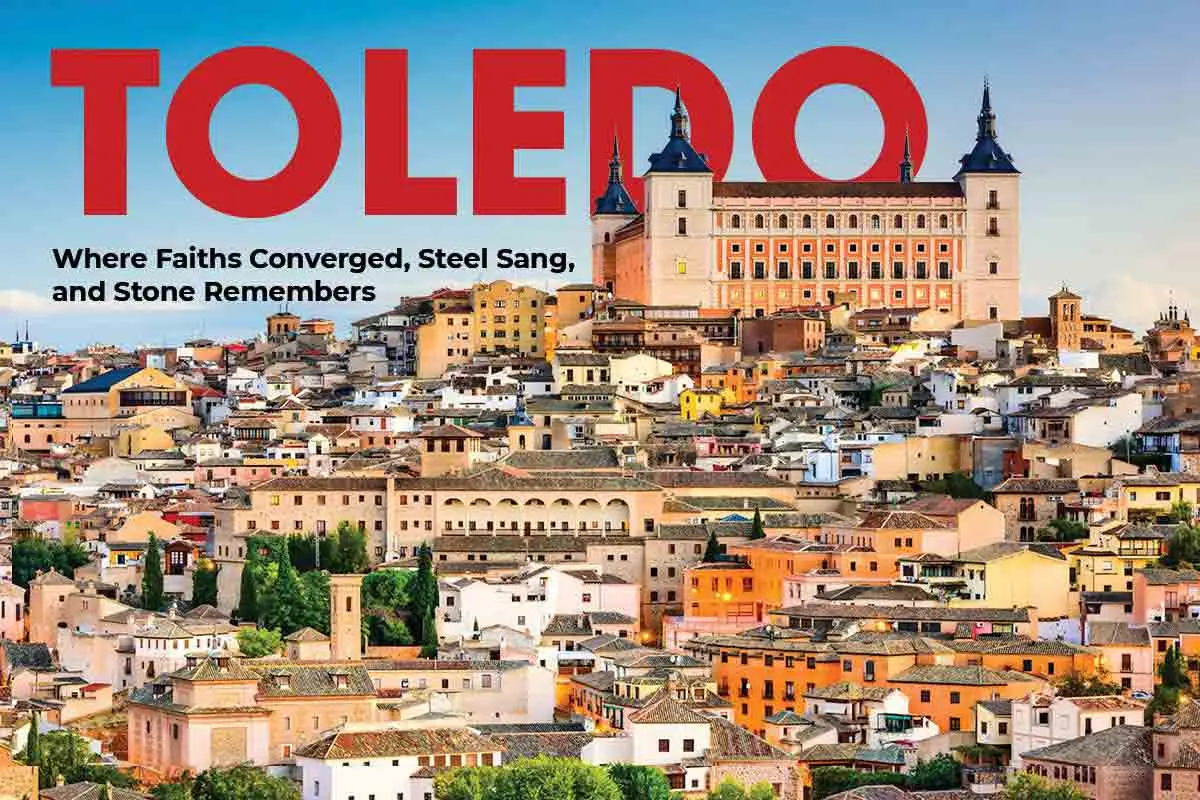
Approaching Toledo feels like entering a manuscript illuminated in gold leaf. The city crowns a granite hill, wrapped almost entirely by the Tagus River, its medieval walls tracing the contours endure of centuries. Stone towers, tiled roofs, church bells, and synagogue arches gather within a compact silhouette that has endured empire after empire.
Toledo carries a title earned through coexistence: La Ciudad de las Tres Culturas, the City of Three Cultures. Christian, Muslim, and Jewish communities shaped its intellectual, architectural, and commercial identity across generations. Their shared presence left inscriptions in brick, geometry in tilework, echoes in prayer halls, and a civic temperament built on exchange rather than erasure.
Recognized by UNESCO as a World Heritage Site since 1986, Toledo stands as a living archive. Roman foundations support Visigoth churches; Islamic arches frame Christian altarpieces; Hebrew inscriptions rest within Mudéjar plasterwork. Here, continuity prevails over replacement.
A City Written in Stone
The skyline gathers around two commanding presences: the cathedral and the fortress. The spire of Toledo Cathedral rises with intricate Gothic ambition, its stained glass filtering Iberian sunlight into jewel-toned sanctuaries. Across the city, the formidable Alcazar of Toledo anchors the hilltop, a structure that has served as a Roman palace, royal residence, and military bastion.
Within the winding lanes of the old quarter, architectural dialogue unfolds. The horseshoe arches of Mezquita del Cristo de la Luz recall the city’s Islamic period. Nearby, the serene interiors of Sinagoga del Transito reveal Hebrew inscriptions framed by delicate Mudéjar artistry. Churches, convents, synagogues, and former mosques exist within walking distance, each structure part of a layered civic memory.
The medieval walls remain largely intact, encircling streets that incline sharply and twist deliberately. Urban design here responds to terrain, climate, and defense. Movement feels intimate and deliberate, shaped by stone rather than speed.

| Toledo’s Architectural Convergence | ||||
|---|---|---|---|---|
| Structure | Cultural Influence | Architectural Style | Era of Origin | Present Significance |
| Toledo Cathedral | Christian | High Gothic | 13th century | Spiritual and artistic centre |
| Alcázar of Toledo | Roman / Christian | Renaissance fortress | 3rd centuryfoundations | Military museum & city symbol |
| Mezquita del Cristo de la Luz | Islamic | Caliphal / Mudéjar | 10th century | Testament to Islamic Toledo |
| Sinagoga del Tránsito | Jewish | Mudéjar | 14th century | Sephardic Heritage Museum |
| Puerta de bisagra | Islamic / Christian | Defensive gate | 10th–16th century | Monumental city entrance |
The Forge That Made Toledo Legendary
Steel defines Toledo’s reputation as vividly as faith. Since Roman times, the city earned distinction for blade-making. Toledo steel achieved renown across Europe for flexibility, sharpness, and durability. Swords crafted here accompanied soldiers, nobles, and explorers across continents.
The metallurgical excellence arose from a combination of local iron ore, carbon control, and masterful tempering techniques passed through guild traditions. Blades displayed strength with resilience, capable of bending without breaking. By the Middle Ages, “Toledo steel” became shorthand for elite craftsmanship.
Today, artisan workshops continue to shape ceremonial swords and historic replicas, preserving a tradition embedded in civic identity. Steel here symbolizes discipline, patience, and generational knowledge.

| Toledo’s Steel Legacy | |
|---|---|
| Attribute | Detail |
| Historical Origins | Roman and Visigoth periods |
| Peak Prominence | 15th–17th centuries |
| Key Characteristic | Flexibility combined with hardness |
| Traditional Technique | Layered forging and precise tempering |
| Modern Continuation | Ceremonial blades & artisan replicas |
Damascene Gold on Black Steel

If Toledo forged weapons for battle, it also refined ornament for artistry. Damascene metalwork, locally known as Damasquinado, involves inlaying gold or silver threads into etched blackened steel surfaces. The result shimmers with intricate geometric and floral motifs, echoing Islamic design vocabulary.
Artisans carve minute channels into the metal’s surface, hammer fine precious-metal wires into place, then oxidize the background to intensify contrast. The effect carries both precision and poetry. Jewelry boxes, plates, brooches, and decorative plaques carry this signature aesthetic.
Damascene craft represents dialogue across cultures: Islamic geometry meeting Christian heraldry, refined through Spanish technique. Each piece carries patience measured in hours of meticulous handwork.
Read Next: Walking through Munich: A City Lived and Remembered
Sweetness in the Shadow of Stone
Toledo’s culinary heritage finds its emblem in marzipan. Almond paste blended with sugar and shaped into delicate figures forms a confection deeply tied to convent kitchens and medieval trade routes. Almond cultivation thrived under Islamic agricultural systems, while sugar refining gained prominence through Mediterranean commerce.
Local legends attribute the widespread popularity of marzipan to periods of scarcity, when almonds and sugar provided sustenance during grain shortages. Over centuries, it evolved into festive artistry. Pastry windows in Toledo display miniature fruits, flowers, and heraldic shields sculpted from almond paste, dusted with powdered sugar.
Marzipan here transcends dessert. It stands as edible heritage, molded by necessity and perfected by ritual.

| Toledo at a Glance | |
|---|---|
| Category | Key Detail |
| Designation | UNESCO World Heritage Site (1986) |
| Nickname | City of Three Cultures |
| Geographic Setting | Hilltop encircled by Tagus River |
| Signature Craft | Toledo steel swords |
| Decorative Art | Damascene metalwork |
| Culinary Icon | Traditional marzipan |
| Historic Core | Roman-walled medieval old town |
The Intellectual Crucible
During the Middle Ages, Toledo flourished as a center of translation and scholarship. After Christian forces regained control in 1085, scholars from across Europe gathered to translate Arabic philosophical and scientific texts into Latin. Classical Greek works preserved by Islamic scholars re-entered Western Europe through Toledo’s scriptoria.
Astronomy, medicine, mathematics, and Aristotelian philosophy traveled through its libraries, influencing European thought for centuries. Knowledge moved across languages Arabic, Hebrew, Latin, mirroring the city’s broader cultural interweaving.
Toledo’s identity rests as much in manuscripts as masonry. Ideas shaped its trajectory alongside stone and steel.
Streets That Curve With Memory
Wandering through Toledo involves ascent and pause. Narrow alleys open unexpectedly into plazas. Balconies lean inward. Carved wooden doors reveal interior courtyards hidden from the street. Every incline invites reflection.
From the Mirador del Valle across the river, the city appears compact and cohesive, its skyline rising in terracotta gradients. The cathedral spire and Alcázar punctuate the horizon, framed by sky and river. At dusk, golden light softens granite facades, turning the hilltop into a luminous citadel.
Evening hours restore quietude. Footsteps echo. Lanterns glow. The city exhales centuries in a single breath.
Economy Rooted in Heritage
Modern Toledo balances preservation with vitality. Tourism sustains much of its contemporary economy, drawing visitors drawn to architecture, craft, and history. Artisan workshops remain active, ensuring traditional skills remain visible rather than archived.
Cultural festivals animate plazas with music and reenactments of medieval pageantry. Religious processions during Holy Week move solemnly through ancient streets. Academic institutions continue the city’s scholarly lineage.
Toledo maintains continuity through stewardship. Conservation efforts protect façades and interiors, guided by regulations aligned with World Heritage standards. Growth unfolds with restraint, preserving skyline integrity and urban cohesion.
Why Toledo Endures?
Toledo commands attention through density rather than scale. Within its walls lies a synthesis of civilizations that chose exchange over isolation. Faith traditions left architectural signatures that coexist without dilution. Steel forged resilience; gold inlay expressed refinement; almond and sugar shaped sweetness from scarcity.
Few cities present such concentrated testimony to coexistence. Toledo’s endurance arises from integration. Roman engineering underpins Islamic arches; Gothic vaults rise above former mosques; Hebrew poetry once echoed through Mudéjar halls.
Here, history forms strata rather than chapters. The river continues its encircling course, granite holds firm, and the city remains poised above the Tagus as it has for centuries. Toledo stands as proof that civilizations thrive when ideas cross thresholds and craftsmanship honors lineage.
Stone remembers. Steel sings. And on its hill above the river, Toledo endures.