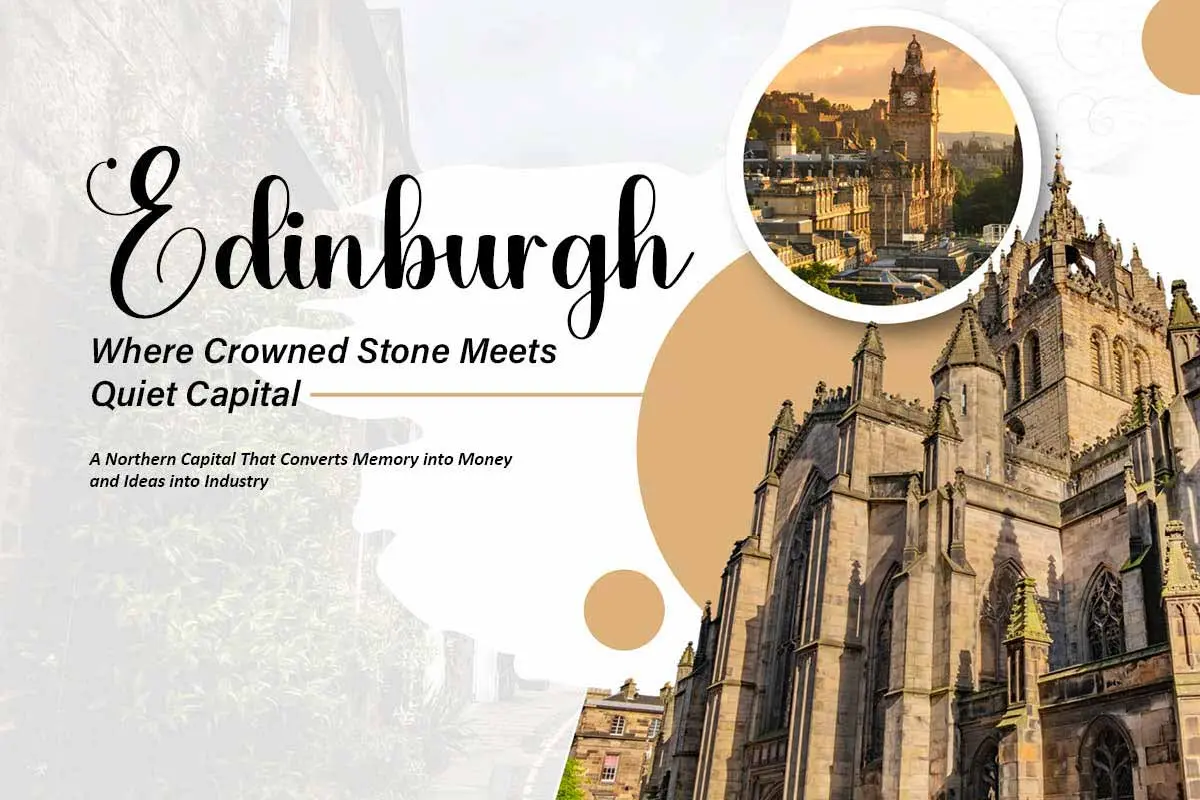
A Northern Capital That Converts Memory into Money and Ideas into Industry
Edinburgh does not rush to introduce itself. It stands composed. Volcanic rock anchors its skyline. Medieval closes descend in quiet spirals. Georgian terraces extend with mathematical confidence. Wind moves across Arthur’s Seat, and the city seems to measure time differently.
Here, history operates as infrastructure. Culture converts into capital. Finance sits comfortably beside philosophy. Edinburgh thinks in ledgers and literature, in research grants and royal charters.
Scotland’s capital has built an economy that draws strength from preservation, education, financial services, and an increasingly confident technology sector. It projects stability while recalibrating for the twenty-first century. The result is a city that monetises memory and scales intellect.
A Skyline Engineered by History
At the summit of Castle Rock stands Edinburgh Castle, a fortress that has shaped the city’s identity for centuries. From this vantage, the Royal Mile stretches toward Holyrood Palace, connecting crown to parliament, past to policy.
The Old Town carries medieval density. The New Town, a UNESCO-listed Georgian grid, reflects Enlightenment order. Together, they form a physical thesis on governance and civic ambition.
Architecture here functions as an economic signal. Heritage drives tourism revenue. Urban form shapes property values. Conservation generates employment across construction, heritage management, and cultural programming.
| Edinburgh’s Iconic Anchors & Economic Role | |||
|---|---|---|---|
| Landmark | Historic Function | Present-Day Economic Role | Symbolic Value |
| Edinburgh Castle | Military stronghold | Major tourism driver | Sovereignty & endurance |
| Royal Mile | Trade route | Retail, hospitality, visitor economy | Continuity |
| Holyrood Palace | Monarchy | Diplomatic & ceremonial activity | Constitutional identity |
| Arthur’s Seat | Natural vantage | Outdoor recreation economy | Civic pause |
| Calton Hill | Civic monument cluster | Cultural & event space | Enlightenment ideals |
The Capital of Festivals and Fiscal Flow
Few cities convert culture into measurable output as effectively as Edinburgh. Each August, the population swells as performers, producers, critics, and investors converge for the Edinburgh Festival Fringe, the largest arts festival in the world. Alongside it operate the Edinburgh International Festival and the Royal Edinburgh Military Tattoo.
These events generate substantial visitor expenditure across accommodation, transport, food services, and venue rentals. Seasonal employment spikes. International visibility expands. Creative professionals secure distribution and touring contracts.
Culture here operates as export industry. Scripts developed in Edinburgh tour globally. Productions secure streaming deals. Publishing contracts emerge from festival exposure.
The festival economy demonstrates how soft power translates into revenue streams.
| Edinburgh’s Festival Economy | |||
|---|---|---|---|
| Festival | Estimated Annual Attendance | Primary Economic Impact | Global Reach |
| Edinburgh Festival Fringe | 3M+ visits across events | Hospitality, venue hire, ticket sales | International performers from 60+ countries |
| Edinburgh International Festival | 400K+ | High-value cultural tourism | Global orchestras & companies |
| Royal Edinburgh Military Tattoo | 200K+ ticketed | Premium tourism segment | Broadcast in 40+ nations |
| Edinburgh International Book Festival | 200K+ | Publishing & intellectual exchange | Literary networks worldwide |
Finance: The Quiet Core
Edinburgh is the United Kingdom’s second-largest financial centre, after London. Asset management, pensions, insurance, and fintech drive substantial employment.
Institutions such as Royal Bank of Scotland, Standard Life, and Baillie Gifford anchor a financial ecosystem managing trillions in assets globally.
This concentration produces multiplier effects. Legal services, actuarial consultancies, compliance specialists, and data firms cluster nearby. Graduate retention remains strong due to the proximity between universities and employers.
Finance in Edinburgh is conservative in temperament. Long-term portfolio strategies dominate. Intergenerational wealth planning forms a core service line. Institutional trust underpins brand value.
| Edinburgh’s Financial Services Profile | |||
|---|---|---|---|
| Segment | Core Activity | Competitive Advantage | Economic Contribution |
| Asset Management | Global equity & multi-asset funds | Long-term investment philosophy | High-value employment |
| Insurance & Pensions | Risk management | Regulatory expertise | Stable capital flows |
| Fintech | Digital platforms & payments | University-linked innovation | Startup ecosystem growth |
| Legal & Compliance | Financial governance | Skilled workforce | Professional services cluster |
Universities as Economic Multipliers
The intellectual engine of the city rests within institutions such as University of Edinburgh, Heriot-Watt University, and Edinburgh Napier University.
The University of Edinburgh alone contributes billions annually to the regional economy through research funding, international tuition, spin-out ventures, and intellectual property licensing. Artificial intelligence research traces roots here, including early work that shaped global machine learning discourse.
University spin-outs in data science, biotechnology, and robotics attract venture capital. Graduates feed directly into finance and technology firms within the city.
Education functions as export sector. International students contribute tuition revenue and long-term diplomatic capital. Research grants channel public and private funding into laboratories and startups.
Edinburgh monetises intellect with disciplined efficiency.
Technology Rising Through Stone
While heritage defines first impressions, code increasingly defines future growth. The city has cultivated a robust technology corridor, particularly around data science, fintech, gaming, and health technology.
Companies such as Skyscanner demonstrate how local startups scale globally. Venture capital inflows have strengthened year-on-year, supported by government-backed innovation funds and university incubation programmes.
Technology firms benefit from Edinburgh’s quality-of-life metrics. Walkability, green space access, and cultural density support talent retention. International firms establish satellite offices to tap into research clusters.
Edinburgh’s approach to technology mirrors its financial philosophy: steady scaling, research depth, governance awareness.
Tourism as a Structured Industry
Visitor numbers remain a central pillar of economic performance. Beyond festivals, year-round attractions sustain a consistent inflow. Whisky tours, literary heritage linked to figures such as Sir Walter Scott and Robert Louis Stevenson, and cinematic associations with franchises filmed across the city extend global visibility.
The hospitality sector employs tens of thousands across hotels, restaurants, tour operations, and event production. Property development aligns with tourism cycles, influencing urban planning decisions.
Tourism revenue reinforces conservation funding. Restoration projects maintain authenticity, which in turn sustains visitor demand. A feedback loop forms between preservation and profitability.
Governance and Policy Weight
As the seat of the Scottish Parliament, Edinburgh shapes national policy on education, health, energy, and taxation. Political institutions create additional economic layers: public administration, advisory firms, lobbying groups, and media networks.
Policy debates around renewable energy and social welfare influence investment patterns. Edinburgh often positions itself as a progressive capital, advocating sustainability targets and inclusive growth strategies.
Public sector employment remains a stabilising force within the urban economy.
Property, Infrastructure, and Urban Value
Georgian townhouses command premium prices. Tech-driven demand increases pressure on housing supply. Infrastructure projects aim to balance growth with preservation.
The tram extension connecting the airport to the city centre has reshaped mobility economics. Improved connectivity reduces commuting friction and enhances tourism access.
Urban value here derives from scarcity and stewardship. Strict conservation policies maintain architectural integrity, reinforcing property premiums.
The Cultural-Intellectual Feedback Loop
Edinburgh’s identity as a literary city earned formal recognition when it became the first UNESCO City of Literature. Bookstores cluster along cobbled streets. Debates unfold in lecture halls and cafés. Publishing houses operate alongside fintech startups.
Intellectual capital circulates continuously between universities, festivals, financial firms, and government institutions. This loop strengthens civic confidence.
Ideas generate events. Events generate revenue. Revenue funds institutions. Institutions produce further ideas.
Economic Character: Measured and Durable
Edinburgh resists speculative excess. Growth patterns demonstrate caution. Regulatory frameworks emphasise oversight. Long-term planning supersedes impulsive expansion.
The city blends four dominant economic pillars:
- Financial services
- Higher education and research
- Tourism and culture
- Technology and innovation
Diversification reduces vulnerability to sector-specific shocks. During financial downturns, tourism and education sustain activity. During travel slowdowns, finance and public administration stabilise employment.
This structural balance underpins resilience.
Why Edinburgh Matters?
Edinburgh operates as Scotland’s economic and intellectual command centre. It converts heritage into recurring revenue. It channels academic inquiry into commercial ventures. It houses financial institutions managing global capital. It hosts festivals that project cultural authority worldwide.
Stone and software coexist. Bagpipes echo near biotech labs. Parliament debates policy within walking distance of venture capital meetings.
The city demonstrates that preservation and profitability reinforce each other when managed with discipline. Economic strength here does not rely on spectacle. It rests on credibility, education, governance, and capital stewardship.
Edinburgh endures because it integrates crown, code, and capital within a coherent civic philosophy. It invests in continuity while preparing for acceleration.
In the north of the United Kingdom, on volcanic rock shaped by time, a city trades in ideas as confidently as it trades in assets.