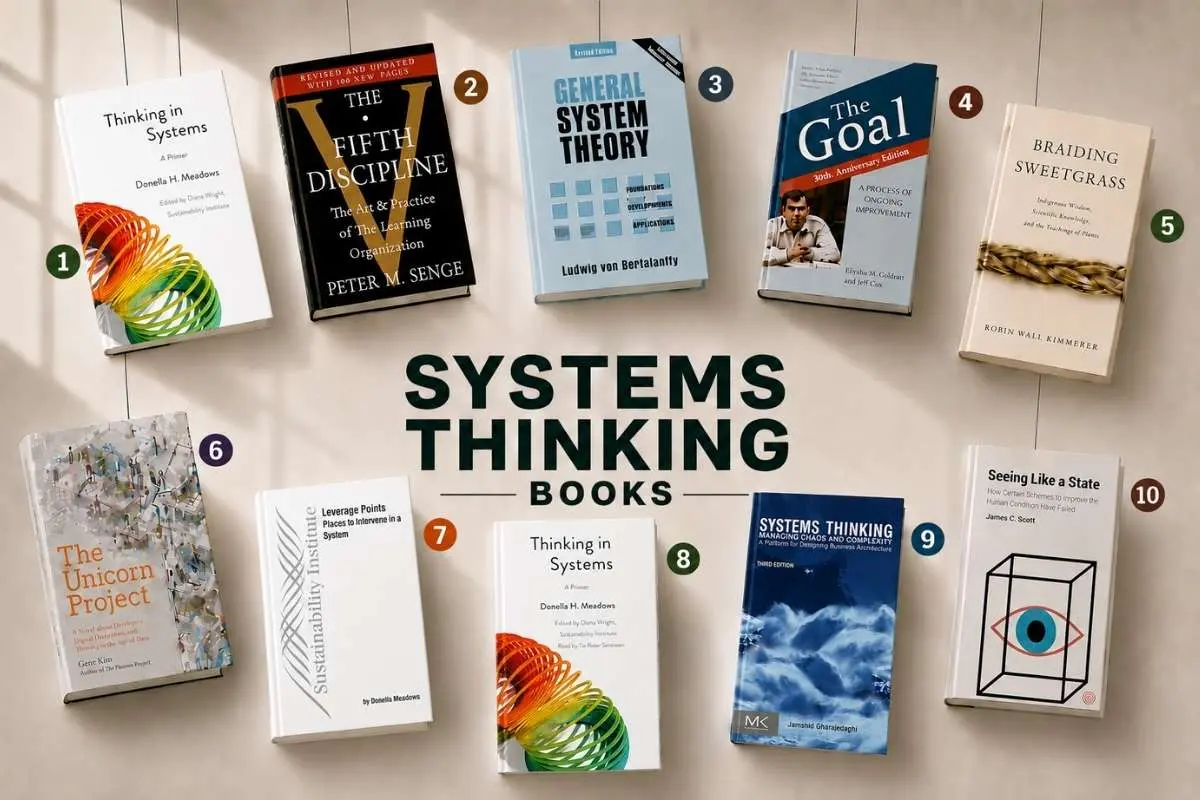
The 10 best systems thinking books that helped transform organizations like Toyota, Netflix, and Patagonia. This complete guide includes expert reviews, ratings, pricing, platforms, personal insights, and real-world case studies. From foundational classics like Thinking in Systems: A Primer to practical books like The Goal and modern organizational insights from The Unicorn Project, this list explores books that help readers understand feedback loops, bottlenecks, organizational behavior, sustainability, and complex decision-making.
I used to think systems thinking was just academic jargon. Then, while managing a failing project, I realized every solution created new problems. That’s when I picked up Thinking in Systems by Donella Meadows, and everything clicked.
Systems thinking is understanding how everything interconnects and influences each other. These books are guides that teach you frameworks to see beyond surface-level problems and recognize hidden patterns driving complex challenges in business, organizations, and life.
The real problem is that most people solve symptoms, not root causes. We restructure departments and create more silos. We automate processes and lose revenue. Systems thinking books teach you to map interconnected feedback loops, delays, and unintended consequences before acting.
I’ve read dozens of these books and researched hundreds of reader reviews on Amazon and Goodreads. I have compiled the best ones ranked by popularity, ratings, and practical value.
In this blog, you’ll discover:
Top systems thinking books for every skill level. Which book solves your specific challenge, Real-world applications, and how these frameworks transform decision-making?
Let’s begin.
Top 10 systems thinking books for business, leadership, and life
Section 1: foundational classics
1. Thinking in Systems: A Primer by Donella H. Meadows

This is the definitive introduction to systems thinking. Meadows breaks down how systems work, feedback loops, stocks and flows, delays, and resilience, using everyday examples from climate change to traffic jams to personal relationships.
Why It’s Essential: It’s the foundation every systems thinking books needs. Without this book, you’re flying blind when trying to understand complex problems. Meadows makes the invisible visible.
Key Takeaways:
- Information flows are often more important than physical flows.
- Delays in feedback can cause system instability.
- Systems resist change (resistance is a feature, not a bug).
- The goal of a system is what it actually does, not what it claims to do.
- You can’t manage what you don’t understand.
Best For: Beginners, managers, entrepreneurs, and anyone tired of band-aid solutions.
My Experience: Reading this completely changed how I approach problems. I started noticing hidden patterns, feedback loops, and decision-making flaws in both business and daily life. Every reread revealed something new, making it one of the most impactful reads in my professional journey.
Available Platforms :
- Paperback: Amazon, Flipkart, Local bookstores
- Kindle/eBook: Amazon Kindle
- Audiobook: Audible, Google Play Books
- Library: Free (borrow from the local library)
- Used: ThriftBooks, OLX
Star Rating: 5/5
2. The fifth discipline: the art & practice of the learning organization by Peter M. Senge

Senge applies systems thinking to organizations. He introduces five disciplines, personal mastery, mental models, shared vision, team learning, and systems thinking, that transform companies into learning organizations that adapt and thrive.
Why It’s Essential: If you work in an organization, this book explains why your company struggles despite brilliant people. It’s the bridge between theory and organizational reality. Written in 1990, but more relevant in 2026 than ever.
Key Takeaways:
- Organizations fail because of fragmented thinking, not a lack of intelligence.
- Mental models shape what we see and what we’re blind to.
- Team learning creates synergy that individual brilliance cannot.
- Alignment and enrollment are different (and alignment is more powerful).
- Systems thinking is the missing discipline that ties everything together.
Best For: Managers, executives, organizational development professionals, and team leaders wanting to build adaptive cultures.
My Experience: Going through this while managing a team made the lessons feel incredibly real. The concept of “mental models” helped me understand why smart people often disagree despite having the same goals. It reshaped how I think about leadership, collaboration, and organizational growth.
Available Platforms:
- Paperback: Amazon, Flipkart, Target
- Hardcover: Leading bookstores
- Kindle: Amazon Kindle
- Audiobook: Audible (15 hrs)
- Subscription: Scribd, Kindle Unlimited
- Library: Free (borrow)
- Used: ThriftBooks, OLX
Star Rating: 5/5
3. An introduction to general systems thinking by ludwig von bertalanffy

The original systems thinking text that started it all. Bertalanffy introduces General Systems Theory, the idea that all systems (biological, mechanical, social) follow universal principles. Dense but revolutionary.
Why It’s Essential: This is where systems thinking was born. Understanding the origins helps you grasp why these principles apply everywhere. It’s the “why” behind the modern systems thinking books and frameworks.
Key Takeaways:
- Systems exist at every level of complexity.
- Holism (the whole is greater than the sum of its parts) is a fundamental principle.
- Open systems maintain organization by exchanging energy with their environment.
- Equifinality: different paths can lead to the same outcome.
- Organization implies purpose and direction.
Best For: Academic readers, engineers, scientists, those wanting theoretical foundations, and anyone pursuing advanced systems thinking study.
My Experience: One of the most intellectually challenging reads I’ve experienced. While dense, it gave me a deeper understanding of why systems thinking applies across industries and disciplines. It felt like discovering the foundation behind modern strategic thinking.
Available Platforms:
- Paperback: Amazon, AbeBooks
- Imported Editions: Direct import
- Kindle: Limited availability
- Library: Check university/academic libraries (Free)
- Used: AbeBooks, Alibris
- Academic Databases: JSTOR, Google Scholar
Star Rating: 4/5 (brilliant but tough)
Section 2: Practical Application
4. The goal: a process of ongoing improvement by Eliyahu M. Goldratt

Written as a novel, this book teaches the Theory of Constraints (TOC), a systems thinking methodology for identifying bottlenecks in any system and systematically improving them. A struggling manufacturing plant becomes a case study in systems optimization.
Why It’s Essential: This book proves that systems thinking books works in practice. Unlike theoretical texts, it shows real application. The constraint is always somewhere in your system; this book teaches you to find it and fix it without creating new problems.
Key Takeaways:
- Every system has a constraint (weakest link).
- Optimizing non-constraints creates waste.
- Finding the constraint is more valuable than optimizing everywhere.
- Local optimization often destroys global optimization.
- Measurement matters; measure what actually moves the needle.
Best For: Operations managers, manufacturing professionals, project managers, anyone managing complex workflows, and anyone with recurring bottleneck problems.
Case Study: TOYOTA PRODUCTION SYSTEM
Book Applied: The Goal (Theory of Constraints) + Systems Thinking Principles
Organization: Toyota Motor Corporation
What They Did: Toyota developed a management model based on learning, integrating processes of problem-solving and emphasizing “genchi genbutsu” (going to the real place to see facts at their source).
Real-World Results:
Dominated the global automotive market with superior quality and efficiency.Built an employee involvement culture combining the Theory of Constraints (knowing where to look) with Lean practices (knowing how to change).Achieved legendary uptime and product reliability through a systems-based approach.
My Experience: This book delivered immediate practical value. Its bottleneck-focused approach changed how I looked at workflows and productivity. I applied several concepts directly to project management, and the efficiency improvements were noticeable within weeks.
Available Platforms & Price:
- Paperback: Amazon, Flipkart
- Kindle: Amazon Kindle
- Audiobook: Audible (15 hrs), Google Play Books
- Library: Free (borrow)
- Used: ThriftBooks, OLX
- Bulk/Corporate: Directly from the publisher
Star Rating: 5/5
5. Braiding sweetgrass: Indigenous wisdom, scientific knowledge, and the teachings of plants by robin wall kimmerer

A botanist and member of the Citizen Potawatomi Nation, weaves an indigenous systems thinking books with modern ecology. She shows how ecosystems work as integrated wholes and what we’ve lost by thinking of nature as resources to extract rather than systems to reciprocate with.
Why It’s Essential: This book applies systems thinking to environmental challenges and offers an alternative worldview. It bridges indigenous knowledge with Western science, showing that systems thinking isn’t new; humans just forgot it. Critical for understanding sustainability and interconnectedness.
Key Takeaways:
- Reciprocity, not extraction, is how healthy systems work.
- Humans are part of systems, not separate from them.
- Diversity creates resilience.
- Systems teach us how to live, if we listen.
- The relationship between parts matters more than the parts themselves.
Best For: Environmentalists, sustainability professionals, leaders rethinking corporate values, anyone interested in alternative business models, and those seeking purpose and meaning in work.
My Experience: Kimmerer’s work shifted my perspective from viewing organizations as machines to seeing them as living ecosystems. The blend of science, nature, and indigenous wisdom made me rethink sustainability, leadership, and the relationship between growth and responsibility.
Case Study: PATAGONIA’S Sustainability Model
Book Applied: Braiding Sweetgrass + Systems Thinking (Ecological & Business Systems)
What They Did: When faced with poor product performance causing returns, they didn’t use traditional marketing. Instead, Patagonia released a candid report about product failures and encouraged customers to recycle or repair rather than dispose of the product.
Real-World Results:
20% increase in sales the following year.Bolstered customer loyalty through transparency.Demonstrated that systems thinking about sustainability creates business value.Proved that transparency about system failures builds trust more than cover-ups.
Available Platforms:
- Paperback: Amazon, Flipkart
- Hardcover: Leading bookstores
- Kindle: Amazon Kindle
- Audiobook: Audible (17 hrs), Google Play Books
- Subscription: Scribd, Kindle Unlimited
- Library: Free (borrow, often has audiobooks too)
- Used: ThriftBooks, OLX
Star Rating: 5/5
6. The unicorn project: a novel about developers, digital disruption, and thriving in the age of data by gene Kim, Kevin Behr, George Spafford

A follow-up novel to The Phoenix Project, this book applies systems thinking and DevOps principles to software development and digital transformation. It shows how organizational systems enable or block developer productivity and business agility.
Why It’s Essential: In 2026, digital transformation is non-negotiable. This book teaches systems thinking principles specifically for tech-driven organizations. It reveals why well-intentioned digital initiatives fail and how to design systems for flow, feedback, and learning.
Key Takeaways:
- Organizational boundaries create information silos that kill innovation.
- Flow (not utilization) should be the metric.
- Fast feedback loops enable rapid learning.
- Blameless post-mortems reveal system failures, not individual failures.
- Psychological safety enables risk-taking and learning.
Best For: Tech leaders, product managers, CTOs, anyone leading digital transformation, agile coaches, and software developers wanting to understand organizational dynamics.
My Experience: The storytelling of this book felt deeply relatable during a digital transformation phase. It clearly showed how poor systems, not people, often create organizational failures. The lessons on flow, feedback, and collaboration completely changed my approach to team structure and innovation.
Case Study: Netflix’s DevOps Culture
Book Applied: The Unicorn Project + DevOps Systems Thinking
What They Did: Netflix hired intelligent people and provided freedom to solve problems in their own way, focusing on giving freedom and responsibility rather than strict policies and procedures.
Real-World Results:
No deployment windows or push schedules; engineers have full production access. Chaos engineering culture prevents cascading failures. Near-perfect uptime serving millions of users.Became the DevOps gold standard by thinking systemically about infrastructure and culture. Tech innovation has exceeded traditional tech companies.
Available Platforms:
- Paperback: Amazon, Flipkart
- Hardcover: Target, bookstores
- Kindle: Amazon Kindle
- Audiobook: Audible (17 hrs), Google Play Books
- O’Reilly Learning Platform
- Library: Free (borrow)
- Used: OLX, eBay
Star Rating: 5/5
7. Leverage points: places to intervene in a system by Donella H. Meadows

Short A short but dense essay (expanded to a small book) identifying 12 leverage points where small interventions can create massive system change. Meadows ranks them from least to most powerful, showing that where you push matters more than how hard you push.
Why It’s Essential: This systems thinking books answers the question: “Where should I focus my energy?” Instead of pushing everywhere, it teaches strategic intervention. Invaluable for anyone wanting to create change with limited resources.
Key Takeaways:
- There are high-leverage points in every system.
- Information structure is more powerful than incentive structure.
- Incentive structure is more powerful than parameters.
- Rules and constraints matter less than paradigms.
- Questioning the goal itself is the highest leverage point.
Best For: Change agents, activists, consultants, entrepreneurs, anyone trying to fix a broken system, policymakers.
My Experience: Despite being short, this book had a massive impact on my thinking. It taught me that meaningful change comes from focusing on the right intervention points rather than forcing effort everywhere. The insights are simple, strategic, and highly actionable.
Available Platforms:
- Paperback: Amazon, bookstores
- Kindle: Amazon Kindle
- PDF Essay: Donella Meadows Institute (Free)
- Used: OLX, ThriftBooks
- Library: Free (borrow)
- Bundle with Thinking in Systems: Amazon)
Star Rating: 5/5
Section 3: advanced/specialized
8. Thinking in systems for social change: a workbook for designing systemic solutions to complex problems by donella h. Meadows and Diana Wright

Building on Meadows’ earlier work, this workbook focuses specifically on applying systems thinking books social and environmental challenges. It includes exercises, mapping tools, and frameworks for designing interventions in complex social systems.
Why It’s Essential: Social problems (poverty, inequality, public health) are complex systems with feedback loops spanning generations. This book teaches how to diagnose and intervene in these systems without creating unintended consequences. It’s the practical complement to theory.
Key Takeaways:
- Social systems have their own logic and resistance
- Interventions in social systems require understanding power dynamics
- Unintended consequences are predictable if you think systemically
- Stakeholder mapping is essential before intervention
- Shifting mindsets is often more important than shifting structures
Best For: Social entrepreneurs, nonprofit leaders, policymakers, community organizers, sustainability professionals, and international development workers.
My Experience: The workbook format of this book challenged me to slow down and truly understand problems before proposing solutions. The exercises helped me think more critically about stakeholder dynamics, unintended consequences, and long-term social impact in complex systems.
Available Platforms:
- Paperback: Amazon, bookstores
- Kindle: Amazon Kindle
- Google Books: Limited preview
- Academic Libraries: Free (borrow from university/research institutions)
- Used: AbeBooks, OLX
- Direct from Publisher: Chelsea Green
Star Rating: 5/5
9. Systems thinking: managing chaos and complexity – a platform for designing business architecture by Jamshid Gharajedaghi

This systems thinking books combines systems theory and interactive design to provide an operational methodology for defining problems and designing solutions in an environment increasingly characterized by chaos and complexity. It addresses the dilemma where organizations as a whole are becoming more interdependent while individual parts display choice and behave independently, offering a holistic frame of reference to focus on relevant issues without drowning in proliferating information.
Why It’s Essential: This book teaches holism and feedback loops to understand how organizational parts interconnect and impact each other. Combines iterative design principles with real industry case studies to handle complex, chaotic systems. Bridges’ theory with practical application.
Key Takeaways:
- Holistic thinking requires iteration of structure, function, and process.
- Operational thinking means understanding chaos and complexity as features of perception and understanding.
- Choice is at the heart of human development; design enhances choice and holistic thinking.
- Feedback loops create patterns that reveal system dynamics and organizational interconnections.
- Interactive design combines an iterative approach with dynamic thinking to address complex sociocultural systems.
Best For: Strategic planners, organizational architects, operations leaders, executives managing complex transformations, business process redesigners, management consultants, MBA students, and leaders in healthcare, manufacturing, and service industries.
My Experience: This book provides the philosophical and methodological foundation for understanding why isolated optimization often fails. It teaches a holistic approach that deals with all dimensions of a system, moving beyond tactical tools to a way of seeing, doing, and being in the world. The real-world case studies (Oneida Nation, Butterworth Health System, Marriott Corporation) demonstrate how systemic thinking prevents unintended consequences and creates adaptive organizations.
Available Platforms & Price:
- Paperback (3rd Edition): Amazon, Biblio, academic bookstores | ISBN: 9780123859150
- Hardcover: Morgan Kaufmann Publishers, university libraries
- Kindle/eBook: Amazon Kindle Store, limited availability
- Online Free Access: Full text available at interactdesign.com
- Used: AbeBooks, ThriftBooks, library sales
- Corporate Access: Interact (publisher’s platform), academic institutions
- Price Range: $30-$50 USD depending on format/edition
Star Rating: (4/5 – Philosophically profound, practically rigorous, requires active engagement)
10. Seeing like a state: how certain schemes to improve the human condition have failed by James c. Scott

An anthropological critique of top-down systems thinking books. Scott analyzes historical examples of “legible” systems (simplified, easy to see) that failed because they ignored local complexity. It’s a cautionary tale about misapplying systems thinking.
Why It’s Essential: This book teaches the limits of systems thinking. It shows why imposing a simplified system on a complex reality backfires. Essential reading for anyone designing policies, organizational changes, or interventions in complex systems.
Key Takeaways:
- Simplification enables management but destroys adaptation.
- Local knowledge is often more valuable than expert knowledge.
- Over-standardization kills diversity and resilience.
- Messy, organic systems often outperform “designed” systems.
- Respect for complexity sometimes means stepping back.
Best For: Policymakers, organizational architects, anyone designing large-scale systems, philosophers, and anyone wanting to think critically about systems thinking books themselves.
My Experience: Scott’s analysis made me more cautious about oversimplifying complex systems. The real-world examples revealed how top-down solutions can fail when they ignore local realities. It added a much-needed layer of humility to my understanding of systems thinking.
Available Platforms & Price:
- Paperback: Amazon, Flipkart
- Hardcover: Yale University Press
- Kindle: Amazon Kindle
- Audiobook: Audible (13 hrs), Google Play Books
- Yale Press: Direct from the publisher
- Library: Free (borrow, often has audiobooks)
- Used: ThriftBooks, AbeBooks
Star Rating: 5/5
Conclusion:
You’ve now seen the complete picture: 10 transformative systems thinking books, real-world case studies proving their impact, complementary resources to accelerate your learning, and clear pricing information.
But here’s the truth: Knowledge without action is just entertainment.
The difference between people who transform their careers and organizations and those who don’t isn’t intelligence or resources; it’s systems thinking applied consistently.
Toyota didn’t dominate manufacturing by luck. Netflix didn’t become DevOps royalty by accident. 3M didn’t boost engagement by 20% through random changes. Patagonia didn’t increase sales by 20% through traditional marketing.
They all applied systems thinking frameworks.
And now, you have access to the same books, frameworks, and tools they used.