
Systems thinking in leadership is an approach that focuses on understanding how different parts of an organization connect and influence each other, rather than solving problems in isolation. This blog explains how leaders can apply it through steps like identifying root causes, mapping systems, and analyzing feedback loops.
At first, most business problems seem straightforward. But in many cases, challenges sit deeper beneath the surface, connected to decisions and patterns that are easy to overlook in the moment.
Take a manufacturing company trying to speed up production to meet rising demand. For a few weeks, the numbers look great. But then:
Employees start burning out.
Machine maintenance gets delayed.
Product quality drops.
So, what can management do to face these challenges? Can implementing systems thinking in leadership be the solution?
According to the University of Phoenix, Systems thinking is a way to approach issues by looking at them as systems. Rather than considering only how to solve an immediate problem, you consider how all of the pieces connect to make the whole. But how can leaders use this method?
How to Implement Systems Thinking in Leadership?
A leader does not fix problems in isolation. They look at how work flows across teams and where things connect. This section breaks that process into clear, usable steps.
1. Start by Defining the Real Problem
Most teams react to what they see. That often leads to surface fixes. You need to slow down and frame the real issue.
Ask simple but sharp questions. What keeps happening again and again, and where does it start? Look for patterns over time instead of one bad event.
For example, if sales drop, do not just push for more calls. Check product gaps, marketing quality, and customer support delays. The problem often sits outside the obvious area.
2. Map the System Around the Problem
Once you see the pattern, map how things connect. This step shows how teams, tools, and actions influence each other.
Draw a simple flow. Start from the input and move to the output. Include people, steps, and dependencies that affect the result.
You do not need complex tools. Even a rough sketch works. The goal of using systems thinking in leadership is to see how one action leads to another across the system.
3. Identify Feedback Loops
Most outcomes repeat because of loops. One action triggers another, and the cycle keeps going.
Look for reinforcing loops first. These loops make problems grow fast. A small delay leads to stress, stress leads to errors, and errors create more delay.
Then find balancing loops. These try to stabilize the system. A strong review process, for example, can reduce repeated mistakes.
When you spot these loops, you gain control. You now know where to step in.
4. Find the Root Cause
Symptoms are easy to fix. Root causes take effort to uncover.
Use a simple method like asking “why” five times. Each answer should move you closer to the source of the issue.
For example, a team misses deadlines. Why? Tasks take longer. Why? Requirements change often. Why? Stakeholders are not aligned early. Now you see the real gap.
Fixing that gap prevents the issue from coming back.
5. Focus on High-Impact Leverage Points
Not all fixes give equal results. Some small changes can shift the whole system.
Look for points where a small action can create a large effect. This could be better communication, clearer goals, or a tool upgrade. Avoid spreading effort across many small fixes. Instead, act where it matters most.
Implementing this system sounds simple. But it begins when you, as a leader, start to think in a systematic way. And how do you do that?
What are the Characteristics of a Systems Thinker?
Leaders who think in systems show clear and steady habits in their work. These habits shape how they see problems and make decisions each day. They do not react fast without thinking through the impact. Instead, they pause, study patterns, and act with purpose.
The traits below show how they approach complex situations with clarity and control.
- Sees the Bigger Picture: They understand how teams, tools, and processes connect. Decisions are made with the full system in mind, not in isolation.
- Focuses on Patterns: They look for trends that repeat over time. This helps them identify deeper issues instead of reacting to single incidents.
- Looks for Root Causes: They dig beyond surface-level problems. Fixing the source reduces the chances of issues returning.
- Thinks in Cause and Effect Relationships: They consider how one action impacts other parts of the system. This helps avoid unintended consequences.
- Identifies and Understands Feedback Loops: They recognize cycles that drive outcomes over time. This allows them to break negative patterns and support positive ones.
- Balances Short-Term and Long-Term Thinking: They weigh immediate results against future impact. This creates more stable and sustainable decisions.
- Handles Complexity While Maintaining Clarity: They focus on key relationships instead of every detail. This keeps decisions clear and practical.
- Asks Better and Deeper Questions: They challenge assumptions and explore why problems occur. Strong questions lead to better insights.
- Encourages Collaboration: They involve teams to build a clear view of the system. This improves alignment and execution.
- Uses Data Along With Observation: They combine data with real-world insights. This makes decisions more accurate and grounded.
Now you know what systems thinking is, but does this method of solving actually work? Does it help in long-term stability?
Read Next: Why Systems Thinking in the Workplace Matters for Business Growth in 2026?
What are the Benefits of Using Systems Thinking in Leadership?
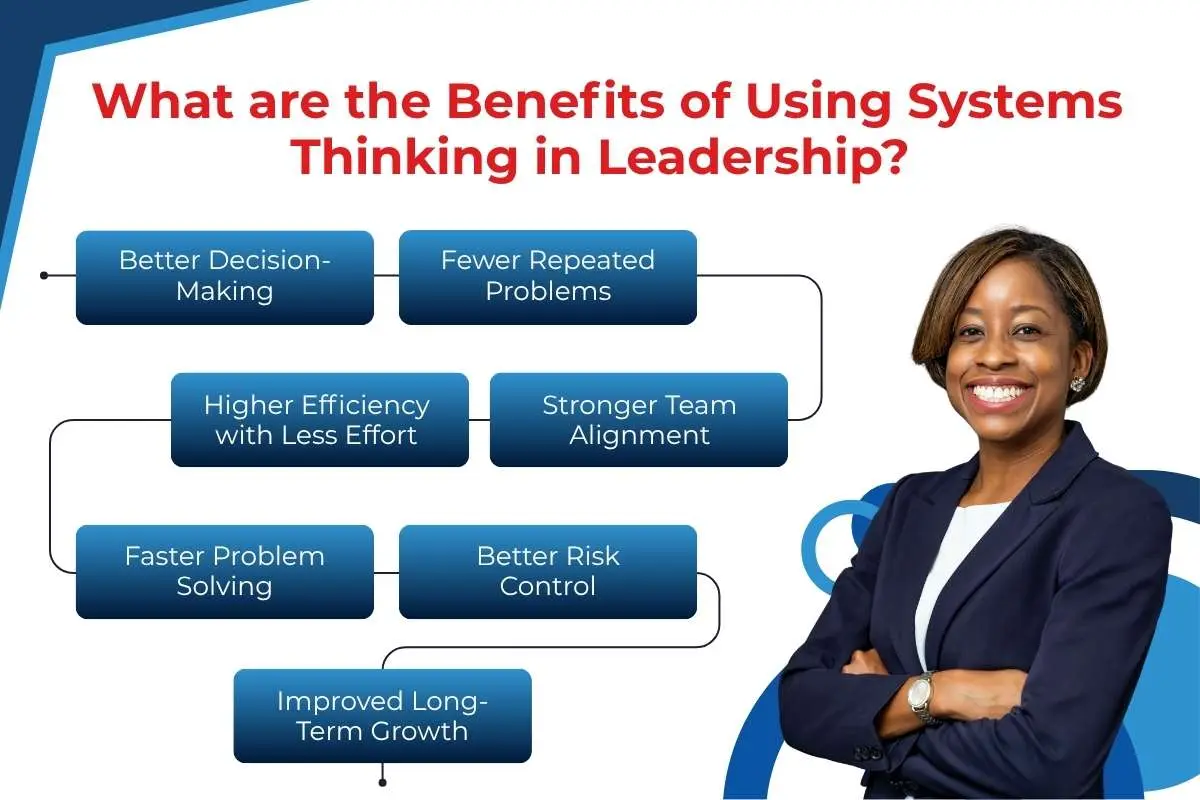
You shouldn’t react to problems. Understand how actions connect across teams, processes, and time. This creates stronger decisions and more stable outcomes across the organization. Here is how you can benefit from it:
1. Better Decision-Making
Most decisions fail because they focus on one part of the problem. A systems approach helps you see the full picture before acting. You understand how one decision can affect multiple teams and processes at the same time.
This reduces guesswork and improves clarity. You are not just solving what is visible, but also preventing what may happen next. Over time, your decisions become more accurate and less reactive.
2. Fewer Repeated Problems
Many organizations face the same issues again and again. This happens because leaders fix symptoms instead of the root cause. A systems view helps you go deeper and identify where the problem truly starts.
Once the root cause is fixed, the issue stops repeating. Teams spend less time handling the same crisis and more time on meaningful work. This creates a more stable and predictable work environment.
3. Stronger Team Alignment
Teams often work in silos and focus only on their own goals. This creates gaps, delays, and confusion between departments. Using this method can help teams understand how their work connects with others.
When people see the bigger picture, they collaborate better. They plan with others in mind instead of working in isolation. This reduces friction and helps teams move in the same direction.
4. Higher Efficiency with Less Effort
Inefficiency often hides in small gaps across the system. These gaps slow down work and create unnecessary steps. When you map the system, these weak points become clear.
Leaders can then remove delays, fix handoffs, and improve workflows. This allows teams to do more work without increasing pressure. The system becomes smoother and more reliable over time.
5. Faster Problem Solving
Without a systems view, teams waste time figuring out where the problem started. This slows down the response and increases frustration. A clear understanding of the system removes this confusion.
You already know where to look when something breaks. You can act quickly and fix the issue at its source. This keeps operations stable and reduces downtime.
6. Better Risk Control
Some risks grow slowly and stay hidden until they become serious. A systems approach helps you notice patterns early. You can see signals that others might ignore.
This allows you to act before the problem becomes critical. You reduce damage and maintain control over the situation. Over time, this builds a more resilient system.
7. Improved Long-Term Growth
Immediate fixes often create long-term problems. A systems approach helps you balance both. You make decisions that support growth without damaging the future.
Processes become stronger as the organization grows. This reduces chaos during expansion and keeps performance stable. Growth becomes more structured and sustainable.
Systems thinking is a long process that requires a lot of patience. Hence, it is no surprise that it has some challenges when it comes to implementation. Let us now take a look at these as well as learn about things to avoid.
What are Some Challenges Faced?
Shifting and applying systems thinking in leadership is a mindset shift. Most leaders are trained to respond fast, fix what is visible, and move on. That habit creates friction here. When a problem appears, the natural instinct is to act quickly, even if the full picture is not clear. This often leads to surface-level fixes that solve the issue for a short time but allow it to return later in a different form.
Another challenge comes from limited visibility across teams. In many organizations, work happens in silos. Each team focuses on its own targets, tools, and timelines. As a result, leaders rarely see how work flows from one team to another. A delay in one place may begin somewhere else, but without that connection, the response stays incomplete. Building a clear, end-to-end view of the system takes effort, and it does not happen overnight.
There is also the difficulty of tracing problems back to their origin. Issues rarely start where they appear. A missed deadline may come from unclear planning, or a quality issue may stem from rushed decisions made earlier. Finding these root causes requires patience and structured thinking. It slows down the initial response, which can feel uncomfortable, but it leads to more stable outcomes over time.
What Things to Avoid While Implementing Systems Thinking in Leadership?
While these challenges are natural, certain habits can make them worse. One of the most common mistakes is jumping to quick fixes. Acting fast may create the feeling of progress, but it often ignores the deeper issue. A team may push harder to meet deadlines, but if the planning process is weak, the same delays will return. Slowing down to understand the cause leads to more effective solutions.
Focusing on one part of the system without considering the rest can also be harmful. Changes made in isolation can shift problems instead of solving them.
For instance, improving speed in one team without adjusting quality checks. This can increase errors elsewhere. Looking at the full system helps prevent these unintended effects and supports more balanced decisions.
Leaders also tend to overcomplicate the process when they try to apply this approach. They create detailed maps and track too many variables at once. This makes it harder for teams to follow and slows down action. Applying systems thinking in leadership gives you a simpler view that highlights key flows and major dependencies.
Read Next: 10 Systems Thinking Books to Understand Complex Problems and Hidden Patterns
Case Study: Systems Thinking in Leadership at the Bharat 2.0 Conclave

Bharat 2.0 Conclave brought together founders, CEOs, and industry leaders on a shared platform. The event focused on growth, innovation, and India’s future as a connected business ecosystem.
Instead of isolated talks, the conclave used panels and discussions to link ideas across industries. Leaders from different sectors interacted in the same space. This created a setting where decisions could be viewed as part of a larger system.
The Challenge
Most leaders work within their own domain. This limits visibility and creates gaps in decision-making. A choice made in one function often affects others in ways that are not fully understood.
As organizations grow, these gaps become harder to manage. Teams move in different directions, and problems repeat across the system. The challenge was to bring these disconnected views into one shared understanding.
The Systems Approach
The conclave addressed this by creating structured interactions across industries. Leaders did not just present ideas; they responded to each other in real time. This helped connect different perspectives into a single conversation.
Audience participation added another layer. Questions and inputs pushed speakers to refine their thinking. This created a feedback loop where ideas evolved during the session.
Key Takeaways
Systems thinking works best when leaders connect ideas, people, and industries. Shared platforms improve visibility and reduce siloed thinking. Feedback-driven discussions lead to better decisions. A focus on long-term impact creates more stable and scalable growth.
This case shows that leadership becomes stronger when it operates as part of a system, not in isolation.
Conclusion
In the end, leadership is rarely about fixing one problem at a time. Every decision, no matter how small, sets off a chain of reactions across people, processes, and outcomes. The real challenge lies in seeing those connections before they turn into consequences.
That is where systems thinking in leadership makes a lasting difference. It shifts the focus from quick fixes to deeper understanding, helping leaders recognize patterns, anticipate ripple effects, and make decisions that hold up over time. Instead of constantly reacting to issues, leaders begin to shape systems that work more smoothly, adapt better, and grow stronger with every decision made.
People Also Ask
1. What is the importance of systems thinking in leadership?
It helps leaders see connections, not just problems. This leads to smarter decisions, fewer surprises, and stronger long-term results.
2. What is the difference between systems thinking and design thinking?
Systems thinking looks at how everything connects. Design thinking focuses on solving specific problems with user-focused solutions.
3. How does systems thinking work in the workplace?
It helps teams understand how their work impacts others. This improves coordination, reduces repeated issues, and builds better outcomes.