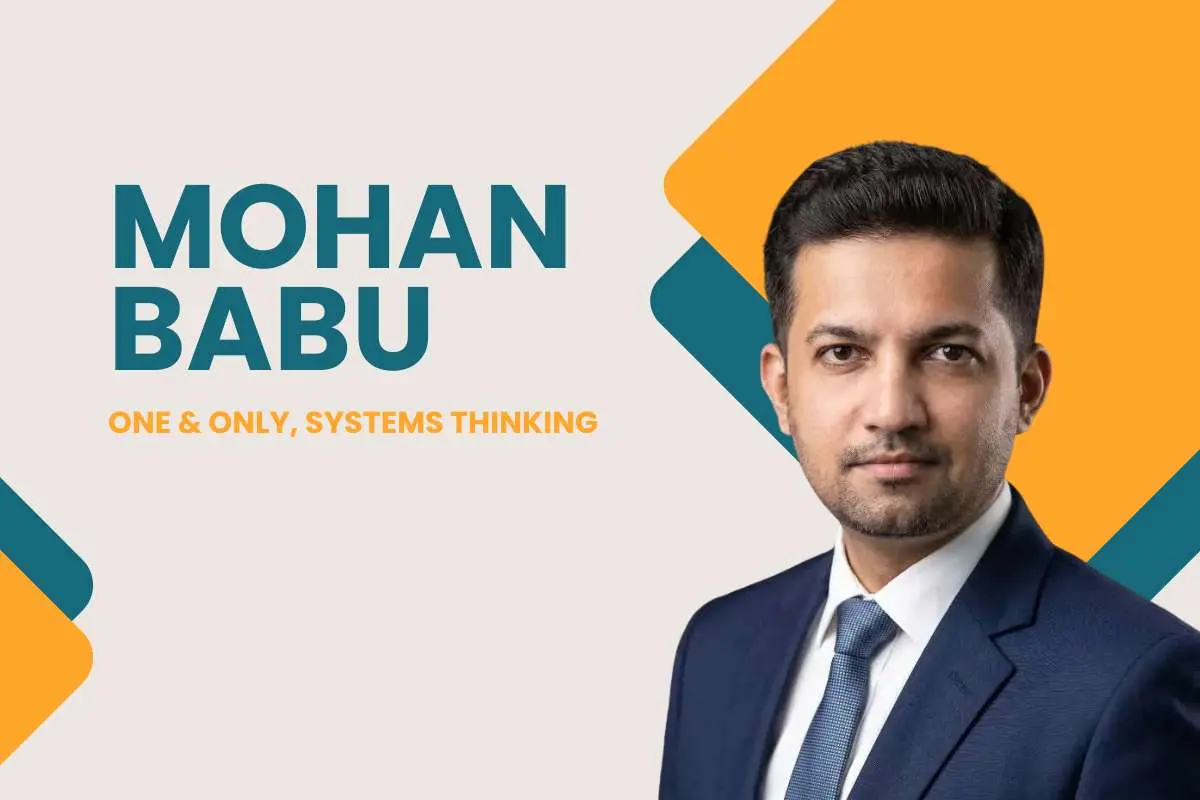
Systems thinking scales a business by replacing individual talent with documented, repeatable processes that ensure consistent outcomes without founder intervention. This guide details how Mohan Babu codified execution at One & Only to build a high-output brand implementation powerhouse. Read on to master these exact frameworks and build resilient systems that handle growth and scalability effortlessly.
Most businesses in the signage and brand implementation space grow by adding people. When they need more output, they hire. When quality dips, they supervise harder. And when a project fails, they blame the individual.
Mohan Babu, Founder of One & Only, watched this pattern for 15 years before he started his own company. And when he did, he built it entirely differently.
He didn’t scale by adding more people to a broken process. He built the process first, so that more people could operate within it without breaking it.
That distinction, process before people, systems before scale, is the entire story of how One & Only grew from an idea in 2022 into a multi-vertical brand implementation company operating across corporate real estate and broader market segments in just a few years.
“If it’s not implemented right, it doesn’t exist.” — Mohan Babu, Founder, One & Only.
What Systems Thinking Actually Means in a Physical Business?
Systems thinking is not a software concept. It is the practice of designing how work flows through an organisation — every handoff, every decision point, every quality check — so the outcome is predictable regardless of who is executing it.
India has approximately 63 million SMEs, contributing around 30% of the country’s GDP. Yet technology and digital adoption remain critically low, with most businesses still relying on people-dependent, informal processes rather than structured systems. In physical industries like signage and branding, that gap is even more acute.
Mohan applied systems thinking across three specific areas inside One & Only:

1. Documentation That Travels Without Him
Every project at One & Only runs on a documented process — detailed design drawings, material specifications, pre-execution mockups, on-site supervision checklists, and formal closure documentation. These are not internal guidelines. They are operating documents that every team member uses regardless of the project size, location, or client.
The effect: a site team in a different city executes with the same standard as one Mohan personally supervised. Quality doesn’t depend on proximity.
2. Removing Decision Silos between Design and Execution
The most common failure mode in brand implementation is a gap between what the design team draws and what the execution team builds. Design makes decisions in isolation. Execution encounters real-world constraints on the site. The client gets a result that doesn’t match the original vision.
Mohan’s system collapses this gap structurally. At One & Only, design decisions are made with implementation inputs already in the room. If a design cannot be executed efficiently, it does not move forward — regardless of how good it looks in a presentation.
This is systems thinking applied to decision-making: the constraint is built into the design phase, not discovered during execution.
3. Selective Partnerships That Match the System
Scaling a business often means outsourcing work to external partners. Most founders choose partners based on capacity and cost. Mohan chose them based on a single criterion: accountability.
He reduced the number of external dependencies deliberately, keeping only partners who could work within the documented process and who shared the same commitment to timelines and quality standards. The result: fewer variables, fewer surprises, and consistent output across locations.
The Scalability Test Every Founder Should Apply
There is a simple question that reveals whether a business is genuinely scalable or just a founder running very fast: Can it deliver the same result when I’m not involved?
Most businesses in relationship-driven, execution-heavy industries cannot honestly answer yes. Mohan built One & Only, so the answer is yes by default.
A 2025 NITI Aayog report found that Industry 4.0-aligned systems thinking can improve productivity for Indian businesses by up to 30%. But the same research shows that approximately 45% of Indian SMEs cite budget constraints as a key barrier to structured implementation, not knowledge, not willingness, but the assumption that building proper systems requires large capital.
Mohan’s experience challenges that assumption. His system didn’t require heavy technology investment to begin with. It required documentation, discipline, and a willingness to say no to projects and partnerships that didn’t fit the process.
Three Lessons Other Founders Can Take From Mohan’s Approach
These are not generic principles. They come directly from the specific decisions Mohan made at One & Only.

Lesson 1: Your process is your product.
In a service business, clients pay for outcomes. But outcomes only stay consistent when the process that produces them is codified and followed. Mohan treated the internal implementation process as seriously as the client-facing deliverable. That’s the discipline most service founders skip.
Lesson 2: Controlled growth beats aggressive growth.
Mohan explicitly chose sustainable scaling over volume-first expansion. He tightened his vendor ecosystem, defined clearer project criteria, and built backend systems before expanding into new cities. Founders who grow faster than their systems can support create a quality problem that erodes the reputation faster than growth built it.
Lesson 3: Accountability is a hiring criterion, not a value statement.
It is easy to say your company values accountability. Mohan embedded it structurally, by choosing partners who had demonstrated it, creating processes that make accountability visible (documented stages, defined responsibilities, formal closures), and leading with clarity so his own team always knew exactly what was expected of them.
What’s Next for One & Only and Why the System Makes It Possible?
Mohan’s 2026 roadmap includes expansion into key cities, a structured franchise model, and the development of “One O,” a platform designed to unify brand implementation management into a single structured system.
The franchise model is worth examining specifically. Franchising a service business is only viable if the service can be delivered consistently by operators who weren’t trained by the founder personally. That requires a system mature enough to be handed over.
One & Only is building toward that handover. The system isn’t an internal tool. It’s becoming the product.
Global research on systems thinking and SME growth consistently finds that businesses that document and systematise their core processes achieve higher growth rates and better sustainability outcomes than those that rely on founder-level talent as the primary quality mechanism. Mohan Babu didn’t wait for the research to confirm it. He built it first.
FAQ
1. What is systems thinking in business?
Systems thinking is the practice of designing how work flows through an organisation so outcomes are predictable and repeatable, regardless of who is executing. Instead of relying on individual talent or supervision, it creates documented processes, defined handoffs, and clear quality checkpoints that operate consistently at scale.
2. How did Mohan Babu apply systems thinking to One & Only?
Mohan built a documented, end-to-end implementation process covering every stage from design to on-site closure. He collapsed the traditional gap between design teams and execution teams by including implementation inputs at the design stage. He also reduced external dependencies by working only with accountability-first partners who operated within the documented system.
3. What is the biggest mistake founders make when scaling a service business?
Most founders scale by adding people to an undocumented process, which means quality depends on individual performance rather than system performance. The result is inconsistency at scale. Building the process before scaling, so it works without the founder in the room, is the distinguishing factor between businesses that grow and businesses that grow and then shrink.
4. What is One & Only working on in 2026?
One & Only is expanding into new cities, building a structured franchise model, and developing “One O,” a platform aimed at unifying brand implementation management. These initiatives are designed to work because the underlying operational system is already mature enough to be replicated.
- Connect with Mohan Babu: LinkedIn
Links and sources: