Marketing claims about hyper-fast, AI-powered, post-production video editing are obscuring the truth about live streaming AI video. This article unpacks the differences between real real-time and near-real-time AI video, explains why true live AI video is so difficult to achieve, and explores some solutions.
The internet might lead us to believe that real time AI video generation is everywhere, provided by several different companies. But in reality, it’s not that easy to find.
Many of the companies that claim to provide live streaming AI video are actually delivering very fast AI video, with a perceivable lag. Sometimes they can achieve true live video generation, but only for clips that last a second or two, or only under specific conditions that don’t exist outside of a research lab. Generally, even fast AI video models are used only to transform existing clips which are then used as on-demand media assets, as opposed to being used for live streaming use cases.
This gap between promises and reality have led many people to conclude that live streaming AI video is just marketing-speak for “very fast,” and others to believe that real-time AI video isn’t particularly impactful. Overall, there’s a general lack of clarity around the definition of live AI video generation and editing.
The Line That Defines Live AI Video
True real time AI video generation is defined by video frames rendered continuously from a live input feed with zero perceptible lag and no reliance on batch processing. In practice, it delivers the processing speed required to capture live camera footage and transform the output instantaneously, ensuring viewers experience seamless, on-the-fly editing without visual delay.
The gold standard for real-time AI video is 60 FPS (frames per second), or processing time of under ~16ms/frame. No company has yet broken this barrier in a repeatable and predictable way outside of a research lab.
Processing video at ~30-60 FPS, or ~16-33ms/frame, is still perceived as real time. At this speed there are no obvious lags, breaks, or gaps. Decart occupies this space, with MotionStream and StreamDiffusion V2 as close contenders. The latter can both hit the 30-60FPS streaming bracket, but their setup is a lot heavier, not production-ready, and is still constrained to shorter clips. HeyGen and Kling are approaching this capability.
AI video generation or editing that moves slower than 30 FPS is better called near-real-time or pseudo-real-time. It’s live, but it’s not instant. Below 30 FPS you’ll see jolts, breaks, gaps, and lag, and items might not fully obey the laws of physics or remain consistent as they interact with each other. Pika, Sora, Synthesia, and Runway all lie in this category.
The Paradigm Shift of True Streaming AI Video

Crossing the line between fast but non real-time, and continuous live streaming, makes all the difference. True live streaming AI video solutions allow you to edit video at the speed of thought, without any lags. It removes constraints on the imagination, and unlocks doors to responsive immersive experiences across use cases like gaming, marketing, entertainment, and sales.
“The elimination of latency, combined with the ability to generate video infinitely, makes it possible for anyone to explore the depths of their imagination and create longform content. They’ll be able to interactively make adjustments to the scene, lighting, camera angles and character expressions as the video is being generated,” says Kfir Aberman, founding member at Decart. It opens the door to a more dynamic creative experience that will transform how stories are created.”
Among the use cases for real-time AI video are live virtual “try-ons” for clothing; personalized visual experiences that respond to voice and movement; and advanced robots with powerful visual reasoning. Live streaming AI video enables gaming experiences that feel real, streaming personalities that instantly adapt content to viewer feedback, and customized avatars for online conferences and chats that interact realistically with other avatars.
Why Is Live AI Video so Hard to Achieve?
It might seem like the divide between near-real-time and true real-time AI video is insignificant, but the fissure runs deeper than you realize. True real-time AI video requires simultaneously:
- Keeping latency under ~16ms or 24–30 FPS
- Achieving infinite temporal consistency without mistakes creeping in
- Supporting continuous generation, not short clips
- Responding to interactive input
Every one of these is a significant challenge, and solving them all at once is exponentially harder.
The obstacles include:
- The AI processing pipeline of decoding, processing, and acting upon each frame, which is relatively long
- The geographic distance that frames have to travel through the internet, which adds milliseconds to the process
- Model inference, which creates a serious bottleneck and adds a lot of lag
- Infrastructure that isn’t designed for fast responsiveness and defaults to batch processing
- Centralized data centers which get congested when usage is high
- Fluctuating packet delivery, which causes dropped frames even when throughput remains high
Solving the Problem Requires a New Compute Grid for AI

Achieving true real time AI video generation requires a multi-pronged approach. Optimizing the underlying model is the first and most obvious step, with companies developing innovative techniques to shave critical milliseconds off processing times. For example, Decart enhanced its Lucy editing architecture by pruning parameters, fine-tuning smaller and faster models, and accelerating the denoising pipeline.
Improving the infrastructure is equally important. Often compute power goes unused because it’s not optimized for AI workloads, or heavy CPUs and GPUs work against the goal by focusing on overall throughput, prioritizing batch processing, and deprioritizing speed.
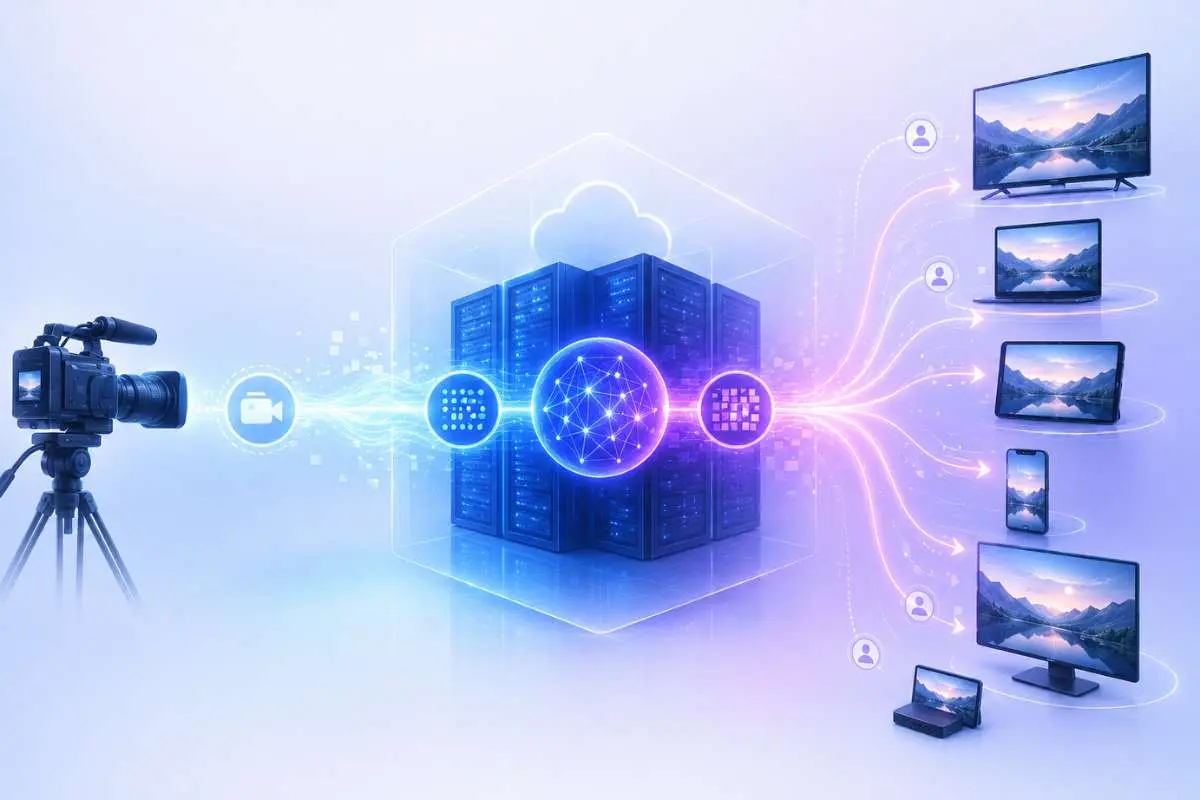
But neither of these steps is enough to cut latency sufficiently, because AI video processing runs over the internet. Data has to travel a significant distance, even at the speed of light, which slows it down, while congested, centralized data centers add friction. It all needs to run on distributed architecture which moves processing closer to the user.
To this end, Decart teamed up with NVIDIA and Comcast to build the new distributed “AI grid.” It uses Comcast’s distributed architecture to move the location of AI video processing from centralized data centers to edge networks, together with NVIDIA’s edge infrastructure (GPUs) in a manner that is optimized for AI video throughput. Decart’s models are likewise optimized for both these partners to take advantage of the compute power and edge availability, cutting latency to the bone even for consumer users without an on-prem research lab setup.
Live Streaming AI Video and Near-Real-Time Are Light Years Apart
Contrary to the impression you might get from AI video providers’ marketing materials, there really is such a thing as real-time, continuous streaming AI video generation, and it is transformative. While genuine solutions like Decart, MotionStream, and StreamDiffusion V2 are still in their infancy, the technology is advancing rapidly. It won’t be long before awareness spreads of the immense benefit transferred by true live streaming AI video.
FAQs
1. What does live AI streaming video really mean?
It means video that is generated or edited at over ~30 FPS, so that there is no perceptual lag, jolt, jitter, or gaps. It also means that the AI video is generated in a continuous stream, one frame after another, instead of being batch rendered and then sent in chunks that are later reassembled.
2. Does any company offer true real time AI video generation?
Currently only Decart can offer true real-time, continuous AI video generation outside of research lab conditions. MotionStream and StreamDiffusion V2 deliver real-time AI video, but the clips are very short and the setup is very heavy. HeyGen and Kling are close to achieving it.
3. What is the difference between super-fast AI video and live streaming video?
The difference is in the viewer experience. Live streaming video feels instant and effortless. Super-fast AI video is generated from recordings, so when it’s streamed as the output happens, the viewer sees lags or gaps and the visual elements don’t always move in a realistic way.
4. Which use cases need true real-time AI video?
Immersive mixed reality, AR, and VR experiences need true real-time AI video to maintain a convincing user experience. Gaming, virtual sales, and entertainment and streaming also need true real-time AI video to deepen and personalize the user experience. It’s also been argued that live streaming video is the missing piece in agentic AI systems, to enable them to make better decisions.