Retaining experienced personnel is essential for business stability, yet retention alone never guarantees innovation or market growth. Satisfied teams often settle into predictable routines, completing their assigned duties without actively seeking ways to improve internal processes or client outcomes.
Differentiating between employee engagement vs employee satisfaction enables management to allocate corporate development budgets with far greater precision. While satisfaction secures baseline retention by meeting physical and financial needs, engagement inspires the initiative needed to solve complex business challenges.
In this article, we will see the differences between the two concepts in detail. We will also focus on why and how these distinctions matter. But first, let us start by understanding what employee engagement vs employee satisfaction are.
What is employee satisfaction?

Employee satisfaction shows how happy employees feel about their jobs. It covers their pay, benefits, workload, work hours, and workplace conditions. It also reflects how they feel about their daily work experience.
The Cambridge Dictionary defines employee satisfaction as:
“The happiness that workers feel when they are satisfied with their job and work conditions, used as one way of measuring a company’s success”
Key characteristics of employee satisfaction
- Fair pay: Employees feel they receive fair pay for their work.
- Good work conditions: Employees have a safe and comfortable place to work.
- Manageable workload: Employees can handle their tasks without constant stress.
- Job security: Employees feel that their jobs are stable and secure.
- Workplace support: Employees can get help when they face work problems.
- Job comfort: Employees feel at ease with their daily work routine.
- Basic contentment: Employees feel good about their jobs without seeking extra duties.
Satisfaction focuses on how employees feel about their jobs. Engagement goes further by looking at commitment, purpose, and the effort employees give.
What is employee engagement?
Employee engagement shows how strongly employees connect with their work and organization. It reflects their commitment, motivation, and willingness to contribute to shared goals. Engaged employees care about their work and want to help the organization succeed.
Watson Wyatt defines employee engagement as:
“A combination of commitment—the motivation employees have to help the organization succeed—and line of sight—the focus and direction employees need—to know what to do to make the organization successful.”
This makes employee engagement more than job satisfaction. An employee may feel happy with their job but show little interest beyond regular duties. An engaged employee understands their role and often puts more effort into their work.
Key characteristics of employee engagement
- Strong commitment: Employees want to support the organization and its goals.
- Clear purpose: Employees understand why their work matters.
- Higher motivation: Employees feel motivated to perform well.
- Active involvement: Employees take an active interest in their work.
- Extra effort: Employees may do more when the situation requires it.
- Goal alignment: Employees understand how their work supports company goals.
- Willingness to contribute: Employees share ideas and take part in improving work.
Employee engagement vs Employee satisfaction: Key differences
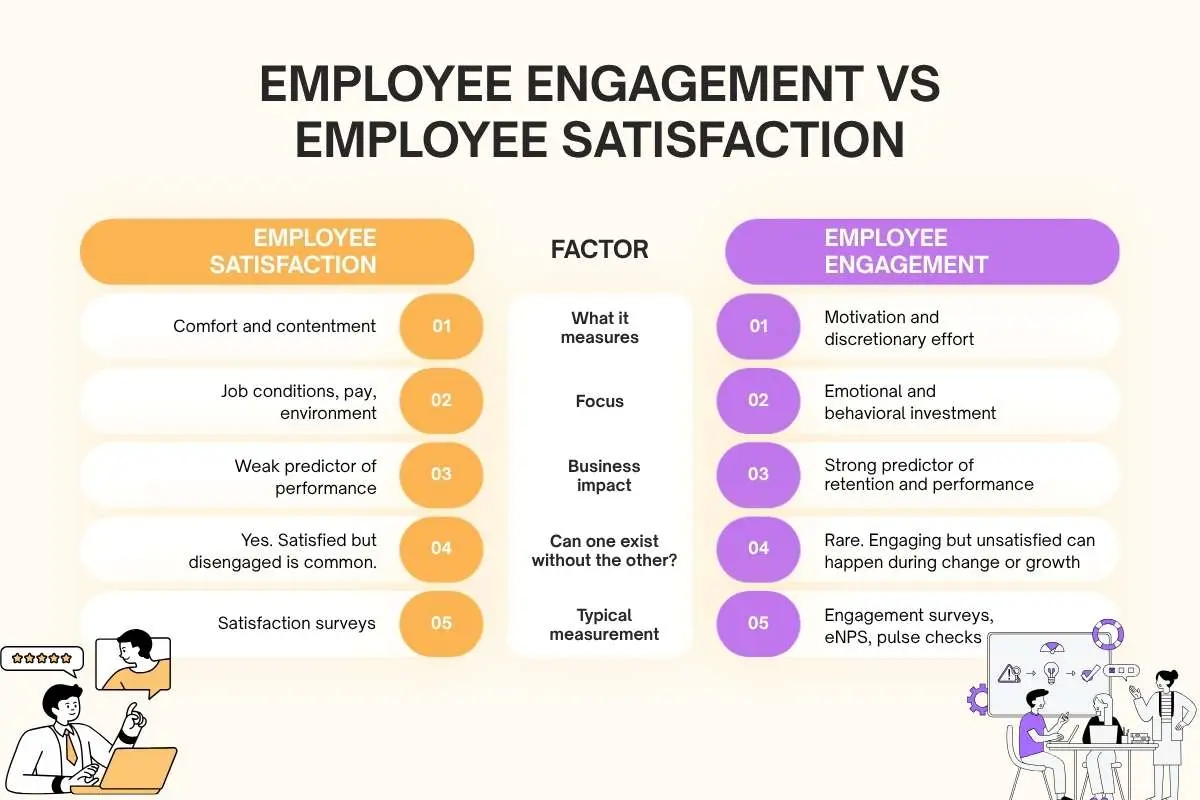
Employee engagement vs employee satisfaction often sound similar. They measure different parts of the employee experience, though. Satisfaction looks at how employees feel about their jobs. Engagement looks at how strongly they connect with their work and the organization.
| Employee Satisfaction | Factor | Employee Engagement |
| Comfort and contentment | What it measures | Motivation and discretionary effort |
| Job conditions, pay, environment | Focus | Emotional and behavioral investment |
| Weak predictor of performance | Business impact | Strong predictor of retention and performance |
| Yes. Satisfied but disengaged is common. | Can one exist without the other? | Rare. Engaging but unsatisfied can happen during change or growth. |
| Satisfaction surveys | Typical measurement | Engagement surveys, eNPS, pulse checks |
1. What it measures
Employee satisfaction measures how content people feel about their jobs. It looks at factors such as pay, benefits, workload, and working conditions. Employees may feel happy when these needs are met.
Employee engagement measures something deeper. It looks at employee motivation and their willingness to give extra effort. Engaged employees care about their work and want to help the organization succeed.
2. Focus
Employee satisfaction focuses on job conditions, pay, and the work environment. Employees may feel satisfied when they receive fair pay and have good working conditions. They may also enjoy their daily work experience.
Employee engagement focuses on emotional and behavioral investment. Employees feel connected to their work and company goals. They may take more initiative, share ideas, and put extra effort into their work.
3. Business impact
Employee satisfaction can support a positive work experience. Yet, it does not always predict strong performance. Employees can feel happy at work while doing only what their role requires.
Employee engagement has a stronger link with business results. They also show better productivity and lower employee turnover.
This difference between employee engagement vs employee satisfaction matters to employers. Engagement connects how employees feel with how they act at work. It can also affect whether employees stay, perform well, and support business goals.
4. Can exist without the other?
Yes, employee satisfaction can exist without employee engagement. This creates a common blind spot for employers. An employee may enjoy their pay, workplace, and manager but still feel little connection to company goals.
Such employees may complete their assigned work. However, they may not volunteer for extra tasks or suggest new ideas. They can remain satisfied while showing low motivation. An employee may feel strongly connected to their work but become unhappy during a period of change or growth. A heavier workload, company change, or new leaders can affect engagement.
This is why companies should track both measures. Looking only at satisfaction may hide problems with motivation and commitment.
5. Typical measurement
59% of employees believe change will happen as a result of a survey.
Employee satisfaction is usually measured through satisfaction surveys. These surveys may ask about pay, workload, management, working conditions, and overall job satisfaction.
Employee engagement uses different types of surveys. These may measure motivation, recognition, purpose, growth, and connection with company goals. Companies may also use eNPS and pulse checks to track employee views over time.
Using both measures gives leaders a clearer picture. Satisfaction shows how employees feel about their work experience. Engagement shows how strongly they connect with their work and organization.
Why does this distinction matter for what you measure?

Employee satisfaction surveys can tell companies how people feel about their jobs. However, they may not show whether employees feel connected to their work. A team can report high satisfaction while still showing low motivation or commitment.
This creates a measurement gap between employee engagement vs employee satisfaction. Employees may be happy with their work, but show little interest in company goals. Satisfaction surveys can miss this problem because they focus more on comfort and contentment.
Engagement metrics offer a wider view. They measure factors such as motivation, commitment, purpose, recognition, and willingness to contribute.
Choosing the right measure
Both employee satisfaction and employee engagement give useful information. Satisfaction helps companies understand how employees feel about their jobs and workplace. Engagement shows how strongly employees connect with their work and company goals.
Neither measure gives the full picture on its own. A satisfaction survey can highlight concerns about pay, workload, or working conditions. An engagement survey can show issues with motivation, commitment, or purpose.
Using both measures helps companies understand these differences. Leaders can then see where employees feel content and where they may need more support. This approach also helps companies track changes in employee experience over time.
Conclusion:
Satisfaction and engagement go hand in hand with internal morale. Hence, looking at only one of these measurements is not enough. A successful business needs to look at both while understanding what drives its business performance.
While competitive benefits and stable working environments keep turnover low, long-term operational success depends on cultivating a deeply committed workforce.
Aligning corporate strategy to address both employee engagement vs employee satisfaction ensures that employee retention strategies yield real organizational growth. Companies that run employee engagement activities that support both priorities build resilient teams capable of maintaining high productivity standards in any market environment.
FAQs
1. Can an employee be satisfied without being engaged?
Yes. An employee may be completely content with their salary, hours, and working conditions, yet lack the motivation or emotional connection to put extra effort into their daily work.
2. Which metric is more important for reducing company turnover?
Satisfaction provides the baseline required to prevent staff from leaving for better compensation. Engagement builds long-term loyalty and keeps high performers invested in the company.
3. How can leadership accurately measure both metrics?
Management can track satisfaction through pulse surveys while measuring engagement through productivity output, voluntary participation in initiatives, and peer-review feedback.
4. What is the fastest way to improve engagement levels?
Providing clear growth pathways, recognizing individual contributions, and giving staff autonomy over their projects directly connects daily work to broader business goals.
5. Who is ultimately responsible for driving employee engagement vs employee satisfaction in an organization?
Human resources typically drive satisfaction by managing compensation, benefits, and workplace policies. Managers drive engagement through continuous feedback and daily support.