
If you run a small factory, “smart manufacturing” can sound like a polite way of saying “prepare your wallet.” You might picture robots, screens covering every wall, and a software bill that needs its own accountant.
But it does not have to work that way.
A small manufacturer does not need to make the entire factory smart overnight. A better starting point is one costly or frustrating problem, such as downtime, waste, or poor production visibility. Measure it, find the right technology, and improve it step by step.
In this guide, we’ll look at what smart manufacturing for small businesses really means, where to start, which technologies make sense, how to control costs, and how to tell if the investment actually paid off.
What does smart manufacturing actually look like for a small factory?
For a small factory, smart manufacturing does not have to mean a fleet of robots or a control room that looks like a spaceship. It can start with something simpler: turning everyday production data into better decisions.
Think of the flow as:
Machine data → useful information → better decision → measurable improvement.
A manufacturer might replace paper downtime logs with digital tracking, monitor energy use to spot waste, or add sensors that flag unusual machine behavior before an issue becomes a costly breakdown. Production data can also connect with inventory or scheduling, giving teams a clearer view of what is happening on the shop floor.
That is what smart manufacturing for small businesses can look like in practice. Factory size matters less than the problem being solved. A five-machine workshop and a large plant may use different tools, but both can benefit from good data.
The key is to follow a smart manufacturing process, rather than buying technology first and figuring out its purpose later. Connected equipment alone is not the goal. The value comes when data helps people act faster, reduce waste, or make better production decisions.
Start with one production problem, not a shopping list of technology

The first question should not be, “Which smart manufacturing technology should we buy?” For small manufacturers, that can lead to an expensive solution looking for a problem.
Ask a better question: Where are we losing the most time, money, quality, or production capacity?
For smart manufacturing for small businesses, the first project should usually target one clear pain point:
| Problem | Starting point | What to measure |
| Too much downtime | Machine monitoring | Downtime hours |
| Quality problems | Process and quality data | Scrap rate |
| Poor production visibility | Digital production tracking | On-time production rate |
| High energy costs | Energy monitoring | Energy use per unit |
| Manual data entry | Automated data collection | Labor hours spent on data entry |
The goal is not to collect as much data as possible. It is to collect the right data and use it to make a measurable improvement.
Before starting, record a baseline. How often does the machine stop? How much scrap is produced? How long does data entry take? These smart manufacturing metrics give you something to compare against later.
A good first project should be small enough to manage, clear enough to measure, and useful enough that the team notices the difference. If it works, scale it. If it does not, you have learned something without betting the whole factory on it.
Which smart manufacturing technologies are worth the money?
The right technology is the one that solves a real problem without creating three new ones. That matters even more for smaller manufacturers, where every new system has to earn its place.
The options can range from IoT sensors and machine monitoring to cloud manufacturing software, industrial data platforms, and automated data collection. Basic analytics can help turn that data into useful insights, while predictive maintenance can help identify equipment problems before they become expensive interruptions. Smart manufacturing technologies can also include digital twins, but these make more sense for certain processes than as a starting point for every factory.
Before investing, ask five simple questions:
- Does it solve a known problem?
- Can your existing equipment support it?
- Can your employees use it without a struggle?
- Can you measure the result?
- Can you expand it if the pilot works?
This is where smart manufacturing tools should be judged by their usefulness, not by how impressive they look in a product demo.
And if your machines have been around longer than some of your employees, that does not automatically rule out smart manufacturing for small businesses. Sensors, gateways, and data-collection systems can often add digital capabilities to existing equipment. In some cases, retrofitting an older machine makes more sense than replacing a perfectly useful one simply to make it “smart.”
How much does smart manufacturing for small businesses cost?
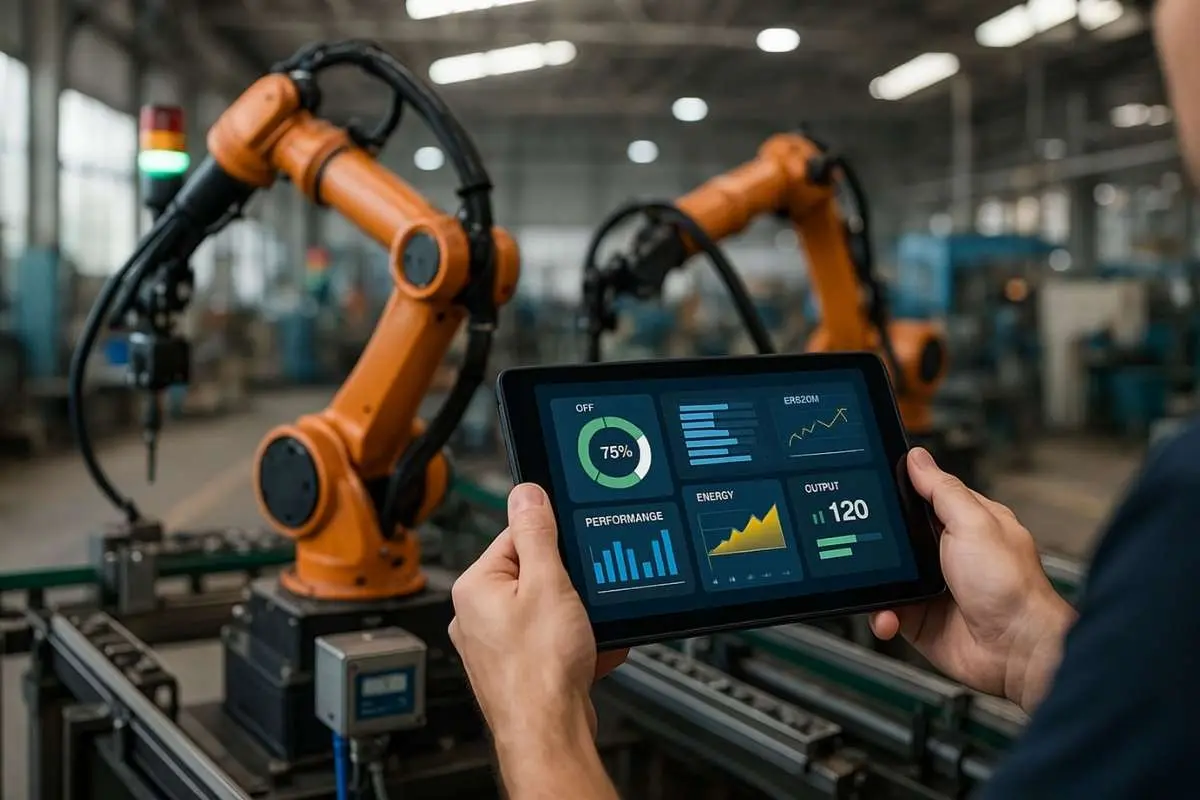
There is no single price tag for smart manufacturing. The cost depends on what you are trying to fix and how far you want to take the project.
Low-cost starting point
Basic sensors, digital data collection, simple dashboards, and software subscriptions can help a small factory start collecting useful data without changing its entire setup.
Mid-level investment
Machine monitoring, connected equipment, analytics, and system integration require more investment, but can provide deeper visibility into production and equipment performance.
Larger transformation
Advanced robotics, automation, digital twins, and integrated systems sit at the higher end of the investment range. These are better suited to businesses that have already tested smaller projects and know where the value lies.
The key difference is pilot cost versus full-factory transformation. For smart manufacturing for small businesses, starting with a focused pilot reduces the risk of spending heavily before knowing what works.
The OECD reported that 17.4% of small firms used AI in 2025, compared with 52% of large firms, highlighting the technology adoption gap between smaller and larger businesses.
Start small. Prove the value. Then spend more where the numbers justify it.
How can an SME prove that the investment is actually working?
Buying technology is not the result. Better business performance is. Before starting a smart manufacturing project, record a baseline so you can compare what changed afterward.
What should you measure?
Depending on the project, track:
- Downtime and maintenance costs
- Scrap rate and quality
- Production cycle and changeover time
- Energy use
- On-time production
- Labor hours spent collecting data
For smart manufacturing for small businesses, smart manufacturing ROI does not always mean producing more units. Fewer breakdowns, less waste, faster decisions, and better production visibility can all create value.
Deloitte’s 2025 survey found that manufacturers reported average improvements of 10% to 20% in production output, 7% to 20% in employee productivity, and 10% to 15% in unlocked capacity after implementing smart manufacturing initiatives. The survey covered 600 executives from large manufacturing companies, so these figures should be treated as a benchmark, not a promise for SMEs.
The simplest test is this: Did the problem you started with get measurably better? If yes, you have a case for scaling. If not, fix the approach before spending more.
What can small manufacturers do to reduce downtime first?
Downtime is one of the easiest places to see the value of better production data. The old process might look like this:
Before: Operator notices the machine has stopped → tells the supervisor → someone investigates → downtime gets recorded later.
By then, part of the story may already be missing.
With machine monitoring, the process can become:
After: Machine data identifies the stop → an alert is generated → the cause is logged → recurring patterns become visible.
That shift matters because it turns downtime from something people remember into something the business can measure and act on. A team can see which machines stop most often, when problems happen, and which issues keep coming back.
For smart manufacturing for small businesses, this can help to reduce downtime with smart manufacturing as a practical first project. The goal is not to monitor everything at once. Start with the machine or process causing the most disruption, then use the data to decide what deserves attention next.
What mistakes should small manufacturers avoid?
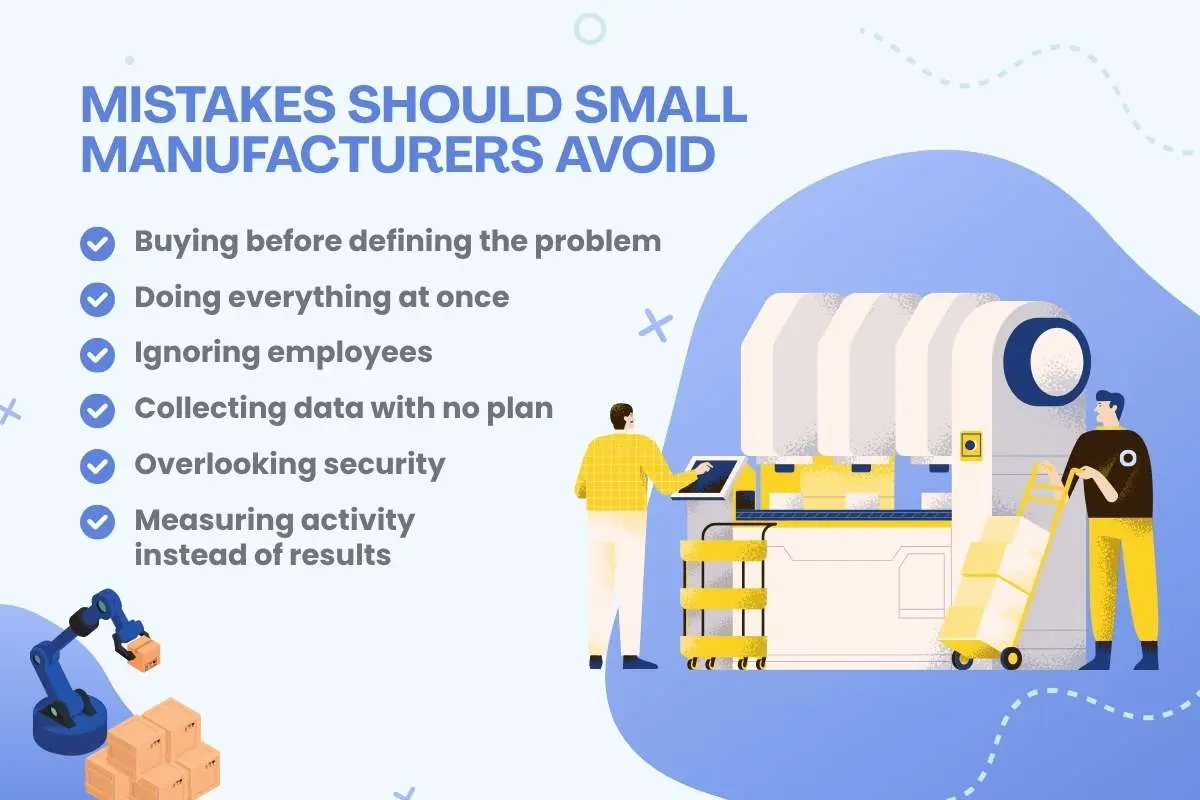
Smart manufacturing can solve problems, but only if the rollout does not create new ones. The most common smart manufacturing mistakes often start before the technology is even installed.
- Buying before defining the problem: Choose the problem first, then the technology.
- Doing everything at once: A factory-wide transformation can quickly become expensive and messy.
- Ignoring employees: If the people using the system find it confusing, adoption will suffer.
- Collecting data with no plan: More data is not automatically better data.
- Overlooking security: Connected machines and systems need proper access controls and cybersecurity.
- Measuring activity instead of results: Installing sensors is not a business outcome.
A factory can become very good at collecting useless data.
For smart manufacturing for small businesses, the better approach is to focus on measurable improvements. If a new system cannot help you make a better decision, reduce a cost, or solve a known problem, question whether you need it at all.
When should a small manufacturer consider a digital twin?
A digital twin can help when a manufacturer needs to model, monitor, or test a physical process digitally before making changes on the factory floor. But smart manufacturing for small businesses does not need to start there.
For many SMEs, basic data collection or machine monitoring can deliver value much sooner. Before investing in advanced tools, understand what is a digital twin and whether it solves a problem you actually have. If simpler technology does the job, there is no need to bring a digital twin into the factory just for bragging rights.
Conclusion: The smartest approach is usually a small pilot, not a factory-wide makeover
You do not need to transform the entire factory to find out whether smart manufacturing works for you. Start with one problem and keep the first experiment manageable.
A simple SME adoption roadmap
- Pick one problem: Focus on a recurring cost or bottleneck.
- Set a baseline: Record what the process looks like today.
- Choose a small intervention: Use the simplest technology that can help.
- Run a pilot: Test it in one machine, line, or process.
- Measure the result: Compare performance against your baseline.
- Fix what failed: Improve the approach before expanding it.
- Scale what works: Invest further only when the numbers support it.
The World Economic Forum reports that its Global Lighthouse Network sites have achieved, on average, 40% higher productivity alongside improvements in other operational measures through advanced manufacturing technologies.
That does not mean every SME will see the same result. But it shows why smart manufacturing for small businesses should be judged by measurable operational gains, not how much technology gets installed. For a broader look at how these technologies, processes, and connected systems fit together, understanding smart manufacturing as a whole can help you see where your next step should be.
FAQ
1. Can a small manufacturer adopt smart manufacturing on a limited budget?
Yes. Start with one measurable problem and use the simplest technology that can solve it.
2. Does smart manufacturing require replacing old machinery?
No. Sensors, monitoring devices, and data-collection tools can often add smart capabilities to existing equipment.
3. What should an SME automate first?
Start with a repetitive, time-consuming task or a process that causes frequent errors, delays, or downtime.
4. How can a small business measure smart manufacturing ROI?
Set a baseline before implementation, then track changes in costs, downtime, waste, productivity, quality, or labor time.
5. What is the best way to start smart manufacturing for small businesses?
Run a small pilot, measure the results, fix what does not work, and scale only when the numbers justify it.