Dubai company setup has become remarkably accessible, with the government digitizing much of the setup process, international ownership available for most activities, and entrepreneurs able to tap into a global commercial hub from the UAE.
However, Dubai company setup is only one part of the journey.
For international founders, the more challenging questions often arise after the initial Dubai company setup. Which structure truly fits the business? Which license is appropriate? What about banking, visas, tax registration, documentation, renewals, and ongoing compliance?
And once the company is operational, who provides support when something needs to be changed or renewed?
This distinction is becoming even more important in 2026. Dubai’s traditional free zone versus mainland choice has become more flexible, while government initiatives are making company formation increasingly digital.
For founders, this means a faster process, but navigating the correct procedures remains essential.
The real question is no longer simply “Why Dubai?” It is “How do I manage Dubai company setup without getting lost in everything that comes after the license?”
Why Dubai continues to attract global founders?
Dubai’s fundamental appeal to international founders remains consistent. Its strategic location connects Europe, Asia, and Africa within a single working day, while its ports and airports support international trade.
The government has also spent years building an environment designed to attract foreign capital and entrepreneurs.
The scale of that ecosystem continues to grow. In 2025, the Dubai Chamber of Digital Economy supported the establishment and expansion of 1,690 digital startups, a 39.7% increase from 2024.
Artificial intelligence companies accounted for approximately 15% of the companies supported, fintech represented 12%, and mobility tech, SaaS, and e-commerce together accounted for 20%. Global companies represented 75% of the total.
The Dubai Chamber of Commerce recorded 71,830 new member companies in 2025, bringing active membership to 292,486, a 13.2% year-on-year increase.
Indian-owned businesses were the largest source of new foreign members, followed by Pakistan, Egypt, and the UK.
Zooming out further, the UAE attracted AED 177.3 billion in inbound foreign direct investment in 2025, a 6% increase year on year. The UAE ranked ninth globally among destinations for inbound FDI, according to the latest UNCTAD World Investment Report.
While this figure covers the entire UAE rather than Dubai alone, it provides useful context for the scale of international business activity entering the country.
The numbers tell one story: more entrepreneurs are choosing the UAE.
The next question is how those entrepreneurs should approach their Dubai company setup once they arrive.
A technology startup selling internationally has very different licensing, premises, banking, and tax considerations from a retailer, restaurant, or trading company serving the UAE market directly.
Increasingly, founders need more than a company formation transaction. They need a process that can carry them from incorporation into actual business operations.
The two routes: free zone vs. Mainland
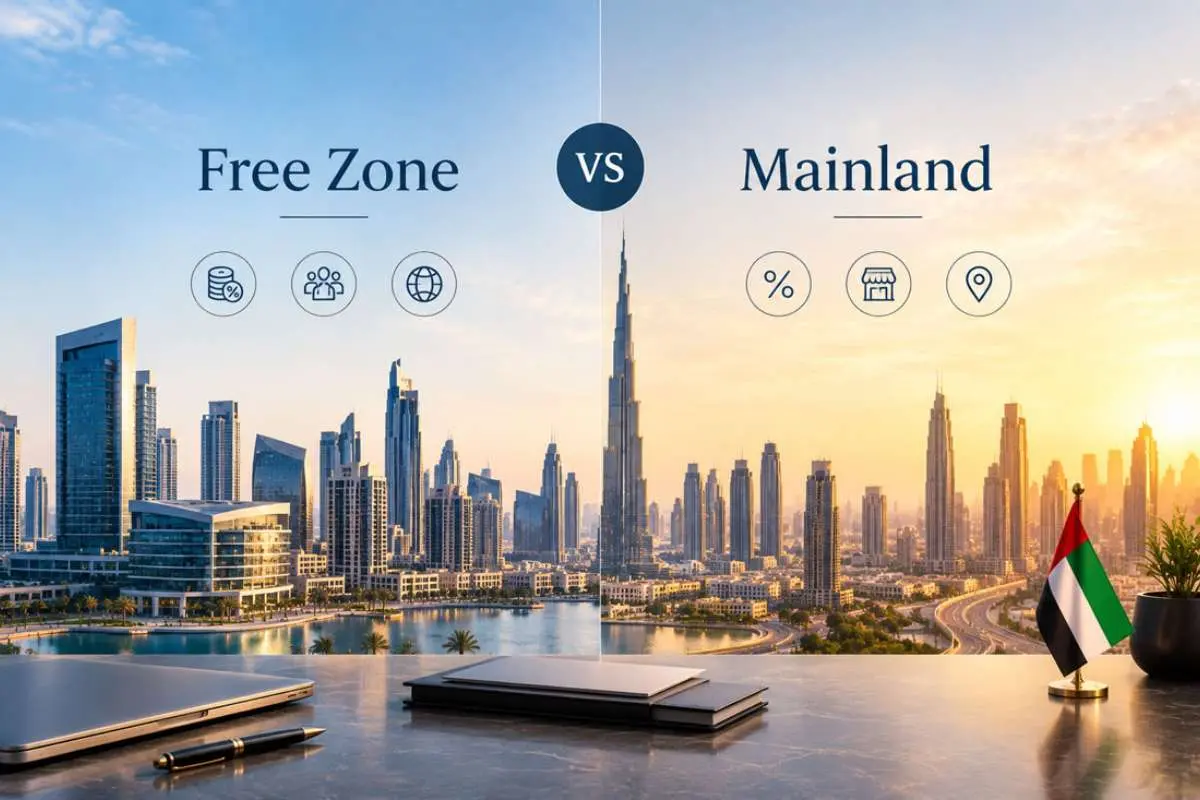
Every Dubai company setup begins with a choice between a free zone company and a mainland company. These are licensed by different authorities and operate under different regulations.
Every Dubai company setup begins with a choice between a free zone company and a mainland company.
Dubai’s official Invest in Dubai platform outlines the primary company setup options available.
Understanding these options is an essential part of planning a successful Dubai company setup.
Free zone companies operate within designated economic zones, while mainland companies are licensed through Dubai’s Department of Economy and Tourism.
A free zone entity can adopt several legal forms, such as a Free Zone Establishment (FZE) with a single shareholder or a Free Zone Company (FZCO) with two or more shareholders.
Some zones offer additional structures based on the business activity. A common mainland legal form is the Limited Liability Company (LLC), which is registered with the DET and subject to requirements specific to its activity.
Historically, free zones were particularly attractive for their 100% foreign ownership. Following amendments to the Commercial Companies Law, most activities for Dubai mainland companies can now also be 100% foreign-owned.
A small number of strategically important activities still have specific ownership or local participation requirements.
For most international founders, ownership is therefore no longer the primary deciding factor it once was. More critical questions include customer location, revenue generation, physical business needs, and operational intent.
This is why Dubai company setup should not be treated as a simple product purchase. The cheapest or fastest license is not necessarily the right one. The structure must fit the business.
The mainland access question just changed
Dubai’s business landscape has evolved significantly. Historically, free zone companies faced restrictions when conducting business directly outside their free zone.
Dubai has now introduced a framework that provides additional options for eligible free zone businesses.
Under Dubai Executive Council Resolution No. 11 of 2025, free zone establishments can conduct activities outside their free zone and within Dubai, provided they obtain the relevant license or permit.
In October 2025, Dubai officially launched the Free Zone Mainland Operating Permit.
Eligible free zone companies can apply through the Invest in Dubai platform, creating a structured route for certain mainland activities.
The framework can involve a branch license or a permit for specific activities. Temporary permits can be valid for up to six months, while other licensing arrangements may apply depending on the structure and activity.
This does not eliminate the free zone versus mainland decision.
Founders still need to determine whether their particular activity qualifies, which permissions are required, and whether a mainland structure might ultimately be more appropriate for their business.
For a founder, understanding how these options interact with licensing, customers, banking, premises, and ongoing compliance is precisely where professional guidance becomes valuable.
The rules may be increasingly digital, but the decision still requires context.
Free zones: more than a tax story
Free zones are often marketed primarily for their tax advantages, which significantly undersells their broader offerings.
The UAE Ministry of Economy and Tourism states that more than 40 free zones operate across the UAE, covering a wide range of sectors and business activities.
Each free zone offers a different combination of licensing, infrastructure, workspace, visa capacity, and sector-specific advantages.
Many free zones provide flexible workspace options such as flexi-desks or shared offices. However, specific requirements depend on the chosen free zone, business activity, and number of visas needed.
Costs and incorporation timelines also vary. Some free zones offer largely digital registration for standard activities, while others involve more substantial compliance and infrastructure requirements.
The tax position, while real, comes with an important caveat.
A free zone company does not automatically receive the UAE’s 0% corporate tax rate simply by being incorporated in a free zone. It must qualify as a Qualifying Free Zone Person under UAE corporate tax law and meet the relevant conditions.
For businesses whose activities and income genuinely fit this framework, the 0% rate on qualifying income can be significant.
However, the outcome depends on the company’s activities, income mix, structure, and ongoing compliance, not merely on the name of the free zone.
This is another area where founders can benefit from looking beyond the formation fee. Choosing the structure is one decision. Understanding how to maintain it correctly is another.
Mainland: when it actually makes sense
A mainland company can be advantageous when broader access to the UAE market outweighs any additional licensing, premises, or regulatory requirements for the chosen activity.
It allows direct sales to UAE customers, participation in government contracts, and operations across the emirate.
For a retail brand, restaurant group, healthcare provider, or professional services firm targeting local corporate clients, this access may be central to the business model.
Depending on the license and activity, mainland businesses may require registered premises. However, Dubai’s licensing initiatives have allowed some eligible businesses to start without a lease or fixed location during an initial period.
Mainland companies subject to the standard corporate tax regime are taxed at 0% on taxable income up to AED 375,000 and 9% above that threshold.
The standard regime does not require the company to qualify for the separate Qualifying Free Zone Person framework, although other UAE compliance and regulatory requirements may still apply.
The important point is not that mainland is inherently better or worse than a free zone.
The business should determine the structure, not the other way around.
Choosing based on what the business actually does

The right structure is one of the most important decisions in Dubai company setup and stems from a few practical questions.
Where does the revenue actually come from: international clients, UAE-based customers, or a combination of both?
Does the new mainland permit framework cover the specific activity?
What does the business physically need: a flexi-desk, office, shop, warehouse, or perhaps nothing at all?
Does the business need access to government contracts? How many visas will the team require? Which license category accurately describes the activity?
What documentation will the bank expect?
And what happens when the license needs to be renewed or the business needs to change its activities?
These questions may sound straightforward, but they are where many founders end up needing help.
A growing number of businesses also use more than one structure. A free zone entity may handle international invoicing, while a mainland branch, local distributor, or eligible mainland operating permit handles UAE-based activity.
The important part is building a structure around the reality of the business.
This is also where a modern company setup service needs to go beyond submitting forms.
Founders increasingly expect to see what is happening, upload documents securely, track progress, receive updates, and manage the company after incorporation.
They should not have to start from zero every time they need assistance.
What comes after the license?
The trade license is a visible milestone in Dubai company setup, but it is not the finish line.
A corporate bank account still needs to be opened, and UAE banks conduct thorough due diligence on new business accounts. Incomplete documentation or an unclear description of the business activity can cause delays.
Dubai has been working to reduce this friction. The Dubai Unified Licence provides businesses with a government-verified digital identity and is designed to simplify interactions across different services.
Residency visas and Emirates ID processing follow the license.
Corporate tax registration applies to taxable persons, including free zone entities, even where the company ultimately qualifies for a 0% rate on qualifying income.
VAT registration may also become relevant once the applicable thresholds are reached.
And then there is the ongoing administration.
Licenses expire. Documents need updating. Visas need renewing. Banks may request additional information.
Companies change activities, add employees, modify shareholders, or need new certificates.
For a founder running an actual business, these tasks are rarely the reason they moved to Dubai in the first place.
This is why the quality of support around Dubai company setup matters.
A founder should not have to restart the search for help every time something needs to be done.
The rise of digital-first business setup
Dubai’s government infrastructure has shifted further toward digital-first Dubai company setup than many founders realize.
In October 2025, DET’s Dubai Business Registration and Licensing Corporation unveiled the next-generation Invest in Dubai platform at GITEX Global.
The upgraded platform introduced its 360 Services feature, bringing licensing, permits, and approvals from multiple government entities into a single digital interface.
Since its launch in 2021, the platform has attracted more than 500,000 users, facilitated 1.3 million transactions, and enabled the incorporation of 280,916 new businesses.
Processing times for licenses and related services fell from 14 days in 2022 to approximately one day in 2025.
The shift continued into 2026.
In June, DET launched SME in a Box, designed to give founders a single entry point to licensing support, banking, digital payments, logistics, telecommunications, and other operational services through a network of private-sector partners.
These developments are important indicators of Dubai’s direction.
Company formation is becoming increasingly digital, connected, and streamlined.
However, a digital government service and a human-led business setup service address different needs.
A government platform can expedite transactions and bring multiple services together.
Founders may still need personalized guidance from someone who understands their broader business context, can help them interpret their options, and remains available when circumstances change.
This is where modern business setup platforms can add another layer of value.
The opportunity is no longer simply to digitize company formation. It is to simplify the entire founder experience.
Common mistakes founders make
Certain patterns repeatedly emerge among founders who move quickly and later discover that their setup does not match the business.
- Choosing a free zone based on the cheapest headline price without checking renewal costs, visa fees, office requirements, and the total cost of maintaining the company.
- Selecting a license category that does not accurately reflect the business’s actual activity, only to encounter questions later from a bank, client, regulator, or service provider.
- Assuming identical tax treatment across free zones. Qualification depends on the specific activity, structure, and applicable requirements rather than simply having a free zone license.
- Underestimating ongoing compliance. Some free zones impose annual audit or financial statement requirements while others do not. The specific authority’s rules need to be checked rather than assumed.
- Treating company formation as a one-time transaction. A license may be issued quickly, but banking, visas, tax registration, renewals, amendments, and ongoing administration continue long after incorporation.
The final mistake is particularly easy to make in an increasingly digital market.
When setup can happen quickly, founders can assume the entire business journey should be equally simple.
In reality, speed is valuable only when it is combined with accuracy and continued support.
How GenZone approaches this?

This is where GenZone’s approach differs from a traditional company formation transaction.
GenZone’s founders have firsthand experience navigating the complexities of setting up and operating businesses in the UAE.
That experience shaped the company’s philosophy: company formation should not end when the license arrives.
GenZone combines the digital convenience founders now expect with ongoing human support.
Through its client platform, founders can onboard digitally, submit and manage documents, track their application’s progress, receive licensing documentation, and continue managing important company-related processes, including renewals.
The platform is only one part of the experience.
Instead of leaving founders to navigate a ticket system or search through government portals whenever they have a question, GenZone provides direct human support, including a dedicated WhatsApp group for client communication.
The aim is straightforward: make the process fast and reliable without making the founder feel like they are managing it alone.
That distinction becomes particularly important when non-routine situations arise.
A founder may need to determine whether a specific activity is suitable for a free zone or mainland structure. A bank might request additional documentation. A visa may require renewal. A license might need an amendment.
These issues are not necessarily complex, but founders would rather have someone help resolve them than figure everything out from scratch.
GenZone’s Dubai company setup service therefore offers more than license acquisition.
It combines technology, expertise, and ongoing human support throughout the business setup journey.
The approach is informed by the founders’ own experience navigating the UAE business environment.
Instead of a purely transactional model, GenZone has built a platform around what founders need after they decide to establish a company.
A final checklist
Before signing anything, a founder evaluating Dubai should be able to clearly answer a short list of questions:
- What is the core business activity, and does it match an available license category?
- Which structure, free zone, mainland, or dual structure, fits where the revenue actually comes from?
- Does the chosen structure provide the market access, premises, and visa capacity the business needs?
- What does the realistic all-in cost look like across formation, visas, banking, and renewal?
- What are the actual banking and compliance timelines?
- What will the ongoing corporate tax, VAT, and audit obligations be once the business is operational?
- And perhaps most importantly, who will help manage the process after the license has been issued?
The last question is easy to overlook because company formation is often presented as the destination.
It is actually the beginning.
The bottom line
Dubai has made starting a business easier than ever.
Its tax framework, international connectivity, foreign ownership rules, growing SME ecosystem, and increasingly digital government infrastructure have created a compelling environment for international entrepreneurs.
But easier formation does not eliminate the need for sound decisions or continuous support.
The future of business setup is unlikely to be purely digital or purely human.
It is the combination of both: technology that streamlines onboarding, documentation, tracking, licensing, and renewals, backed by people who understand the business behind the application.
That is the model GenZone is building around.
Because for an entrepreneur coming to Dubai, obtaining a license is merely one milestone.
What truly matters is having a reliable partner beside you for everything that comes next.