Five Guys built its brand around a simple idea: make the food good enough that customers do the marketing. For much of its history, the burger chain relied heavily on word-of-mouth, product quality, and employee incentives rather than conventional advertising.
Driven by viral social media posts highlighting the cost of a typical Five Guys meal, critics periodically question whether the premium-priced model can sustain its growth. Yet the financial picture is more complicated. The brand isn’t collapsing; Five Guys generated about $2.27 billion in U.S. systemwide sales in 2024, according to QSR’s 2025 ranking.
How does an enterprise thrive in a hyper-competitive quick-service restaurant (QSR) market without a traditional ad budget? To answer this question, any comprehensive Five Guys case study must look beyond surface-level hype and examine the operational infrastructure, economic tradeoffs, and behavioral incentives that power this fast-casual juggernaut.
FIVE GUYS AT A GLANCE
- Founded: 1986 (Arlington, Virginia)
- Global Footprint: 1,900+ restaurants worldwide (2026)
- U.S. Systemwide Sales: $2.27B (2024)
- Traditional National Advertising: Historically Limited
Built a Brand Without Traditional Advertising
To understand any modern Five Guys case study, one must travel back to 1986 in Arlington, Virginia. Founders Jerry and Janie Murrell offered their sons a straightforward choice: start a business or go to college. The family chose to open a small hamburger carryout shop based on a simple, uncompromising rule passed down from Murrell’s mother: “If you can make a good hamburger, even if you’re in an alley, people will find you.”
In the early years, expansion was deliberate and localized. Throughout the late 1980s and 1990s, the family perfected their simple, fresh-never-frozen concept, growing to just five locations within the Washington, D.C. metro area. The turning point arrived in 2003 when the Murrells finally embraced regional franchising. Within 18 months of opening territory sales, over 300 franchise units were sold out.
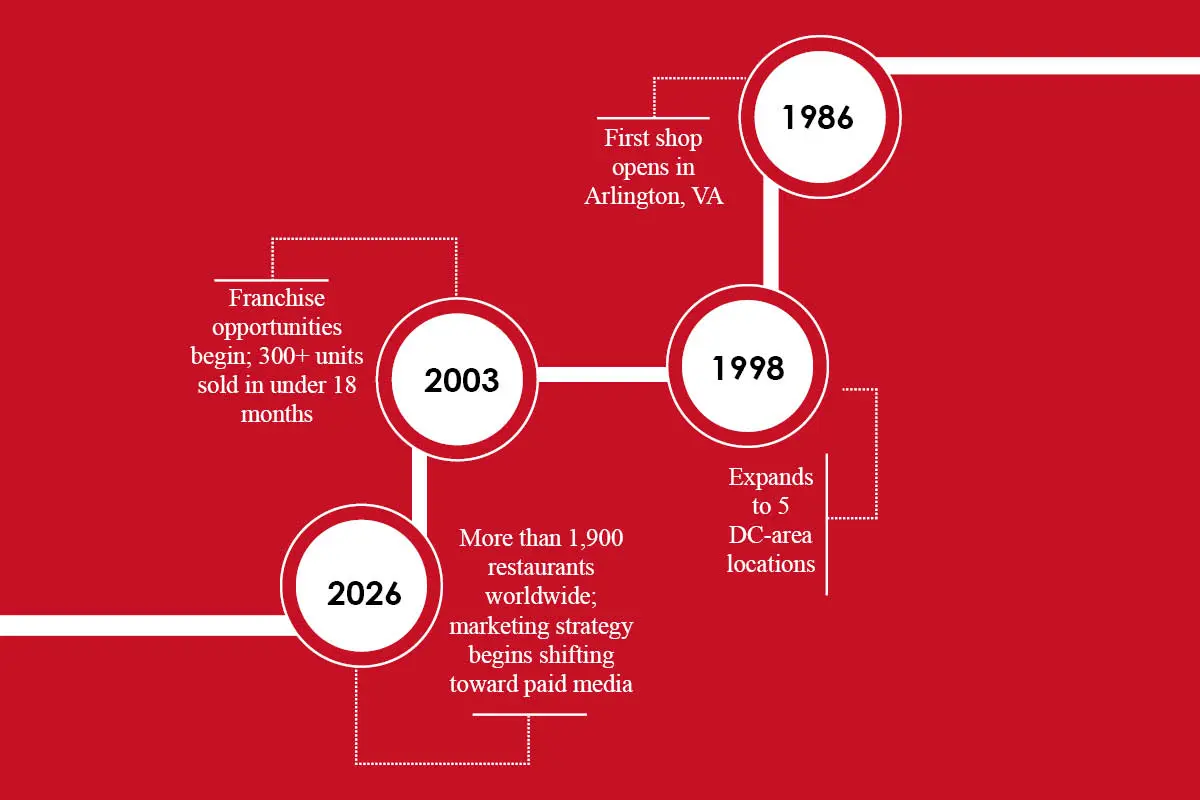
- 1986: First shop opens in Arlington, VA
- 1998: Expands to 5 DC-area locations
- 2003: Franchise opportunities begin; 300+ units sold in under 18 months
- 2026: More than 1,900 restaurants worldwide; marketing strategy begins shifting toward paid media
Rather than building its brand primarily through conventional national advertising, Five Guys historically put greater emphasis on the restaurant experience, food quality, and employee incentives. Relying heavily on conventional advertising, Five Guys historically directed marketing resources toward the customer experience and employee incentives. Those priorities included investment in ingredients and employee incentive programs designed to reinforce store-level execution.
Deconstructing the Five Guys Business Model
The core of the Five Guys Business Model relies on radical operational simplicity paired with uncompromising quality control. Rather than attempting to appeal to every consumer demographic with sprawling menus, breakfast options, or drive-thrus, the brand concentrates on a relatively focused menu built around burgers, hot dogs, fries, sandwiches, and shakes.
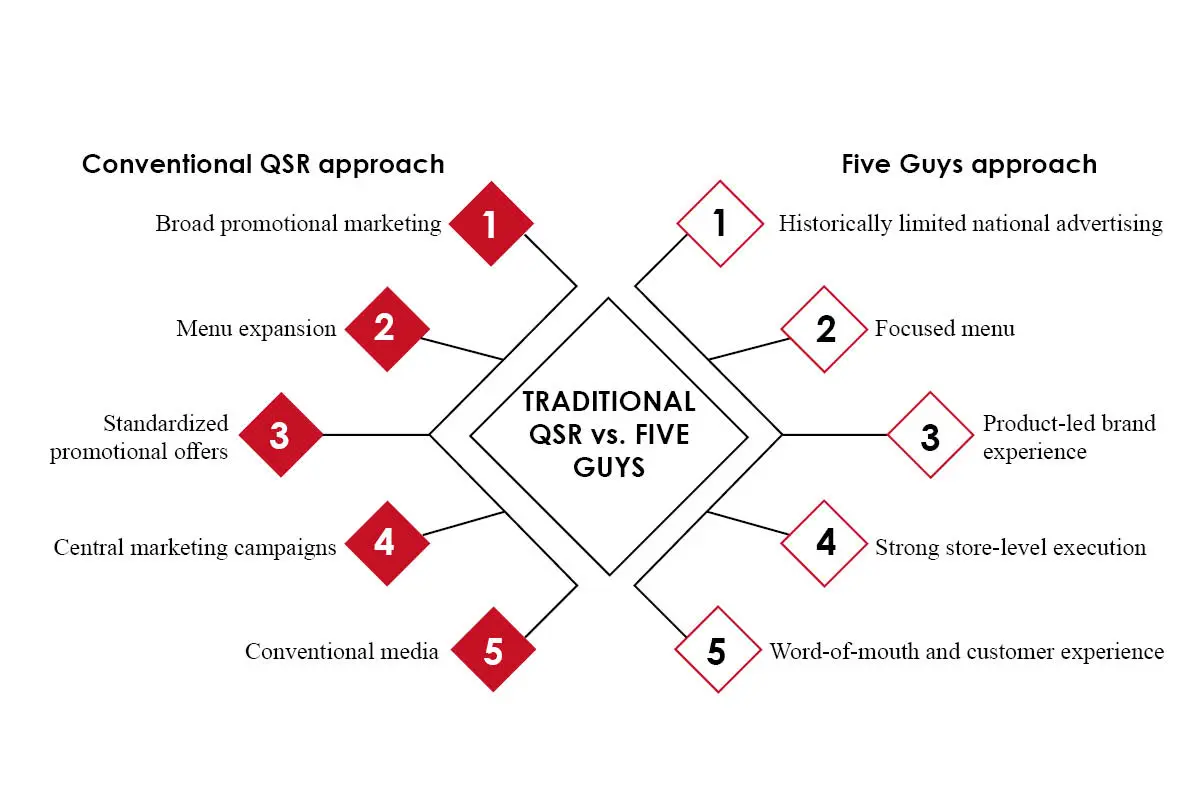
| TRADITIONAL QSR vs. FIVE GUYS | |
| Conventional QSR approach | Five Guys approach |
| Broad promotional marketing | Historically limited national advertising |
| Menu expansion | Focused menu |
| Standardized promotional offers | Product-led brand experience |
| Central marketing campaigns | Strong store-level execution |
| Conventional media | Word-of-mouth and customer experience |
1. Capital Reallocation: Food Quality as Customer Acquisition
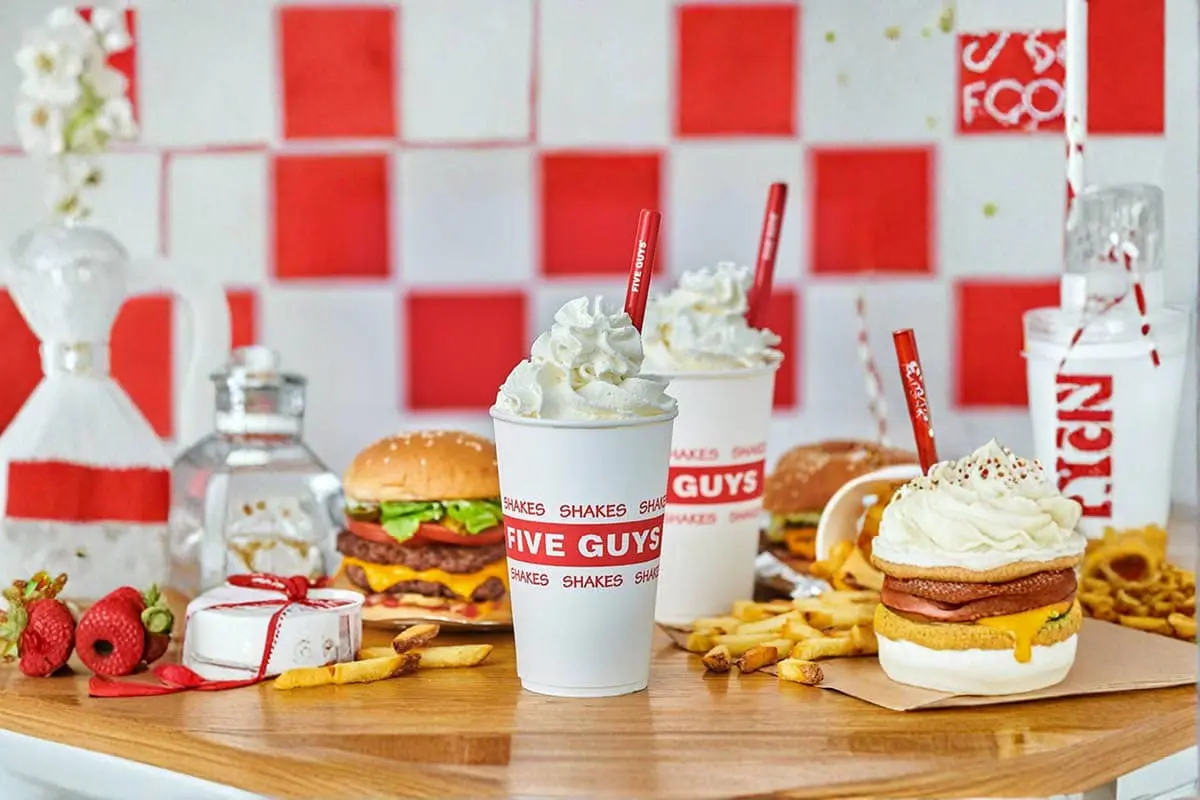
A thorough Five Guys case study reveals that the kitchen layout itself acts as the company’s primary billboard. Inside a store, you will not find freezers, timers, or microwave ovens. All beef is delivered fresh, held in walk-in coolers, and hand-formed into patties daily. French fries are cut in-house every morning from whole Idaho potatoes and cooked exclusively in pure peanut oil.
By making food quality part of the brand-building engine, Five Guys turned the restaurant experience itself into a marketing asset. This creates a self-sustaining word-of-mouth loop that reduces the brand’s dependence on traditional marketing campaigns. (Source)
2. The Secret Shopper Quality Control Mechanism
Instead of paying external marketing firms, the company channels millions of dollars annually back to store-level teams through a weekly Secret Shopper program.
- Two Secret Shops Per Week: It uses a confidential secret-shopper program to evaluate restaurant performance. According to the company, each restaurant receives two secret shops per week, with eligible employees able to earn bonuses based on results.
- Strict Scoring Metrics: Shoppers evaluate raw food assembly, grill temperature, service speed, line cleanliness, and employee greeting warmth.
- Direct Crew Payouts: Franchise and corporate dollars are placed into a central pool and disbursed as direct cash bonuses to crew members who score at the top.
In analyzing this Five Guys case study, business leaders discover an alignment of incentives: when frontline line cooks and cashiers stand to earn cash bonuses based on quality scores, store operations self-correct without needing top-down corporate policing.
Read More: Spoonflower: The Custom Fabric and Wallpaper Business Built on Design
How the Five Guys Experience Drives Word-of-Mouth
The underlying driver of any successful Five Guys Success Story is behavioral design. The company systematically engineers positive consumer impressions inside the store through intentional psychological triggers.
THE “EXTRA SCOOP” ECONOMICS
- [Low Raw Ingredient Cost] ──> Bulk Idaho Potatoes
- [High Perceived Value] ──> Overflowing Bag
- [Business Outcome] ──> Free Organic Word
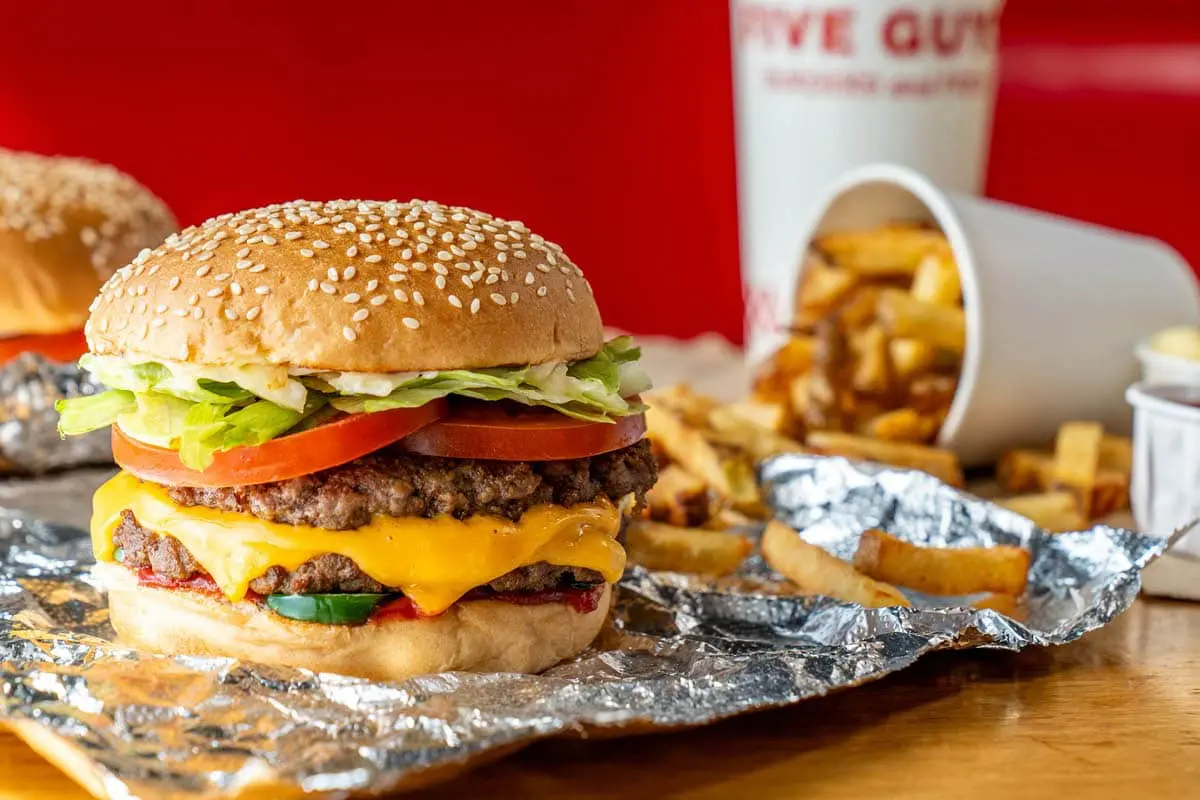
Consider the familiar “extra scoop” of fries added to the paper bag. It is a small operational detail, but it illustrates a larger marketing principle: physical cues can shape how customers perceive value and remember an experience.
The overflowing bag creates a visible sense of generosity. Customers receive more than what appears to fit inside the standard serving container, turning an ordinary side of fries into a memorable part of the Five Guys experience.
Whether this portioning is deliberate behavioral design or simply part of the brand’s generous serving style, the effect is easy to understand. The customer leaves with a physical reminder of the experience, reinforcing the perception that Five Guys offers something different from a typical burger chain.
For businesses, the lesson is broader than fries. Small, repeatable details in the customer experience can become recognizable brand signals, especially when customers naturally share those experiences with others.
How Five Guys’ Premium Pricing Tests the Model
Why do rumors questioning whether the company is shutting down periodically trend across social platforms?
Five Guys’ premium pricing creates a different strategic tension. Fresh ingredients, generous portions, and a labor-intensive preparation model can carry a higher cost base than a value-oriented burger chain. The company has largely maintained that positioning rather than competing primarily on price.
PRICE VS. PERCEPTION FRICTION
Commodity Inflation (Fresh Beef, Peanut Oil, Potatoes) -> Refusal to Compromise on Raw Ingredients -> Prices Passed Directly to Store Menu -> Viral Social Media Receipts & “Closing” Rumors -> Financial Reality: Average Unit Volumes Hold Strong
This pricing choice sparked significant internet backlash. Yet, an objective audit of unit economics in this Five Guys case study confirms that QSR’s 2025 data put Five Guys’ U.S. average unit volume at about $1.54 million in 2024, giving a more current picture of the brand’s store-level performance.
Strategic Conclusion
The Five Guys Case Study is not proof that advertising is unnecessary. It is proof that a strong product and consistent customer experience can become powerful marketing assets in their own right.
For decades, Five Guys built its reputation through food quality, operational discipline, employee incentives, and word-of-mouth rather than relying heavily on traditional national advertising. But the brand is now entering a new phase, with greater investment in digital and paid media.
The lesson for business leaders is clear: marketing does not always begin with an advertising campaign. When the product experience is strong enough, the customer can become part of the marketing engine. Five Guys’ next chapter will show how that word-of-mouth foundation performs when combined with a more modern marketing strategy.
Frequently Asked Questions
1. Is Five Guys still using a no-advertising strategy?
No longer in the absolute sense suggested by its historical reputation. Five Guys launched a national advertising campaign in 2026 and subsequently appointed a new U.S. media agency, marking a significant evolution from its historically limited national advertising model.
2. How did Five Guys grow without traditional advertising?
Five Guys historically relied heavily on product quality, customer experience, word-of-mouth, and employee incentives instead of conventional national advertising.
3. What is the Five Guys business model?
The model combines a focused menu, fresh food preparation, franchising, operational consistency, and a strong emphasis on customer experience.