Why Good Knowledge Needs a Clear Path
Ever watched two people solve the same problem because neither knew the other had already fixed it? That is a knowledge problem, not a people problem.
Imagine an employee solving a tricky customer issue, only for the solution to stay buried in their inbox. A month later, someone else faces the same issue and starts from scratch. Round and round the team goes.
Saving a file is not enough. The knowledge management process gives useful lessons a clear path, from capture to action, so teams can find answers instead of reinventing the wheel.
What Is the Knowledge Management Process?
The knowledge management process is how a business creates, captures, reviews, shares, finds, and uses what its people know. It turns useful lessons into knowledge others can apply.
Think of a support agent who solves a tricky customer issue. The team records the fix, checks the steps, and adds them to a shared guide. When the same problem returns, another agent can use that guide instead of starting from scratch.
How the Process Differs From the System
| Term | What It Means |
| Process | The steps knowledge follows, from creation to use |
| System | The tools and shared spaces that support those steps |
| Framework | The wider approach that guides and governs the work |
A knowledge management framework helps teams shape their approach, while the process explains what happens in practice.
Publishing a guide is not the finish line. Teams must keep it accurate, useful, and easy to find.
How Does the Knowledge Management Process Work Step by Step?
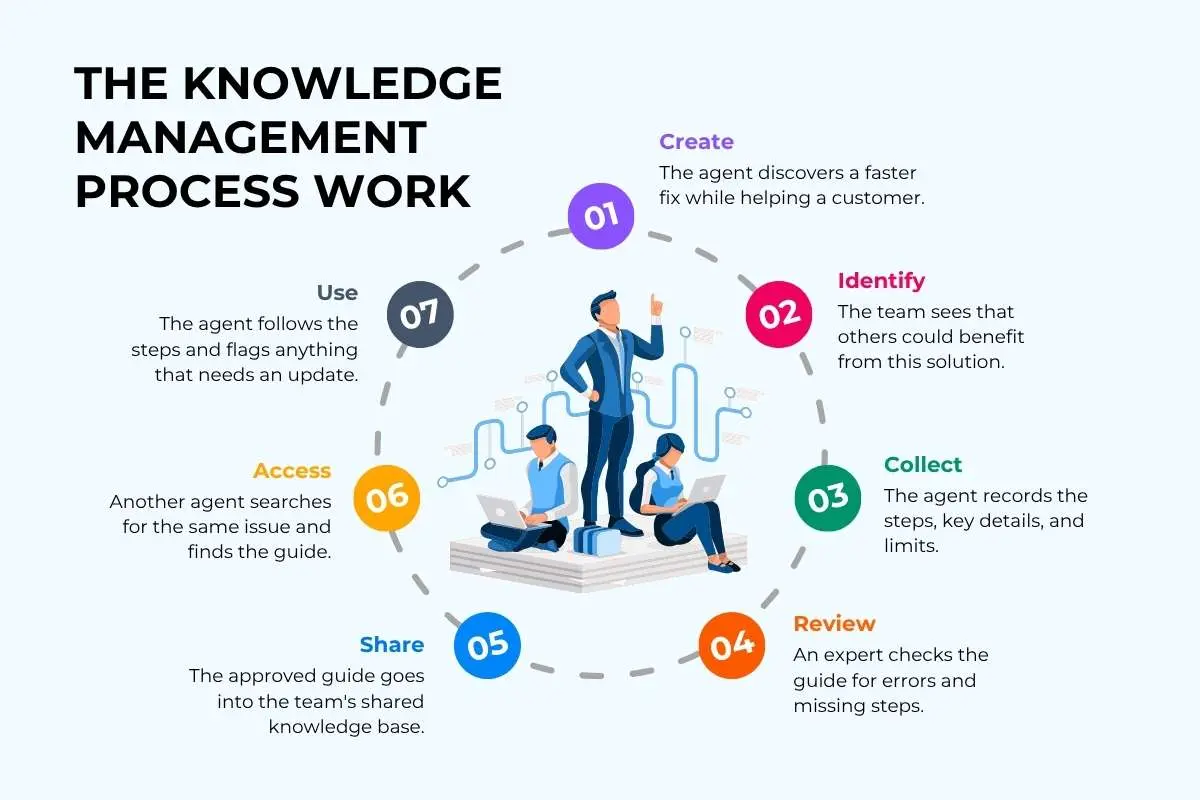
APQC’s seven-step knowledge flow model shows how useful knowledge moves from an idea to real action. Let’s follow one example: a support agent finds a faster way to fix a common customer issue.
- Create: The agent discovers a faster fix while helping a customer.
- Identify: The team sees that others could benefit from this solution.
- Collect: The agent records the steps, key details, and limits.
- Review: An expert checks the guide for errors and missing steps.
- Share: The approved guide goes into the team’s shared knowledge base.
- Access: Another agent searches for the same issue and finds the guide.
- Use: The agent follows the steps and flags anything that needs an update.
Each step has a clear result. A useful idea becomes a record, the record becomes trusted guidance, and that guidance helps someone solve a real problem.
What Should Happen at Each Stage?
| Stage | Main question |
| Create and identify | Is this knowledge useful? |
| Collect and review | Is it clear and correct? |
| Share and access | Can the right people find it? |
| Use | Does it solve the problem? |
This flow works best when each step leads to the next. If a guide is unclear or hard to find, the process breaks down.
Where do the tools fit?
Knowledge management systems support this flow by storing approved guides and helping employees find them. But tools alone cannot decide what matters, check every detail, or keep content accurate. People still need to own those tasks.
What Happens When Knowledge Gets Stuck?
A knowledge management process can look fine on paper and still fail in daily work. The trouble starts when useful knowledge gets lost, ignored, or left to gather dust.
- Nothing gets captured: Employees solve problems, but the lessons stay in their heads or inboxes.
- The content is unclear: Guides miss key steps, examples, or context.
- Nobody owns updates: Old instructions stay live after the process changes.
- Answers are hard to find: Knowledge is scattered across folders and tools.
- Nobody uses the guide: Employees cannot trust it or see how it fits their work.
Warning Signs to Watch For
| Warning sign | Likely problem |
| The same questions keep returning | Answers are hard to find or incomplete |
| Two guides give different answers | Reviews or ownership are weak |
| One expert answers everything | Key know-how is not shared |
The risk grows when experienced staff leaves. SHRM’s 2025 research found that 64% of HR professionals said their organizations did not formally document knowledge about client or partner relations, putting valuable institutional knowledge at risk when employees leave.
This points to a gap in knowledge transfer, not just a lack of documents.
Planning for better employee retention through knowledge management also means capturing critical know-how before experienced employees leave. After all, a useful lesson does little good if nobody else can access it.
Which Tools Support the Knowledge Management Process?

The right tools help knowledge move between people without getting lost. Four types support the knowledge management process:
- Knowledge bases: Store approved guides, answers, and procedures.
- Document management tools: Track files, versions, and changes.
- Search tools: Help employees find answers across sources.
- Collaboration tools: Help teams share lessons and solve problems.
The best choice depends on the problem. If employees struggle to find guides, better search may help. If the guides contain errors, better search will only help people find the wrong answers faster.
Where Does AI Fit?
APQC’s 2026 survey found that 49% of respondents named AI and other smart technology as a top knowledge management priority.
AI can help people find and sort information, but reliable content must come first. The right Knowledge management tools support the work. They cannot replace clear processes, accurate content, or human review.
How Can You Build a Process That Employees Actually Follow?
Start small. A huge rollout can wait.
- Pick one problem: Target repeated questions, slow onboarding, or reliance on one expert.
- Map the workflow: Find where knowledge starts, moves, and gets lost.
- Assign clear roles: Name who creates, checks, and updates content.
- Fit it into daily work: Capture lessons after projects or support cases.
- Test with real users: Ask an employee to find and use an answer without help.
- Fix weak points: Improve unclear steps and missing details.
Regarding Knowledge management for startups, one focused workflow is a smart start. Test it from end to end before expanding. Real users reveal problems that polished demos often miss.
How Do You Know If the Process Is Working?

A busy knowledge base does not always mean a useful one. The real test is whether employees can find answers, avoid repeat mistakes, and trust what they read.
Three Metrics Worth Tracking
| Metric | What it tells you |
| Time to find an answer | Can employees find what they need quickly? |
| Repeat questions or errors | Does shared knowledge prevent repeat problems? |
| Content accuracy | Can employees trust the information? |
Check accuracy by comparing guides with current procedures, asking subject-matter experts to review them, and correcting outdated or conflicting information.
APQC’s 2026 survey found that 59% of organizations were in the two earliest stages of knowledge management maturity. This shows why getting the basics right matters before adding complex features.
Good Knowledge management metrics connect results to real work. Judge the knowledge management process by the problems it solves, not the number of documents it stores.
Conclusion
A strong knowledge management process helps useful knowledge move from one person to another, ready to be found, trusted, and used. You do not need a complex system to get started. Pick one common team question, document the answer, have an expert check it, and let another employee test it. This is the foundation of effective Knowledge Management.
Frequently Asked Questions
1. What Are the Main Steps in a Knowledge Management Process?
Create, identify, collect, review, share, access, and use knowledge.
2. Who Is Responsible for Knowledge Management?
Teams share responsibility, with clear owners for content and reviews.
3. How Often Should Knowledge Be Updated?
Review it when work changes and at planned intervals.
4. Can Small Businesses Use Knowledge Management?
Yes. Start with shared guides and clear ownership.