


Understanding Papa John’s current position
Papa John’s is facing a significant sales setback in North America, where comparable sales fell 8.3% year over year in the second quarter of 2026. The decline highlights the pressure on the pizza chain to attract customers in a market shaped by aggressive promotions, price sensitivity, and changing expectations around food quality and value. While international comparable sales grew 1.5% during the same period, global comparable sales still declined 5.7%, showing that international growth has not offset the weakness in North America. Papa John’s Second Quarter 2026 Financial Results
The company’s response makes its turnaround an important case study in restaurant performance and recovery. In September, CEO Todd Penegor discussed the need to address product quality, restaurant operations, and customers’ perception of value. With third-quarter results scheduled for November 5, 2026, the effectiveness of Papa John’s turnaround strategy remains to be assessed against future sales and profitability figures, rather than plans alone. The Wall Street Journal, Papa John’s to Report Third Quarter 2026 Results on November 5, 2026
The main restaurant business challenges facing Papa John’s
Papa John’s second-quarter 2026 results show the scale of the pressure on its North American business. Global system-wide restaurant sales declined 4.8%, while North American comparable sales fell 8.3% year over year. The company also revised its full-year outlook, projecting a 6% to 8% decline in North American comparable sales and lower adjusted EBITDA than previously expected. These figures highlight the extent of Papa John’s business challenges and explain why the company needs to improve performance beyond short-term promotional activity. Papa John’s Second Quarter 2026 Financial Results
The decline in reported revenue needs to be viewed alongside changes in the company’s restaurant portfolio. Revenue fell 8.8% to $482.4 million in Q2, partly reflecting the refranchising of 85 company-owned restaurants in late 2025. However, the drop in North American comparable sales indicates that weaker performance at existing restaurants is also a concern. Refranchising helps explain part of the revenue movement, but it does not account for the comparable-sales decline.
Competition and customer value perceptions add to the challenge. The market has become highly promotional, while lower order volumes and a softer consumer environment have weighed on North American performance. September reporting also highlighted the company’s focus on pizza quality, restaurant execution, and the value customers believe they receive. The Papa John’s sales decline therefore reflects a combination of financial, competitive, and customer-experience pressures. Its recovery will depend on addressing these issues while tracking whether changes lead to stronger demand and more sustainable profitability. WSJ Aug 6, 2026, The Wall Street Journal
Papa John’s performance at a glance
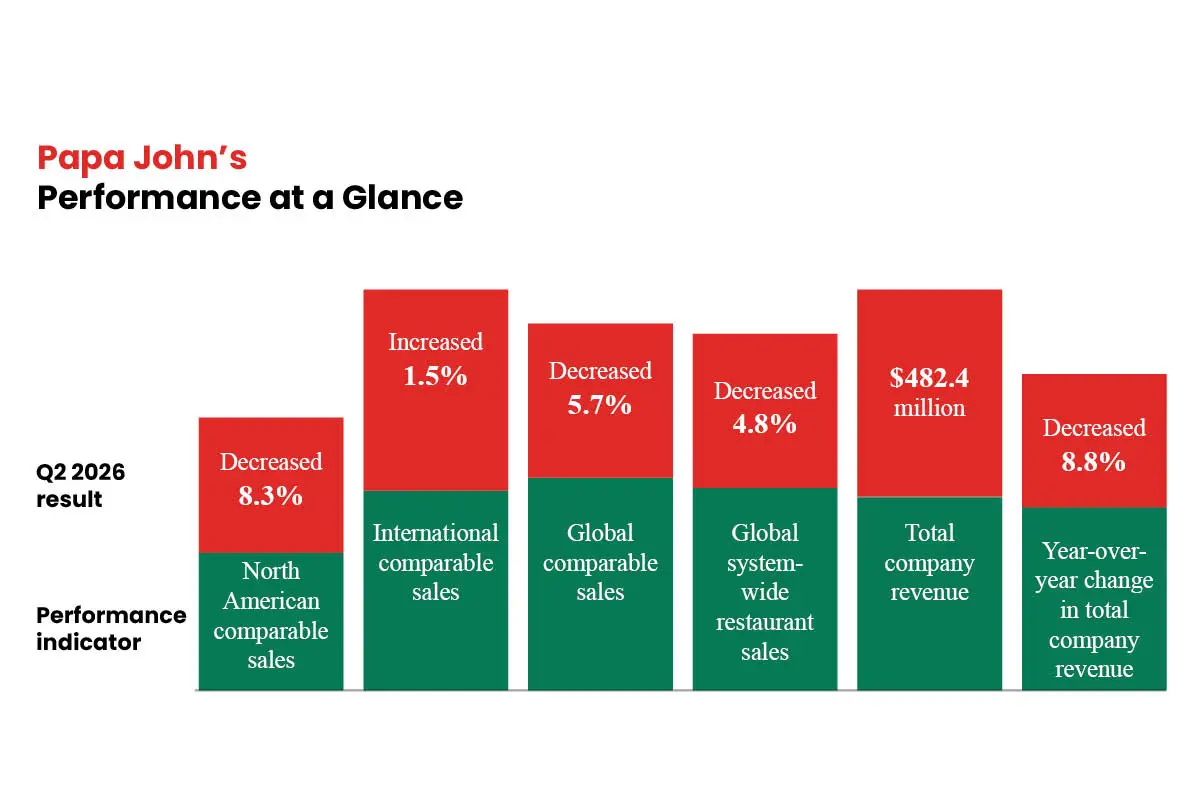
| Performance indicator | Q2 2026 result |
|---|---|
| North American comparable sales | Decreased 8.3% |
| International comparable sales | Increased 1.5% |
| Global comparable sales | Decreased 5.7% |
| Global system-wide restaurant sales | Decreased 4.8% |
| Total company revenue | $482.4 million |
| Year-over-year change in total company revenue | Decreased 8.8% |
Source: Papa John’s Second Quarter 2026 Financial Results
Why Papa John’s is losing ground in a competitive market
Papa John’s operates in a crowded pizza and quick-service restaurant market where customers can compare prices, promotions, delivery options, and food quality across multiple brands. Its second-quarter 2026 results identified a softer consumer environment, lower order volumes, and a highly promotional market as ongoing pressures in North America. These factors have made it harder for the company to attract enough customer visits to offset declining comparable sales. The Papa John’s sales decline reflects these documented market pressures alongside challenges specific to the company’s own performance.
Value is a central part of the competition. When rival restaurants use discounts and bundled offers to attract price-conscious customers, Papa John’s must demonstrate why its products are worth choosing at their price. Promotions can encourage orders in the short term, but relying too heavily on discounts can put pressure on restaurant profitability. The company therefore needs to balance attractive offers with product quality and a consistent customer experience.
Digital convenience and restaurant execution also matter. Ordering should be straightforward, while food preparation, presentation, and service need to meet customer expectations across locations. Papa John’s has identified digital improvements and operational changes as part of its broader transformation. However, these initiatives will need to produce measurable results, including stronger order volumes and improved comparable sales, before they can be considered evidence of a successful recovery. This is a central test for Papa John’s turnaround strategy: whether improvements to value, product experience, and convenience can help the brand compete more effectively without undermining profitability.
Source: Papa John’s Q2 2026 Form 10-Q
Papa John’s recovery strategies: What is the company doing?
Papa John’s is working to improve customer engagement through menu innovation, loyalty initiatives, and digital ordering. The company introduced new mobile apps and a refreshed website in 2025, while its Q2 2026 filing reported encouraging progress in Papa Rewards membership and AI-driven improvements to the ordering experience. A new point-of-sale system is also being pilot-tested across U.S. company-owned and franchised restaurants, with full deployment expected by the end of 2027. This remains an ongoing project, not a completed rollout.
The company is also restructuring its restaurant network and cost base. By June 28, 2026, it had closed 101 North American restaurants and reduced its corporate workforce by approximately 7%. Another 17 company-owned restaurant closures had been approved, most expected by the end of 2026. Papa John’s also reported approximately $16 million in cumulative supply-chain savings and said it was on track to achieve at least $25 million by year-end. These results are separate from its future targets: at least $60 million in North American system-wide supply-chain savings over two years and at least $30 million in general and administrative expense savings across fiscal 2026 and 2027, excluding marketing spending.
These initiatives form the operational foundation of Papa John’s turnaround strategy, but their impact on overall performance remains uncertain. The company aims to strengthen restaurant economics and create capacity for future investment; whether that translates into a sustained recovery will depend on subsequent comparable-sales results, restaurant profitability, and delivery of its stated savings targets. Planned closures, technology deployment, and projected savings should be assessed as work in progress until the company reports the outcomes.
Source: Papa John’s official Q2 2026 Form 10-Q
From business challenges to recovery actions
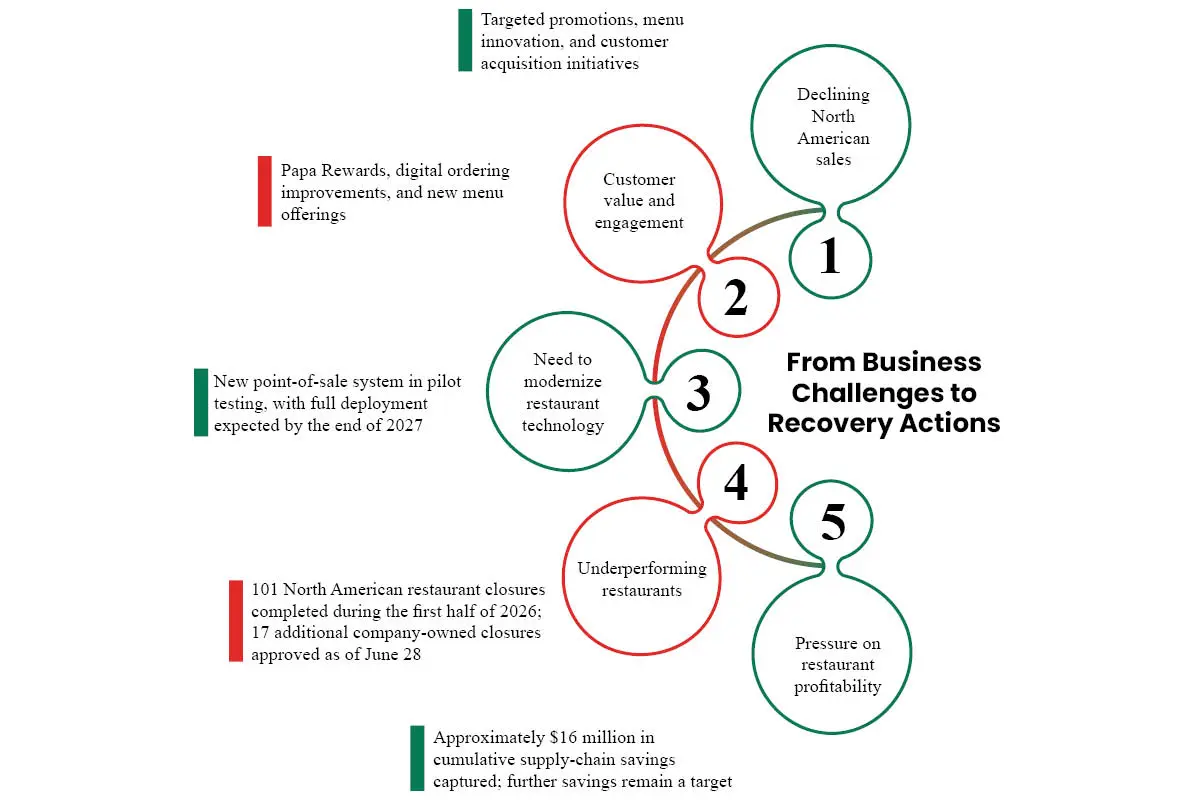
| Business challenge | Papa John’s response |
|---|---|
| Declining North American sales | Targeted promotions, menu innovation, and customer acquisition initiatives |
| Customer value and engagement | Papa Rewards, digital ordering improvements, and new menu offerings |
| Need to modernize restaurant technology | New point-of-sale system in pilot testing, with full deployment expected by the end of 2027 |
| Underperforming restaurants | 101 North American restaurant closures completed during the first half of 2026; 17 additional company-owned closures approved as of June 28 |
| Pressure on restaurant profitability | Approximately $16 million in cumulative supply-chain savings captured; further savings remain a target |
Sources: Papa John’s official Q2 2026 Form 10-Q
Lessons other restaurant businesses can learn
Papa John’s experience shows that a recognizable brand does not guarantee strong sales. Restaurant businesses need to understand why customers are ordering less and respond with changes that improve perceived value, product consistency, and convenience. Promotions can attract price-conscious customers, but long-term loyalty depends on delivering an experience that justifies the price.
Another lesson is to assess restaurant performance alongside the health of the wider franchise network. Papa John’s is closing underperforming locations, reducing costs, and investing in systems intended to support more efficient operations. However, closures and savings targets should be evaluated against their actual impact on restaurant profitability and future growth, rather than treated as proof of success.
Finally, businesses should measure recovery through results, not announcements. Papa John’s turnaround strategy can be assessed through comparable-sales trends, order volumes, restaurant-level profitability, and whether planned cost savings are achieved without compromising customer experience. These indicators help restaurant leaders distinguish meaningful improvement from short-term changes in performance. Papa John’s official Q2 2026 Form 10-Q
Conclusion
Papa John’s enters the final months of 2026 with North American comparable sales under pressure and a revised full-year outlook pointing to continued challenges. Its turnaround will depend on whether initiatives such as digital improvements, restaurant restructuring, and supply-chain savings lead to measurable gains rather than simply reducing costs.
The clearest indicators to watch are North American comparable sales, order volumes, adjusted EBITDA, and progress against the company’s savings targets. The planned point-of-sale rollout, expected to reach full deployment by the end of 2027, is another milestone to monitor. Until subsequent financial results show sustained improvement, Papa John’s turnaround strategy remains a work in progress, not a confirmed recovery. The company’s next results, scheduled for November 5, 2026, should provide a further indication of whether performance is stabilizing.
Frequently asked questions (FAQs)
1. Why is Papa John’s struggling?
Papa John’s is facing weaker North American sales, lower order volumes, and strong competition from restaurants using aggressive promotions. In Q2 2026, North American comparable sales fell 8.3% year over year.
2. What are Papa John’s main business challenges?
Its key challenges include attracting customers, improving value perception, maintaining product quality, and strengthening restaurant profitability amid a competitive market.
3. What is Papa John’s recovery strategy?
The company is focusing on targeted promotions, menu innovation, digital ordering improvements, restaurant restructuring, and cost savings. Its new point-of-sale system remains in development, with full deployment expected by the end of 2027.
4. Is Papa John’s turnaround strategy working?
The turnaround remains ongoing. The company has reported some completed cost-saving measures, but its ability to reverse declining sales will need to be assessed through future comparable-sales and profitability results.
5. What can other restaurants learn from Papa John’s?
Restaurants should balance competitive pricing with product quality, track customer demand, support franchise performance, and measure whether technology investments and cost reductions produce sustainable improvements.