


When businesses struggle to connect data across systems and make timely decisions, they risk costly errors, delays, and missed opportunities. Without AI solutions that can analyze complex information and uncover meaningful insights, teams may spend more time on manual analysis than on business growth.
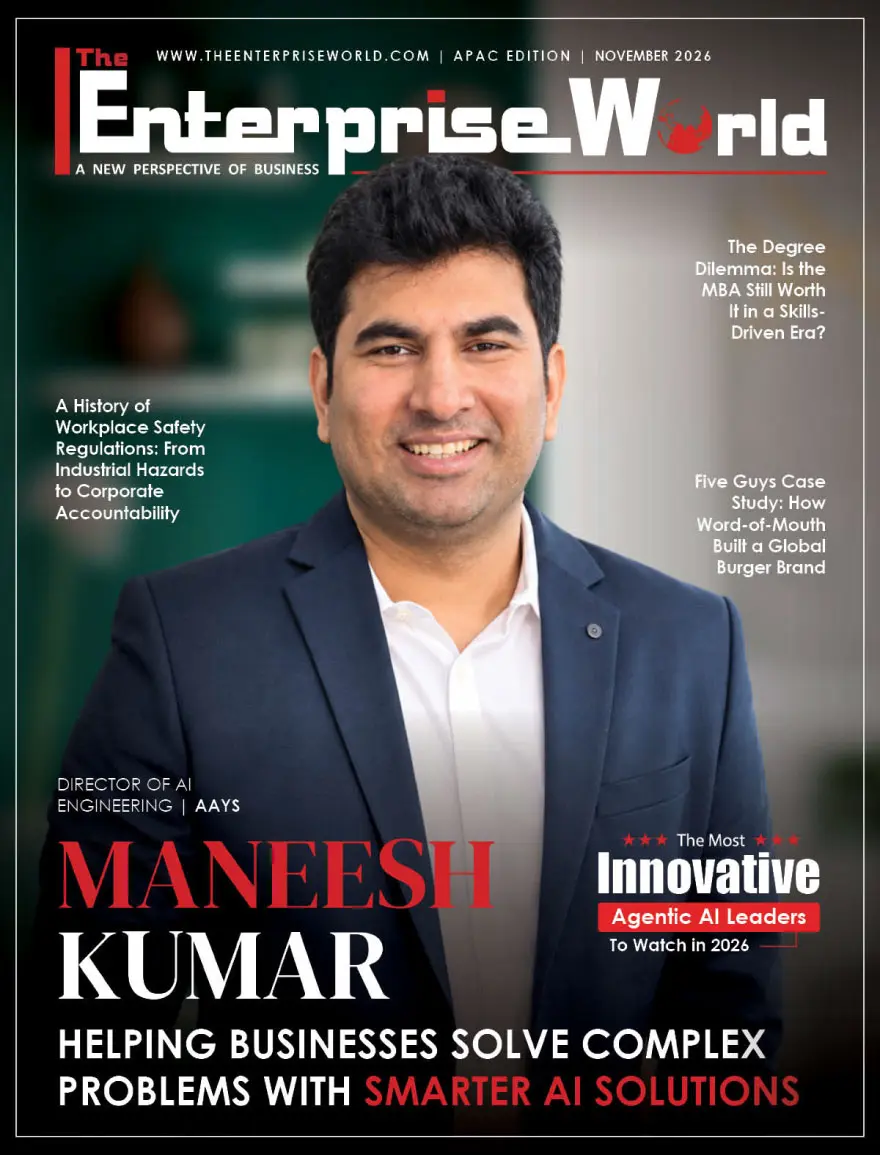
Maneesh Kumar, Director of AI Engineering at Aays, helps businesses address these challenges through agentic AI, enterprise data solutions, and intelligent automation. With experience in software engineering, cloud technologies, and AI architecture, he leads the development of AI solutions that simplify complex workflows, improve decision-making, and support responsible automation. By combining multi-agent systems with strong security measures, continuous evaluation, and human oversight, he helps businesses turn AI capabilities into practical solutions they can rely on.
His focus is on making AI reliable, secure, and valuable in real business settings. At Aays, this work contributes to the company’s record of delivering more than $5 billion in measurable value across 350+ engagements, reflecting the impact of its data and AI solutions on enterprise businesses.
Strong foundation in AI and data science
Maneesh Kumar’s professional journey has been shaped by his curiosity about how technology can solve complex problems and improve the way businesses operate. Over the past decade, he has built experience in software engineering, cloud technologies, enterprise architecture, and artificial intelligence (AI), gradually moving toward developing practical AI solutions for businesses.
His time at Microsoft played an important role in this journey. Working with large-scale enterprise systems helped him understand how cloud technologies could support intelligent solutions. His experience with AI systems involving vision and speech further strengthened his interest in automation and its potential to simplify complex tasks.
To deepen his understanding of the field, Maneesh Kumar pursued a postgraduate program in AI and Machine Learning from the University of Texas at Austin and a Master of Data Science from Deakin University. He later joined WinWire Technologies, where he worked on enterprise AI solutions, including agentic AI and Retrieval-Augmented Generation (RAG) systems across cloud and on-premises environments.
Developing systems in which multiple AI agents work together gave him valuable insights into the challenges of building reliable AI solutions. He learned that success depends on the technology itself and on how different components work together, how results are evaluated, and how security and human oversight are maintained.
These experiences also inspired his book, From Prompts to Agentic AI: Building Agentic AI & Enterprise RAG Systems on Azure, which explores the practical aspects of building enterprise AI systems.
The growth of Aays
Aays has grown from reporting past business performance to predicting outcomes and helping companies make better decisions using generative and agentic AI. Its solutions can investigate problems, recommend actions, and complete tasks within set limits, with security, monitoring, and governance in place.
Aays has delivered more than $5 billion in measurable value across 350+ engagements and worked with around 800 petabytes of data across complex business systems. Its team of 250+ professionals across India, the UK, and the US serves five of the world’s leading Fortune Global companies.
Aays is also Great Place to Work-Certified, reflecting its commitment to a workplace that supports learning, experimentation, and continuous improvement.
Aays uses AI agents to simplify financial analysis
Traditional automation works well for tasks with fixed rules, but it can struggle when problems require information from different systems and detailed analysis. Agentic AI helps address these challenges by allowing AI agents to work together, analyze information, and support decisions within defined limits.
At Aays, this approach helps finance teams investigate differences between actual results and forecasts during month-end financial analysis. When information is spread across enterprise resource planning (ERP) systems, customer relationship management (CRM) platforms, and internal databases, finding the reasons for these differences can take considerable time.
Aays uses specialized AI agents to make this process easier. One agent collects relevant information, another examines possible causes, such as pricing, sales volume, product mix, or currency movements, and a third checks the evidence and prepares an explanation. A supervising agent coordinates the process, while finance professionals review and approve the findings.
This approach allows Aays to go beyond fixed automation by helping businesses investigate financial differences using enterprise data while maintaining appropriate controls. As a result, finance teams can spend less time gathering information and more time understanding business performance and making informed decisions.
Most challenging experience
One of the most challenging experiences in Maneesh Kumar’s career was building Atlas, an enterprise multi-agent AI platform, at WinWire. Although individual agents performed well during testing, combining them created problems such as repeated tasks, inefficient coordination, excessive resource use, and errors spreading between stages. Sometimes, the final responses sounded convincing despite flawed reasoning.
To address these issues, Maneesh Kumar and his team introduced a central planning and supervision layer, clearer communication between agents, restricted tool access, detailed execution tracking, and automated testing. These changes made the system easier to monitor and improve.
The experience taught Maneesh Kumar that greater AI autonomy does not necessarily mean greater reliability. Without proper limits and monitoring, small mistakes can lead to larger problems.
This lesson continues to shape his leadership and development approach. He believes testing, monitoring, and safety measures must be built in from the beginning. Rather than expecting AI systems to never fail, his goal is to ensure that errors can be identified, understood, contained, and corrected before they cause greater harm.
Structured approach towards building AI solutions
Aays follows a structured approach to turn agentic AI concepts into reliable business solutions. It identifies business problems, designs suitable workflows, tests performance, and establishes safeguards for responsible use.
Before granting an AI system greater independence, Aays evaluates the potential impact of errors, whether actions can be reversed, how clearly success can be measured, and the reliability of available data. Tasks such as information gathering, data reconciliation, and initial financial variance analysis may be automated, while high-risk or irreversible decisions remain under human control.
Aays uses an autonomy ladder to determine how independently an AI system can operate:
- Assist: Helps prepare insights.
- Recommend: Suggests actions for human approval.
- Act with Approval: Executes tasks after authorization.
- Act and Report: Performs tasks independently within defined limits, with activities recorded for review.
Progression depends on demonstrated performance, not assumptions about the technology.
To maintain reliability, Aays uses test datasets based on real business scenarios, automated checks for accuracy and information grounding, and tools to track system execution. Technologies such as OpenTelemetry, Model Context Protocol (MCP), and LangGraph support monitoring, tool integration, and workflow coordination.
Ultimately, Aays measures success through shorter processing times, lower operating costs, and faster decision-making. The goal is to deliver secure, reliable AI solutions that address real business needs and produce measurable value.
Client success story
Aays helped a global consumer goods manufacturer reduce the time needed for month-end financial analysis by 65%. The company’s finance team struggled to compare actual results with forecasts and understand major differences because its data was spread across separate ERP and CRM systems. As a result, each analysis cycle took more than two weeks.
To solve this problem, Aays introduced a multi-agent AI solution that collected data, analyzed performance differences, and prepared explanations supported by evidence. Human controllers reviewed and approved the findings before the final reports were submitted, ensuring that important financial decisions remained under human supervision.
The solution helped the finance team gain insights faster. It also showed that speed alone is not enough. People need to understand and trust AI-generated results before using them to make decisions. To support this, Aays added source citations and clear records showing how the system reached its conclusions.
For Maneesh Kumar, the real value of AI lies in helping people make better decisions through reliable, understandable, and useful results.
Trust and security are foundational architectural principles
At Aays, trust, security, and accountability are essential to every AI solution. The company follows five key practices to protect business data, maintain accuracy, and keep people in control.
- Data Privacy and Security: Aays keeps client data within the customer’s secure cloud environment and uses role-based access controls to limit agent access. Sensitive personal and business information is masked before reaching AI models.
- Accuracy and Reliable Information: AI responses are grounded in verified enterprise data with clear references. Regular testing helps maintain accuracy, while uncertain results are flagged rather than presented as facts.
- Controlled Actions and Safeguards: Agents operate within defined limits on tool access and actions. Financial transactions and changes to business systems require approval at designated stages.
- Auditability and Accountability: Aays records reasoning steps, system requests, and tool usage to support reviews and investigations. Every automated workflow has a designated human owner.
- Human Oversight and Regulatory Compliance: Operators can override or pause agents and roll back actions when needed. Aays also considers responsible AI standards and applicable regulations, including India’s Digital Personal Data Protection Act.
Through these practices, Aays helps businesses adopt AI with greater confidence, protect data, manage risks, and maintain accountability for important decisions.
Industry recognition and strategic partnerships
Aays has established its credibility in the AI industry through independent industry assessments, business recognitions, strategic partnerships, and its experience delivering data and AI projects. These achievements reflect the company’s expertise, industry standing, and ability to support businesses with practical solutions.
Independent analyst assessments
- AIM Research, PeMa Quadrant: Named a Top Service Provider in AI and Data Engineering and a Top Service Provider in GenAI.
- AIM Research: Recognized as a “Seasoned Vendor” in the data science and GenAI space.
- ISG Provider Lens (2025, global): Identified among the top players in Specialty Analytics Services for Supply Chain and for Retail and CPG.
- Everest Group PEAK Matrix (2025): Featured in the Data and AI Services Specialists assessment for North America.
Industry recognition
- Financial Times and Statista: Named among the High-Growth Companies in Asia-Pacific in 2024.
- AIM: Listed among the 50 Best Firms for Data Scientists to Work For in 2024.
- Great Place to Work: Certified in India.
Strategic partnership with Databricks
- Partner status: Aays achieved Silver and DPP partner status with Databricks in under 12 months and is working toward Gold.
- Experience: More than four years of hands-on experience delivering solutions on Databricks.
- Customer base: 35+ active Databricks customers across production and paid proof-of-concept engagements.
- Joint go-to-market: 12 joint accounts with Databricks.
- Conversion: Around 60% of Databricks proofs of concept convert to committed engagements.
Strategic partnership with Microsoft
- Experience: More than four years of experience building solutions on the Azure data stack.
- Clients and delivery: 20+ clients served and 200+ projects implemented in the last three years.
- Consumption: More than USD 30 million in Azure consumption generated over two years, with 100% of that work focused on data and AI.
- Team: More than 200 people trained on Azure, including 53 data science and AI engineers and 27 certified engineers.
Maneesh Kumar’s professional credentials and contributions
Maneesh holds several professional credentials in AI, data science, and cloud technologies, including:
- Claude Certified Architect
- Azure AI Engineer Associate (AI-102)
- Azure AI Fundamentals (AI-900)
- Azure Data Scientist Associate (DP-100)
- Azure Data Fundamentals (DP-900)
- Azure Developer Associate (AZ-204)
- Azure Solutions Architect Expert
Culture of innovation and continuous learning
Maneesh believes innovation thrives when teams can experiment, learn from setbacks, and improve without blame. At Aays, he encourages engineers to test ideas carefully, understand customers’ everyday challenges, and build solutions that work reliably in real business settings. He also emphasizes security, evaluation, monitoring, and human oversight throughout development to ensure responsible AI adoption.
Beyond his leadership role, Maneesh Kumar shares his knowledge through technical writing, educational content, his #50DaysOfAgenticAI series, and his YouTube channel, Agentic AI, Unpacked. Through practical examples and hands-on demonstrations, he makes complex AI concepts easier to understand. He believes teaching strengthens his own knowledge while helping others develop the skills to build reliable, useful, and responsible AI solutions.
Preparing for the next phase of agentic AI
Maneesh Kumar highlights three developments that will shape agentic AI over the next three to five years: self-improving agents that learn from experience, persistent memory that enables long-term contextual understanding, and reliable autonomous systems backed by continuous evaluation and governance. These capabilities will help AI systems move beyond executing predefined tasks toward adapting to changing business needs, learning from outcomes, and handling complex workflows with greater reliability. Strong safeguards, transparency, and human oversight will remain essential to building trust.
At Aays, Maneesh Kumar aims to help businesses move beyond small AI experiments toward scalable, production-ready solutions that deliver measurable results across finance and operations.
His experience has taught him that greater autonomy must be earned through consistent performance and accountability. He believes the future of agentic AI lies not in replacing human judgment, but in building intelligent systems that continuously improve, amplify human capabilities, and enable people to focus on innovation, strategic thinking, and higher-value decisions.
Life before and after stepping into an entrepreneurial role
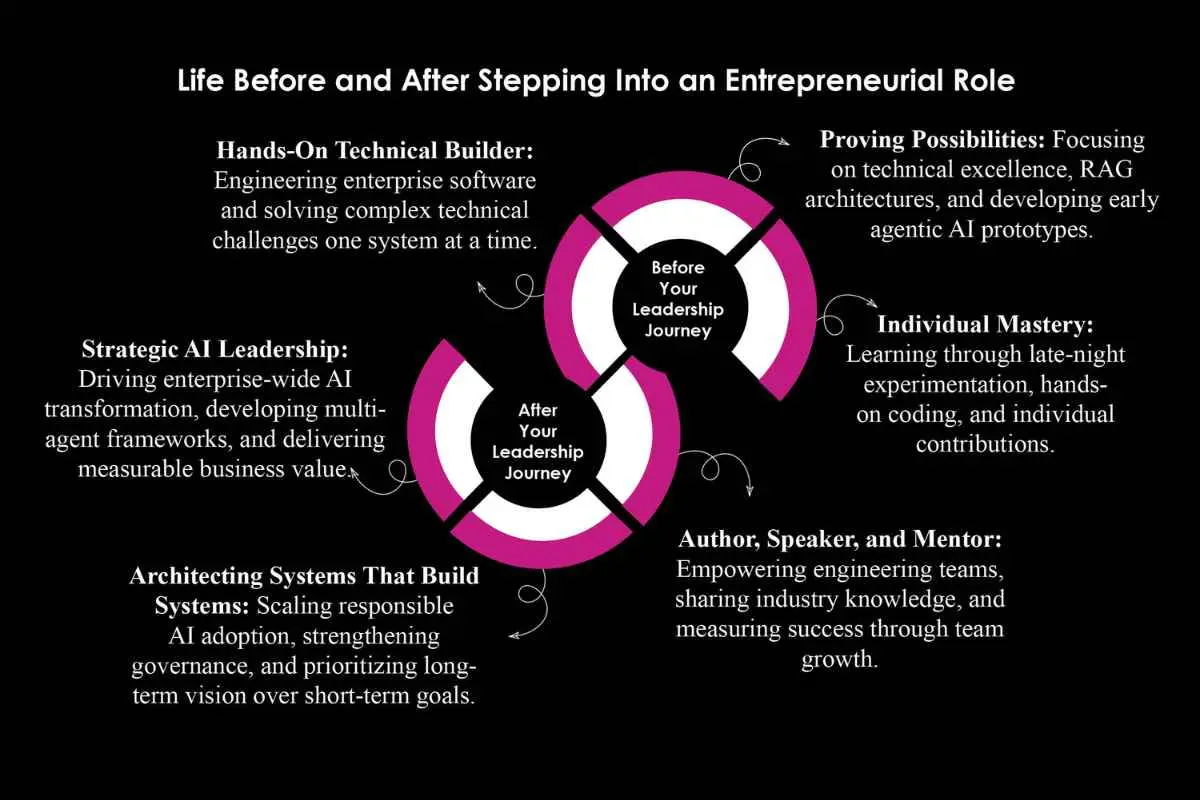
Before Your Leadership Journey:
- Hands-On Technical Builder: Engineering enterprise software and solving complex technical challenges one system at a time.
- Proving Possibilities: Focusing on technical excellence, RAG architectures, and developing early agentic AI prototypes.
- Individual Mastery: Learning through late-night experimentation, hands-on coding, and individual contributions.
After your leadership journey:
- Strategic AI Leadership: Driving enterprise-wide AI transformation, developing multi-agent frameworks, and delivering measurable business value.
- Architecting Systems That Build Systems: Scaling responsible AI adoption, strengthening governance, and prioritizing long-term vision over short-term goals.
- Author, Speaker, and Mentor: Empowering engineering teams, sharing industry knowledge, and measuring success through team growth.
Maneesh Kumar’s daily routine
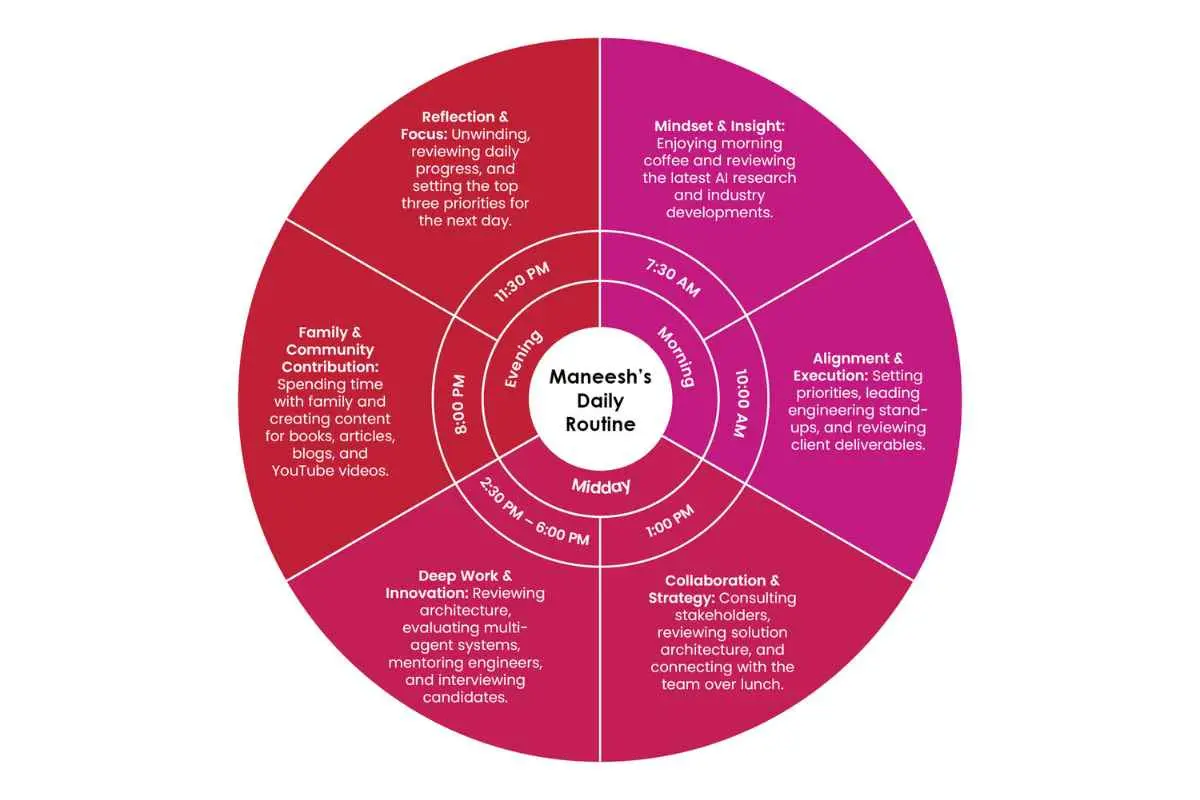
- Early Morning (7:30 AM) | Mindset & Insight: Enjoying morning coffee and reviewing the latest AI research and industry developments.
- Start of Workday (10:00 AM) | Alignment & Execution: Setting priorities, leading engineering stand-ups, and reviewing client deliverables.
- Midday (1:00 PM) | Collaboration & Strategy: Consulting stakeholders, reviewing solution architecture, and connecting with the team over lunch.
- Key Work Priorities (2:30 PM – 6:00 PM) | Deep Work & Innovation: Reviewing architecture, evaluating multi-agent systems, mentoring engineers, and interviewing candidates.
- Evening (8:00 PM) | Family & Community Contribution: Spending time with family and creating content for books, articles, blogs, and YouTube videos.
- Night / Wind-down (11:30 PM) | Reflection & Focus: Unwinding, reviewing daily progress, and setting the top three priorities for the next day.
Open letter to business leaders and aspiring AI professionals
Dear fellow leaders, builders, and innovators,
I believe the next phase of AI will be defined by systems that can reason, learn from experience, collaborate through specialized agents, and continuously improve from real-world outcomes. Over the next three to five years, breakthroughs in agentic reasoning, persistent memory, and self-improving AI architectures will reshape how enterprises make decisions and execute complex workflows. The real challenge will be making these systems reliable, secure, and accountable at scale.
At Aays, my vision is to help businesses move beyond AI experimentation and build intelligent, adaptive enterprise systems that deliver measurable business value across finance and operations. For aspiring AI professionals, my message is simple: go beyond learning tools and frameworks. Develop a deep understanding of AI fundamentals, system design, evaluation, and responsible deployment, because building AI that works reliably in the real world is what truly matters.
I believe autonomy must be earned through demonstrated reliability, continuous evaluation, and responsible governance. The future is not about replacing human intelligence, but augmenting it—combining the speed and scale of AI with human judgment, creativity, and accountability. Let us focus not merely on building smarter AI, but on building AI that earns trust, creates lasting value, and expands what humanity can achieve.
Warm regards,
Maneesh Kumar
Director of AI Engineering, Aays
Quick takes
1. One recommended tool:
AlphaEvolve by Google DeepMind — an evolutionary coding agent that uses AI to discover, test, and optimize algorithms beyond conventional human-designed approaches. It offers a glimpse into a future where AI does not just use software, but helps invent better algorithms and accelerate scientific discovery.
2. One motivating quote:
“Be a learn-it-all, not a know-it-all.”
Satya Nadella.
3. One piece of advice:
Think beyond building AI that works—build AI that people can trust. Start with real business problems, design for reliability and responsible autonomy, validate outcomes with evidence, and scale only when measurable value is proven. The goal is not to deploy more AI, but to create meaningful, lasting impact.
4. One recommended book:
From Prompts to Agentic AI: Building Agentic AI & Enterprise RAG Systems on Azure, his guide to building enterprise RAG and agentic AI systems.
Maneesh Kumar’s 5 impactful business mantras solve real problems:
- Focus on genuine business challenges, not just emerging technology.
- Earn Trust Through Results: Build reliable systems that prove their value through measurable outcomes.
- Make Responsibility a Priority: Integrate security, governance, and accountability from the beginning.
- Let Autonomy Be Earned: Expand AI independence only when evidence demonstrates reliability.
- Keep Learning and Sharing: Strengthen your skills, learn from setbacks, and help others grow.













