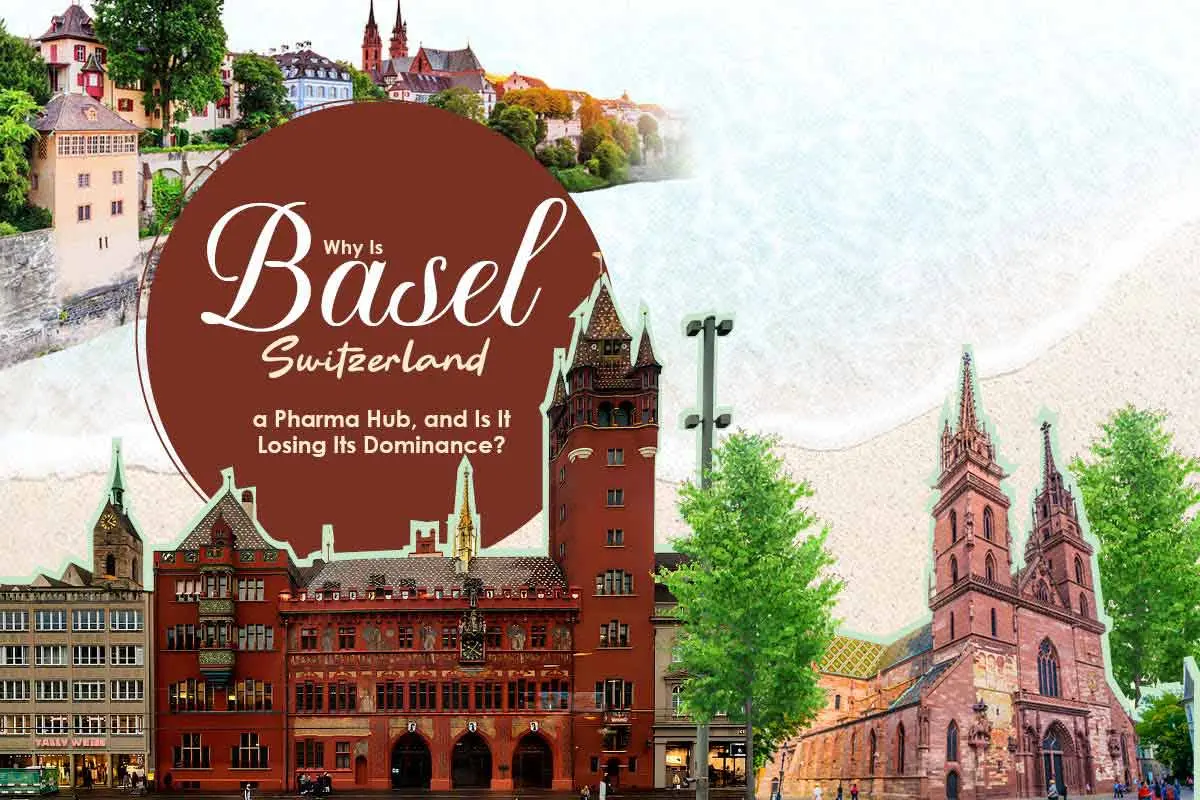
Some cities become known for what they build. Others become known for what they trade. Basel became known for what it learned to make.
Set along the Rhine where Switzerland meets France and Germany, Basel turned trade, textiles, and chemistry into an economic advantage. Dyes and chemical manufacturing eventually gave the city two major pharmaceutical names: Roche and Novartis.
But the relationship is changing.
Pharmaceutical manufacturing is becoming more distributed, while companies reconsider where research, development, and production should take place. Novartis has announced changes to some Basel operations, even as Roche continues investing in research.
Basel is also no longer simply a city of pharmaceutical giants. Biotechnology companies, CDMOs, research institutions, specialist suppliers, and startups have created a broader life-sciences network.
The question is not simply whether Basel is losing its pharmaceutical dominance. It is whether Basel Switzerland, is redefining what that dominance means.
From Dyes to Drugs
Basel’s pharmaceutical story started with trade, textiles, and chemistry. Its textile industry created demand for dyes and chemicals, bringing innovators from across Europe, particularly Germany and France, to Basel.
Geigy traces its origins to 1758, Ciba emerged from nineteenth-century chemical manufacturing, and Sandoz was founded in Basel in 1886. Ciba began producing pharmaceutical substances in 1900, while Sandoz developed pharmaceutical activities in the early twentieth century.
Ciba and Geigy merged in 1970, followed by the merger of Ciba-Geigy and Sandoz in 1996 to form Novartis.
This history gave Basel an established culture of chemistry, industrial production, research, and international commerce. Pharmaceuticals grew from what the city already knew how to do.
When Roche and Novartis Changed the Scale
Roche and Novartis transformed Basel’s pharmaceutical economy. Their presence attracted scientists, manufacturers, suppliers, technology providers, and specialist talent. Experienced employees later moved into startups and specialist businesses, while suppliers located close to major customers.
A cluster developed around the giants.
Over the past two decades, it has also become more entrepreneurial. Startups, independent biotechnology companies, corporate spinoffs, and international businesses have emerged around Roche and Novartis. The acquisition of Basel-based Actelion by Johnson & Johnson for approximately $30 billion became one example of the value created within the region.
Why Basel Became a Pharma Hub
Geography helped. Basel sits where Switzerland, France, and Germany meet, while the Rhine has long connected the city with wider commercial activity.
Scientific infrastructure strengthened that advantage. The University of Basel, ETH Zurich’s Department of Biosystems Science and Engineering, the Friedrich Miescher Institute, and Roche’s Institute of Human Biology contribute expertise across biology, medicine, and biotechnology.
The wider Basel region now has more than 800 life-sciences companies and around 33,000 professionals.
BASEL’S PHARMA ECOSYSTEM
800+ → Companies
33,000 → Professionals
↓
R&D → DEVELOPMENT → PRODUCTION
↓
Startups | CDMOs | Research | Specialist Suppliers
↓
CHF 1B BaseLaunch | CHF 1B Botnar | CHF 500M Roche R&D
That density matters. Drug development requires laboratory expertise, clinical knowledge, manufacturing, regulatory experience, investment, and commercial support. Basel has capabilities across much of that chain, connecting research and development with company headquarters and production.
The Ecosystem Beyond Roche and Novartis
The region includes biotechnology companies, CDMOs, medical technology businesses, specialist suppliers, and research organizations. Lonza, Bachem, Celonic, Corden Pharma, and ten23 health provide specialized development and manufacturing capabilities.
Pharmaceutical companies create demand for these services, while experienced professionals can build businesses of their own. Ten23 Health, founded by former Lonza executive Hanns-Christian Mahler, is one example.
BaseLaunch has strengthened the entrepreneurial side by helping scientists turn research into companies and supporting projects between scientific discovery and Series A funding. Around CHF 1 billion has been invested in 28 projects it has incubated, according to the research.
Basel Switzerland, therefore, has a strength beyond its two giants. Companies developing technologies, medicines, manufacturing capabilities, and specialist services around them may become increasingly important.
Basel Against Boston
Boston provides a useful comparison. Its life-sciences strength comes from universities, research institutions, and entrepreneurial culture. Basel has those elements too, but developed primarily from industry.
Roche, Novartis, and their predecessors created the industrial base, while academic and research institutions strengthened its scientific capabilities.
That history gives Basel strength across the pharmaceutical value chain, from research and development to company headquarters and production. Its challenge is ensuring that this industrial strength continues to generate new science, companies, and innovation.
Is Basel Losing Its Pharma Edge?
There are reasons to ask.
Pharmaceutical companies are increasingly deciding where specific activities should sit within international networks. Basel is not immune.
Novartis’ September 2026 restructuring illustrates the shift. The company plans to discontinue small-volume biologics production at its Kleinbasel site by the end of 2027, potentially affecting around 130 positions.
Yet laboratories for biological cell banks, analytical testing, and technical development will move to the main Basel campus by the end of 2028. A new biologics technical-development centre is also planned there.
One activity is being reduced while another is strengthened.
Some production will move to other European facilities, but research and technical-development capabilities are being concentrated at the Basel campus.
Roche Is Still Investing
Roche offers a counterpoint to the idea of decline.
In 2025, the company broke ground on Building 12 at its Basel headquarters, a CHF500 million R&D building designed for around 450 researchers and planned for completion in 2029. It will support early drug development and strengthen the connection between research and clinical development.
Roche has also invested around CHF 8 billion in its Swiss sites since 2015.
Basel Switzerland, therefore remains important to Roche’s long-term research strategy.
The Next Phase
Basel’s next phase may depend on expanding beyond its traditional strengths.
The Botnar Institute for Immune Engineering, supported by a CHF 1 billion endowment, aims to bring leading immune-engineering researchers to Basel. Digitalisation could provide another growth area as drug development becomes increasingly digital and research connects digital technologies with laboratory work.
Investment in multi-tenant facilities is creating space for companies beyond traditional pharmaceutical headquarters. Research also indicates growing interest from Asian companies, potentially influenced by wider US-China tensions and changing global investment patterns.
The players around the two large pharmaceutical companies may therefore become more significant, even as Roche and Novartis remain central.
Conclusion: Basel Is Changing, Not Disappearing
Basel’s pharmaceutical identity was built over centuries. Trade and textile manufacturing created the chemical expertise; Geigy, Ciba, and Sandoz developed it; Roche and Novartis helped turn it into a global pharmaceutical centre.
Now another transition is underway.
Some manufacturing will move. Pharmaceutical companies will continue reassessing where activities should take place. Life-sciences clusters such as Boston will compete for talent, capital, and companies, while growing interest from Asian businesses could reshape the international landscape.
Yet the evidence does not point to a simple decline.
Roche is investing CHF500 million in Basel and has invested around CHF8 billion in Swiss sites since 2015. Novartis is reducing one form of production while expanding technical-development capabilities. More than 800 life-sciences companies and around 33,000 professionals form a wider ecosystem around the pharmaceutical giants.
The story of Basel Switzerland, is therefore not simply one of decline.
It is a story of adaptation.
The city may become less defined by pharmaceutical production and more by the research, expertise, biotechnology, specialist development, digital innovation, and entrepreneurial activity around it.
Basel built its pharmaceutical reputation through repeated reinvention. Its ability to evolve again may be what keeps it relevant.