A massive crowd on an exhibition floor means nothing if none of those visitors hold signature authority for enterprise deals. Deciding on a business summit vs trade show requires matching your event spend directly to your current growth stage and sales goals.
Trade shows give sales teams direct access to high buyer volume for quick product demos and instant purchase agreements. Business summits offer closed-door access to peer executives, policy leaders, and strategic partners who shape long-term industry standards.
Smart corporate strategies do not treat these two formats as mutually exclusive. Companies routinely cycle between both platforms to balance immediate revenue needs with long-term brand authority.
So, how do they stack up against each other?
Business summit vs trade show: key differences
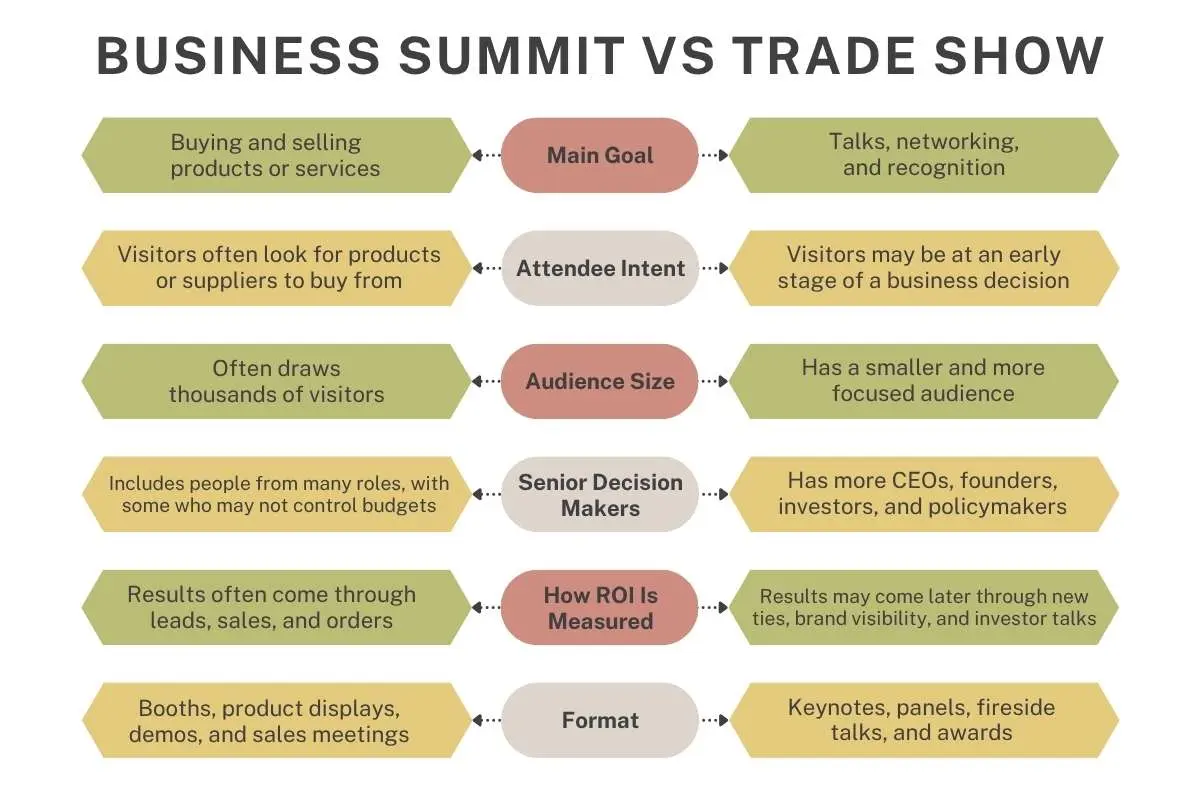
A trade show and a business summit bring business professionals together, but they serve different goals. Trade shows focus more on products, services, buying, and sourcing. Business summits focus more on ideas, relationships, leadership, and business conversations. The table below highlights the main differences.
| Trade Show | Factor | Business Summit |
|---|---|---|
| Buying and selling products or services | Main Goal | Talks, networking, and recognition |
| Visitors often look for products or suppliers to buy from | Attendee Intent | Visitors may be at an early stage of a business decision |
| Often draws thousands of visitors | Audience Size | Has a smaller and more focused audience |
| Includes people from many roles, with some who may not control budgets | Senior Decision Makers | Has more CEOs, founders, investors, and policymakers |
| Results often come through leads, sales, and orders | How ROI Is Measured | Results may come later through new ties, brand visibility, and investor talks |
| Booths, product displays, demos, and sales meetings | Format | Keynotes, panels, fireside talks, and awards |
- Main Goal: A trade show helps companies show and sell their producs or services. A business summit gives people a place to share ideas, meet peers, discuss business, and gain recognition.
- Attendee Intent: People at trade shows often have a clear need. They may want to find a supplier, compare products, or make a purchase. People at business summits may join before they have a clear buying need. They may want to learn, meet the right people, or think about future business plans.
- Audience Size: Trade shows often draw large crowds. Some attract thousands or even tens of thousands of people. Business summits tend to have fewer people. They often bring together a more focused group of business leaders and other key guests.
- Senior Decision Makers: Trade shows can bring people from many job roles. Some may not have the power to approve a deal or control a budget. Business summits often bring more senior people into the same room. These can include CEOs, founders, investors, and policymakers.
- How ROI Is Measured: Trade shows can show results soon after the event. Companies can track leads, sales, orders, and other direct results. A business summit may create value over a longer period. New business ties, brand visibility, and talks with investors may lead to results later.
- Format: Trade shows use booths and product displays to help companies meet buyers. Many also include product demos and sales meetings. Business summits use keynotes, panel talks, and fireside talks to share ideas. They may also include awards that give people and companies public recognition.
Ultimately, a trade show works best when a company wants to meet buyers, show products, or find suppliers. A business summit serves a wider business need. It brings leaders together to share ideas, build ties, gain visibility, and discuss future plans. The right choice between business summit vs trade show depends on why you are attending business events.
Why this distinction matters more as summits evolve

“It’s been a huge group of amazing leaders that I have met; I have heard their stories. So just being here under one roof of inspirational people has been absolutely amazing.”
-Faria Arsh, CEO of Autism Foundation C.I.C.
Business summits have changed in recent years. Many now focus on who attends, not just how many people attend. They bring more senior leaders into one room. This gives attendees more chances to meet people who can make or influence business decisions.
Recognition has also become a key part of many summits. Awards now sit alongside talks and networking. They can give leaders and companies a way to gain public recognition for their work. This makes the summit useful for both business talks and brand visibility.
Newer summit platforms reflect this shift. NEXT Conclave 2026 in Dubai, for example, combines a curated audience with leadership talks, networking, and awards. This shows how newer summits are moving toward formats that focus on senior attendees and recognition.
This shift also makes the choice between a trade show and a summit less clear. A trade show still makes sense when a company needs direct access to buyers. But a summit can offer more value when the goal is to meet senior leaders, build business ties, or gain recognition. The right choice now depends more on the business goal than the event type alone.
Which one should you choose?

The right choice between business summit vs trade show depends on what you want from the event. A trade show can work well when you want to reach many buyers, show your products, and create sales in the near term. It gives your team direct access to people who may be ready to buy.
A business summit fits a different goal. It can help you build trust, meet senior leaders, and form business ties that may grow over time. A business summit sponsorship can also give your company or leaders more public recognition.
Many organizations do not have to choose just one. They use both at different stages of growth. A company may use trade shows to drive sales and reach new buyers. It may then use a business and leadership summit to build stronger ties with leaders, partners, and investors. Your goals, audience, and stage of growth can help you decide where to focus.
Conclusion:
The global exhibition industry is valued at $45.5 billion in 2026. On the other hand, Business event spending is forecasted to reach US$1.6 trillion by 2028.
The real difference between a business summit vs trade show comes down to the specific job each event performs. High-performing organizations treat these formats as a cycle between both as their growth stage evolves. Ultimately, these events are focused on driving immediate revenue at trade shows while using summits to define their broader industry authority, as events like NEXT Conclave 2026 illustrate.
FAQs
1. What is the difference between a business summit vs trade show?
Trade shows focus on direct product sales and high buyer volume, while business summits focus on high-level networking and strategy.
2. Business summit vs trade show: which is better for lead generation?
Trade shows are better for generating immediate sales leads, while summits build long-term relationships with key executives.
3. Who attends a business summit?
Business summits are attended by senior executives, industry leaders, policymakers, and C-suite decision-makers.
4. Why do companies participate in trade shows?
Companies participate in trade shows to demonstrate products, meet active buyers, and secure fast transaction orders.
5. Can an organization participate in both trade shows and business summits?
Yes, companies often use trade shows for short-term sales and business summits for long-term brand authority.