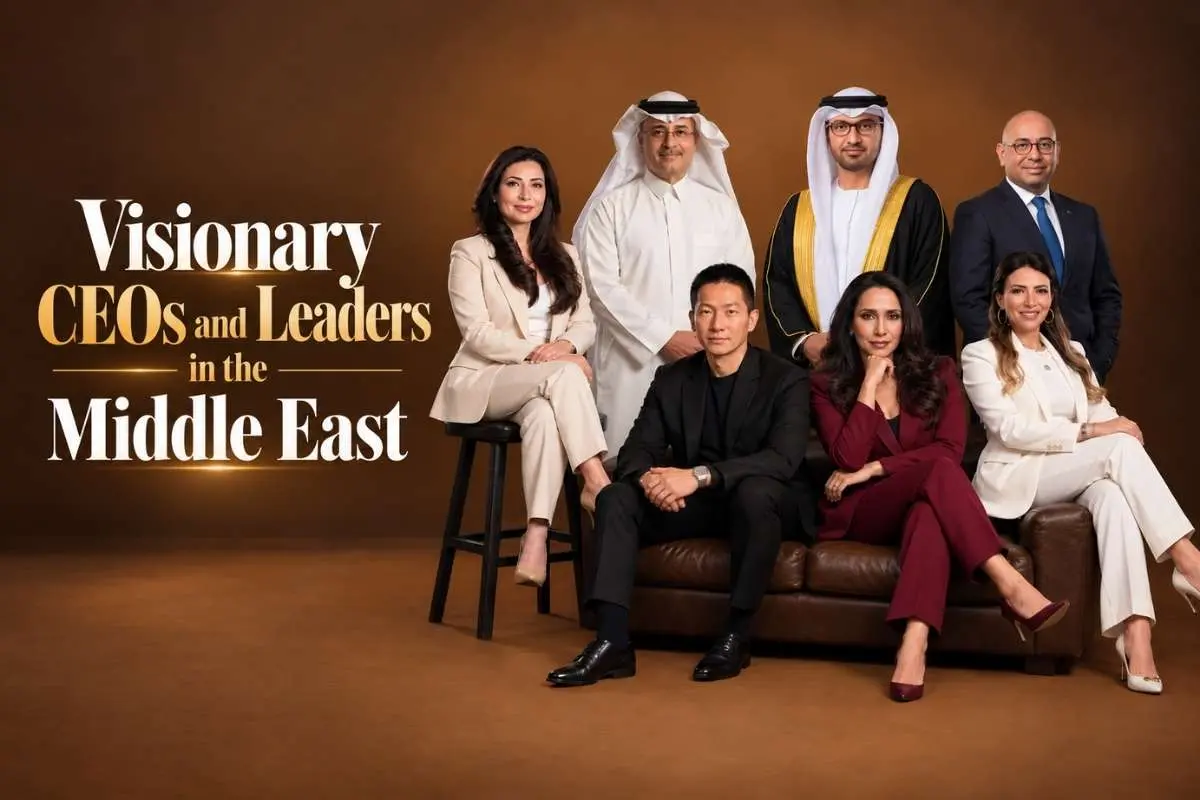
You can usually spot a changing business landscape before the headlines catch up. New companies appear, old industries reinvent themselves, and leaders are suddenly expected to understand technology, global markets, sustainability, and growth all at once. The Middle East is going through exactly that shift, with visionary CEOs/leaders in the Middle East helping businesses navigate technology, global markets, sustainability, and growth.
So, what makes someone a visionary leader in the Middle East? In this article, visionary leaders in the Middle East means people whose documented work, business decisions, innovation, or influence is helping shape the region’s changing economy. This is not a ranking. It is a closer look at the leaders and leadership trends worth knowing.
What Makes a Leader Visionary in the Middle East?
Having a big idea is easy. Building something that lasts is harder. A visionary leader looks beyond today’s business and thinks about what comes next.
That can mean:
- Expanding into new markets
- Investing in technology
- Developing talent
- Supporting economic diversification
- Thinking long term
- Connecting growth with wider development
This is why visionary leaders in the Middle East come from different backgrounds, including CEOs, founders, technology executives, and women business leaders. Forbes Middle East’s 2026 list covers 102 individuals across 100 entries, 21 nationalities, and 29 sectors.
Leadership also extends beyond the organisation, making Building executive authority and personal branding increasingly relevant.
Visionary CEOs/leaders in the Middle East: 8 to Know
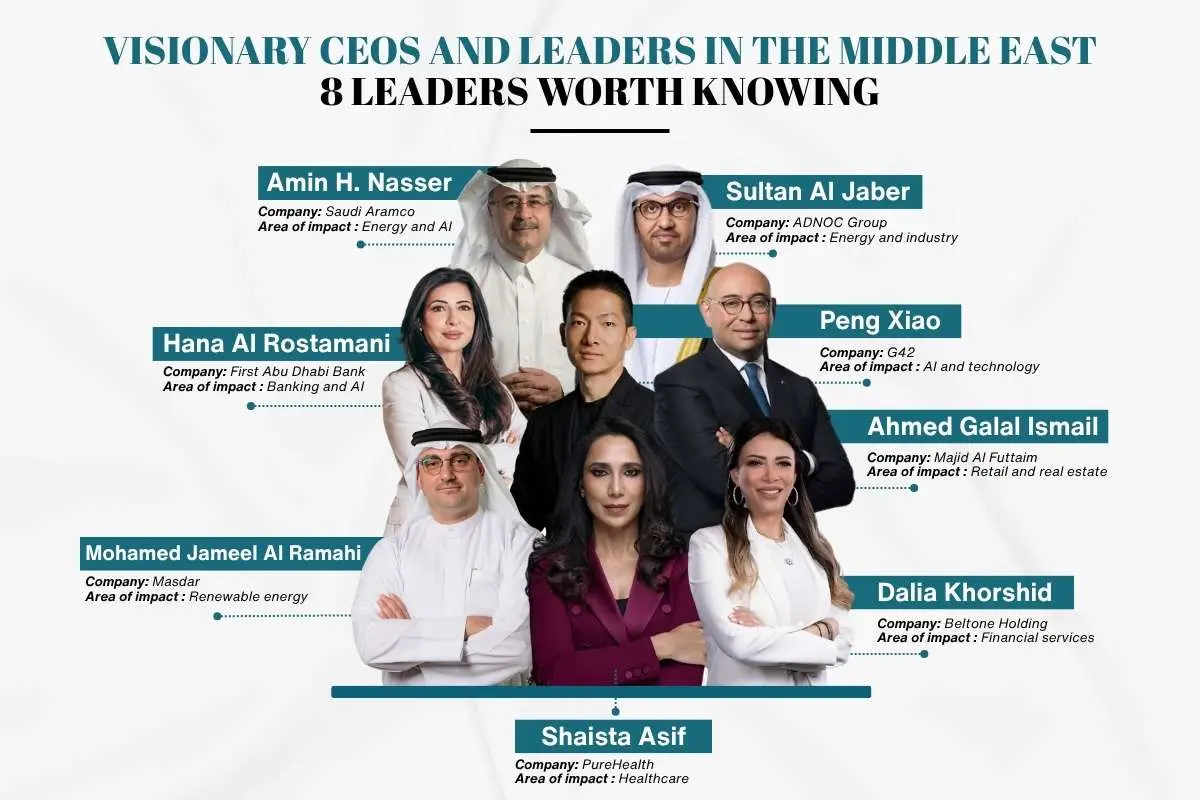
What does leadership look like when energy, AI, banking, healthcare, and clean technology are all changing at once? Visionary CEOs/leaders in the Middle East are working across all of these areas, and their paths are far from identical.
Here are eight names from Forbes Middle East’s 2026 CEO list, chosen to show that range rather than create another ranking:
| Leader | Company | Area of impact |
| Amin H. Nasser | Saudi Aramco | Energy and AI |
| Sultan Al Jaber | ADNOC Group | Energy and industry |
| Hana Al Rostamani | First Abu Dhabi Bank | Banking and AI |
| Peng Xiao | G42 | AI and technology |
| Ahmed Galal Ismail | Majid Al Futtaim | Retail and real estate |
| Mohamed Jameel Al Ramahi | Masdar | Renewable energy |
| Shaista Asif | PureHealth | Healthcare |
| Dalia Khorshid | Beltone Holding | Financial services |
Forbes’ methodology considers factors including regional impact, company scale, recent performance, experience, and innovation. So, rather than asking who is “most important,” it is more useful to ask what each leader is building, changing, or scaling.
What Can Businesses Learn From These Leaders?
The names may differ, but a few practical lessons keep showing up:
- Think beyond your current market. Look for new customers, sectors, and regions before growth starts to slow.
- Use technology to solve real problems. AI and digital tools matter when they improve how a business works.
- Build relationships across industries. Investors, founders, policymakers, and partners can bring perspectives you may not find inside your own sector.
- Adapt early. Waiting until change becomes unavoidable usually leaves fewer options.
For businesses exploring Scaling a Business in the UAE, these lessons can help turn long-term thinking into regional growth. Business Events in Dubai can also bring leaders into the same room with investors and potential partners. Ultimately, visionary leaders in the Middle East show that growth often starts with seeing what comes next.
Most Influential Arabs: What Does Influence Actually Look Like?
Influence is not always about holding the biggest title or running the largest company. The people featured in lists such as Top 10 Most Influential Arabs can shape industries through business growth, investment, technology, innovation, job creation, or regional expansion.
| Type of influence | What it can look like |
| Business | Scaling major companies |
| Technology | Building digital platforms |
| Investment | Funding new industries |
| Innovation | Turning ideas into businesses |
| Regional impact | Expanding across markets |
So, when discussing the Top 10 Most Influential Arabs, it is more useful to look at what a person has actually built or changed rather than simply handing out a trophy for importance. This also explains why visionary leaders in the Middle East can come from very different fields. Their influence may extend well beyond their own organisations, as seen in How Past Winners Scaled Brand Influence. The Top 10 Most Influential Arabs conversation, then, is really about documented impact, not our own ranking.
Top Tech Entrepreneurs and Founders: Where Vision Meets Technology

Technology leadership in the region is no longer limited to software companies. AI, fintech, digital platforms, cloud infrastructure, health technology, and smart cities are all becoming part of the business story. That makes Top Tech Entrepreneurs and Founders a useful lens for understanding where growth is coming from.
The shift is practical, too. PwC’s 2025 Middle East CEO Survey found that 60% of Middle East CEOs believed their businesses would not remain viable within 10 years or less without adaptation.
For visionary leaders in the Middle East, that raises a simple question: What can you build, adapt, and scale?
That is where the region’s tech ecosystem gets interesting:
- AI and data are changing how businesses operate.
- Fintech is reshaping financial services.
- Health technology is opening new ways to deliver care.
- Smart cities are connecting technology with everyday life.
Dubai’s Emerging Startups in Dubai also show how founders are testing new technologies and business models. The Top Tech Entrepreneurs and Founders worth watching are not simply chasing the latest tool. They are solving problems, building companies, and changing industries. That is what makes them relevant to the region’s next chapter.
Women Leaders in Business Dubai: How Leadership Is Broadening
Walk into a boardroom in Dubai today and you are likely to find women leading far more than one type of business. Banking, healthcare, aviation, technology, investment, and consulting are all part of the picture.
Forbes Middle East’s 2025 list covers 100 businesswomen across 32 sectors and 29 nationalities, with 46 entries based in the UAE.
A few examples show just how varied that leadership is:
- Hana Al Rostamani, Group CEO of First Abu Dhabi Bank, leads one of the region’s major financial institutions.
- Shaista Asif, Co-founder and Group CEO of PureHealth, leads a major healthcare platform with operations across the sector.
- Alisha Moopen, Managing Director and Group CEO of Aster DM Healthcare GCC, works across healthcare and regional expansion.
- Suzanne Al Anani, CEO of Dubai Aviation Engineering Projects, operates in aviation and major infrastructure development.
This wider mix shows how Women Leaders in Business Dubai are becoming part of different corners of the economy. For visionary leaders in the Middle East, professional networks and industry communities can also create opportunities to exchange ideas, build relationships, and grow influence. That is one reason why attending business events remains relevant for emerging leaders.
Why Attend Business Events When You Already Know Your Industry?

Even experienced leaders can get stuck in the same circles. Business events bring fresh perspectives by putting them around new markets, different industries, investors, technology companies, potential partners, and ideas they may not encounter every day.
For visionary leaders in the Middle East, that cross-industry exposure can spark useful conversations and unexpected opportunities. The wider NEXT ecosystem follows this approach by creating spaces for leaders to connect beyond their usual sectors. And once you meet someone worth knowing, following up after a business summit can determine whether that introduction becomes something more.
Conclusion:
Visionary leadership is not really about having the biggest title in the room. It is about what you build, change, and enable others to achieve. Across the region, visionary CEOs/leaders in the Middle East are helping reshape industries, open new markets, and create opportunities in emerging sectors. And tomorrow’s influential leaders may already be building their first company, leading a growing team, or testing an idea that could change an industry.
Frequently Asked Questions about Visionary Leaders in the Middle East
1. Who are visionary leaders in the Middle East?
Leaders known for documented innovation, business growth, industry change, and wider regional impact.
2. Who are some well-known business leaders in the Middle East?
This article highlights examples drawn from Forbes Middle East’s 2026 Top 100 CEOs list.
3. Why are Middle Eastern business leaders gaining global attention?
Diversification, technology, investment, international expansion, and economic transformation are reshaping the region’s business landscape.
4. What industries are Middle Eastern business leaders shaping?
They are influencing energy, technology, finance, healthcare, retail, real estate, aviation, and renewable energy.
5. What makes Middle Eastern leadership different today?
Regional leaders increasingly balance traditional industries with technology, diversification, global expansion, and long-term economic development.