
A sudden spike in voluntary departures usually catches executive teams completely off guard. The board sees stable quarterly revenue, HR points to generous benefits packages, but experienced engineers and top sales reps keep quietly handing in two-week notices. Money gets top talent through the door, but daily operational friction is what drives them straight to competitors.
Comparing internal survey data against a verified employee engagement benchmark gives leadership an unfiltered view of how company culture actually compares to sector rivals.
In this article, we will see how analyzing these metrics reveals hidden management failures and burnout risks long before key personnel start updating LinkedIn profiles.
Let us start by understanding the different types of benchmarks used across industries.
The 3 types of employee engagement benchmarks
An employee engagement benchmark gives a company a point of comparison. Instead of looking at one engagement score alone, leaders can compare results with similar companies, workforce groups, or business conditions. This makes it easier to see whether engagement levels are strong or need attention.
1. Industry benchmarks
Industry benchmarks compare employee engagement scores with companies in the same industry. This approach gives leaders a more useful view. This is because different industries often face different work demands, pay levels, staffing needs, and workplace pressures.
Examples of industry benchmarks:
- Average employee engagement score
- Employee Net Promoter Score (eNPS)
- Employee satisfaction score
- Voluntary turnover rate
- Employee wellbeing score
For example, a hospital may have different engagement challenges than a software company. Healthcare workers may face long shifts and high emotional demands, while software teams may focus more on workload, flexibility, and career growth.
Companies can use industry benchmarks to see how their results compare with similar employers. A score that looks average on its own may rank below the industry average. This can show leaders where they need to focus their efforts.
Tips to measure:
- Compare your score with data from the same industry.
- Use benchmarks from companies with similar work conditions.
- Compare results across the same survey period.
- Track the gap between your score and the industry average.
2. Company size benchmarks
Company size benchmarks compare engagement scores based on the number of employees. Small, mid-sized, and large companies can have very different workplace experiences, so size can affect engagement results.
Employees at smaller companies may have more direct access to senior leaders. They may also find it easier to share ideas, ask questions, and build close relationships with coworkers. Larger companies often have more layers of management, which can make communication feel less direct.
Examples of company size benchmarks:
- Average engagement score by company size
- Manager effectiveness score
- Employee recognition score
- Employee retention rate
- Internal communication score
A company should consider its size before judging its engagement score against another employer. Comparing same-sized organizations can give leaders a clearer and more relevant view of their results.
Tips to measure:
- Group benchmark data by company size.
- Compare your results with companies in a similar employee range.
- Track engagement scores as your workforce grows.
- Review scores by location or business unit if the company has several teams.
3. Demographic benchmarks
Demographic benchmarks break engagement data into groups. These groups can include age, tenure, department, job role, or management level. This helps leaders find gaps that a company-wide score may hide.
Examples of demographic benchmarks:
- Engagement score by age
- Engagement score by tenure
- Engagement score by department
- Engagement score by job role
- Engagement score by management level
For example, an organization may have a strong overall engagement score, but newer employees may report lower levels of support. Employees in one department may also feel less connected to leadership than employees in another team.
These differences can point to specific issues that need attention. Leaders can measure employee engagement(Supporting) to understand which groups need more support. It can also tell which are the best employee engagement practices that work.
Tips to measure:
- Break survey results into relevant employee groups.
- Compare engagement by age, tenure, role, and department.
- Protect employee privacy when groups have few members.
- Track gaps between groups over time.
- Focus on groups with a clear and repeated engagement gap.
Using several types of employee engagement benchmark data gives companies a more complete view of workforce sentiment. Together, they help leaders make better decisions based on meaningful comparisons. It eliminates the need to focus on one score alone.
What influences your benchmark data?

Several factors can affect your employee engagement benchmark data. Companies should review these factors before comparing their scores. A fair comparison needs similar conditions.
- Company size and structure: Company size can affect employee engagement. Large companies often have more management levels. Smaller companies may give employees more access to leaders. These differences can affect communication, trust, and engagement.
- Industry and role type: Different jobs create different employee experiences. Sales teams may face high targets and customer demands. Technical teams may face different needs, such as workload or skill growth. These factors can affect engagement scores.
- Leadership style and communication: Leadership can influence how employees feel at work. Clear communication can build trust. Regular feedback can also help employees feel heard. Poor communication may lead to lower engagement scores.
- Survey method: The survey method can also affect your results. Different employee engagement software may use different questions, scales, and scoring methods.
Companies should check these details before comparing scores from different surveys. It is also important that companies follow through and make the necessary changes, as only 59% of employees believe change will happen as a result of a survey.
These factors add context to your benchmark data. Leaders can make better comparisons by reviewing them first. This helps them avoid judging engagement based on one score alone.
How to use benchmarks the right way?
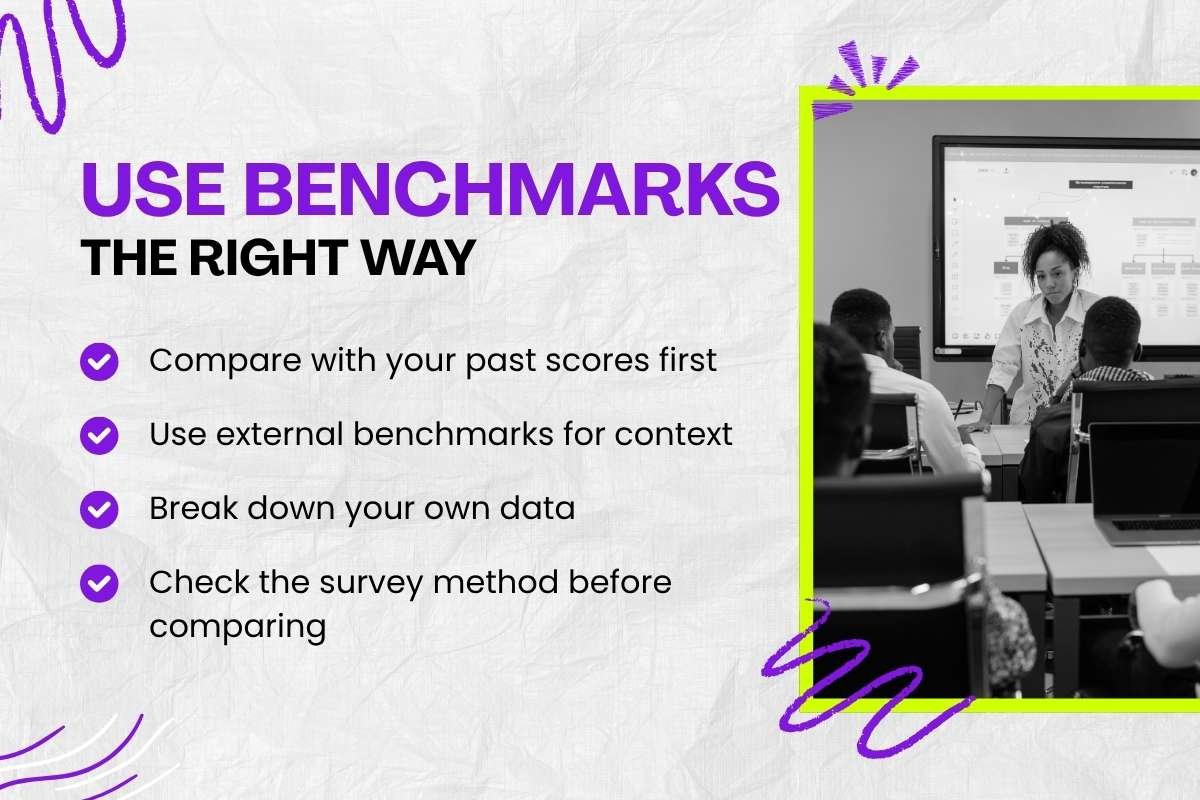
Employee engagement benchmarks can help leaders understand their results. However, companies should use them as a guide, not a target. The best approach starts with your own data.
1. Compare with your past scores first
Start by reviewing your own engagement scores over time. Look for clear changes across surveys. A rising score can show that recent efforts are working. A falling score may point to a new issue. Your own trend often gives more useful insight than an outside score.
2. Use external benchmarks for context
Industry and company size benchmarks can add useful context. They show how your results compare with similar organizations. Do not treat these numbers as a scorecard to chase. A lower score may reflect differences in roles, work conditions, or survey methods.
3. Break down your own data
Review engagement scores across teams, departments, roles, and tenure groups. This can reveal gaps hidden by your overall score. One team may have strong engagement while another needs more support. These patterns can help leaders focus their efforts.
4. Check the survey method before comparing
Raw scores may not match across different survey tools. Surveys can use different questions, rating scales, and scoring methods. Check these details before comparing results. Similar survey methods give you a more useful comparison.
The goal is not to get the highest benchmark score. The goal is to understand employee engagement and track real change. Use external benchmarks to add context while giving more weight to your own trends.
Common mistakes when benchmarking engagement

Employee engagement benchmarks can guide better decisions. However, poor use of benchmark data can lead to wrong conclusions. Leaders should avoid a few common mistakes.
- Treating benchmarks as targets: A benchmark gives you a point of reference. It does not mean your company must reach that score. Your workforce may have different needs, roles, and work conditions. Focus on steady improvement within your own company.
- Comparing different survey methods: Survey tools may use different questions and rating scales. Their scoring methods may also vary. Comparing these raw scores can give a false picture. Check the survey design before making any comparison.
- Reacting to one benchmark gap: A single gap does not always show a real problem. Review your past engagement scores first. Look for a pattern across several surveys. This gives leaders a clearer view of what has changed.
Good benchmarking needs context. Leaders should use both internal trends and external data. This approach supports better decisions without placing too much weight on one number.
Conclusion
According to Gallup, Last year, low engagement cost the world economy approximately $10 trillion in lost productivity, or 9% of GDP.
Treating team stability as a soft HR initiative rather than a hard financial metric is an expensive mistake. Corporate boards that evaluate an employee engagement benchmark protect their bottom line by catching burnout and productivity drop-offs before they manifest.
Building long-term enterprise value depends on keeping experienced talent focused on high-margin work instead of constant re-onboarding. Grounding your internal culture goals in real-world industry data turns workforce management into an accountable, profit-protecting business strategy.
FAQs
1. How often should a company compare internal sentiment against industry benchmarks?
Annual evaluations provide a clean strategic baseline without triggering knee-jerk overreactions to brief quarterly dips.
2. How do you prevent managers from faking high survey scores?
Keep all feedback strictly anonymous and track voluntary retention alongside survey results to ensure the data matches reality on the floor.
3. Can benchmark data directly lower recruitment costs?
Yes, spotting departmental culture gaps early allows you to fix manager friction and stop expensive turnover at the source.
4. Who carries primary responsibility for meeting benchmark targets?
Frontline managers and department heads drive daily morale, while HR handles the measurement and tracking systems.
5. What is the most common mistake executives make with benchmark data?
Relying entirely on company-wide averages while ignoring severe cultural divides between individual departments.