
Rapid business growth often exposes fragile internal communication systems.
A fast-growing company may double its headcount in six months, only to watch its once-vibrant workplace culture crumble under rapid expansion. What can be done in such a case? Approaching engagement methodically might be the answer.
Employee engagement models are frameworks that define the drivers that affect how involved and productive people feel at work. Replacing informal check-ins with proper methods ensures no employee gets lost in the shuffle.
Maintaining cultural alignment during aggressive expansion requires efficient management. Equipping department leads with a clear plan for engagement fosters psychological safety and keeps teams focused on shared objectives.
In this article, we will take a look at some of the models used for employee engagement and see how they affect engagement
The top employee engagement models
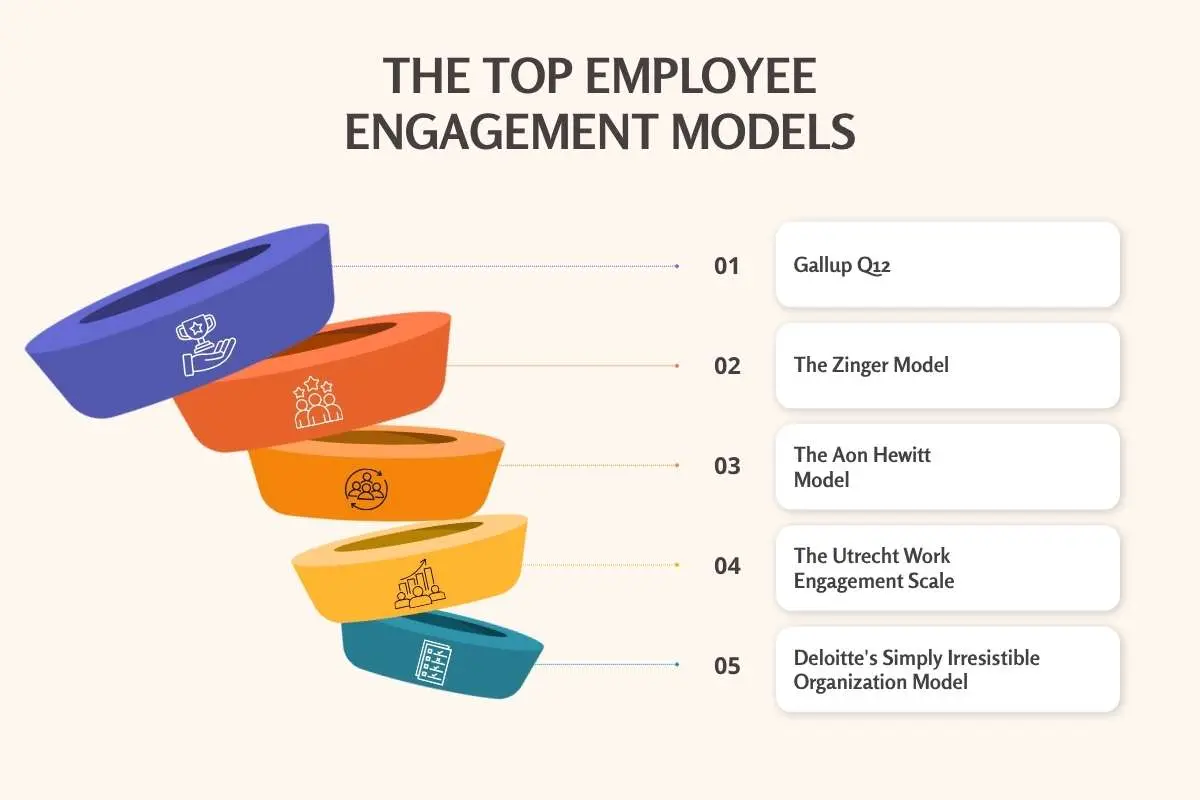
Employee engagement models help companies understand how employees feel about their work. Each model looks at engagement from a different angle. Some focus on workplace needs, while others look at employee behavior or work experience. These models give leaders a clear way to measure engagement and find areas that need attention.
1. Gallup Q12
The Gallup developed the Q12 framework to measure the workplace conditions that support employee engagement. It uses 12 questions that cover clear expectations, recognition, growth, relationships, resources, and purpose. The model focuses on needs that managers can act on within their teams.
Companies use Q12 results to see how employees experience their daily work. Managers can review team results, discuss concerns, and track changes over time. For instance, a low score on recognition may lead a manager to improve feedback and praise.
Pros
- Simple and easy to use
- Backed by extensive workplace research
- Helps identify specific engagement gaps
- Gives managers clear areas to address
Cons
- Focuses mainly on workplace conditions
- Results may not explain the cause of a problem
- Requires follow-up action to create value
2. The zinger model
David Zinger developed the Zinger Model to give companies a wider view of employee engagement. The model connects engagement with meaningful work, employee strengths, energy, recognition, and workplace relationships. It looks at several parts of the employee experience instead of relying on one score.
Companies can use the model to find areas that affect engagement at both employee and team levels. It also helps leaders see how different parts of work connect. For example, employees may enjoy their work but lack strong team relationships. Leaders could then create more chances for teamwork and peer support.
Pros
- Takes a broad view of engagement
- Covers employee and workplace factors
- Connects with key engagement drivers
- Supports practical workplace changes
Cons
- Covers many factors at once
- May seem complex for new users
- Some factors can be hard to measure
3. The Aon Hewitt model
Aon Hewitt developed the Say, Stay, Strive model to explain engagement through three employee behaviors:
- Say means employees speak positively about their organization.
- Stay reflects their desire to remain with the company.
- Strive shows their willingness to put extra effort into their work.
The model gives companies a simple way to study how engagement affects employee behavior. A company may find that employees speak well about it but still want to leave. Leaders can then review areas such as career growth, manager support, and workplace conditions.
Pros
- Easy to understand and explain
- Links engagement with employee behavior
- Helps reveal different engagement outcomes
- Gives leaders clear areas to review
Cons
- Provides a narrower view of engagement
- Does not always explain why gaps exist
- May need other tools for deeper analysis
4. The Utrecht work engagement scale
Wilmar Schaufeli and Arnold Bakker developed the Utrecht Work Engagement Scale, or UWES. It focuses on three areas: vigor, dedication, and absorption. Vigor means having energy for work. Dedication reflects enthusiasm and a sense of purpose. Absorption means becoming deeply focused on work.
The UWES is one of the employee engagement models that helps companies and researchers understand how employees experience their work. The original scale had 17 items, while the UWES-9 uses nine items for a shorter assessment. For example, low vigor scores may encourage leaders to review workloads, work patterns, or other factors that affect employee energy.
Pros
- Has a strong academic foundation
- Measures three clear areas of engagement
- Useful for research and workplace studies
- Offers a shorter nine-item version
Cons
- Focuses more on work experience
- May not cover wider workplace factors
- Can feel more research-focused than business-focused
5. Deloitte’s Simply Irresistible Organization Model
Deloitte’s Simply Irresistible Organization Model takes a broad view of employee engagement. It looks beyond survey scores and examines workplace factors that affect the employee experience. The model covers five areas: meaningful work, supportive management, a positive work environment, growth opportunities, and trust in leadership.
Companies can use the model to review how workplace practices affect engagement. It helps leaders connect employee experience with practical changes. For example, a company may offer strong career growth but weak manager support. Leaders could then focus on manager training and better support systems.
Pros
- Looks beyond survey scores
- Covers many parts of the employee experience
- Connects engagement with workplace practices
- Helps leaders find areas for improvement
Cons
- Covers many areas at once
- Can require significant effort to apply
- Some practices may need different approaches across teams
How do these models compare?

These models do not measure employee engagement in the same way. Some focus on how employees experience their work, while others look at employee behavior or workplace conditions. The right choice depends on the question a company wants to answer.
| Employee Engagement Models | Main Focus | What It Helps Measure | Best Used For |
| Gallup Q12 | Engagement conditions | Clarity, recognition, growth, relationships, and support | Finding workplace gaps managers can address |
| Zinger Model | Employee experience | Meaning, strengths, energy, relationships, and recognition | Taking a broad view of engagement |
| Aon Hewitt | Employee behavior | Say, Stay, and Strive | Understanding how employees respond to the organization |
| UWES | Work experience | Vigor, dedication, and absorption | Measuring how employees experience their work |
| Deloitte’s Simply Irresistible Organization | Workplace practices | Meaningful work, management, environment, growth, and leadership | Reviewing the wider employee experience |
Gallup Q12 focuses on conditions that managers can change, while Aon Hewitt focuses on visible employee outcomes. UWES looks more closely at the employee’s mental experience of work, especially energy, dedication, and focus. The Zinger Model takes a wider view by connecting several parts of the employee experience.
Deloitte’s model takes the broadest organizational view. It examines five areas and the workplace practices that support them. This makes the employee engagement models useful for different goals rather than interchangeable. A company may use one to measure engagement and another to improve employee retention.
How to choose the right model for your company?
The right model depends on what you want to learn and how you plan to use the results. Follow these simple steps to choose the best fit.
Step 1: Define what you want to measure
Decide whether you want to measure employee feelings, behaviors, workplace conditions, or a mix of these. Choose employee engagement models that match your main goal. A clear goal will also make it easier to compare results and identify key gaps.
Step 2: Consider your resources
Think about your company size, survey tools, time, and budget. Smaller teams may need simpler models, while larger companies can manage more detailed assessments. Also consider who will review the findings and how often you can run the assessment.
Step 3: Choose a model you can act on
Select a model that gives you useful and practical insights. The results should help managers identify problems and make clear improvements. Avoid models that produce data your team cannot use or turn into action.
The best model is not always the most detailed one. Choose an approach that fits your goals, resources, and workplace. Most importantly, use the findings to guide real changes and create a personalized engagement strategy.
Avoid these common mistakes when using engagement models

Employee engagement models work best when companies use them with care. Even a strong model can produce weak results when leaders focus only on scores or skip the next steps.
1. Choosing a model without a clear goal: Companies may select a popular model without deciding what they want to learn. Start with a clear question, then choose a model that can answer it.
2. Treating the model as a one-time survey: Employee engagement changes over time. Running a survey once does not show the full employee experience. Use regular check-ins to track changes and spot new concerns.
3. Focusing only on the score: A low or high score does not tell the whole story. Look at employee feedback and workplace factors to understand drivers of employee engagement.
4. Failing to act on findings: Employees may lose trust when leaders ask for feedback but make no changes. Share key findings and explain what actions the company will take.
5. Using the same model for every goal: Each model measures different aspects of engagement. Choose one based on the insight you need rather than using a model simply because it is familiar.
The value of an engagement model comes from how you use it. A thoughtful approach can turn employee feedback into clear actions and better employee engagement practices. Avoiding these mistakes helps companies build a stronger process for measuring, understanding, and improving engagement.
Conclusion:
Relying on casual chats or guessing how your team feels leads to missed warning signs and expensive resignations. Using structured employee engagement models gives leaders a clear, simple system to spot daily problems, see how well managers are leading, and measure team morale across every department.
When companies swap quick fixes for clear, data-backed plans, communication improves and trust grows. Investing in structured engagement tools keeps your best people around and builds a strong foundation for steady business growth..
FAQs
1. What are employee engagement models?
They are structured operational frameworks that organizations use to measure, analyze, and systematically improve workforce motivation and alignment.
2. Who is responsible for implementing employee engagement models?
Executive leadership establishes the overarching framework, while frontline managers carry out the daily feedback loops and check-in cadences.
3. How do engagement models help reduce turnover?
They give leadership a diagnostic roadmap to spot communication breakdowns and burnout risks early, before employees decide to leave.
4. What is the difference between an engagement survey and an engagement model?
A survey is simply a data-collection tool, whereas an engagement model is the complete system used to analyze that data and drive targeted operational changes.