Indian stock markets opened on a cautious note, with benchmark indices showing limited movement as investors reacted to mixed signals from the GIFT Nifty. The futures indicator, which provides early cues for domestic market openings, suggested an uncertain start for frontline indices.
Early trade saw the BSE Sensex and NIFTY 50 hovering near the flat line, reflecting a wait-and-watch approach among market participants. Traders remained cautious as global geopolitical developments and commodity price movements continued to dominate sentiment.
GIFT Nifty traded within a narrow range, suggesting the market may see mild volatility rather than a clear directional move. Analysts noted that the indicator pointed to a marginally positive start but lacked strong momentum due to global uncertainties.
Market participants in the Indian Stock Market have increasingly turned their focus toward international developments rather than domestic triggers. Global equity performance, currency fluctuations, and crude oil prices are expected to shape trading patterns throughout the session. As a result, investors have adopted a defensive stance, keeping fresh positions limited until clearer signals emerge.
Middle East Tensions Push Oil Higher, Weighing on Sentiment
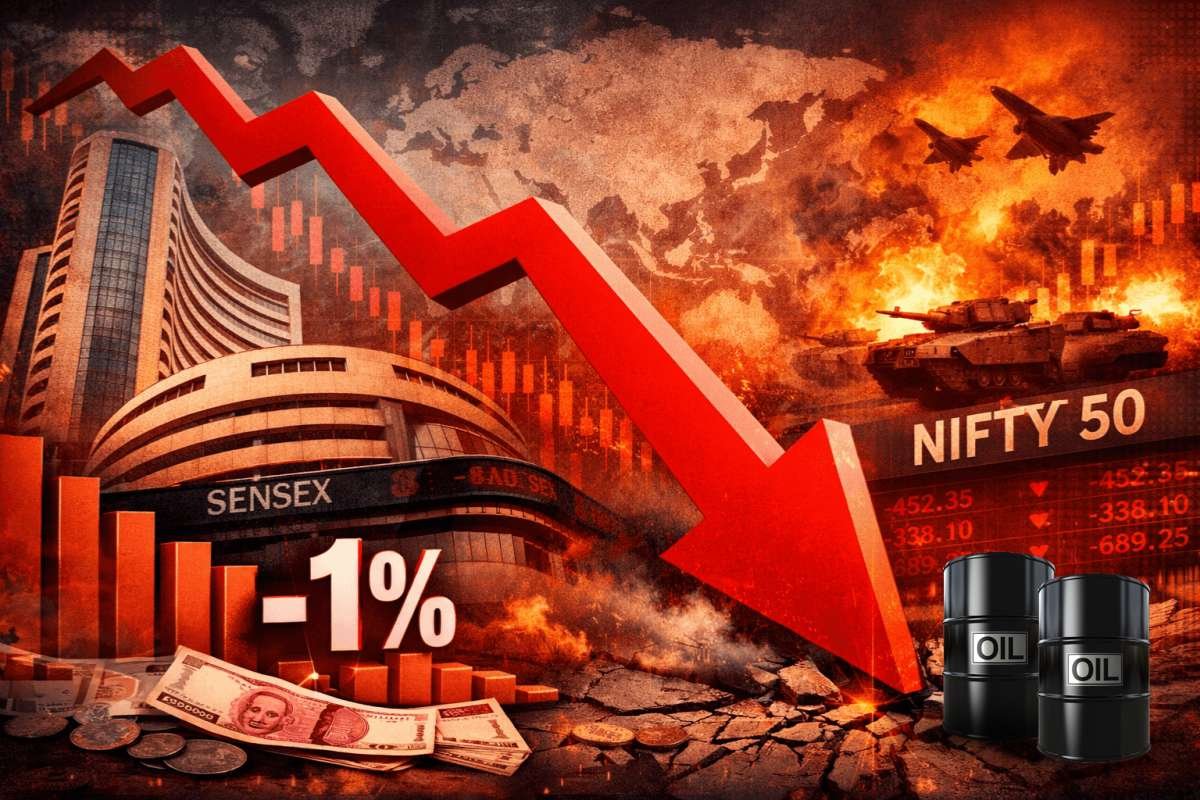
One of the key factors influencing investor sentiment is the rising geopolitical tension involving Iran and its potential impact on global energy markets. The escalating conflict has sparked concerns about disruptions to oil supply routes, pushing crude oil prices sharply higher.
Higher oil prices are particularly significant for the Indian Stock Market, which relies heavily on imported crude to meet its energy needs. A sustained rise in oil costs could increase inflationary pressures and widen the country’s trade deficit, creating additional economic challenges.
Energy-driven inflation fears have also placed pressure on the Indian Rupee, which has remained under strain against the US dollar in recent sessions. Currency weakness, combined with rising commodity prices, has added another layer of uncertainty for financial markets.
Foreign institutional investors have also turned cautious amid the global risk-off environment. Persistent selling by overseas investors has added volatility to domestic equities, as global funds shift capital toward safer assets during periods of geopolitical uncertainty.
These developments have created a cautious mood across global markets, with investors closely tracking geopolitical headlines and commodity movements before making significant investment decisions.
Investors Prepare for a Volatile Week
Despite the cautious start, experts tracking the Indian Stock Market believe that equities continue to benefit from strong domestic fundamentals and steady participation from local investors. However, they warn that volatility may remain elevated in the near term due to ongoing geopolitical risks and global economic uncertainty.
Recent market movements highlight how quickly global developments can influence investor sentiment. Even small shifts in geopolitical tensions or commodity prices can trigger noticeable swings in equity markets.
Analysts say the direction of the market in the coming days will likely depend on several key global triggers, including crude oil trends, currency movements, and foreign investment flows. Central bank policy signals from major economies could also influence global liquidity and investor risk appetite.
For now, investors in the Indian Stock Market appear to be taking a cautious approach, closely monitoring international developments before committing to large trades. While short-term fluctuations may continue, long-term market participants remain focused on economic fundamentals and corporate earnings growth.
As geopolitical developments unfold and global markets respond, Indian equities are expected to navigate a period of heightened uncertainty, with traders balancing risk and opportunity in an increasingly complex global environment.