


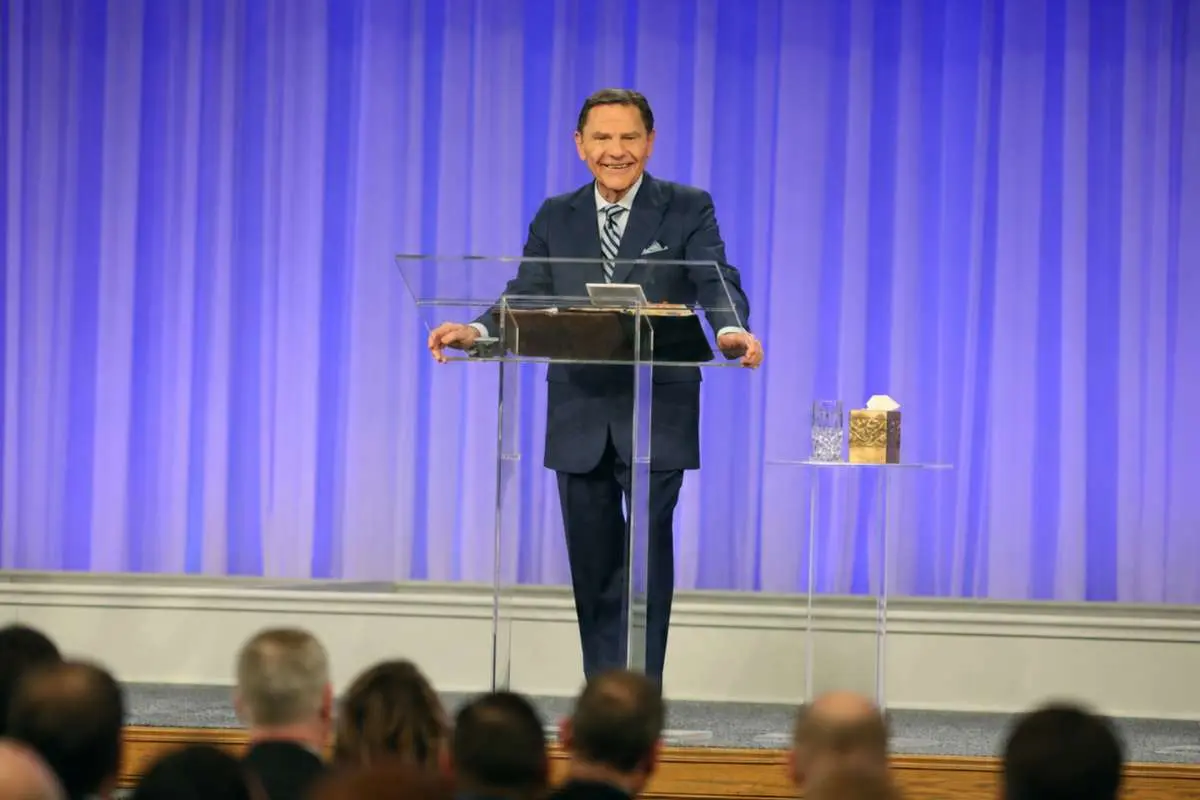
Courtney Copeland Acuña brought her grandfather a question she hears constantly: What would he tell people struggling with anxiety right now? Episode six of the Kenneth Copeland Podcast, released July 15, spends much of its 26 minutes on his answer.
His answer drew on scripture, a vocabulary discipline Kenneth Copeland has practiced for decades, and a financial crisis from his ministry’s own books. It is the podcast’s most practical episode to date, built less on biography than on method.
‘Fear Is Faith in a Storm’s Ability to Hurt You’
Copeland’s framework treats fear and faith as opposites of the same force. A pilot for most of his life, he reached for a compass to explain it: North and south are both directions, and that is all they share.
“Fear is faith in a storm’s ability to hurt you,” he said. “You get rid of that and you begin to speak to the storm.” He estimates the Bible commands “fear not” in one form or another about 175 times, and he quoted the confession he has used through decades of turbulence: “I’m not moved by what I feel, and I’m not moved by what I see. I’m moved only by what I believe.”
One more aphorism from the episode distills the teaching: “Fear tolerated is faith contaminated.”
What Does Kenneth Copeland Recommend for Anxiety?
His prescription came in three scriptural steps. First, Philippians 4, which he read at length from the Amplified Bible: Refuse to fret, bring every request to God with thanksgiving, and fix the mind on whatever is true, honorable, just, pure, and lovely.
Second, 2 Corinthians 10 and its instruction to take every thought captive. “You just put that thought in jail,” Copeland said. “No, I won’t touch you anymore.” Intrusive worry, in his method, gets refused out loud and replaced with what he calls love and faith thoughts about the person or situation involved.
Third, 1 Peter 5: casting “the whole of your care over on him once and for all.” Copeland was clear that the sequence is a practice rather than a feeling. “You don’t try to do it, you do it,” he said.
The $6 Million Test
The episode’s centerpiece applies the method to a crisis inside Kenneth Copeland Ministries itself. The ministry’s television outreach fell $6 million behind at one point, Copeland recalled, and he sat up until nearly midnight before a board meeting, unwilling to turn in the number during what was otherwise the best year the ministry had ever had.
What he sensed from God named the problem as worry itself: “You didn’t roll the care of that over on me. You worried about it.”
Copeland said he and Gloria set themselves in agreement, quit carrying the debt mentally, and watched the situation reverse. “For the first time in the history of this ministry, we paid the TV bill in one check,” he said, “and we never did go back.”
Watching His Words
A long stretch of the episode connects anxiety to vocabulary. Copeland holds that spoken words shape a believer’s life whether or not the speaker understands the principle, and he polices his own speech accordingly. He recounted catching himself saying “I hate this” about his exercise equipment and stopping the phrase on the spot.
Idle expressions draw the same treatment. Copeland retired “thrilled to death” in favor of “thrilled alive,” avoids “fantastic” for things that are not, and prefers what he calls Bible words: awesome, marvelous, and a King James rarity he has adopted for the temple, “magnifical.”
Acuña opened the episode by reading the gravity analogy from The Laws of Prosperity, Copeland’s 1974 book: Faith operates as a real spiritual force the way gravity operates as a physical one, and the laws of the spirit function when faith is put to work. Words, in that framework, are how the force gets applied.
Copeland’s addendum made the principle universal. “It works whether you know anything about it or believe it or not,” he said. “It’s spiritual law.”
Meditation as Method
A question from Rachel in Charlotte, North Carolina, asked how believers recognize a new season of life. Copeland’s tell: An assignment done faithfully starts to feel old, and the next stage usually sits directly in front of you. His tool for finding it is scripture meditation, drawn from Joshua 1 and its charge to meditate on the Word day and night.
He demonstrated with the account of the man of Gadara, delivered by Jesus and later found “clothed and in his right mind.” Copeland said he turned the passage over for years before a question surfaced: Where did the clothes come from? By his reading, someone planned for the man’s restoration before he ever asked for it, cleaned him up, and sent him home to tell his friends what compassion had done.
“That just came from meditating those scriptures,” he said. “Now, that’s the kind of thing that excites me.” One passage, held long enough, produces what a shelf of commentaries cannot.
A Partner Question, and a Convention Postscript
A Partner from Nashville, Tennessee, asked what still excites Copeland about the Bible after almost six decades. “How absolutely true it really is,” he answered. “Wherever I open this book, it’s truth.”
Episode six closed with a preview of the Southwest Believers’ Convention, now underway in Fort Worth through Aug. 1. “The OG group is back preaching together,” Acuña said, naming Kenneth Copeland, Jesse Duplantis, Keith Moore, and Creflo Dollar, joined by Terri Savelle Foy, Nancy Dufresne, and Bill Johnson, with Robert Madu and worship leader Anna Golden opening the week. Admission is free, with registration required.
New episodes of the podcast arrive Wednesday mornings on Spotify, Apple Podcasts, and YouTube, with listener questions from Partners continuing to set the agenda.