Employees often need access to email, HR systems, project tools, customer platforms, and other applications. Without centralized authentication, managing separate logins and passwords can become complex.
Security Assertion Markup Language simplifies this process by allowing an identity provider to authenticate users and securely share that information with trusted applications through a SAML assertion.
SAML is not the same as single sign-on (SSO). SAML is a standard for exchanging authentication and identity information, while SSO describes the experience of accessing multiple applications after authenticating once. SAML is one technology used to enable SSO and identity federation.
For businesses, SAML provides a standardized way to build trust between identity systems and applications while reducing the need for repeated logins.
What is security assertion markup language?
Security Assertion Markup Language is an XML-based standard for exchanging security information between trusted systems. NIST describes SAML as a protocol using XML-based request and response messages to exchange security information in the form of assertions about subjects.
In a typical enterprise environment, Security Assertion Markup Language connects two primary systems:
| Identity Provider (IdP) | Authenticates the user and issues identity information. |
| Service Provider (SP) | Provides the application or service the user wants to access. |
The IdP can communicate to the SP that a particular user has successfully authenticated. It can also provide agreed-upon attributes such as the user’s name, email address, department, or role.
SAML vs. SAML assertion

The terms are related but should not be treated as interchangeable.
SAML is the standard. A SAML assertion is the structured statement exchanged under that standard.
A SAML assertion can communicate:
- The identity of the user
- Whether the user was authenticated
- When authentication occurred
- Attributes associated with the user
- Conditions under which the assertion can be accepted
This distinction is central to understanding Security Assertion Markup Language. The IdP authenticates the user, creates an assertion containing relevant information, and sends it to the SP. The SP then validates that information before creating an application session.
NIST’s 2025 Digital Identity Guidelines specifically address federation and assertions, including how authentication information and subscriber attributes can be conveyed to separately administered relying parties.
What are the main components of security assertion markup language?
Understanding the main components makes the Security Assertion Markup Language authentication process easier to follow.
| Component | Role |
| User/Principal | The person requesting access to an application |
| Identity Provider (IdP) | Authenticates the user and issues the SAML assertion |
| Service Provider (SP) | Provides the application or service |
| SAML Assertion | Communicates authentication and identity information |
| Trust Relationship | Defines how the IdP and SP recognize and trust each other’s messages |
The IdP and SP are the two most important roles.
The IdP establishes the user’s authenticated identity. The SP consumes that information and decides whether the user can establish an application session based on the configured trust relationship and applicable access rules.
This arrangement also explains why Security Assertion Markup Language can support federation. Authentication can remain under the control of one organization or identity system while separately administered applications rely on the resulting identity information.
How does security assertion markup language authentication work?

The easiest way to understand Security Assertion Markup Language (SAML) authentication is to follow the request from the user’s browser to the application.
1. The user requests access.
A user opens a SAML-enabled application, such as a business SaaS platform.
The application acts as the service provider and needs to establish the user’s identity before providing access.
2. The application redirects the user to the IdP.
If the user does not already have an active identity session, the SP redirects the browser to the organization’s identity provider.
Depending on the configuration, this can include a SAML authentication request.
3. The IdP authenticates the user.
The identity provider authenticates the user using the organization’s configured authentication methods.
This could involve a password, multifactor authentication, passkey, or another authentication mechanism.
The important point is that the application does not necessarily need to handle the user’s primary credentials itself.
4. The IdP creates a SAML assertion.
After successful authentication, the IdP creates a SAML response containing an assertion.
The assertion can include identity information and attributes required by the service provider.
5. The assertion is sent to the SP.
The user’s browser carries the SAML response back to the service provider’s designated endpoint.
This endpoint is commonly known as the Assertion Consumer Service (ACS).
6. The SP validates the assertion.
This is one of the most important parts of Security Assertion Markup Language authentication and is often overlooked in simplified explanations.
The SP should not automatically trust every assertion it receives. It validates the assertion against the established SAML configuration and applicable protocol requirements.
Validation can include checking:
- The issuer
- The digital signature
- The intended audience
- The recipient or destination
- The assertion’s validity period
- The request-response relationship, where applicable
- Other applicable subject and condition requirements
SAML specifications include controls such as Recipient, NotOnOrAfter, InResponseTo, and AudienceRestriction to help limit where and when an assertion can be accepted.
7. The application creates a session.
If the assertion passes validation, the service provider establishes an application session for the user.
The user can then access the application without separately entering credentials into that application.
The key takeaway: Security Assertion Markup Language does not simply transfer a user’s password between applications. It enables a trusted exchange of authentication and identity information between systems.
How does Security Assertion Markup Language simplify authentication?
The main advantage of Security Assertion Markup Language is that it centralizes authentication while allowing multiple applications to rely on the same identity system.
Instead of requiring every application to authenticate employees independently, an organization can use an identity provider as a central authentication point.
1. Fewer separate logins
Users can access multiple participating applications through an established identity session instead of maintaining separate credentials for every service.
2. Centralized authentication controls
Organizations can manage authentication policies through the identity provider rather than configuring every application independently.
3. Easier access management
When an employee changes roles or leaves the organization, identity and application access can be managed through the organization’s broader identity and access management processes.
SAML itself does not perform every part of the access lifecycle, but it provides an important connection between the identity system and applications.
4. Better user experience
Employees spend less time repeatedly signing into business applications, which becomes increasingly valuable as organizations use more cloud services.
Security assertion markup language use cases
The most common Security Assertion Markup Language use cases involve browser-based authentication and federation between an identity provider and multiple applications.
| Enterprise SSO | Organizations can connect a central identity provider with business applications. Employees authenticate through the organization’s identity system and access participating services. |
| SaaS application access | Businesses can connect cloud applications to a corporate identity provider instead of maintaining separate authentication arrangements for every application. |
| Workforce federation | SAML can support identity relationships across separately administered systems. This can be useful when employees, contractors, or other authorized users need access across organizational boundaries. |
| Education and institutional access | Universities and other institutions have used federated identity systems to provide users with access to separately administered online services. |
| B2B and partner access | Organizations can establish identity relationships with business partners when users from one organization need access to applications operated by another. |
The broader concept is federation, where identity and authentication information crosses organizational or system boundaries through an agreed protocol and trust relationship.
Security assertion markup language security considerations
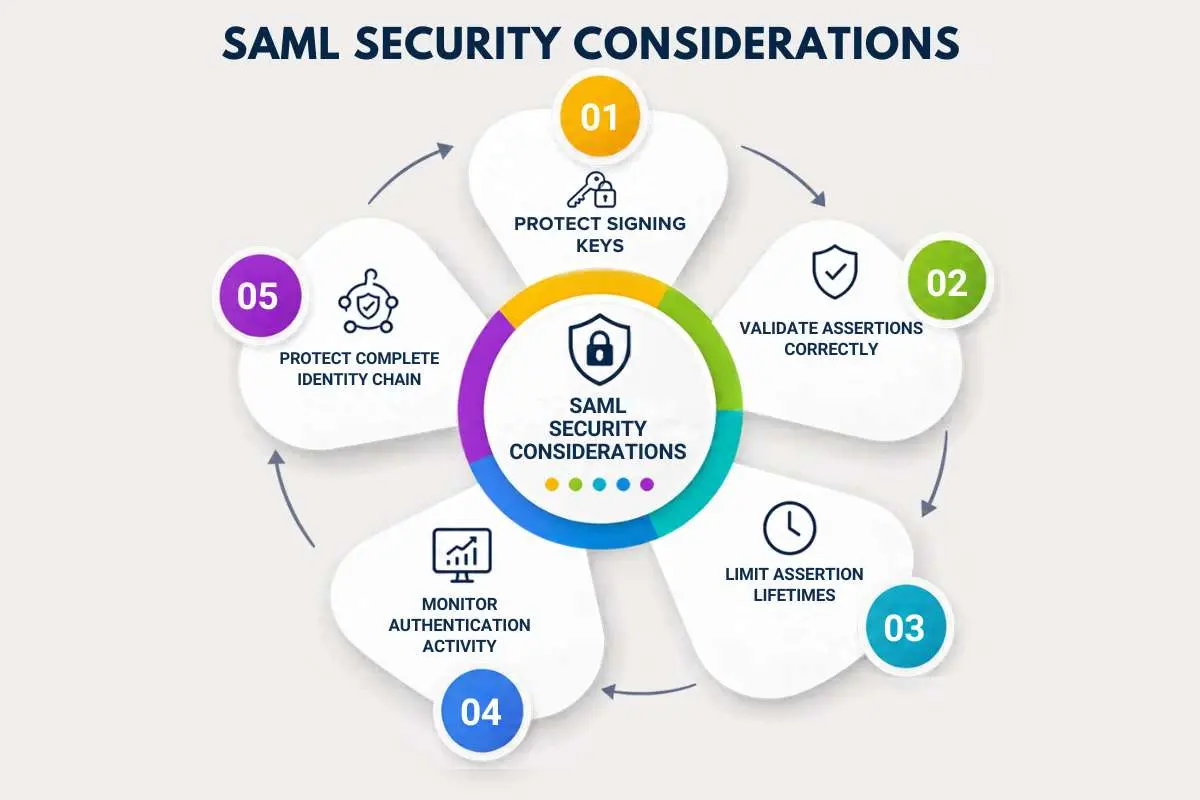
A secure Security Assertion Markup Language for Security Assertions deployment depends on more than simply enabling SSO. The identity provider, service provider, certificates, signing keys, endpoints, browser sessions, and administrative processes all contribute to the security of the system.
1. Protect signing keys
SAML deployments commonly use cryptographic signatures to establish the integrity and origin of assertions. The private keys used for signing therefore require strong protection and lifecycle management.
NIST’s September 2026 IR 8587 specifically emphasizes signing-key protection, validity management, automated key management and rotation, and related lifecycle controls.
2. Validate assertions correctly
An SP should validate more than whether an assertion has a valid signature.
It should also verify that the assertion is intended for the correct service provider and remains within its permitted validity period.
3. Limit assertion lifetimes
An assertion that remains valid for too long can increase the opportunity for misuse if it is exposed.
Appropriate validity periods and session controls can reduce the period during which a compromised assertion may remain useful.
4. Monitor authentication activity
Organizations should monitor authentication failures, unusual sign-in patterns, certificate changes, configuration changes, and other identity-related events.
NIST IR 8587 emphasizes monitoring alongside key management, verification, and lifecycle controls when protecting tokens and assertions.
5. Protect the complete identity chain.
Security does not end with the SAML assertion. A compromised identity provider, signing key, administrator account, or application endpoint can undermine an otherwise correctly configured federation environment.
This is why Security Assertion Markup Language should be treated as one component of a broader identity and access management strategy.
Security assertion markup language vs. OIDC vs. OAuth 2.0
SAML, OpenID Connect (OIDC), and OAuth 2.0 are often discussed together, but they serve different purposes.
| Technology | Primary purpose | Model | Common use |
| SAML | Authentication and identity federation | XML-based assertions | Enterprise and browser-based SSO |
| OpenID Connect (OIDC) | Authentication and identity | OAuth 2.0-based, REST/JSON-oriented | Web, mobile, and modern application authentication |
| OAuth 2.0 | Authorization and delegated access | Authorization framework | Allowing applications to access resources on a user’s behalf |
Markup Language for Security Assertions and OIDC both address authentication and identity, while OAuth 2.0 primarily addresses authorization.
OIDC is built on OAuth 2.0 and was designed for identity interactions through REST-like APIs across browser, mobile, and JavaScript clients. The OpenID Foundation notes that OIDC can support use cases similar to SAML while using a different technical model.
OAuth 2.0 should therefore not simply be described as a newer replacement for SAML.
Organizations can use different protocols for different identity and authorization requirements.
Advantages and limitations of Security Assertion Markup Language (SAML)
Advantages:
| Centralized authentication | Authentication can be managed through a central identity provider. |
| SSO support | Users can access multiple participating applications through a shared authentication experience. |
| Enterprise federation | SAML supports identity relationships between separately administered systems. |
| Reduced credential duplication | Applications do not necessarily need to maintain independent primary credentials for every user. |
| Interoperability | A standardized approach allows identity providers and service providers to exchange authentication information. |
Limitations:
| Configuration complexity | Establishing and maintaining the IdP-SP relationship requires careful configuration. |
| XML complexity | The XML-based structure can be more complex than modern JSON-based approaches. |
| Certificate and key management | Trust relationships depend on certificates, signing keys, metadata, and related configuration. |
| Troubleshooting challenges | A mismatch in audience, endpoint, certificate, attributes, timestamps, or identifiers can prevent authentication. |
| Not ideal for every application | Modern mobile and API-centric applications may be better suited to OIDC and OAuth-based architectures. |
The right choice depends on the application’s architecture, identity requirements, existing infrastructure, and interoperability needs.
The current enterprise perspective on security assertion markup language

The role of Security Assertion Markup Language in the enterprise has evolved as organizations adopt more cloud services, APIs, mobile applications, passwordless authentication, and identity governance tools.
SAML remains relevant for established enterprise federation and SSO environments, but organizations increasingly operate multiple identity protocols rather than relying on one standard for everything.
A modern enterprise identity architecture may include:
- SAML for enterprise application federation
- OIDC for modern application authentication
- OAuth 2.0 for delegated authorization
- MFA and passkeys for stronger authentication
- Identity governance for access lifecycle management
- Privileged access management for sensitive accounts
- Continuous monitoring for identity-related threats
This makes the practical question less about whether an organization “uses SAML” and more about where SAML fits within the organization’s identity architecture.
The 2026 security environment reinforces this approach. NIST finalized IR 8587 in September 2026 to provide implementation recommendations for protecting identity tokens and assertions from forgery, theft, and misuse. The guidance addresses key management, token verification, lifecycle controls, secure configuration, interoperability, and continuous monitoring.
NIST also reported that nearly 250 comments from more than 20 contributors informed the final document during its development.
The broader enterprise lesson is straightforward: SSO convenience cannot replace identity security. As organizations connect more applications and cloud services, the trust relationships behind authentication require strong security controls.
Troubleshooting common Security Assertion Markup Language problems
When Security Assertion Markup Language authentication fails, checking the complete authentication chain is usually more effective than focusing only on the login screen.
| Problem | What to check |
| Invalid audience | Confirm that the assertion is intended for the correct SP |
| Signature or certificate error | Check the signing certificate, trust relationship, and key status |
| Expired assertion | Check NotOnOrAfter, session timing, and clock synchronization |
| Incorrect user attributes | Confirm that the IdP sends the attributes expected by the SP |
| Wrong ACS or redirect endpoint | Verify the configured service provider endpoint |
| Request mismatch | Check identifiers such as InResponseTo when an authentication request is being used |
| Authentication succeeds, but access fails | Separate successful authentication from application authorization or provisioning |
A useful troubleshooting sequence is:
User authentication → SAML response → assertion creation → assertion delivery → assertion validation → application session → application authorization.
This helps determine whether the problem originates with authentication, federation, assertion validation, session creation, or application permissions.
Conclusion:
Security Assertion Markup Language simplifies authentication by allowing identity providers to securely share authentication and identity information with applications.
Its key role is separating authentication from application access. The identity provider verifies the user, sends a SAML assertion, and the service provider validates it before granting access.
In 2026, SAML remains widely used for enterprise federation, alongside OIDC and OAuth 2.0 in modern identity architectures. Its core purpose is to establish trust between identity systems and the applications they serve.
FAQs
1. Is Security Assertion Markup Language the same as SSO?
No. Security assertion markup language is a standard for exchanging authentication and identity data, while SSO allows users to access multiple applications with one authentication. SAML can be used to implement SSO.
2. What is a SAML assertion?
A SAML assertion is a structured statement from an identity provider containing information about an authenticated user, such as authentication details, attributes, and conditions.
3. What is the difference between an IdP and an SP?
The Identity Provider (IdP) authenticates the user and issues the SAML assertion. The Service Provider (SP) validates the assertion and grants application access.
4. Is Markup Language for Security Assertions still relevant in 2026?
Yes. SAML remains widely used for enterprise identity federation and SSO, alongside newer standards such as OIDC and OAuth 2.0.
5. Is Security Assertion Markup Language secure?
SAML can support secure authentication when properly implemented. Organizations should protect signing keys, validate assertions, manage certificates, limit assertion lifetimes, and monitor.