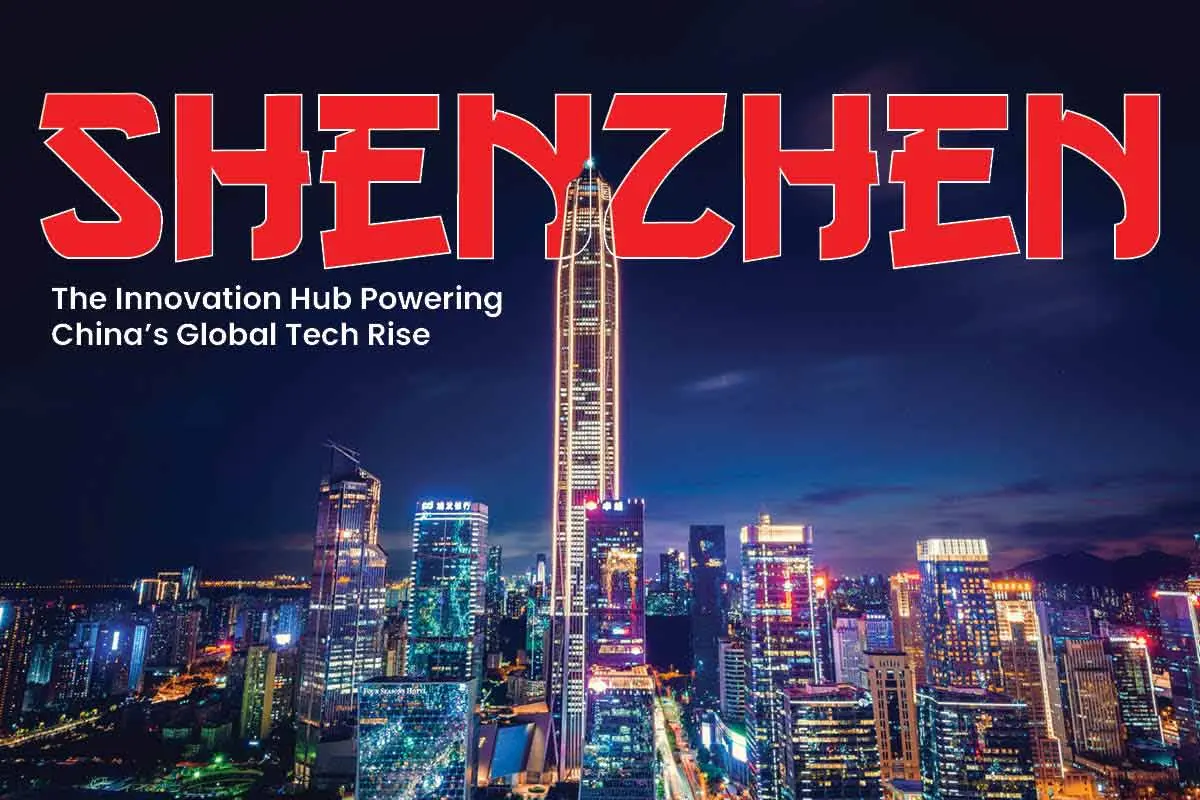
Picture a city where new gadgets appear almost as quickly as ideas. That energy defines Shenzhen today. The media often calls it China’s Silicon Valley, a place where hardware startups, electric vehicle firms, and global tech companies operate within a dense urban setting. The city gained global attention after China designated it as the first Special Economic Zone in 1980.
That decision turned a quiet coastal settlement into one of the country’s largest urban centers. Today, Shenzhen stands as a major center for electronics manufacturing and industrial design, attracting engineers, entrepreneurs, and investors who look for speed, experimentation, and practical innovation.
City Snapshot:
- The fourth-largest city in China by economic output
- Recognized as a UNESCO City of Design
- Major global hub for electronics and hardware manufacturing
- Leading center for electric vehicle innovation
Historical Roots: Turning Points
Shenzhen’s story reflects a remarkable urban shift within a short span of time. Each decade introduced a new phase that shaped the city’s economic identity and urban character. The timeline below outlines key moments that turned a quiet coastal settlement into a major technology center.
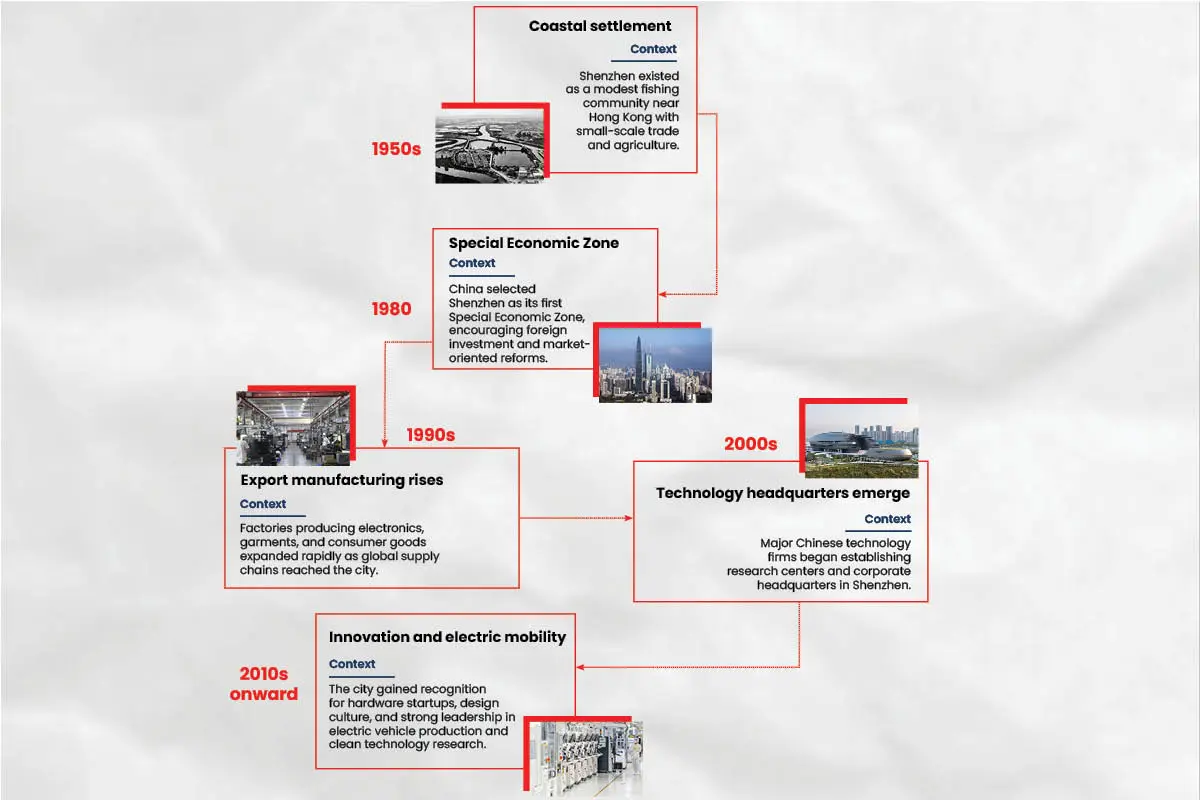
| Period | Key Moment | Context |
| 1950s | Coastal settlement | Shenzhen existed as a modest fishing community near Hong Kong with small-scale trade and agriculture. |
| 1980 | Special Economic Zone | China selected Shenzhen as its first Special Economic Zone, encouraging foreign investment and market-oriented reforms. |
| 1990s | Export manufacturing rises | Factories producing electronics, garments, and consumer goods expanded rapidly as global supply chains reached the city. |
| 2000s | Technology headquarters emerge | Major Chinese technology firms began establishing research centers and corporate headquarters in Shenzhen. |
| 2010s onward | Innovation and electric mobility | The city gained recognition for hardware startups, design culture, and strong leadership in electric vehicle production and clean technology research. |
This timeline highlights how policy choices and industry shifts shaped Shenzhen’s modern identity.
China’s Innovation Engine: The Shenzhen Model
Shenzhen stands at the center of China’s technology growth. The city hosts several globally recognized companies that influence digital services, telecommunications, robotics, and electric vehicles. Over the past two decades, Shenzhen has gained a reputation as one of Asia’s most active innovation hubs. A dense network of manufacturers, engineers, research institutions, and venture investors supports constant experimentation. Ideas often move quickly into working prototypes because the entire production ecosystem operates within the same metropolitan region.
Innovation Pillars
- Global Technology Leaders
- Major companies such as Huawei, Tencent, DJI, and BYD operate large headquarters and research facilities in the city.
- High Patent Activity
- Shenzhen records strong patent filings each year, reflecting intense research and product development across technology sectors.
- Dense Technology Enterprise Network
- Thousands of high-tech firms operate across electronics, artificial intelligence, robotics, and smart devices.
- Research and Startup Collaboration
- Universities and laboratories frequently work with startups to test and commercialize new technologies.
- Manufacturing Expertise
- Deep experience in electronics production supports rapid hardware prototyping and efficient large-scale manufacturing.
- Engineering Talent and Supply Chains
- Skilled engineers and extensive supplier networks help companies convert new concepts into market-ready products quickly.
This combination of talent, industry, and research gives Shenzhen a rare capacity for rapid technology development.
Electric Mobility at Scale
Electric mobility shapes daily transport across Shenzhen. The city hosts BYD, one of the world’s leading electric vehicle producers, whose research and manufacturing facilities anchor a large local industry. Public transportation reflects this technological shift across the metropolitan area. Electric buses move through major corridors while quiet taxi fleets circulate across business districts and residential neighborhoods.
Charging facilities appear in parking areas, transit hubs, and commercial zones, allowing drivers to operate vehicles with minimal interruption. Municipal programs encourage clean transport through policy incentives and long-term infrastructure investment. These measures created an urban environment where electric mobility operates at scale.
Streets filled with battery-powered vehicles illustrate how policy support, industrial capacity, and engineering expertise can combine within a single city. Shenzhen, therefore, functions as a large testing ground where companies refine vehicle technology and charging systems while residents experience electric transport in everyday life.
Electric Mobility in Numbers:
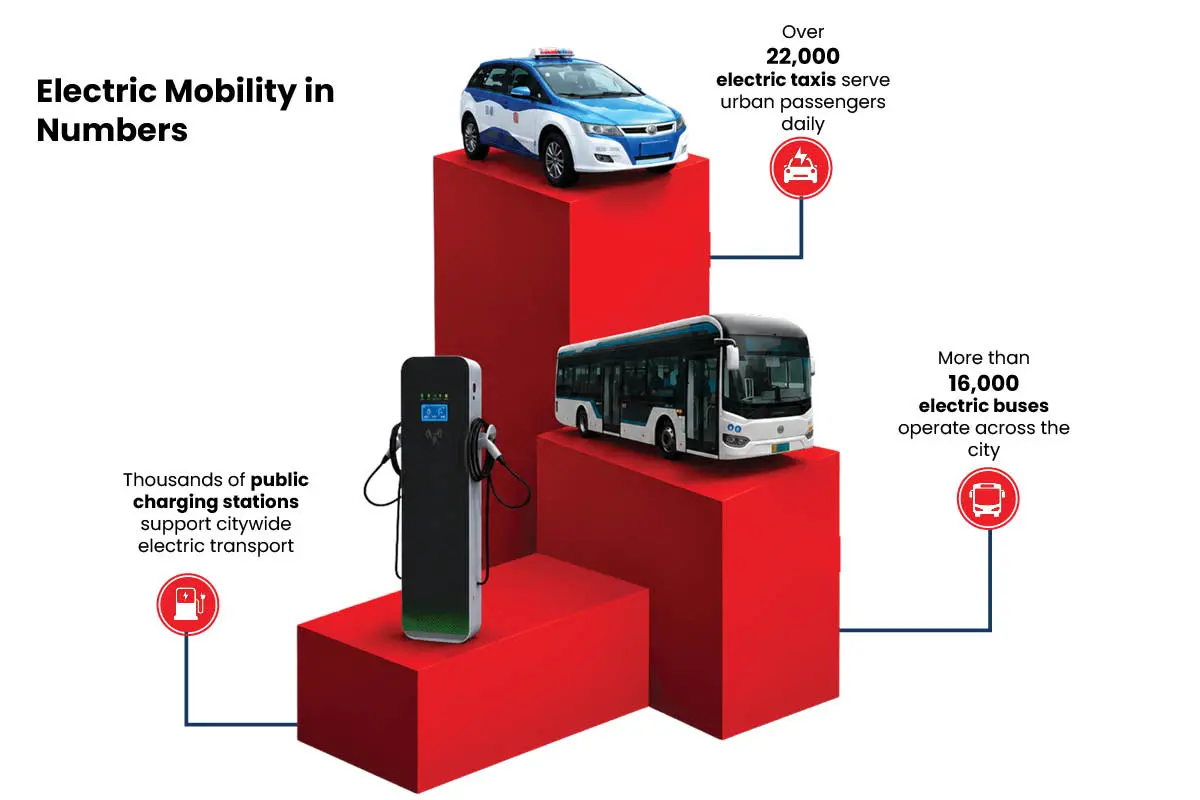
- More than 16,000 electric buses operate across the city
- Over 22,000 electric taxis serve urban passengers daily
- Thousands of public charging stations support citywide electric transport
Where Design Meets Technology
Shenzhen gained international recognition when UNESCO named it a City of Design in 2008. The title acknowledged the city’s growing influence in industrial design, architecture, digital media, and creative production. Design studios operate across technology districts and creative parks, where professionals work on products that reach global markets. International exhibitions and design awards held in Shenzhen attract architects, designers, and researchers who explore new ideas in urban development and product creation.
Creative industries play an important role in the city’s economy. Thousands of design firms collaborate with manufacturers and technology companies during product development. This interaction ensures that devices, vehicles, and consumer electronics combine engineering precision with strong visual identity. As a result, Shenzhen demonstrates how design thinking shapes technology products while supporting economic growth through creative industries.
A Gateway to Global Markets
Shenzhen holds a strategic position in China’s modern economy. Located near Hong Kong, the city acts as a major gateway linking the Chinese industry with international markets. Over several decades, it attracted foreign investment, large technology firms, and extensive manufacturing networks. Factories and technology parks across the region produce electronics, batteries, telecommunications equipment, and consumer devices used worldwide. These industries support large export volumes that contribute significantly to China’s economic performance.
The city also hosts major corporate headquarters and research centers that influence global technology production. International supply chains rely on Shenzhen’s manufacturing efficiency and engineering expertise. As a result, the city stands as one of the most important economic centers in East Asia and a key contributor to China’s industrial strength.
Key Economic Roles
- Major global electronics manufacturing hub
- Headquarters location for leading technology companies
- Large and active startup ecosystem
- Strong international trade links through nearby Hong Kong
Urban Life in Shenzhen
Shenzhen offers a lively urban atmosphere that balances business districts with parks, cultural venues, and waterfront spaces. Visitors experience modern architecture, efficient public transport, and energetic city streets that reflect the city’s fast-paced character.
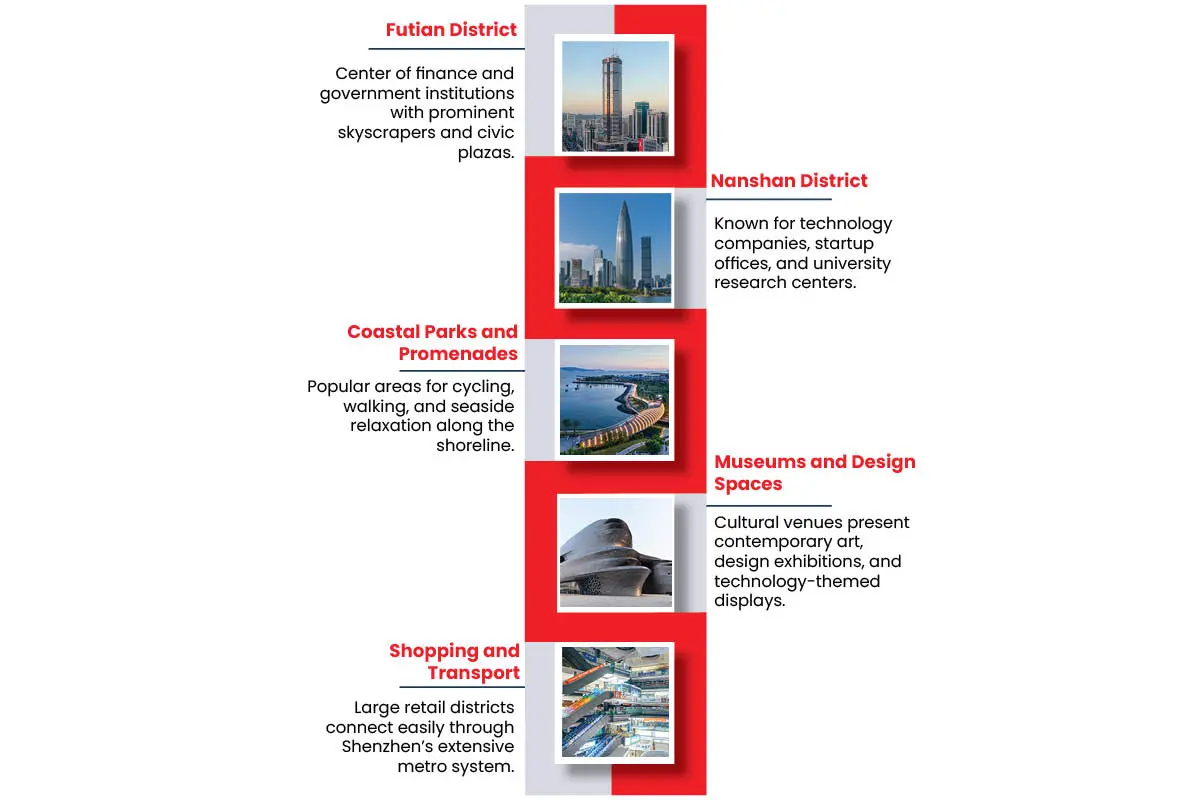
| Place | Description |
| Futian District | Center of finance and government institutions with prominent skyscrapers and civic plazas. |
| Nanshan District | Known for technology companies, startup offices, and university research centers. |
| Coastal Parks and Promenades | Popular areas for cycling, walking, and seaside relaxation along the shoreline. |
| Museums and Design Spaces | Cultural venues present contemporary art, design exhibitions, and technology-themed displays. |
| Shopping and Transport | Large retail districts connect easily through Shenzhen’s extensive metro system. |
Such spaces illustrate how modern infrastructure and public areas shape the city’s lively atmosphere.
Smart Solutions for Urban Growth
Shenzhen, therefore, presents a practical example of managing rapid urban growth through coordinated smart systems.
- Urban Challenge
- Rapid population growth placed pressure on roads, energy systems, and public services. Heavy traffic and rising emissions created environmental concerns in a densely built city.
- City Response
- Municipal planners introduced electric public transport, expanded metro lines, and promoted clean energy programs. Urban management platforms now assist city departments with real-time monitoring and service coordination.
Technology Tools
- Smart traffic control systems that manage congestion
- Clean energy initiatives supporting electric mobility
- Digital platforms that help monitor infrastructure and public services
This approach demonstrates how modern cities can address rapid growth through coordinated technology and policy.
Read Next: Maastricht: Where Europe Found Its Voice and History Found Its Stone
Conclusion
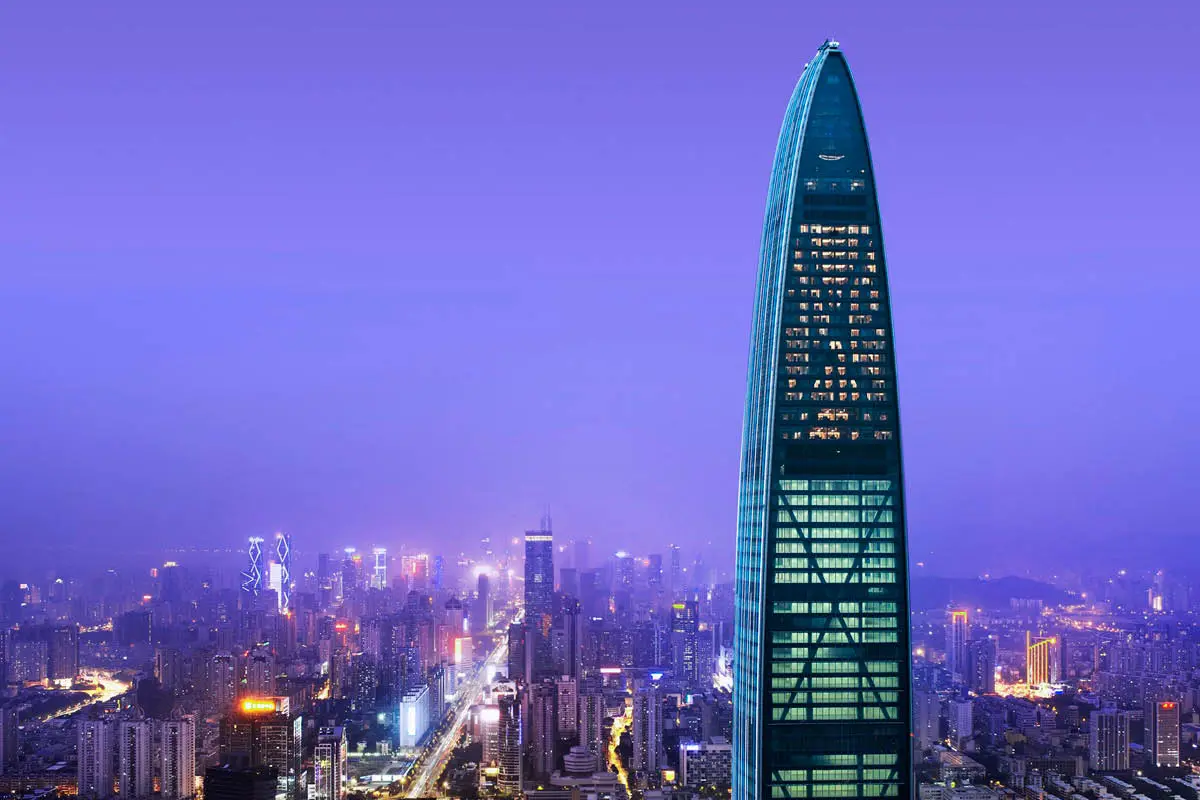
Shenzhen shows how quickly a city can grow when technology, industry, and creative ideas work side by side. Busy technology districts, electric vehicles, design studios, and global trade networks shape everyday activity here. What once began as a small coastal settlement now stands as a confident modern city that reflects China’s economic ambition and technological progress.