Employee training equips staff with immediate tools for their present roles. Workforce development constructs structured internal mobility paths that retain top talent. So, workforce development vs employee training is a difference in how far ahead each one looks.
For example, in her first week, a new hire learns the safety rules and the scheduling software. By year three, she’s running a shift because the company mapped a route from operator to supervisor. The first was training; the second was workforce development.
In this article, we will take a look at the core differences between workforce development and employee training.
What is the difference between workforce development vs employee training?
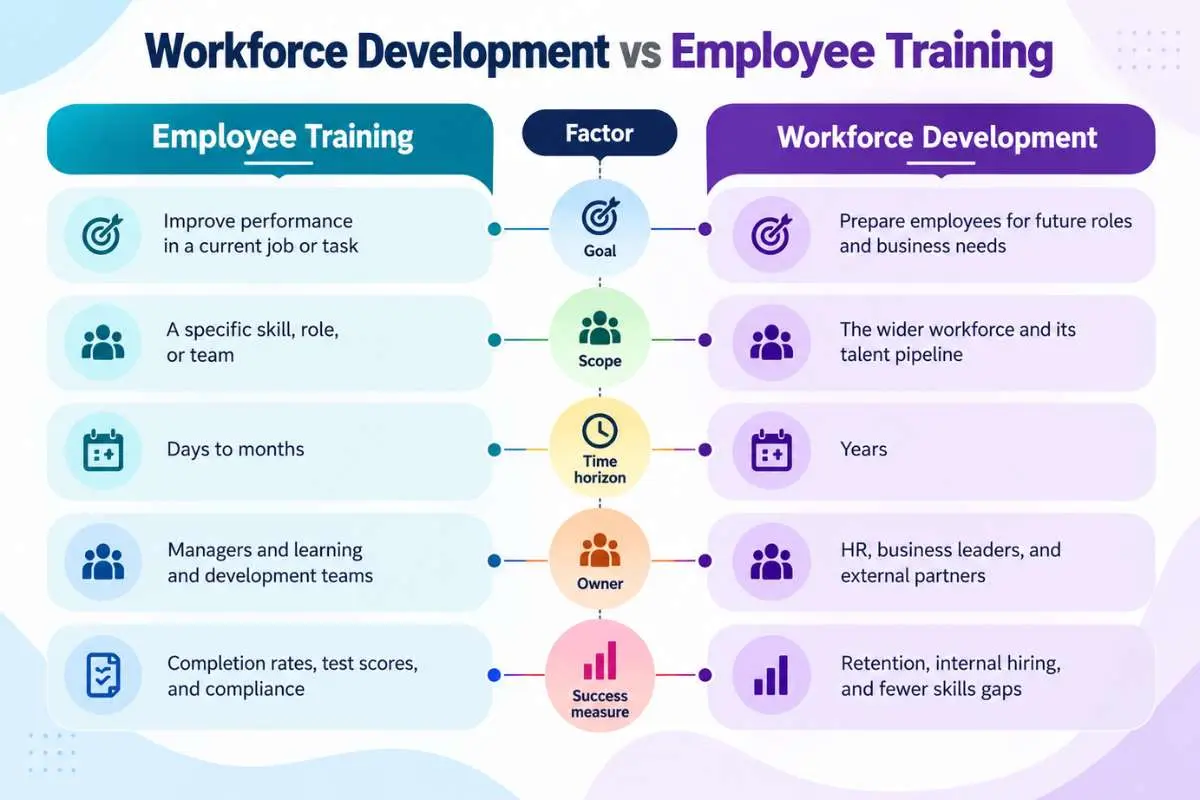
Employee training teaches the skills needed to perform a specific job or task. Workforce development takes a broader view by building the skills, career paths, and talent pipeline a company needs over time. Training is one of the tools used to support this effort.
| Employee training | Factor | Workforce development |
|---|---|---|
| Improve performance in a current job or task | Goal | Prepare employees for future roles and business needs |
| A specific skill, role, or team | Scope | The wider workforce and its talent pipeline |
| Days to months | Time horizon | Years |
| Managers and learning and development teams | Owner | HR, business leaders, and external partners |
| Completion rates, test scores, and compliance | Success measure | Retention, internal hiring, and fewer skills gaps |
The two approaches work best together. Workforce development helps a company decide which skills it needs and how to build them over time. Employee training then helps workers gain the skills they need to meet those goals. This link allows businesses to plan learning around their talent needs instead of treating each training session as a separate task.
The term workforce development also refers to public programs that help people gain skills and find jobs. These programs may involve workforce boards, government agencies, and community college partnerships.
What does each look like in the same situation?
Let us take an example of a regional hospital facing two challenges. First, it must train staff to use a new electronic health records system before launch. Second, many experienced ICU nurses are expected to retire within five years, creating a need for future replacements.
1. Training response: The hospital gives every clinician a short, role-specific session on the new records system before launch. It measures success through course completion and a skills check. The effort ends once staff can use the system correctly and handle their daily tasks.
2. Workforce development response: To prepare for the expected ICU staffing gaps, the hospital starts a nurse residency program, funds specialty certification, and creates a clinical ladder. These steps help junior nurses build the skills needed for ICU roles. The effort takes years, and the hospital tracks how many ICU vacancies it fills with its own staff.
3. The key difference: Both efforts support the same hospital, but they address different needs. Training prepares current staff for an immediate change. Workforce development builds a pipeline of skilled nurses for future roles.
If the hospital focuses only on training, it may lack enough ICU nurses when senior staff retire. If it focuses only on long-term development, staff may struggle to use the new records system at launch. It needs both to meet current demands and plan for future staffing.
When do you need workforce development vs employee training?

Ask whether people lack the skills to do a task now or whether your business may lack the skilled people it needs in the future. The answer helps you decide where to focus your efforts.
Employee training is the right choice when workers need specific skills to meet current job demands. Almost 88% of workers say they have applied new skills in their job over the past year. Use it when a company introduces new tools or processes, needs to meet compliance rules, or wants to improve onboarding. It also works well when a clear skills gap can be closed within weeks or months.
Workforce development is a better fit when a company faces long-term talent needs. You may struggle to fill key roles, lose employees because they see no clear career path, or need new skills as your industry changes. It also helps when you lack enough trained managers or future leaders to fill senior roles.
How do they fit together?
Training alone can fix today’s skills gaps but may not prepare enough people for future roles. Development alone can build a talent pipeline, but workers still need training to handle their current duties.
You don’t need to choose one over the other. Start by meeting current training needs, then add workforce development where future skills shortages or hard-to-fill roles pose a risk.
Conclusion
The difference between workforce development vs employee training comes down to various factors. Timeline and scope, and evaluating your immediate operational needs against long-term growth, determine where to invest. To begin, audit your current training programs. Then identify whether you are fixing an immediate task gap or building a future leadership pipeline. Lastly, assign your budget according to your workforce development strategy.
FAQs
1. Can employee training exist without workforce development?
Yes. Companies often run routine software onboarding or compliance training to meet immediate operational needs without connecting it to long-term career paths.
2. How does ROI measurement differ between workforce development vs employee training?
Training ROI measures quick task mastery and error reduction. Workforce development ROI measures multi-year retention, internal promotion rates, and lower hiring costs.
3. Which department budget covers each initiative?
Training comes from tactical L&D or local department operating budgets. Workforce development is funded by strategic HR, executive succession plans, or workforce grants.
4. How do you transition from basic training to workforce development?
Map clear career paths for core roles, link tactical skills to promotion milestones, and partner with credential providers or educational institutions.
5. Is workforce development only for large enterprises?
No. Small and mid-sized businesses use it to retain high performers and build internal leadership without competing on massive corporate salary pools.