The best AI security platforms depends on what your organization is trying to protect. Employee use of ChatGPT creates a different control problem from a customer service agent that can retrieve records and issue refunds. A tool that discovers unsanctioned AI applications may never inspect the tool calls inside your own application.
For organizations addressing workforce AI, internally built agents, and application testing together, Check Point belongs on the shortlist. For a narrower requirement, a specialist can be a better starting point: Mindgard for adversarial testing, Reco for AI activity inside SaaS, or HiddenLayer for a broader machine learning security program.
This comparison covers platforms that secure AI systems and usage. The selection excludes products whose primary relevance is using AI to detect conventional endpoint or network threats. That distinction makes the shortlist useful to the team actually responsible for the AI deployment.
How this comparison was assembled
We compared documented coverage of workforce AI, application runtime, agent permissions, and adversarial testing. The list begins with portfolios spanning several of those responsibilities, then moves to more focused operating contexts. Check Point leads the broad-program comparison because its documented workforce, agent, and testing products match that scope; the required products and tiers remain a buying consideration.
Recommendations use official product pages and documentation. No hands-on performance benchmark was conducted. This article was prepared for a Check Point content project; product numbers aid navigation and do not represent independent scores.
Best AI security platforms at a glance
| Platform | Start here when | Confirm before purchase |
| Check Point AI Security | Workforce, application, and agent programs overlap | Required products, tiers, and enforcement points |
| Palo Alto Networks Prisma AIRS | AI application runtime and testing are central | API and network deployment scope |
| Cisco AI Defense | Validation and runtime controls need a common approach | Supported environments and integrations |
| Noma Security | AI inventory, posture, and runtime share an owner | Discovery and enforcement coverage |
| HiddenLayer | The program includes more than generative AI | Coverage for each model and artifact type |
| NeuralTrust | AI traffic and tool access need a control layer | Traffic routing and deployment design |
| Mindgard | Adversarial testing drives the security program | Target coverage and remediation workflow |
| Zenity | Agents create identity and permission risks | Platform support and execution visibility |
| Obsidian Security | Browser, SaaS, and agent risks overlap | Required browser and agent instrumentation |
| Reco | SaaS ownership and access relationships are unclear | Which events each integration exposes |
1. Check Point AI Security

Published product interface. Check Point workforce AI dashboard, illustrating one part of the wider AI Security portfolio.
Check Point’s clearest fit is an enterprise with several AI security owners who need a coherent program. Its portfolio separates workforce AI controls, agent protection, and red teaming. That gives the security team a way to discuss employee data sharing, risky agent configurations, and adversarial testing without treating them as one interchangeable feature. Official product information.
The practical advantage is the ability to build a shortlist around several related requirements. The practical constraint is that portfolio breadth does not establish what comes in a particular purchase. Map the required Check Point AI Security products and tiers to your applications, endpoints, and deployment owners. Ask for a demonstration of the specific control point that will handle each risk, including what happens when that control is unavailable.
2. Palo Alto Networks Prisma AIRS
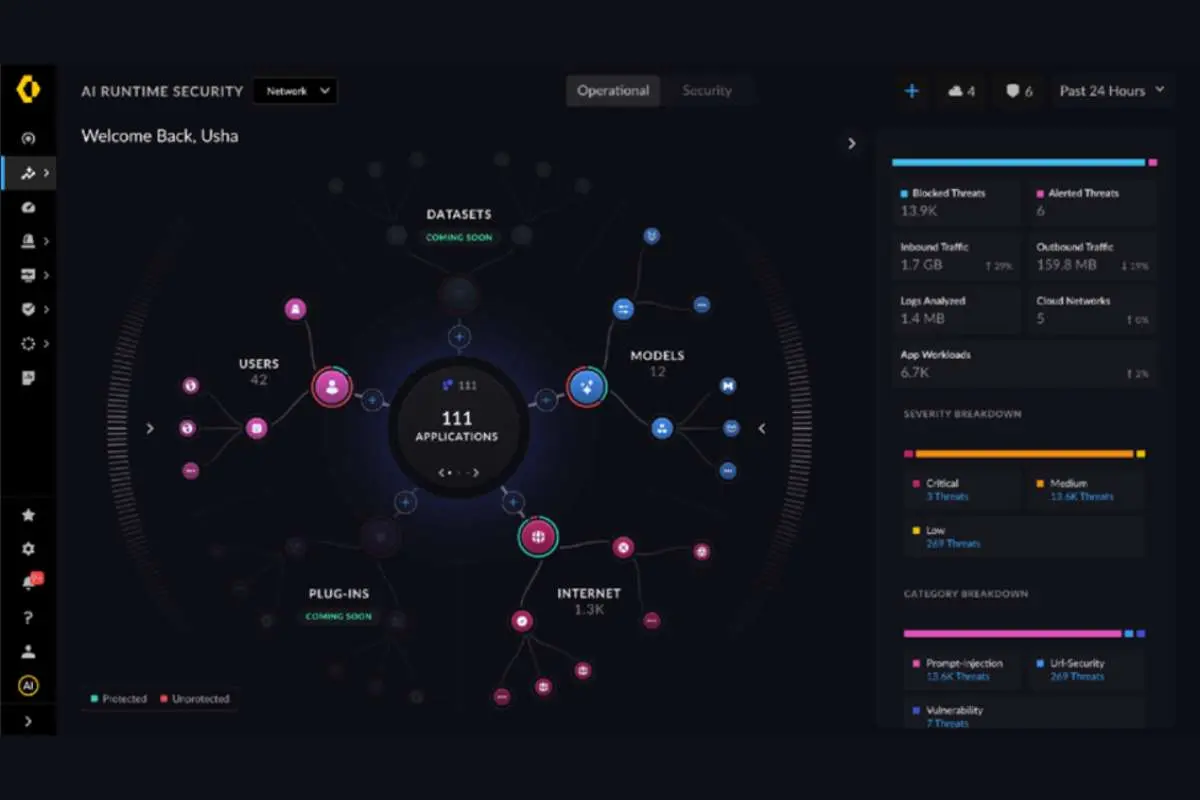
Official interactive-demo image. Prisma AIRS runtime dashboard from Palo Alto Networks’ linked interactive tour. Demonstration data is illustrative.
Prisma AIRS is a relevant choice when the core problem is protecting AI applications as they run. Palo Alto Networks documents runtime inspection alongside AI red teaming, giving application security teams both an assessment path and a production control conversation. Official product information.
The deployment architecture deserves early attention. An application calling a security API and traffic inspected through a network control are different integration projects. Trace a representative request through retrieval, model output, and tool execution, then identify which component sees each step. This is a stronger buying test than a generic prompt-injection demonstration. Confirm the availability and scope of the specific deployment option being proposed; a capability announced for one environment does not establish support for every environment.
3. Cisco AI Defense
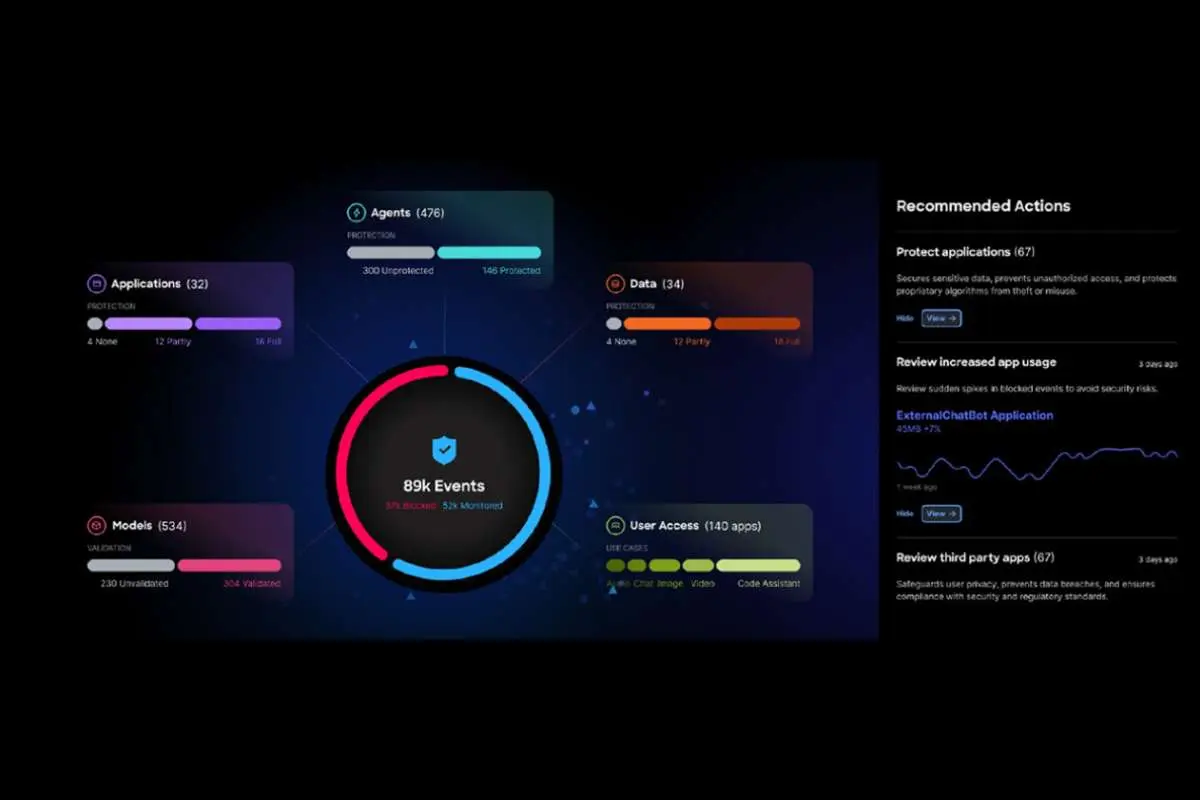
Documentation screenshot. Cisco AI Defense interface published in its product data sheet.
Cisco AI Defense brings AI validation and runtime security into the same product discussion. Its documentation addresses models, applications, and agent interactions, including risks involving external tools. It is a sensible candidate when a security architecture team wants a consistent process for checking an AI system before release and applying controls during operation. Official product information.
The key question is coverage of your actual execution path. A useful demonstration should show the application connection, the policy decision, and the event available to an investigator. Include a legitimate complex workflow as well as an attack scenario. That reveals whether the implementation can preserve necessary business behavior and provide understandable evidence when an interaction is restricted.
4. Noma Security
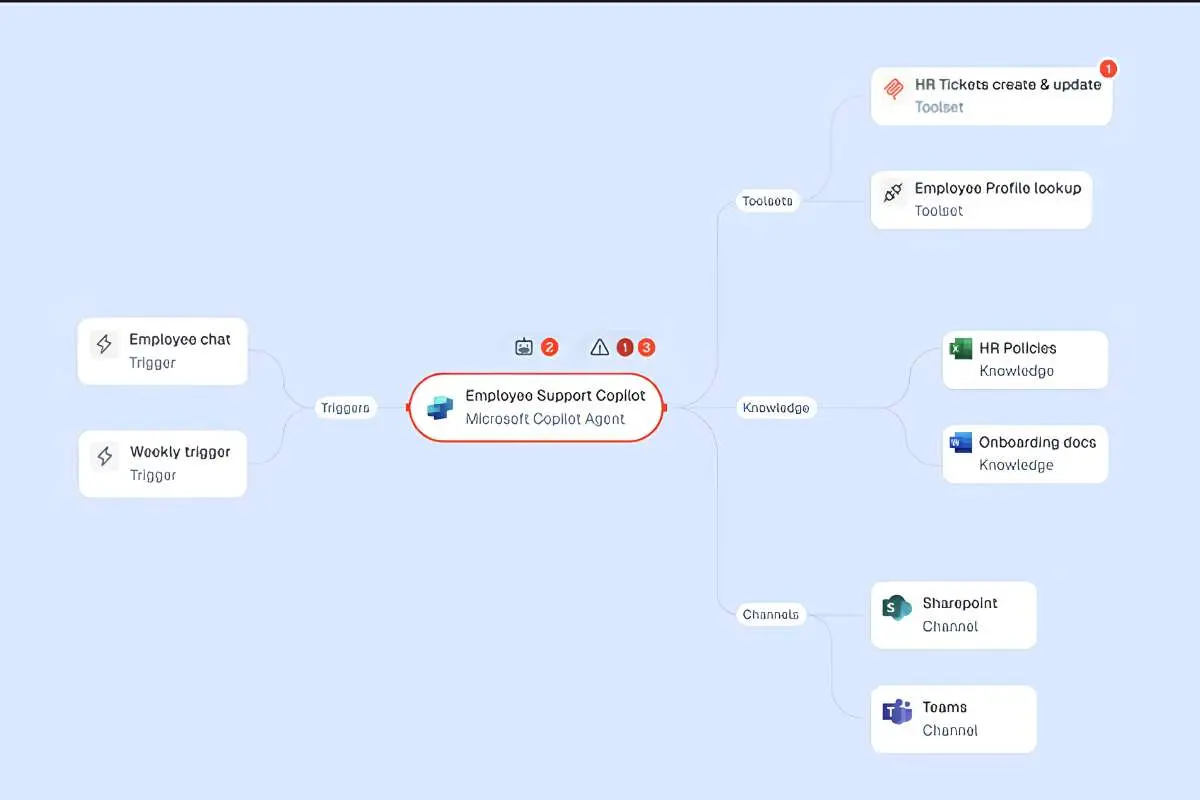
Vendor interface illustration. Noma’s published illustration of AI asset relationships. It is a product illustration, not a captured customer environment.
Noma is worth considering when AI assets, permissions, testing, and runtime findings need to be investigated together. Its platform documents AI security posture management, access controls, red teaming, and detection and response. The relevant buying scenario is an organization that cannot yet connect its AI inventory to the teams and controls responsible for it. Official product information.
Build the proof of concept around a small but varied sample: a cloud agent, an internally built application, and a workflow using an MCP server. Require the inventory to explain what it found and how. Then test enforcement through the proposed integration. Discovery and protection are separate achievements, and an asset appearing in a dashboard should not be accepted as evidence that every interaction is inspected.
5. HiddenLayer
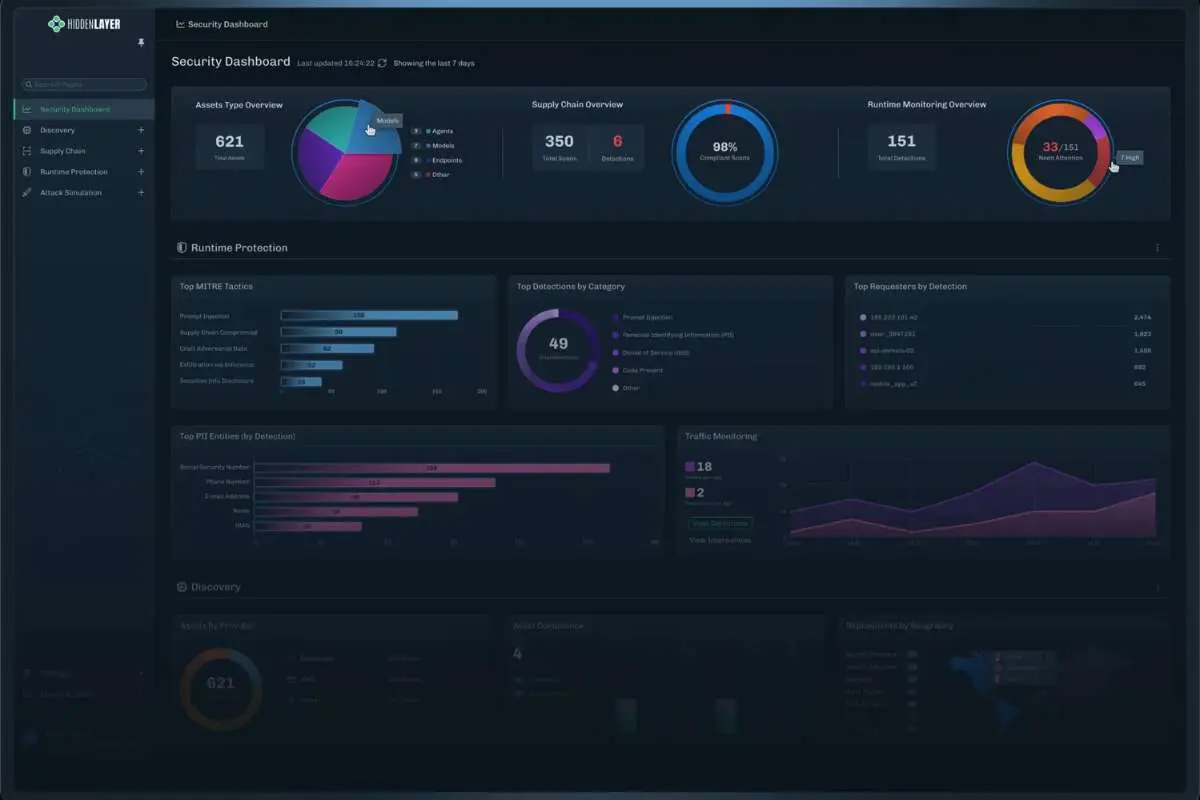
Published product interface. HiddenLayer’s published AI security interface.
HiddenLayer fits programs whose AI estate includes models and artifacts beyond an employee chatbot. Its platform describes discovery, AI supply chain security, attack simulation, and runtime protection. That breadth makes it relevant to teams that already have machine learning engineering responsibilities and need security work to follow the development lifecycle. Official product information.
Start the assessment with the kinds of assets you actually operate. A model artifact, a predictive service, and a generative application do not expose the same attack surface. Ask which checks apply to each, where those checks execute, and what the resulting finding contains. The best fit is a team prepared to connect security findings to model and application owners, with a clear process for retesting changes.
6. NeuralTrust
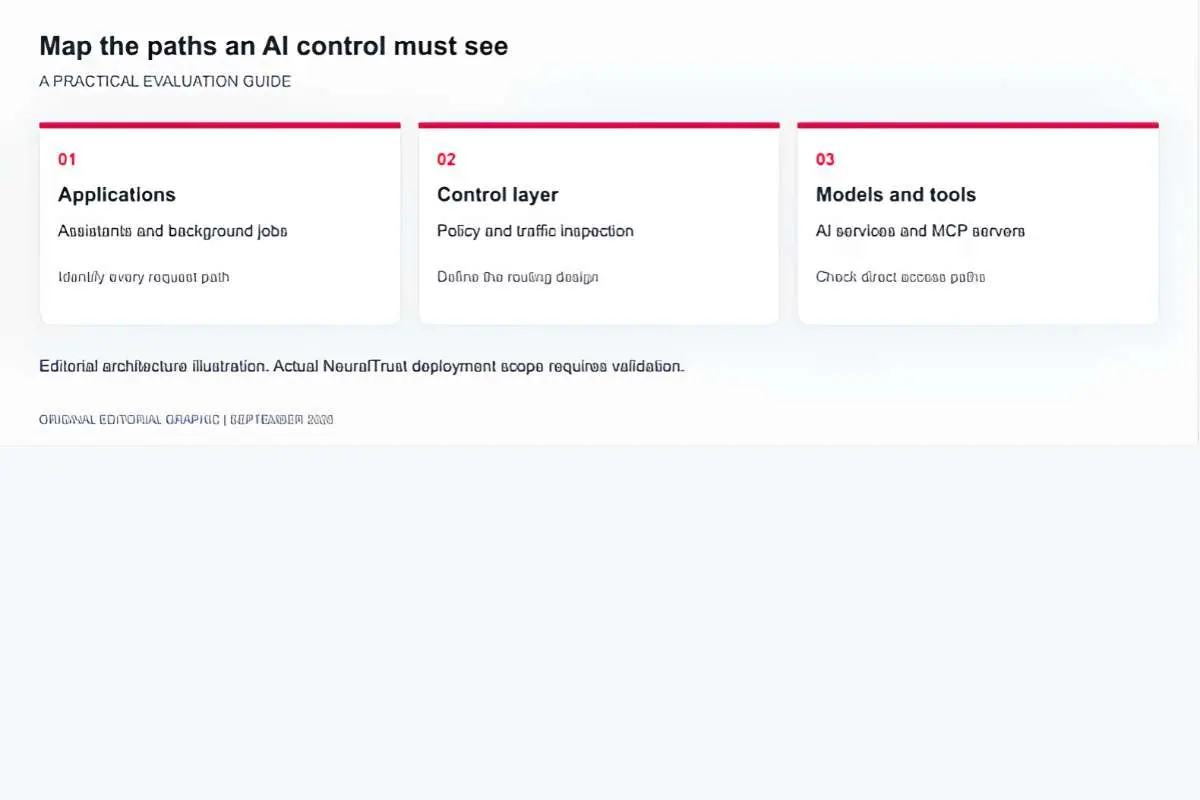
Original explanatory graphic. Editorial deployment map for an AI control layer, informed by NeuralTrust’s platform description. Actual routing and integrations must be confirmed.
NeuralTrust is a candidate when the architecture needs a dedicated layer for governing AI traffic and agent access. Its current platform describes controls across models, tools, MCP servers, and data, with deployment choices intended to support different hosting requirements. Official product information.
Its fit depends on routing and integration decisions. List the paths through which an agent can reach a model or tool, including background jobs and direct API access. Then establish which paths will pass through the proposed control. This makes potential bypasses visible before procurement. Also determine who owns policy changes: a central security team, an application team, or both. A control layer is most useful when its operating model matches the way applications are released.
7. Mindgard
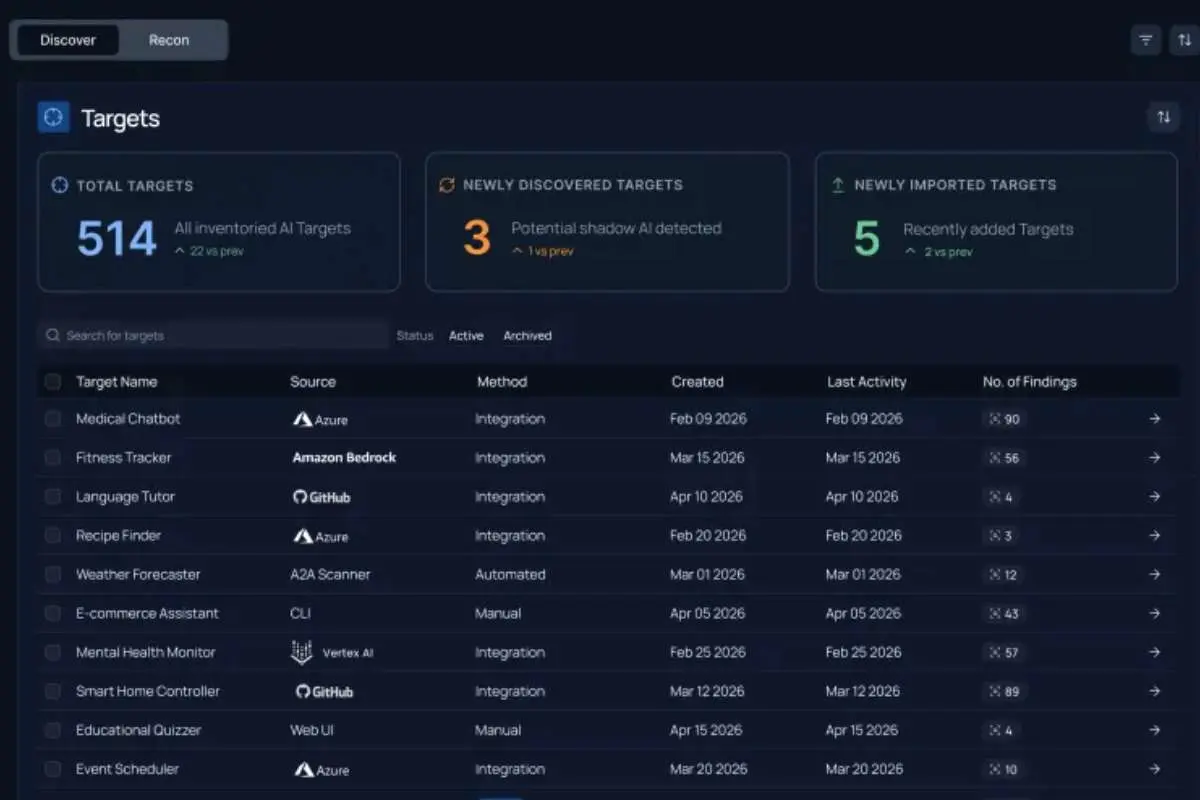
Published product interface. Mindgard’s published target inventory for AI security testing.
Mindgard is a strong starting point when the immediate need is to discover how an AI application fails under adversarial pressure. Its platform emphasizes discovery, reconnaissance, attack assessment, and defense workflows. This is especially relevant when application behavior depends on retrieval, tools, and surrounding integrations rather than the base model alone. Official product information.
A successful evaluation should produce an actionable application finding, not merely a collection of alarming prompts. Ask the team to reproduce a failure, assign it to the appropriate owner, make a change, and rerun the relevant assessment. Confirm which testing and runtime functions are included in the proposed scope. Security engineering effort will still be needed to decide whether a finding represents a meaningful business risk.
8. Zenity

Vendor illustration. Zenity’s published relationship diagram illustrates the identity and access context around AI agents.
Zenity is relevant when AI agents create an ownership and authorization problem. Its platform connects AI observability, posture, identity, and runtime controls. That makes it a useful shortlist entry for enterprises where agents are created across several business platforms and can access sensitive systems through delegated permissions. Official product information.
The first demonstration should answer three questions: who owns the agent, what can it access, and what did it actually do? A long list of discovered agents is only the starting point. Check supported platforms and the granularity of execution visibility. For important actions, establish whether the proposed integration can prevent the action, detect it afterward, or only flag the configuration that made it possible.
9. Obsidian Security

Published product interface. Obsidian’s published AI agent inventory view.
Obsidian combines browser-level AI visibility, SaaS integration context, agent governance, and runtime security. Its AI security materials describe blocking sensitive prompts at the browser and mapping the permissions and tools associated with agents. That makes it relevant when employees and agents reach business data through several different paths, not only through a central AI gateway. Official product information.
The architecture still needs a coverage map. A browser extension observes a different part of the workflow from an API integration or agent monitor. Match those components to the important applications and identify where a control can intervene. Obsidian is particularly useful to compare when a SaaS-centered security team is expanding its responsibility to employee AI and agent activity.
10. Reco
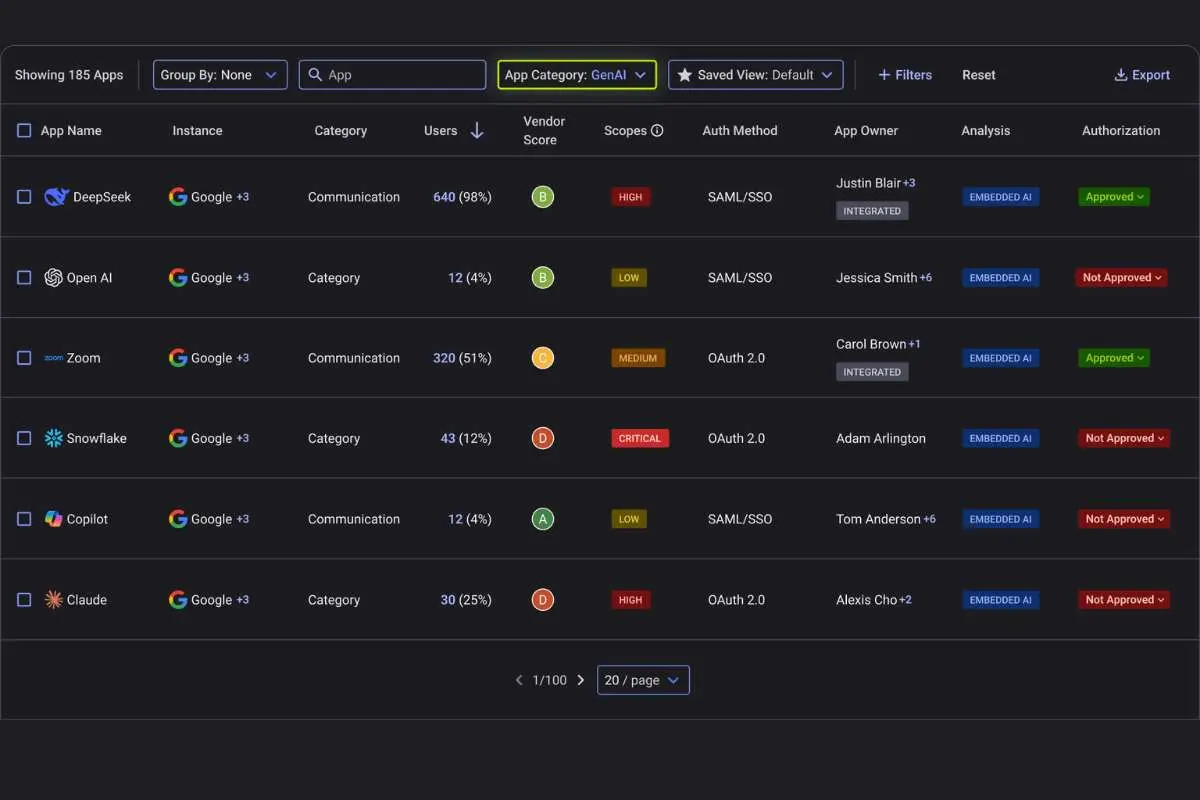
Published product interface. Reco’s published AI application and permission inventory.
Among the Best AI Security Platforms, Reco’s Agent Security product documents an inventory of AI agents, permission mapping, risk scoring, and governance controls across supported environments. Its SaaS context helps connect an agent to the account, data, and integrations that give it authority. This is useful when ownership and access are the missing pieces in an enterprise AI inventory. Official product information .
The distinction from a request-path guardrail is practical. Inventory and relationship analysis help identify excessive access or an unowned workflow; they do not establish that every prompt or tool call is inspected inline. Compare Reco when the primary task is finding and governing those relationships, and map any separate application-runtime requirement to its own demonstrated control point.
Original editorial graphic. Choose the control location before comparing products.
Choose the control location before the vendor
Start with three representative workflows. Include an employee using an external AI service, an internal assistant retrieving company material, and an agent that can change something in another system. Mark where data enters, where permissions are checked, and where a consequential action occurs.
That map usually makes the shortlist smaller. Workforce controls should be assessed at the browser, endpoint, or application access layer. Application guardrails should be assessed inside the request and tool workflow. Posture tools should prove that they can discover the relevant assets and explain their permissions. Testing tools should produce failures that developers can reproduce and retest.
For a coordinated enterprise program spanning those needs, begin with Check Point and compare the required portfolio against specialist combinations. For a single urgent problem, buy against that problem first. Count the engineering work needed to integrate, tune, investigate, and maintain each option alongside the subscription itself.
Does an AI security platform replace existing controls?
Even the Best AI Security Platforms should not become the only control protecting a sensitive operation. Keep application authorization, scoped credentials, data access rules, and approval requirements enforceable independently of model behavior. During the proof of concept, deliberately test a case where the model produces an unsafe request and confirm that the downstream system still applies its own permission checks.