Clean energy is set to draw about $2.2 trillion of the $3.4 trillion invested in global energy in 2026, according to the IEA, nearly double the roughly $1.2 trillion going to fossil fuels. Capital follows structural demand, and it’s shifting fast. So which sectors deserve your money next? The best industries to invest in 2026 are not necessarily those promising the quickest returns, but those backed by durable demand, technology adoption, and room to scale.
This guide breaks down 10 sectors, including AI, cybersecurity, healthcare, robotics, and digital finance, explains why each matters, and shows you how to evaluate opportunities without chasing trends.
Table of contents:
- How We Selected the Best Industries to Invest in 2026
- Quick Comparison Table
- These Are the Top 10 Best Industries to Invest in 2026
- Key Risks Before Investing in Growth Industries
- How Businesses Can Identify the Right Industry
- What Industries Are Expected to Grow Through 2030?
- Conclusion
- FAQs
How we select these industries?
There is no single list of “best” industries for every investor or business. Instead, these sectors were selected using factors that can indicate durable business opportunity:
- Market demand: Is demand growing among consumers or businesses?
- Technology adoption: Is technology creating new products, services, or efficiencies?
- Investment momentum: Is significant capital flowing into the sector?
- Scalability: Can companies expand without costs rising at the same pace?
- Long-term relevance: Does the industry address a structural need likely to remain important?
- Business applications: Can companies use the sector to create measurable revenue, productivity, or cost advantages?
- 2030 outlook: Does the industry have credible growth drivers beyond 2026?
This approach matters because an industry can grow rapidly while individual companies within it still struggle with competition, regulation, high valuations, or weak profitability.
Here is the quick comparison table:
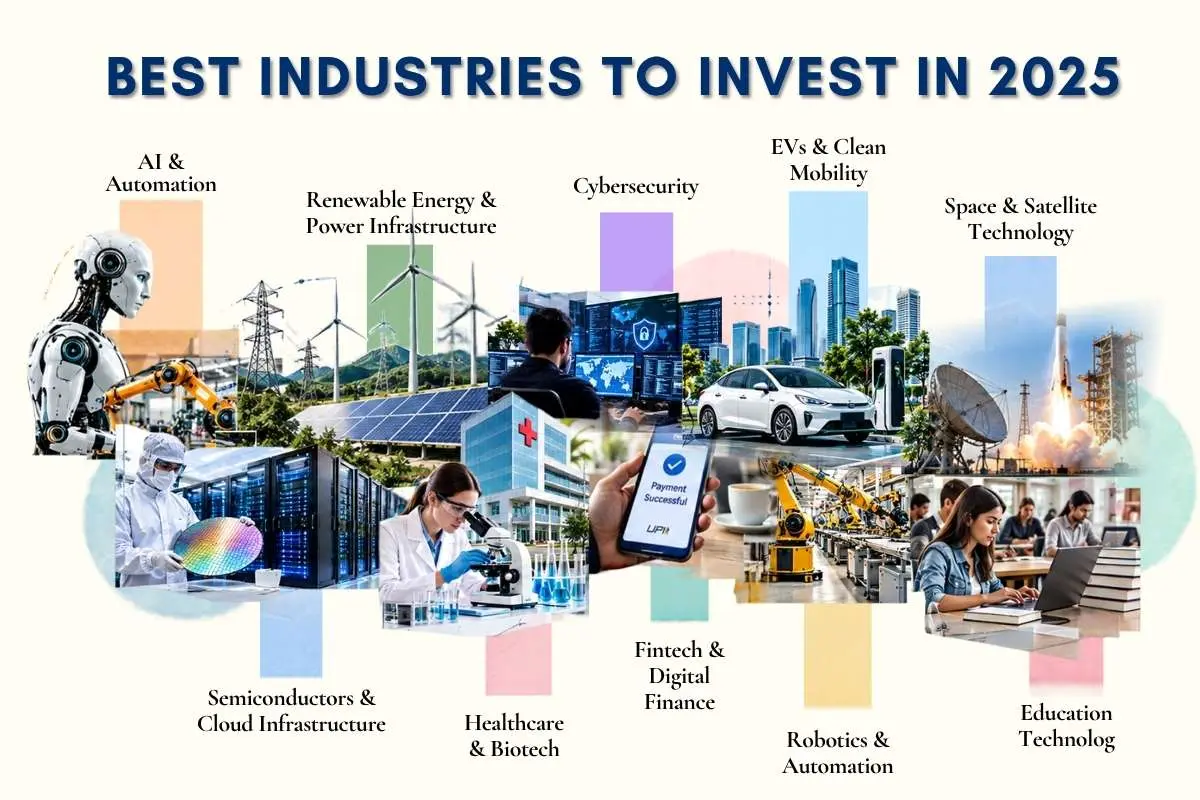
| Industry | Why It Matters in 2026 | Key Opportunity Areas | Outlook |
| AI & Automation | Enterprise AI adoption is accelerating | AI software, agents, automation, AI infrastructure | High |
| Semiconductors & Cloud Infrastructure | AI requires massive computing capacity | Chips, cloud, data centers, networking | High |
| Renewable Energy & Power Infrastructure | Electricity demand is rising | Solar, storage, grids, power management | High |
| Healthcare & Biotech | Aging populations and medical innovation | MedTech, biotech, digital health, diagnostics | High |
| Cybersecurity | Digital threats and AI increase security needs | Cloud security, identity, AI security | High |
| Fintech & Digital Finance | Financial services continue to digitize | Payments, digital banking, financial software | High |
| EVs & Clean Mobility | Electrification is reshaping transportation | EVs, batteries, charging, components | Medium-High |
| Robotics & Automation | Businesses need productivity and labor solutions | Industrial robots, service robots, physical AI | High |
| Space & Satellite Technology | Satellite applications are expanding | Communications, Earth observation, data | High |
| Education Technology | Skills and workforce transformation are accelerating | AI learning, upskilling, digital education | Medium-High |
These are the top 10 best industries to invest in 2026:
1. Artificial intelligence and automation
AI remains one of the biggest business transformation themes of 2026.
The opportunity has moved beyond experimental chatbots toward AI systems that can automate workflows, analyze information, support decision-making, and improve productivity. That shift is why AI ranks among the best industries to invest in 2026, supported by growing enterprise demand for automation and productivity gains. McKinsey identifies AI software and services, cloud services, and semiconductors as part of an “AI foundation” that is reshaping multiple industries.
Businesses can find opportunities in:
- AI software and agents
- Enterprise automation
- AI infrastructure
- Machine learning
- AI-powered customer service
- Industry-specific AI solutions
The key investment question is not simply whether a company uses AI. It is whether AI improves its revenue, margins, productivity, or competitive position.
2. Semiconductors and cloud infrastructure
AI needs computing power, and that makes semiconductors, cloud platforms, data centers, networking equipment, and related infrastructure increasingly important.
McKinsey’s 2026 research identifies semiconductors and cloud services as core components of the rapidly expanding AI foundation.
For businesses, opportunities extend beyond chip manufacturers to:
- Advanced processors
- AI accelerators
- Data centers
- Cloud computing
- Networking equipment
- Cooling and power systems
- Semiconductor manufacturing equipment
This industry also illustrates an important 2026 investment lesson: look at the infrastructure supporting a major trend, not just the most visible companies.
3. Renewable energy and power infrastructure

The energy industry is becoming increasingly important as electricity demand rises from data centers, industrial activity, cooling, and electric vehicles.
The International Energy Agency expects global electricity demand to grow at an average of 3.6% annually from 2026 through 2030. Renewables and nuclear power are projected to provide around half of global electricity generation by 2030.
Opportunities include:
- Solar power
- Wind energy
- Battery storage
- Smart grids
- Power transmission
- Energy management
- Grid modernization
The business opportunity is therefore broader than renewable power generation. Companies that help produce, store, transmit, and manage electricity could also benefit from rising demand.
4. Healthcare, biotechnology and MedTech
Healthcare remains a structurally important industry because demand is supported by aging populations, chronic diseases, medical innovation, and the need for more efficient care.
Investment opportunities include:
- Biotechnology
- Medical devices
- Diagnostics
- Digital health
- Healthcare software
- Surgical robotics
- Healthcare automation
- Pharmaceutical services
PwC’s 2026 healthcare investment outlook highlights AI-driven efficiency, healthcare IT, MedTech, diagnostics, robotics, and other technology-enabled healthcare areas as important investment themes.
For businesses, the strongest opportunities may come from solving expensive healthcare problems rather than simply adding another consumer wellness product.
5. Cybersecurity
As businesses move more operations into cloud platforms and adopt AI, protecting data, identities, systems, and digital infrastructure becomes increasingly critical.
PwC’s 2026 cybersecurity research notes that AI and quantum computing are expanding the attack surface while geopolitical and supply-chain risks are adding further pressure on organizations.
Growth areas include:
- Cloud security
- Identity and access management
- AI security
- Data protection
- Fraud prevention
- Security monitoring
- Managed security services
Cybersecurity also has a strong business advantage: companies often cannot simply postpone essential security spending because the cost of a major breach can be high.
6. Financial technology and digital finance

Fintech continues to transform how consumers and businesses make payments, borrow money, invest, manage accounts, and access financial services.
Opportunities include:
- Digital payments
- Banking technology
- Financial management software
- Digital lending
- Fraud detection
- Insurtech
- Wealth technology
The financial sector is also becoming increasingly dependent on AI, cybersecurity, data, and automation. The World Economic Forum expects digitalization to be a major force transforming financial services through 2030.
Fintech remains relevant when evaluating the best industries to invest in 2026, particularly as businesses adopt digital payments, financial software, and fraud prevention tools. For investors and businesses, the opportunity is increasingly about infrastructure and useful financial tools rather than simply launching another payment app.
7. Electric vehicles and clean mobility
Electric mobility remains a major transportation theme, although the investment case varies considerably by geography, policy, infrastructure, and company.
The IEA’s 2026 outlook projects continued long-term growth in EV deployment, while also highlighting the importance of charging infrastructure and policy support.
Potential opportunity areas include:
- Electric vehicles
- Batteries
- Charging infrastructure
- EV components
- Fleet electrification
- Battery recycling
- Electric commercial vehicles
Businesses should look beyond vehicle manufacturers and consider the wider ecosystem required to support electric mobility.
8. Robotics and intelligent automation
Robotics is moving beyond traditional factory automation. AI is making robots more capable of sensing environments, processing information, and performing increasingly complex tasks.
The World Economic Forum identifies robotics and autonomous systems as one of the major technologies expected to transform businesses through 2030.
Growth areas include:
- Industrial robotics
- Warehouse automation
- Service robots
- Autonomous systems
- Manufacturing automation
- AI-enabled physical systems
For businesses facing labor shortages or pressure to improve productivity, robotics can become a strategic investment rather than simply a technology upgrade.
9. Space and satellite technology

Space technology is becoming more commercially relevant as satellites support communications, navigation, Earth observation, weather monitoring, agriculture, logistics, and defense.
McKinsey’s 2026 research includes space among the high-growth arenas shaping the global economy, while its technology outlook identifies future space technologies as one of the trends attracting rapidly increasing investment.
Potential opportunities include:
- Satellite communications
- Earth observation
- Satellite data
- Launch services
- Space infrastructure
- Navigation technologies
The industry remains capital-intensive and risky, but its expanding commercial applications make it worth watching for long-term investors.
10. Education technology and workforce upskilling
Education technology is evolving as businesses and workers need new skills to keep pace with AI, automation, cybersecurity, and other technological changes. Growing demand for digital skills makes education technology one of the sectors to consider among the best industries to invest in 2026.
The World Economic Forum projects significant workforce transformation through 2030 and identifies AI, big data, cybersecurity, and technology literacy among the fastest-growing skill areas.
Opportunities include:
- AI-powered learning
- Corporate training
- Professional upskilling
- Online education
- Language learning
- Workforce assessment
- Personalized learning platforms
The strongest businesses in this space are likely to focus on measurable outcomes, such as employability, productivity, certifications, or improved workplace performance.
How to evaluate the best industries to invest in 2026 and avoid common risks
A growing industry doesn’t automatically make every company in it a good investment. The same checks that put these 10 sectors on our list also show where each one can go wrong. Run them before committing capital.
1. Start with a structural problem
Durable industries solve problems that won’t disappear. Cybersecurity exists because cloud and AI adoption keep widening the attack surface. Healthcare exists because populations are aging and care costs are rising.
Risk: technology obsolescence. Rapid innovation can outdate products. An ed-tech tool built around one skill or platform can lose relevance quickly.
2. Measure demand and price
Look for spending, adoption rates, and recurring need. The IEA expects global electricity demand to grow 3.6% a year through 2030, which supports solar, storage, and grid businesses.
Risk: high valuations. In hot sectors like AI and semiconductors, strong expectations may already be in the price.
3. Evaluate competition
Fintech and EVs show how a strong market can still be unattractive. The better opportunity is often in infrastructure and useful tools, such as fraud detection or charging networks, rather than another payment app or car brand.
Risk: intense competition. Attractive industries draw rivals and capital, which squeezes margins.
4. Check regulation
Healthcare, fintech, AI, energy, EVs, and space all operate under licensing, compliance, and policy rules. EV demand, for example, varies widely with local incentives and charging infrastructure.
Risk: regulatory change. A rule change can reshape a business model quickly.
5. Calculate capital needs and unit economics
Semiconductors, energy, space, and robotics need heavy upfront investment. Revenue growth means little if acquisition costs, operating costs, or capital requirements stay too high.
Risk: capital intensity.
6. Test supply-chain exposure
Chips, EV batteries, and robotics components often depend on global supply chains.
Risk: geopolitics, tariffs, and shortages can disrupt even well-run companies.
7. Look past 2026, then start with a focused bet
Ask whether the business can still create value after the trend matures. You don’t need to enter a whole industry. Instead of “AI,” build AI tools for healthcare documentation, manufacturing quality control, or financial fraud detection.
Risk: execution. A promising market doesn’t guarantee a particular company will capture it profitably.
The better question isn’t “Which industry will grow fastest?” but “Which businesses can turn industry growth into sustainable profit?”
What industries are expected to grow through 2030?
Several of the industries discussed above have growth drivers extending beyond 2026.
The World Economic Forum expects AI and information processing, robotics, energy generation and storage, semiconductors, biotechnology, cybersecurity-related skills, and satellite technologies to influence business transformation through 2030.
Energy is another particularly important long-term theme. The IEA expects global electricity consumption to reach about 33,600 TWh in 2030, compared with 28,200 TWh in 2025, creating additional demand for generation, grids, storage, and related infrastructure.
This suggests that the strongest long-term opportunities may come from enabling industries, the companies providing the infrastructure, software, energy, security, equipment, and services required by other growing sectors.
Conclusion:
The best industries to invest in 2026 share one thing: they solve lasting problems. AI, semiconductors, clean energy, healthcare, cybersecurity, fintech, and robotics are growing because businesses and consumers increasingly depend on them, with global electricity demand alone expected to rise 3.6% annually through 2030. Still, a growing industry doesn’t guarantee a profitable company. Valuations, regulation, competition, and execution all matter. The smartest approach is to focus on one niche, test demand, and check the unit economics before committing capital.
To evaluate the best industries to invest in 2026 for your goals, select one sector, research its leading companies, compare valuations, and assess the risks before committing capital.
FAQ:
Which industry has the highest growth potential in 2026?
AI and its supporting infrastructure have significant growth potential as businesses rapidly adopt automation and intelligent technologies.
What industries are expected to grow through 2030?
AI, cybersecurity, robotics, clean energy, semiconductors, healthcare, biotechnology, EVs, and space technology have strong long-term growth drivers.
Is AI still a good industry to invest in 2026?
Yes, AI remains a major investment theme, particularly across enterprise software, automation, semiconductors, and AI infrastructure.
What is the safest industry to invest in 2026?
There is no universally safe industry, so investors should consider diversification, valuation, business fundamentals, and risk tolerance.
What are the best industries to invest in 2026?
AI, semiconductors, renewable energy, healthcare, cybersecurity, fintech, robotics, EVs, space, and education technology are key industries to watch.