If you could wave a magic wand and stack every coin, bill, and gold bar in one giant pile, how high would it reach? It is a fun thought that takes us far beyond the spare change in your pocket. Most of what we own today has actually moved into the digital clouds.
It exists only as blinking numbers on a phone screen. To see how much money is in the world, we must look at both the cash we hold and the bits we cannot see.
Where is the Wealth?
- Physical Cash: The actual bills you can hold in your hand.
- Digital Credits: Money that exists only as numbers in a bank app.
- Investments: Value tied up in land, gold, and big companies.
How Much Money is in the World 2026: An Overview
To understand how much money is in the World in 2026, we must look at how much money was in the world by the end of 2025.
See, the total amount of money in the world depends on the definition. But broad money supply across major economies such as the US, Eurozone, China, and Japan stood at about $100 trillion as of mid-February 2026. This serves as a key proxy for global liquidity, as these regions dominate deposits and credit creation.
| Measure | Amount (early 2026) | Description |
|---|---|---|
| Physical cash (M0) | $8.5–9.5 trillion | Notes and coins in circulation. |
| Broad money (M2, major economies) | ~$98.6–100 trillion | Liquid deposits and cash; core spending power. |
| Global broad money (full estimate) | ~$142 trillion (Sep 2025) | Covers 169 countries; grew 7% annually long-term but slowed post-COVID. |
Gold vs Crypto vs Digital Money: The $20 Trillion Reality
Most money is created when banks give out loans. When you buy a house or a car, the bank adds digital credits to an account. This makes the money supply grow even if no new paper bills are printed.
- Digital dominance: Over 90% of our money is now electronic.
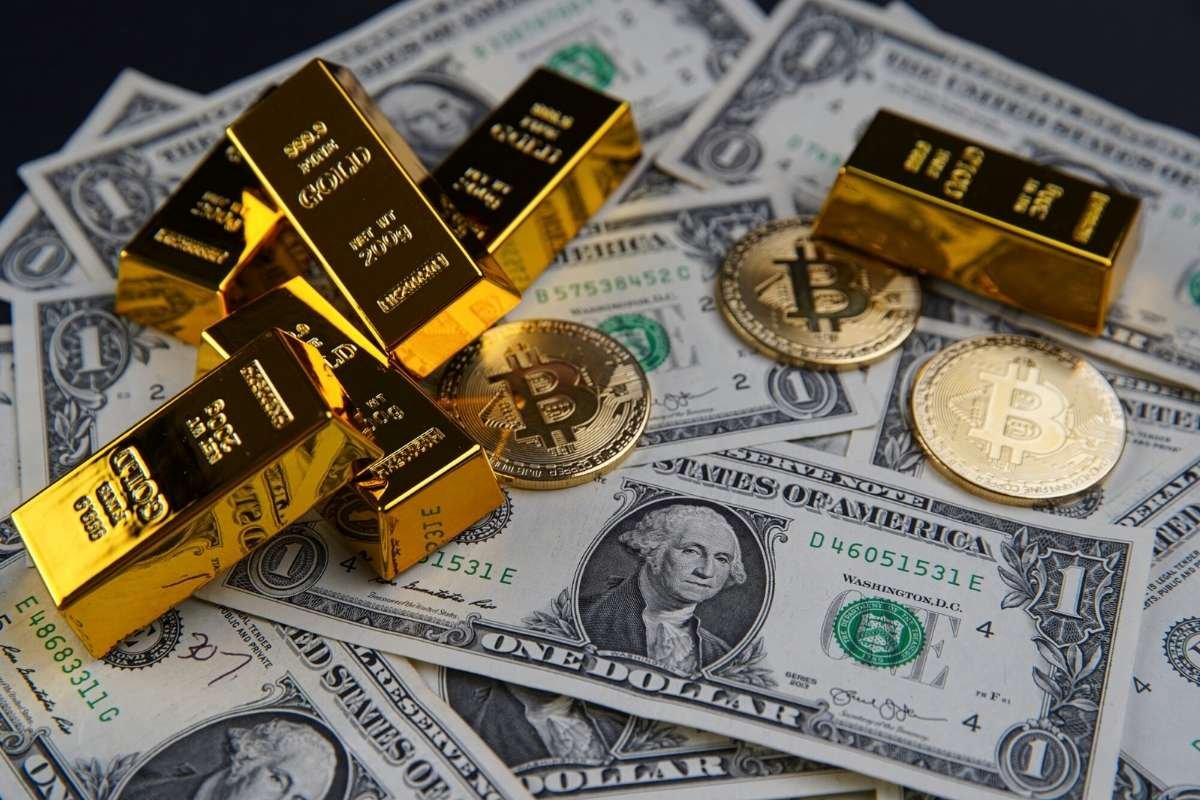
- Gold and Crypto: Gold is worth about $20 trillion, while all crypto is around $2.6 trillion.
M0, M1, M2 Explained Simply: The Money Supply Terms You Must Know
Well, understanding how much money is in the world isn’t useful if you don’t understand the terms that affect it. Money supply terms such as M0, M1, and M2 describe increasingly broad categories of liquid assets in an economy. These are used by central banks to gauge spending power and inflation risks.
Here’s the core definition of each of them:
- M0 (Monetary Base): Physical currency (coins and notes) plus central bank reserves held by commercial banks. It’s the “high-powered” foundation controlled directly by the central bank.
- M1 (Narrow Money): M0 plus highly liquid assets such as checking deposits and traveler’s checks. It represents money immediately available for transactions.
- M2 (Broad Money): M1 plus “near-money” such as savings accounts, small time deposits (e.g., CDs under $100K), and retail money market funds. It captures savings easily convertible to cash.
When we ask how much money is in the world, we must look at different layers. Some money is in your pocket, while some is just a number in a bank. Experts use labels like M0, M1, and M2 to track these layers.
Think of them as circles that get bigger as they include more types of wealth. Most of our wealth is not paper; it exists as digital bits on a screen. Let’s look at how these groups work together to form the global supply.
Why the Layers Matter?
M0 is the smallest group. It is the actual hard cash printed by a mint.
M1 is what you use to buy a snack or pay a bill today. It is very fast to spend.
M2 is the big picture. It includes the money you are saving for a rainy day.
Most of the $100 trillion in the world sits in the M2 group. This is because banks create digital credits when they give out loans for houses or cars.
How Banks Generate Most of the World’s Money?
Think of all the cash in your pocket. Now, think of the numbers you see on your bank app. Both are part of what we call the money supply. Most of the money in the world is not paper or coins.
It is just digital bits on a screen! Banks create most of this when they give out loans. When you buy a house or a car, new money enters the system. It flows from person to person like water in a pipe. This is how the world keeps moving every day.
How Money Flows:

| Step | What Happens |
|---|---|
| The Start | A bank makes a new loan for a car or a home. |
| The Flow | You pay a seller, and that money enters their account. |
| The Total | All these digital bits and cash make up the money supply. |
Ever Wonder How Much Money You’d Have If the World Split It Evenly?
When writing this, one question stood out to me: if the world has $8.9 trillion in cash and our current population is 8.3 billion, what is an average amount of money one could hold?
So, I did a little bit of maths, and here’s what the conclusion was:
$8.5$ trillion = 8.5 ×10¹²
$8.3$ billion = 8.3 × 10⁹
The division is:
8.5× 10128.3× 109
∴ 8.58.31012-9
∴8.58.3× 103≈1.024096 ×1000
So, $8.5$ trillion divided by $8.3$ billion is approximately $1,024.10. But that’s just M0; if we talk about M2, per person, it will sum up between $15,000 and $17,300.
Read more:
- Are You Living in One of the Richest Countries in the World? Find Out Here
- The 20 Largest Economies in the World: Money, Markets, and Momentum
M2 Explained Globally: How Much Money Each Country Holds?
Now that we know what Ms are and how much money each of us could have, let’s find out which countries have the most money.
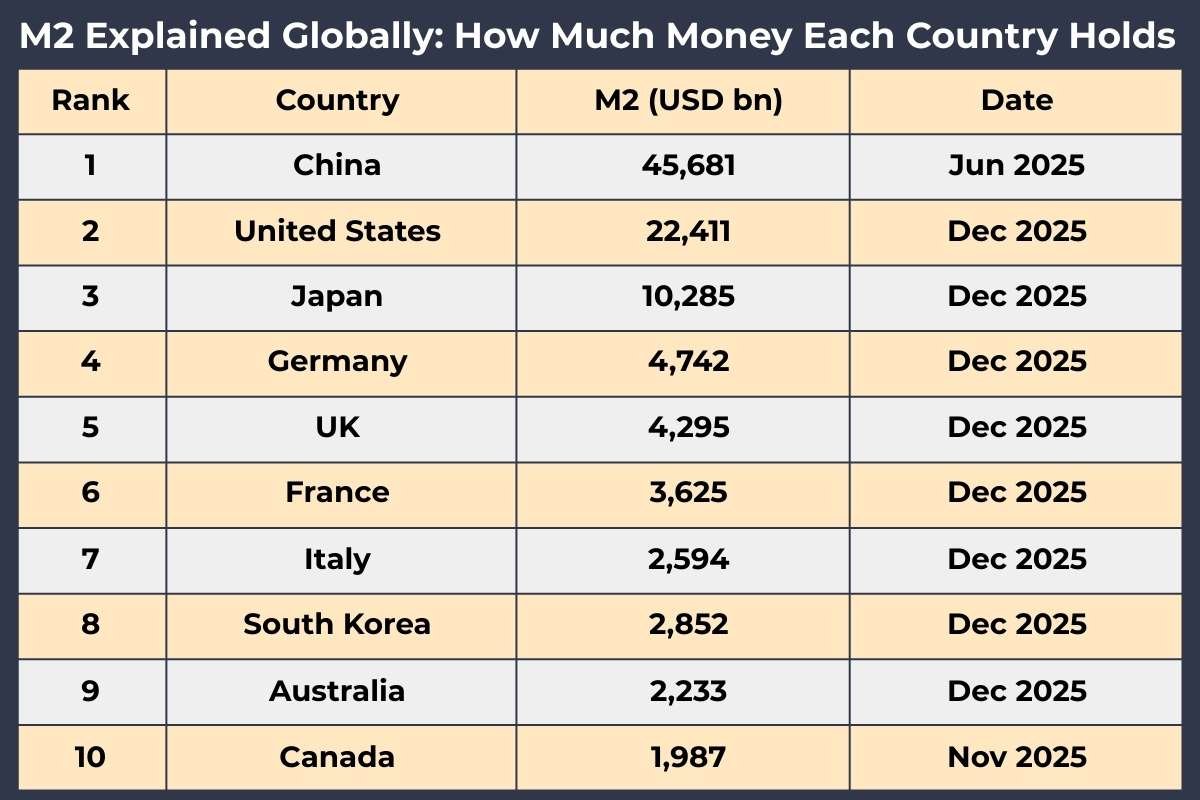
To answer the question in short: China has the largest M2 money supply at approximately $45.7 trillion USD (as of June 2025). It is followed closely by the United States at $22.4 trillion (December 2025).
| Rank | Country | M2 (USD bn) | Date |
|---|---|---|---|
| 1 | China | 45,681 | Jun 2025 |
| 2 | United States | 22,411 | Dec 2025 |
| 3 | Japan | 10,285 | Dec 2025 |
| 4 | Germany | 4,742 | Dec 2025 |
| 5 | UK | 4,295 | Dec 2025 |
| 6 | France | 3,625 | Dec 2025 |
| 7 | Italy | 2,594 | Dec 2025 |
| 8 | South Korea | 2,852 | Dec 2025 |
| 9 | Australia | 2,233 | Dec 2025 |
| 10 | Canada | 1,987 | Nov 2025 |
The EU alone totals ~$18.6T. China dominates due to the rapid credit growth of the nation.
The Ripple Effect of Increasing the Money Supply Explained
Have you ever wondered what happens when more cash flows into our world? It is a big question with a clear answer.
When banks and governments make more money, the total amount in our hands goes up. This can make a country feel rich at first.
But, like adding too much water to a soup, it can thin out the value of every dollar. To see how much money is in the world, we must look at how these new bills change our lives.
The Chain Reaction
When the money supply grows, a specific set of steps usually follows:
- More Spending: People have more cash in their bank accounts. They go out and buy more clothes, cars, or food.
- Higher Prices: Since everyone has more to spend, shops see their shelves go empty. They raise prices to keep up.
- Value Drops: Each bill in your wallet buys less than it did before. This is what we call a drop in “buying power.”
- Lower Interest: It often becomes cheaper to borrow money for a house or a new shop. This keeps the cycle moving.
| Action | Result | Why It Happens |
|---|---|---|
| Print More Cash | Prices Go Up | More money is chasing the same amount of goods. |
| Lower Bank Rates | More Loans | People feel it is a good time to buy a home. |
| Too Much Money | Value Falls | If cash is everywhere, it is no longer rare or special. |
Let’s take a deeper look at these effects. When the money supply increases, the economy sees short-term, medium-term, and long-term effects. Here’s what happens when we don’t keep a check on how much money is in the world:
- Short Term (0-6 Months): You might find it easier to get a loan for a new home. Since there is more “M2” money in the bank, interest rates usually fall. This makes people want to spend and grow their shops.
- Medium Term (1-3 Years): This is when “too much money chases too few goods.” If the supply of milk or gas stays the same but everyone has more cash, the price of those items must go up.
- Long Term (5+ Years): Over time, the “extra” money just becomes the new normal. If the money supply doubles, prices might double too. This can hurt people who save cash in a jar, as that cash loses its power.
| Time Frame | What Happens? | Why It Happens |
|---|---|---|
| Short Term | Spending Spree | People feel rich. They buy more cars, clothes, and food. |
| Medium Term | Price Hikes | Stores run out of goods. They raise prices to keep up. |
| Long Term | Value Drops | Your cash buys less. Debt is easier to pay, but savings shrink. |
Conclusion:
Can we ever truly capture the total wealth of our planet? It is a puzzle whose pieces change every single day. Money comes in many forms: the coins in your hand, the bits on a screen, all of it is part of the answer to the question: how much money is in the world. We have seen how bank loans and new bills can shift the value of what we own.
To understand the global wealth, we must take a broader perspective. As our world continues to grow, these numbers will only continue to increase. So, let us keep watching how they move.
You may also like:
- Which Is the Cheapest Country in the World? Top 10 Picks for Budget Living
- The Richest States in America Compared by GDP, Income, and Industry
FAQs
1. Who creates most of the world’s money?
Central banks print the paper bills you hold in your hand. However, private banks create most of our digital money. They do this when they give out loans. This adds new numbers to the global money supply every day.
2. Is gold part of the total money supply?
Gold is usually seen as a store of value rather than cash. While it is worth about $15 trillion, it is not in the M1 or M2 groups. People buy it to keep their wealth safe over time.
3. Does Bitcoin count as global money?
Most experts do not count crypto as part of the formal money supply yet. It is very volatile and not used for all daily buys. However, its total value is now over $2 trillion in our modern digital world.