A product business once began with a gamble: make first, sell later. Entrepreneurs paid for production, storage, packaging, and inventory before knowing whether anyone would buy. A great idea could just as easily become a warehouse full of unsold products.
Printify turned that model on its head. Founded in 2015 by James Berdigans, Artis Kehris, and Gatis Dukurs, the company built a platform that connects merchants with print production partners, allowing products to be made only after an order arrives. The customer comes first; production follows.
That shift moves the risk out of the warehouse and back into the experiment. Creators can test designs, niche brands can explore demand, and entrepreneurs can build product businesses without first investing in inventory. The Printify print on demand platform is therefore less about printing a product and more about making physical commerce easier to test.
Today, its growing global network connects merchants, production capacity, sales channels, and customers, turning an idea into an order without requiring a warehouse full of hope.
The Input
Every machine begins with an input. In Printify’s case, that input was a familiar problem: why invest in inventory before knowing whether customers will buy it? The answer was to separate selling from manufacturing.
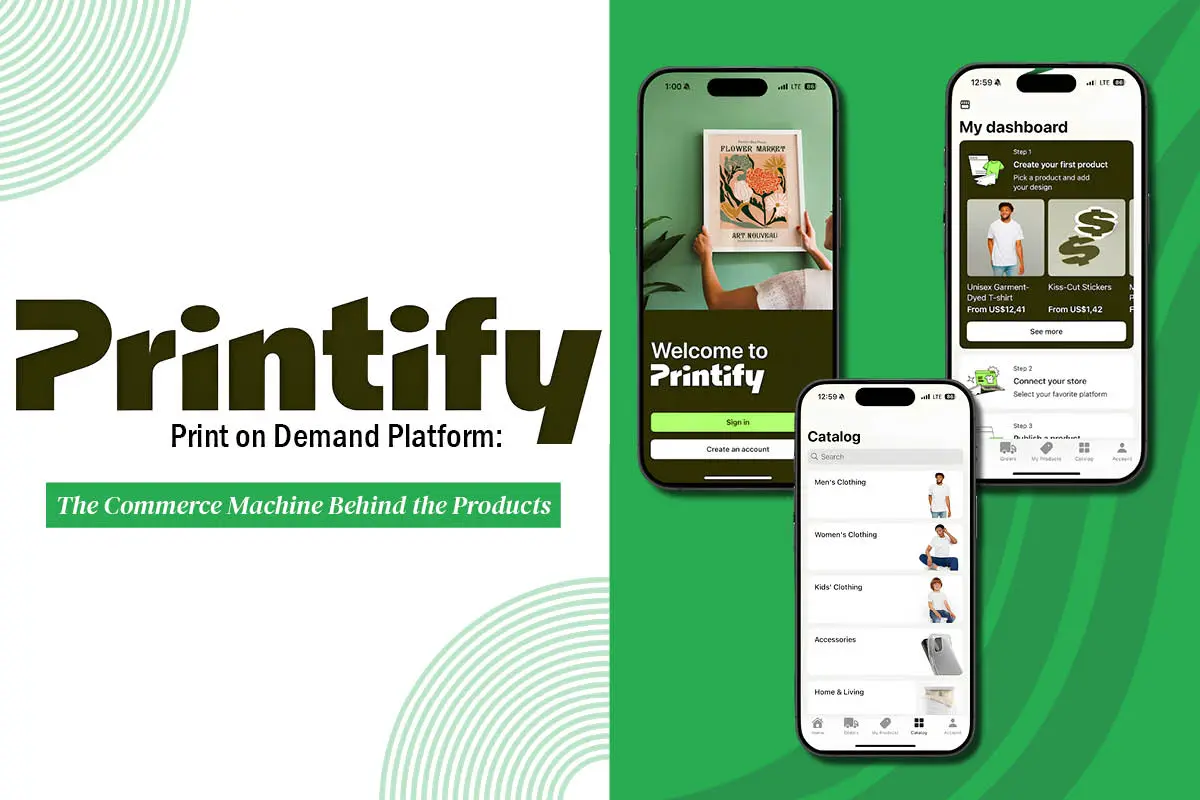
The Printify print on demand platform allows merchants to select products, add designs, create listings, and connect them to online marketplaces or storefronts. When an order arrives, a Print Provider produces, packs, and ships the item. Instead of beginning with a warehouse, an entrepreneur can begin with an idea and test whether it has a market.
The Idea-to-Order Machine
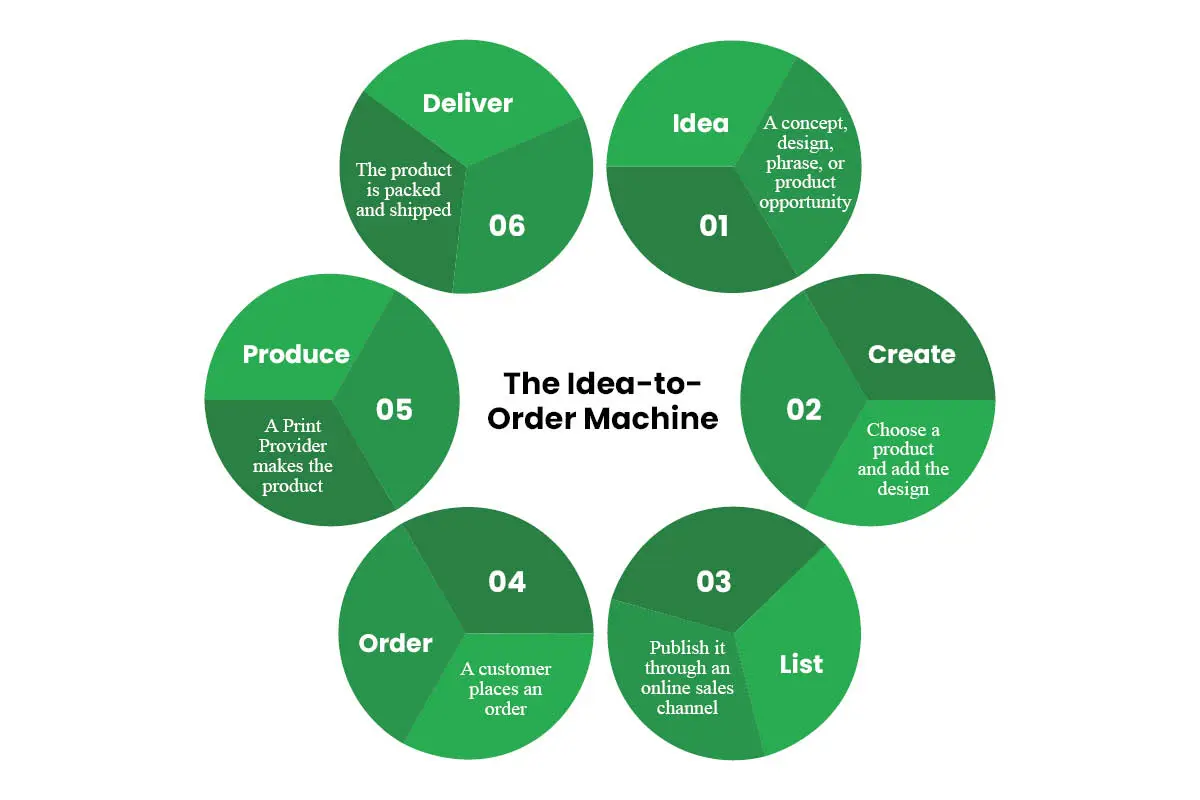
01 – Idea
A concept, design, phrase, or product opportunity
↓
02 – Create
Choose a product and add the design
↓
03 – List
Publish it through an online sales channel
↓
04 – Order
A customer places an order
↓
05 – Produce
A Print Provider makes the product
↓
06 – Deliver
The product is packed and shipped
The shift: No upfront inventory, No warehouse, Production after purchase
The Engine

The engine behind the model is Printify’s aggregator structure. Rather than operating every production facility itself, the Printify print on demand platform brings independent Print Providers into one marketplace and connects their capabilities to merchants.
For sellers, that network can create access to a broader range of products, production locations, pricing options, and fulfillment choices without requiring individual relationships with multiple manufacturers. Printify’s tools help merchants navigate differences in product quality, fulfillment speed, shipping, and provider availability, while order-routing features can redirect eligible orders when a facility cannot fulfill them. The value, therefore, is not simply having printers; it is organizing a fragmented production side of commerce into one usable system.
The Fuel
A machine needs an economic model to keep moving, and the Printify print on demand platform model begins with low barriers to entry. The basic service is free, while merchants pay for production and shipping when orders are placed. Merchants determine their retail prices and keep the difference after paying Printify’s applicable product and shipping costs. The company also offers paid plans, including Premium, with additional benefits for growing merchants.
The structure lets a seller experiment without a major upfront commitment, while a growing merchant can use additional features and pricing benefits as order volume increases.
The Transmission
For the Printify print on demand platform, growth has depended heavily on being available where online merchants already sell. The Printify print on demand platform integrates with major commerce channels including Shopify, Etsy, Amazon, TikTok Shop, and WooCommerce, alongside other e-commerce integrations and API capabilities.
A seller can operate a brand through an existing commerce channel while Printify handles production and fulfillment. Product creation, mockup generation, and AI-assisted design tools further shorten the journey from concept to listing, reducing the number of separate steps a merchant needs to solve before testing a product.
From Idea to Order
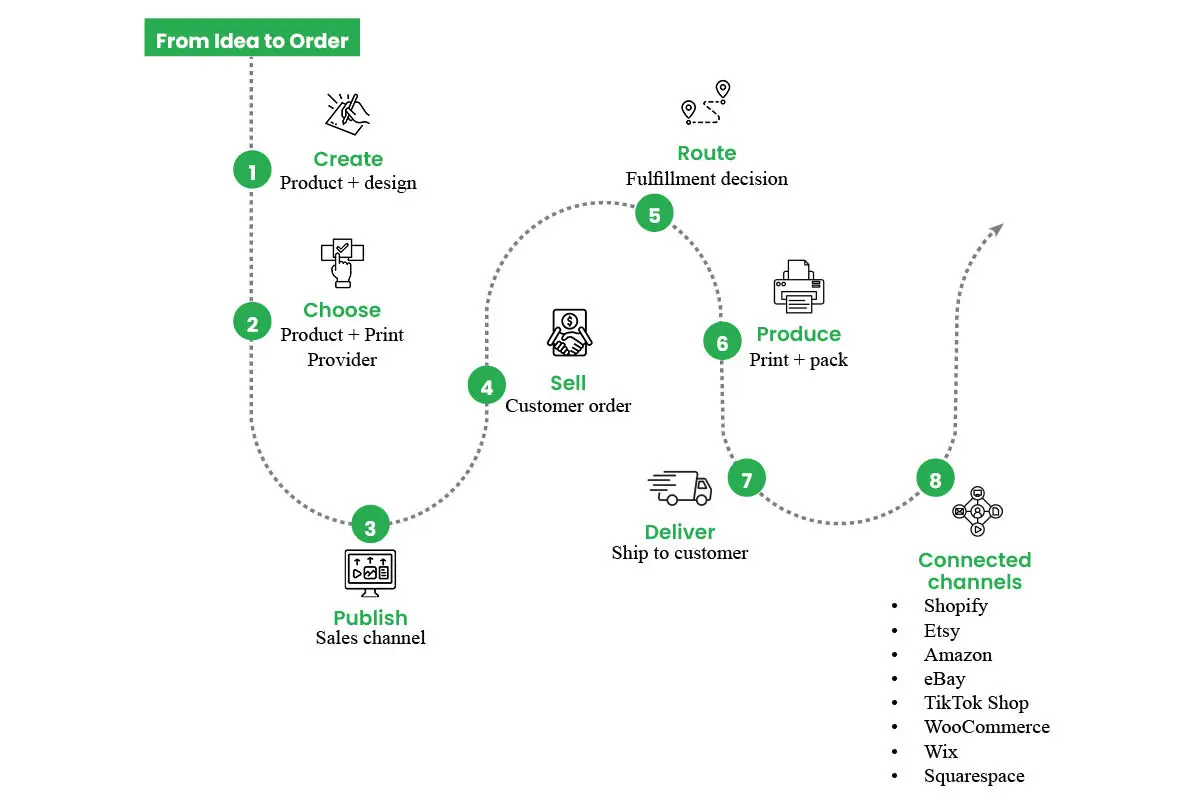
- Create
- Product + design
- Choose
- Product + Print Provider
- Publish
- Sales channel
- Sell
- Customer order
- Route
- Fulfillment decision
- Produce
- Print + pack
- Deliver
- Ship to customer
- Connected channels:
- Shopify
- Etsy
- Amazon
- eBay
- TikTok Shop
- WooCommerce
- Wix
- Squarespace
Read More: Conagra’s Tasty Turnaround: Smart Moves, Fun Foods, and Big Wins
The Signal System
The marketing proposition follows naturally from the economics: starting does not have to be expensive. For creators, independent sellers, and niche entrepreneurs, a product can be tested before significant capital is committed to production.
A designer can experiment with merchandise around an audience, a content creator can turn a community into a product business, and a small brand can test a category without first ordering hundreds of units. The Printify print on demand platform brings product creation, mockups, sales-channel integrations, and fulfillment into a connected workflow, lowering the barrier to experimentation.
The Rival Machines
For years, Printify and Printful represented two recognizable approaches within the print on demand market. Printify built around a broad network of independent production partners, while Printful historically operated with greater vertical integration across its own production and fulfillment operations.
Then, in 2024, the comparison changed. Printify and Printful announced a merger in November 2024, bringing the two major print-on-demand companies under the same larger business. That makes the familiar “Printify versus Printful” framing incomplete for the current market.
The combination brings different approaches to production and fulfillment into the same larger business. Around it sits a wider landscape of POD companies, marketplaces, creator platforms, e-commerce software, and fulfillment providers. The deeper competition is around who can remove friction between a creator, an audience, a transaction, and physical delivery.
The Stress Test
For the Printify print on demand platform, its greatest structural strength, the size and flexibility of its provider network, also creates an operational challenge. A distributed network can provide product breadth, geographic reach, and production flexibility, but multiple providers can introduce differences in quality, speed, capacity, inventory availability, and fulfillment experience. Provider selection, monitoring, and order routing therefore become important parts of the customer experience.
The opportunity side is broad. AI-assisted creation, personalization, social commerce, creator-led brands, localized fulfillment, and B2B merchandise can all expand demand. Yet as POD becomes easier to enter, basic printing may become less distinctive. The more defensible elements may instead sit around the network, integrations, technology, merchant relationships, routing capabilities, and operating knowledge.
Printify SWOT Analysis
| Strengths | Weaknesses | Opportunities | Threats |
| Distributed network of independent Print Providers | Less direct control over production | AI-assisted design and fulfillment optimization | Intensifying competition |
| Broad product and catalog options | Quality and fulfillment can vary across providers | Personalization and customized products | Industry consolidation |
| Integrations with major e-commerce channels | Reliance on third-party production and fulfillment | Social commerce and creator-led brands | Greater expectations around quality and consistency |
| Made-to-order model reduces inventory requirements | Network coordination becomes more complex at scale | B2B merchandise and on-demand programs | Growing sustainability and regulatory requirements |
| – | – | Expansion into new product categories | Increasing competition across POD platforms |
The Diagnostic
The Printify model offers flexibility, but that flexibility comes with choices. A Forbes Advisor review highlights its broad catalog, Print Provider selection, e-commerce integrations, and automated production and shipping. Merchants gain more control over sourcing and fulfillment without carrying inventory.
Yet provider choice can affect pricing, turnaround, shipping, and product quality, while custom-branded packaging remains limited. The diagnostic is simple: the network reduces manufacturing complexity, but merchants still have to manage providers, pricing, shipping, and the customer experience.
The Next Version
The next version of the Printify print on demand platform is unlikely to depend simply on adding more products. The larger opportunity is to shorten the distance between an idea and a finished customer order while making each stage easier to manage.
AI can accelerate the journey from concept to design, while improved routing can support fulfillment decisions and additional sales-channel integrations can put products closer to customers. Personalization, social commerce, new product categories, and B2B opportunities can create further reasons for sellers to use the system.
The Product You Don’t See
The most important thing the Printify print on demand platform sells may not be a T-shirt, mug, poster, or hoodie. It sells the opportunity to test an idea without first committing heavily to inventory, storage, manufacturing, or fulfillment infrastructure.
A creator can test a niche before building a full product line, an entrepreneur can experiment with demand before making a large production commitment, and a growing brand can add merchandise without necessarily building its own manufacturing operation.
The customer sees the finished product arriving at the door. The merchant sees an order moving through fulfillment. Behind both is a network connecting design, demand, production, technology, and delivery. That hidden coordination is where the real business resides.
The deeper product is the freedom to experiment.
Read More: Goldman Sachs’ Secrets to Success: A Blueprint for Entrepreneurs and Investors