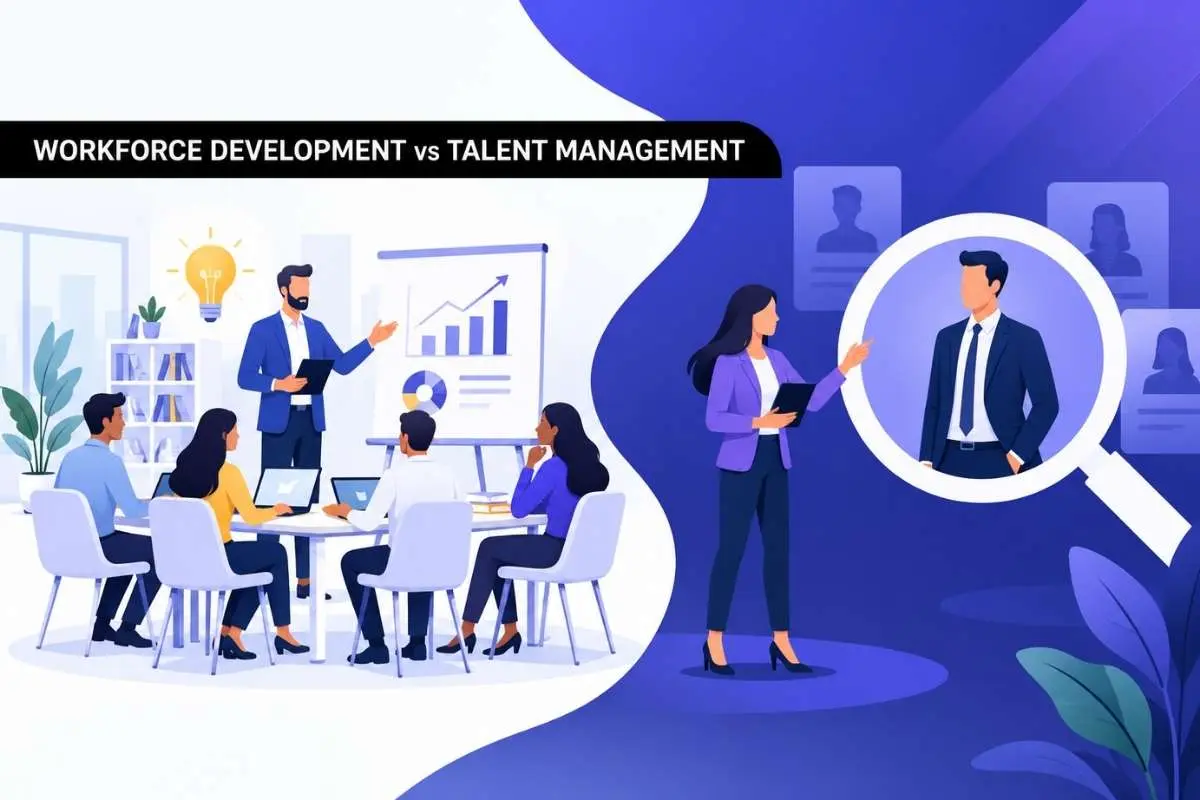
Talent management focuses on identifying, placing, and retaining key individuals within existing structures. Workforce development expands the broader capability pool to prevent systemic labor shortages before they stall operations.
For example, in a quarterly review, the HR lead reports that every critical role now has a named successor. The operations head replies that the plant is still short of 30 technicians. Both are right, and neither problem is solved by the other’s work. That is the gap in workforce development vs talent management: one decides who fills which role; the other builds the supply of people who could.
In this article, you will learn the core structural differences between workforce development and talent management, how to balance both functions, and how to build a resilient workforce strategy.
Workforce development vs talent management: what is the difference?
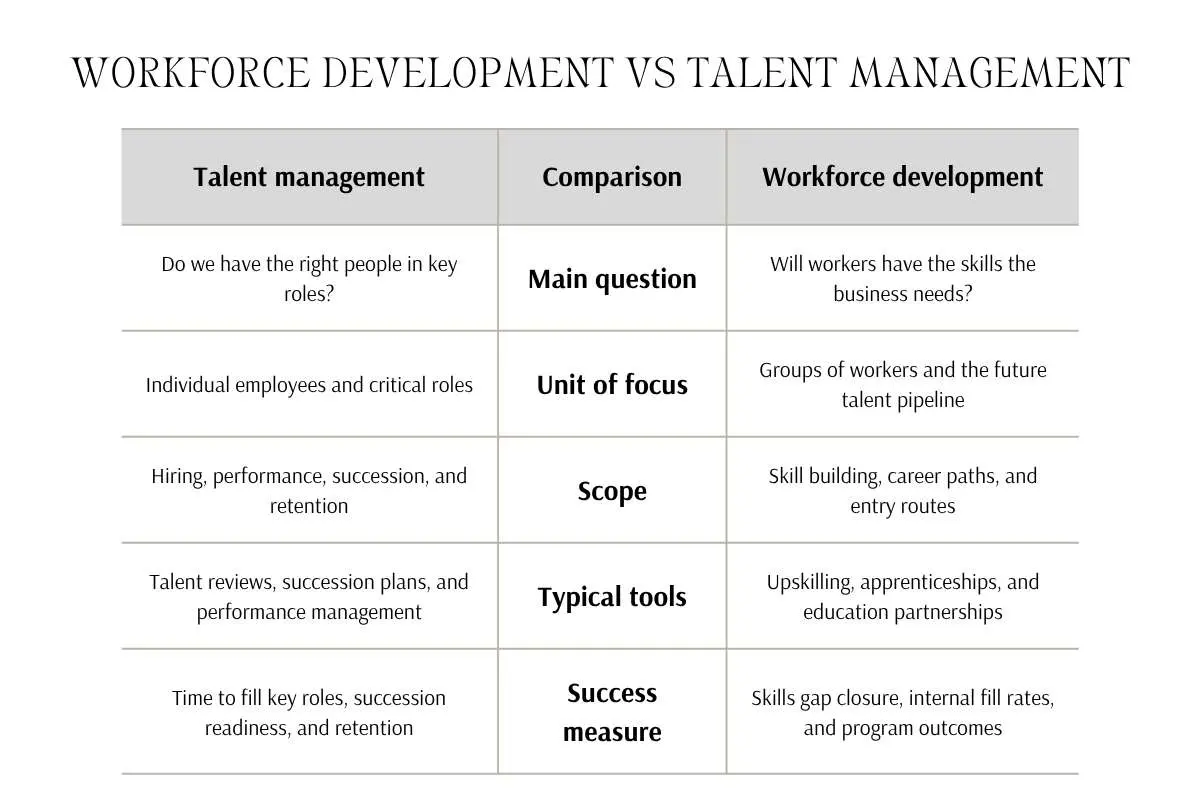
Talent management focuses on attracting, developing, engaging, and retaining employees, especially those in key roles. Workforce development takes a wider view by building the skills a business needs across its workforce. It also helps create a steady supply of skilled workers for future jobs. The main difference lies in how each approach plans for people and their skills.
| Talent management | Comparison | Workforce development |
|---|---|---|
| Do we have the right people in key roles? | Main question | Will workers have the skills the business needs? |
| Individual employees and critical roles | Unit of focus | Groups of workers and the future talent pipeline |
| Hiring, performance, succession, and retention | Scope | Skill building, career paths, and entry routes |
| Talent reviews, succession plans, and performance management | Typical tools | Upskilling, apprenticeships, and education partnerships |
| Time to fill key roles, succession readiness, and retention | Success measure | Skills gap closure, internal fill rates, and program outcomes |
The two approaches also differ in how they connect to a company’s plans for growth. Talent management often works closely with senior leaders to identify key positions, review employee performance, and plan for future leadership needs. Workforce development can involve a wider group of people, including team managers, training providers, and colleges that help prepare workers for jobs the company expects to need.
For example, a company planning to open a new factory may need more technicians with specific technical skills. Workforce development programs can help build that supply of skilled workers. Talent management can then help the company identify employees who are ready to lead teams or take on other key roles as the factory grows.
Workforce development vs talent management: where do they overlap?

Workforce development and talent management meet when a company matches people’s skills to the right roles. Both work best when they share the same information and plan for the skills the business will need.
1. Critical roles
Talent management identifies the key roles a business cannot afford to leave empty. Workforce development helps employees build the skills gap closure needed to fill those roles. Together, the two functions help companies prepare workers before a key job becomes vacant. In fact, 83% of organizations expect skill development to have a high or moderate impact on employee morale and engagement.
2. Career paths
Workforce development gives employees clear ways to learn new skills and prepare for other roles. Talent management helps decide who is ready for a bigger role, a new challenge, or a promotion. When both teams work together, employees can see how training supports their career goals. They also know which skills they need to build to take the next step.
3. Skills data
Both teams need clear records of what employees can do, what they have learned, and which roles they may be ready to fill. Yet, this data often sits in separate systems. Learning tools track courses and training, while performance tools record reviews and future growth. If teams cannot share this data, they may overlook skilled employees or ask people to repeat training they have already completed.
How can companies connect both functions?
Companies can start by building one shared record of employee skills and training. The record can also include work experience and skill gaps. The workforce development and talent management teams can use metrics to review this data every quarter. They can list key roles, check if current employees are ready to fill them, and plan training for those who need more skills. Both teams should also track progress using the same measures. This helps them make better plans and prepare employees for future business needs.
Workforce development vs talent management: which should a company prioritize?

A company should start where the biggest gap exists. If a few key roles are at risk, talent management should come first. If many roles lack the skills the business needs, workforce development should take priority.
| Signs Your Company Needs Talent Management | Signs Your Company Needs Workforce Development |
|---|---|
| Managers are unsure who is ready to take on key roles. | Many roles face the same skill gaps. |
| Top performers keep leaving the company. | The company struggles to fill jobs that need many workers. |
| Losing one key person could hurt business operations. | New technology creates a need for new skills. |
| Managers lack a clear way to judge employee potential. | The business lacks a steady source of entry-level talent. |
| The company struggles to plan promotions, retain skilled workers, and prepare future leaders. | The company needs a wider plan to train workers and prepare people for open roles. |
Company size can help guide this choice, but it does not set a fixed rule. In a firm with 40 employees, losing one key person may create a serious gap. In a company with 4,000 employees that is adopting new technology, skill gaps across many roles may pose a greater risk. The right choice depends on the business’s needs.
Neither approach is better in every case. Mature companies use both. Workforce development builds skills and prepares people for future roles. Talent management helps identify who is ready to take the next step.
Conclusion
The core choice between workforce development vs talent management comes down to one diagnostic test. Is your current gap a missing person, or a broken pipeline?
Start by auditing your most recent hiring challenges. Take the last two roles you struggled to fill or promote into. Label each one as either a placement problem or a supply problem.
If the person exists but isn’t in position, invest in talent management. If the people simply do not exist in the market, allocate your budget to workforce development.
FAQs
1. Is workforce development part of talent management?
Partly. Development is a component of talent management, but workforce development also covers building a pipeline of people not yet hired.
2. What is the difference between talent management and talent development?
Talent development is the growth side of talent management, alongside attraction, performance, and retention.
3. Can one HR team run both?
Yes, in smaller companies, usually with one owner. Larger organizations tend to split them, which makes shared goals and data matter more.
4. Which approach solves immediate hiring freezes faster?
Talent management reallocates existing staff quickly. Workforce development focuses on long-term labor pipeline supply.
5. How do key success metrics differ between workforce development vs talent management?
Talent management tracks retention and succession rates. Workforce development tracks broader candidate supply and regional skills readiness.