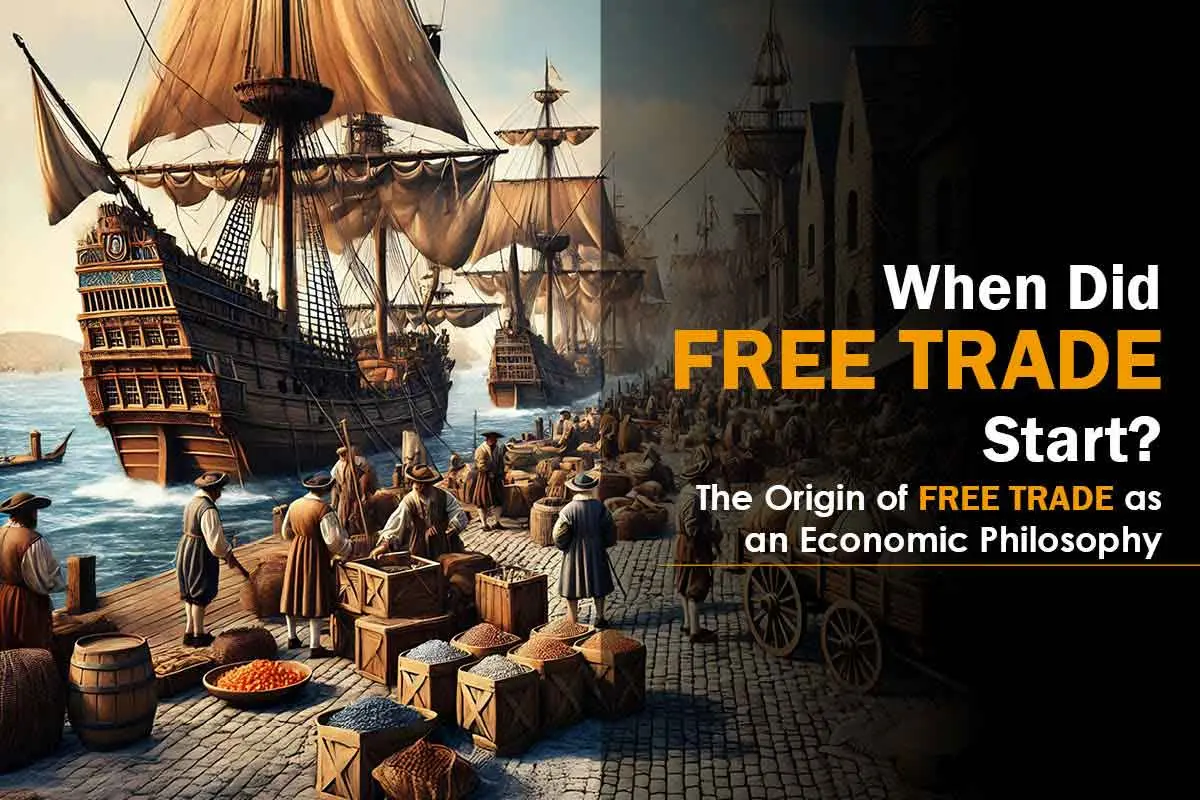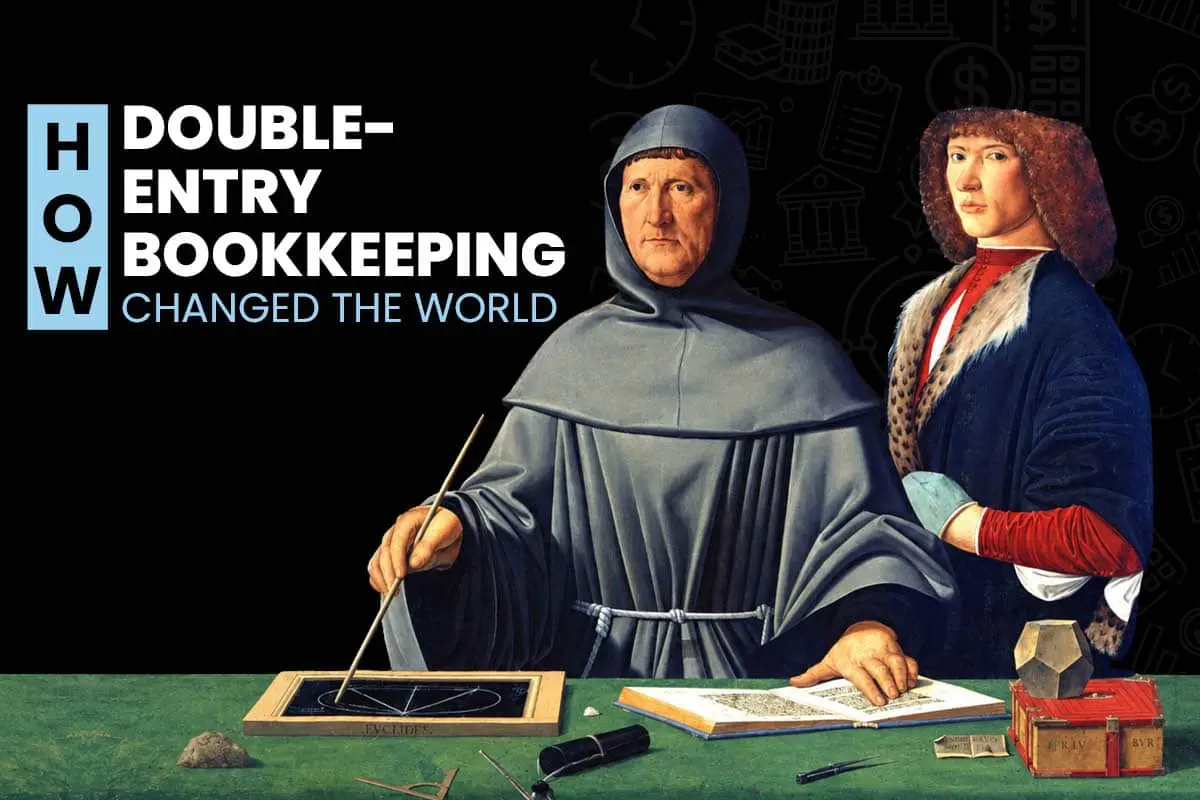
In the bustling mercantile heart of fifteenth-century Venice, something quiet but revolutionary was taking place. Not in the grand piazzas or the doge’s palace, but in the ledgers of merchants who were tired of guessing whether their businesses were actually making money. These traders, navigating the complex web of Mediterranean commerce, developed a method of record-keeping that would eventually reshape the entire world economy. They called it il modo de Vinegia, the Venetian method.
Today, we know it as double-entry bookkeeping. And its story is nothing less than the story of how modern accounting was born.
From Venice to Wall Street: 700 years of double-entry bookkeeping
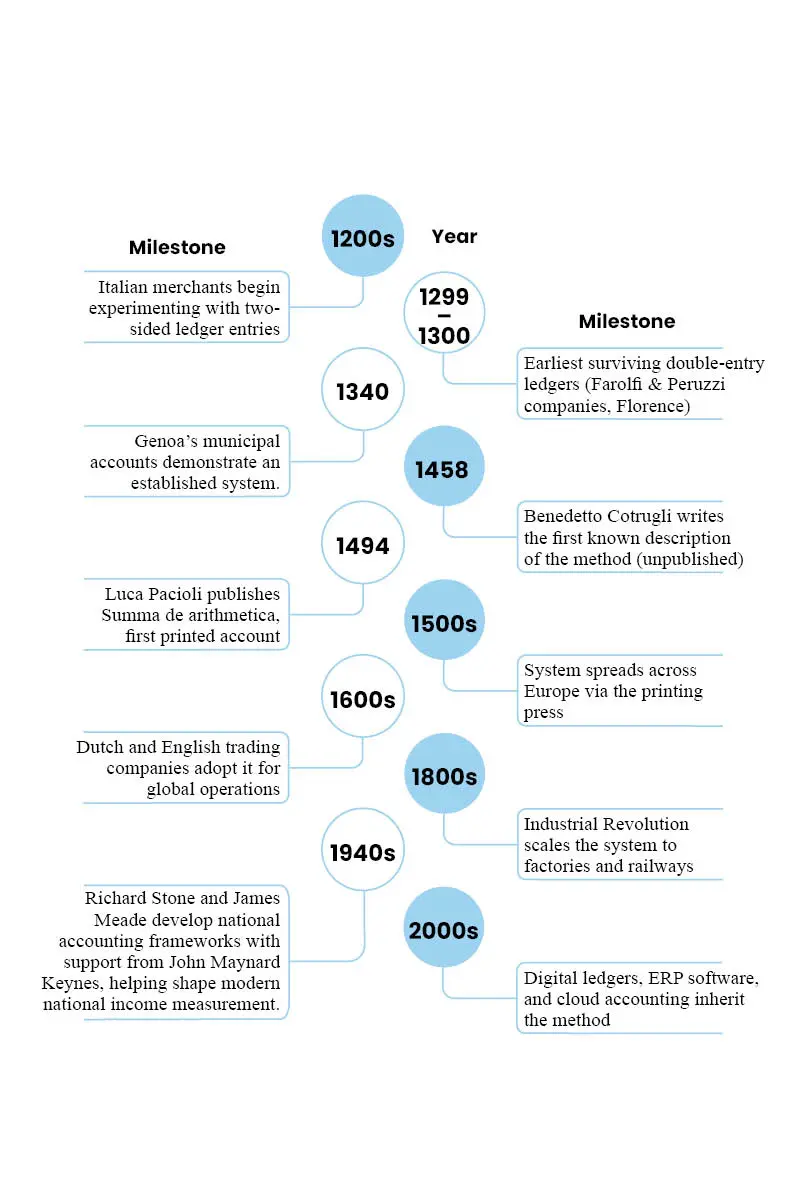
Double-entry bookkeeping is a method of recording every financial transaction twice: once as a debit, once as a credit, so that the books always balance. That simple rule, refined by medieval Italian merchants and later codified by Luca Pacioli in 1494, became the foundation of modern accounting. Its origins are less tidy than legend suggests: two-sided ledgers emerged gradually across several Italian cities, and the earliest surviving examples predate Pacioli by well over a century. What made the system revolutionary was not its invention but its reach once written down and printed; it spread from Venetian counting houses to factories, railways, and the national accounts of the twentieth century. Its story is one of incremental genius.
| Year | Milestone |
|---|---|
| 1200s | Italian merchants begin experimenting with two-sided ledger entries |
| 1299–1300 | Earliest surviving double-entry ledgers (Farolfi & Peruzzi companies, Florence) |
| 1340 | Genoa’s municipal accounts demonstrate an established system. |
| 1458 | Benedetto Cotrugli writes the first known description of the method (unpublished) |
| 1494 | Luca Pacioli publishes Summa de arithmetica, first printed account |
| 1500s | System spreads across Europe via the printing press |
| 1600s | Dutch and English trading companies adopt it for global operations |
| 1800s | Industrial Revolution scales the system to factories and railways |
| 1940s | Richard Stone and James Meade develop national accounting frameworks with support from John Maynard Keynes, helping shape modern national income measurement. |
| 2000s | Digital ledgers, ERP software, and cloud accounting inherit the method |
The merchant’s dilemma
Before double-entry bookkeeping emerged, accounting was a rudimentary affair. An early medieval merchant was, in essence, a travelling salesman. He had little need for elaborate records; he could simply check whether his purse was full or empty. But as the commercial enterprises of the Italian city-states grew larger and more complex, relying on loans, currency trades, and partnerships that stretched across continents, the limitations of single-entry bookkeeping became painfully clear. A merchant could record that he had paid for a shipment of silk, but he had no systematic way to track what that silk had cost him in total, what he owed his partners, or whether the venture had actually turned a profit.
The Venetian solution
The Venetian merchants solved this problem with a principle both simple and profound: every transaction has two sides. When cash leaves your possession, something of equal value must enter it; when you incur a debt, you also acquire an asset. By recording both sides of every transaction a debit and a corresponding credit merchants created a self-balancing system that revealed not just what had happened, but why. This was the birth of double-entry bookkeeping.
Consider a simple example. A bakery buys a new oven for $5,000 in cash. The oven is an asset, so the baker records a debit of $5,000 to the equipment account. But the cash has also left the business, so an equal credit of $5,000 is recorded to the cash account. Nothing has been gained or lost overall $5,000 has simply moved from one pocket to another and the ledger still balances. This was more than a bookkeeping trick: for the first time, a merchant could measure the worth of his enterprise as a coherent whole, separate from his personal affairs. The ledger became a mirror, reflecting the true financial condition of the business.
Luca Pacioli, the man who wrote it down
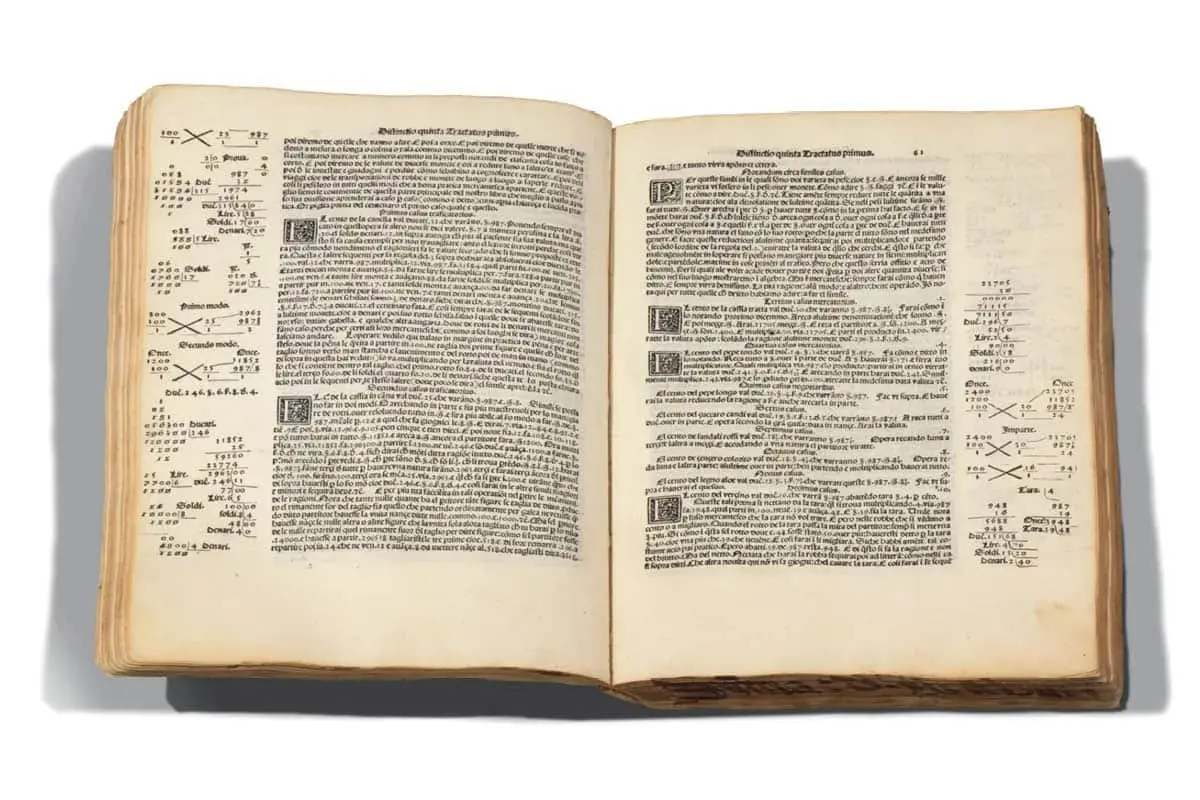
Enter Luca Pacioli. A Franciscan friar, a professor of mathematics, a lover of chess and puzzles, and a close friend of Leonardo da Vinci, Pacioli was the quintessential Renaissance man. In 1494, he published Summa de arithmetica, geometria, proportioni et proportionalita, a sprawling mathematical encyclopedia that included, almost as an afterthought, the first printed description of double-entry bookkeeping.
Pacioli did not claim to have invented the system. He was humble about his role, writing that he was merely recording the current practice of Venetian merchants, which he called “the method of Venice”. But his decision to write it down and to publish it on the newly invented Gutenberg printing press changed everything. The Summa became one of the first books ever printed, and its section on bookkeeping, Particularis de computis et scripturis, spread across Europe with astonishing speed.
Pacioli’s genius lay not in invention but in codification. He took a practical, localized method and turned it into a universal system that could work across all trades and nations. As Christina Geiger of Christie’s put it, “As Leonardo and others made revolutionary strides in art, and Machiavelli did for politics, so too did Pacioli for business”.
Why it mattered, beyond the ledger
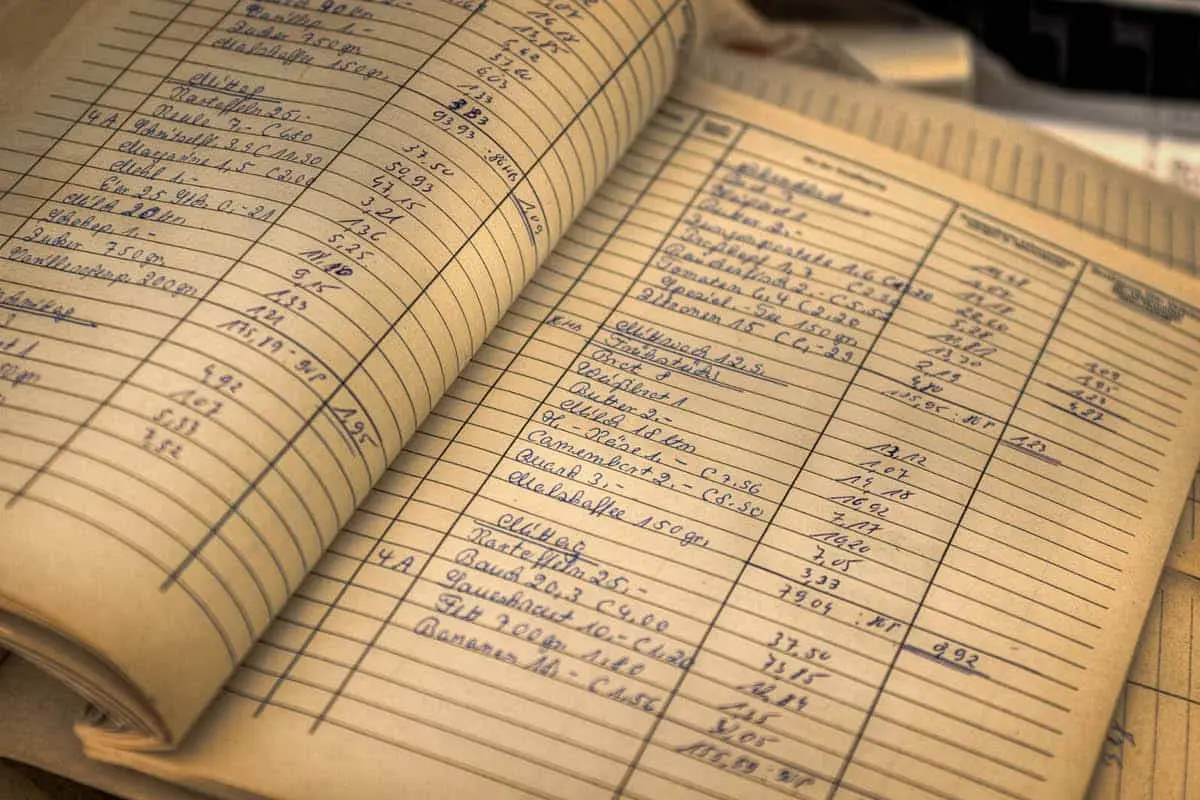
The impact extended far beyond the merchant’s counting house, introducing a level of financial accountability that had never existed before. In a single-entry system, an accounting mistake or a fraudulent activity was difficult to find, but in the double-entry system, a fraudulent partner had to make not one but two related entries to avoid detection. This made it far more likely that an auditor could spot deception while following the audit trail, deterring fraud before it could take root.
This error-detection capability had profound consequences. It created an audit trail that made it harder for managers in distant branch offices to hide mismanagement or fraud, lowering the cost to owners of trusting someone else to run their affairs. And because the books could now be checked, prospective partners had reason to expect accountability a system that, over time, tended to reward those who kept honest records and deter those who did not.
More fundamentally, the system gave businesses a clearer way to track capital and to separate business assets from personal ones. As firms grew beyond the reach of a single owner’s memory, this separation helped merchants and partners see what the business itself owned and owed, distinct from their own affairs. It was one of several developments alongside limited liability, joint-stock structures, and commercial law that made the modern corporation easier to finance and govern. Without tools like double-entry bookkeeping, managing that scale of enterprise would have been far more difficult.
The system that built capitalism
The system that Pacioli described in 1494 is essentially the one used across the world today. The Medici family of fifteenth-century Florence used the system to win the loyalty of their clients. The industrial revolution, with its sprawling factories and complex supply chains, could not have been financed or managed without it.
And when the modern world needed to measure entire economies, it borrowed the same logic. In the 1930s, Simon Kuznets built the first U.S. national income estimates to measure the toll of the Great Depression. A decade later, Richard Stone and James Meade constructed the first true national accounts, using the same system to cross-check every transaction between households, businesses, and government. That framework became the basis for GDP.
Yet the story of double-entry bookkeeping is not one of unbroken triumph, for the same system that enables transparency can also be manipulated. As the corporate collapses of Enron and Lehman Brothers showed, even sophisticated double-entry systems can be used to hide, rather than reveal, financial reality. The system is a tool, and like any tool, its value depends on the integrity of those who wield it.
The human dimension
What makes the story of double-entry bookkeeping so compelling is that it is, at its heart, a deeply human story of merchants who simply wanted to know whether their ventures were worthwhile, of a friar who believed mathematics could bring order to the chaos of commerce, and of every business owner since who has felt the quiet satisfaction of knowing the numbers add up.
From the Rialto to Wall Street, from Pacioli’s quill to the digital ledgers of our own age, the Venetian method endures not because it is clever, but because it works. And it still matters today for one simple reason: it turns trust into something you can check, and every business, no matter how small, into a story that can be told in numbers.
Frequently asked questions
1. Did Luca Pacioli invent double-entry bookkeeping?
No. He documented the Venetian method merchants already used, then made it famous by printing it in 1494.
2. Why is it called “double-entry” bookkeeping?
Every transaction is recorded twice once as a debit, once as a credit so the books always balance.
3. How does double-entry bookkeeping help detect fraud?
A fraudulent partner would have to falsify two related entries instead of one, leaving a trail an auditor can follow.
4. Is double-entry bookkeeping still used today?
Yes. Every business from a corner shop to a multinational relies on the same debit-and-credit logic.
5. Did double-entry bookkeeping really help create modern capitalism?
It played a foundational role, but it worked alongside limited liability, joint-stock structures, and commercial law no single system can claim sole credit.