IKEA is more than a store; it is an experience that keeps visitors engaged for hours, even without a planned purchase. Customers wander through staged room displays, exploring furniture, décor, and accessories while imagining them in their own homes. The layout, lighting, and product arrangement encourage curiosity, discovery, and spontaneous buying, creating a unique blend of shopping and inspiration. This immersive environment complements IKEA’s mission, “to create a better everyday life for the many people,” by offering affordable, functional home furnishings designed for everyday living.
Founded in Sweden in 1943 by Ingvar Kamprad, IKEA began as a small mail-order business and grew into the world’s largest furniture retailer. Its flat-pack model and self-service stores reshaped furniture retail across continents. Today, IKEA operates in numerous countries, including a growing presence in India, where it blends Scandinavian design principles with local preferences and lifestyles.
IKEA: Business Model and Global Framework
IKEA operates as a global home furnishing retailer offering ready-to-assemble furniture, décor, textiles, lighting, and kitchen and bathroom solutions. Its core idea centers on practical design at prices accessible to many households. The flat-pack concept remains central to its operations, enabling efficient transport, lower storage expenses, and cost savings passed to customers.
Key Milestones and Global Expansion:
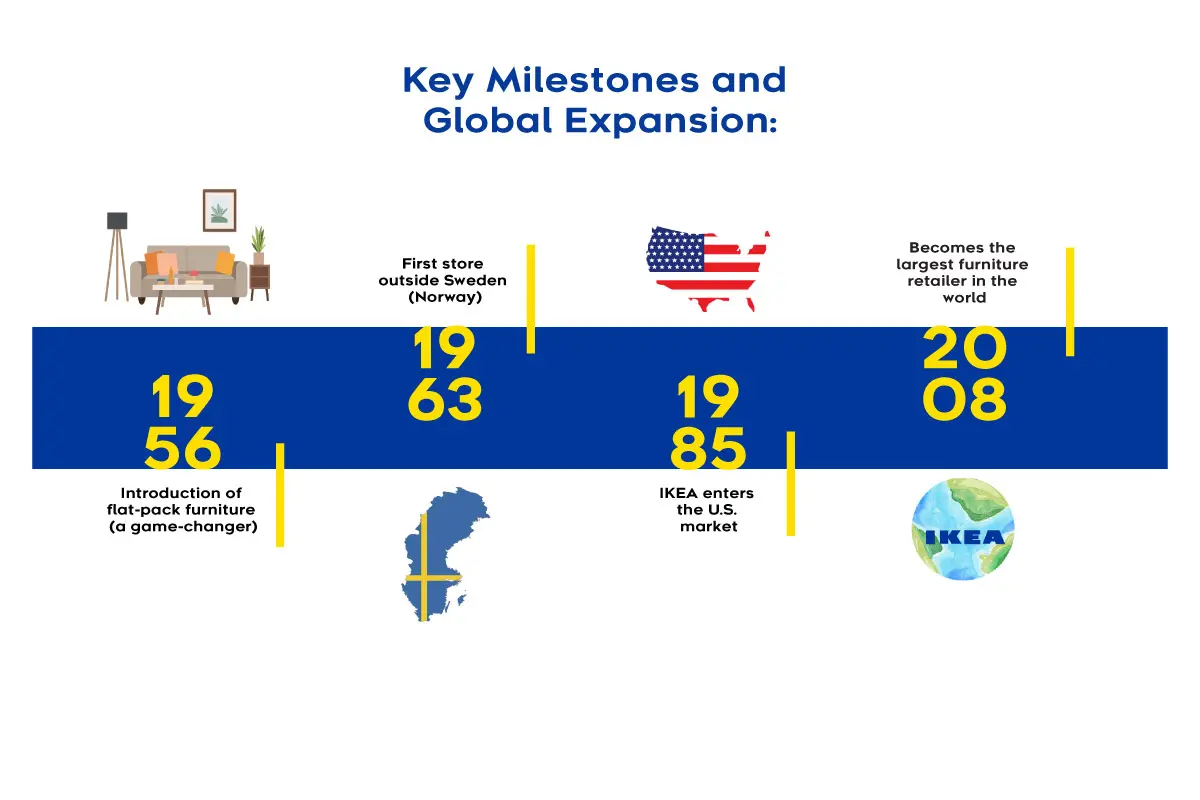
- 1956: Introduction of flat-pack furniture (a game-changer)
- 1963: First store outside Sweden (Norway)
- 1985: IKEA enters the U.S. market
- 2008: Becomes the largest furniture retailer in the world
The company functions through a franchise system led by Inter IKEA Group, working alongside independent franchisees across markets. In India, IKEA plays a dual role as a growing retail market and a strategic sourcing hub, partnering with local suppliers.
Beyond commerce, the IKEA Foundation supports initiatives focused on livelihoods, climate action, and child welfare, reflecting the brand’s commitment to meaningful social contribution.
Flat-Pack Logic: The Design Behind the Price
Flat-pack design stands at the center of IKEA’s cost-conscious retail strategy.
Design: IKEA structures its stores around the flat-pack concept, offering furniture in compact, ready-to-assemble formats. Products use standardized components and simplified construction to ensure consistency in production and planning.
Packaging: Each item fits into space-efficient boxes that maximize carton capacity. Standard packaging reduces storage requirements within warehouses and retail outlets.
Transport: Compact loads allow more units per shipment, lowering freight frequency and handling expenses. Efficient logistics planning reduces operational overhead across markets.
Assembly: Customers complete the final assembly at home. This approach limits in-store service labor and transfers part of the production effort to the buyer.
Pricing Impact: Reduced logistics, controlled manufacturing, and shared assembly responsibility keep overall costs measured. The flat-pack system, therefore, supports disciplined pricing while maintaining large-scale retail efficiency.
These integrated operational decisions define IKEA’s cost framework and uphold its commitment to affordable design.
The Blueprint of Buying Behavior
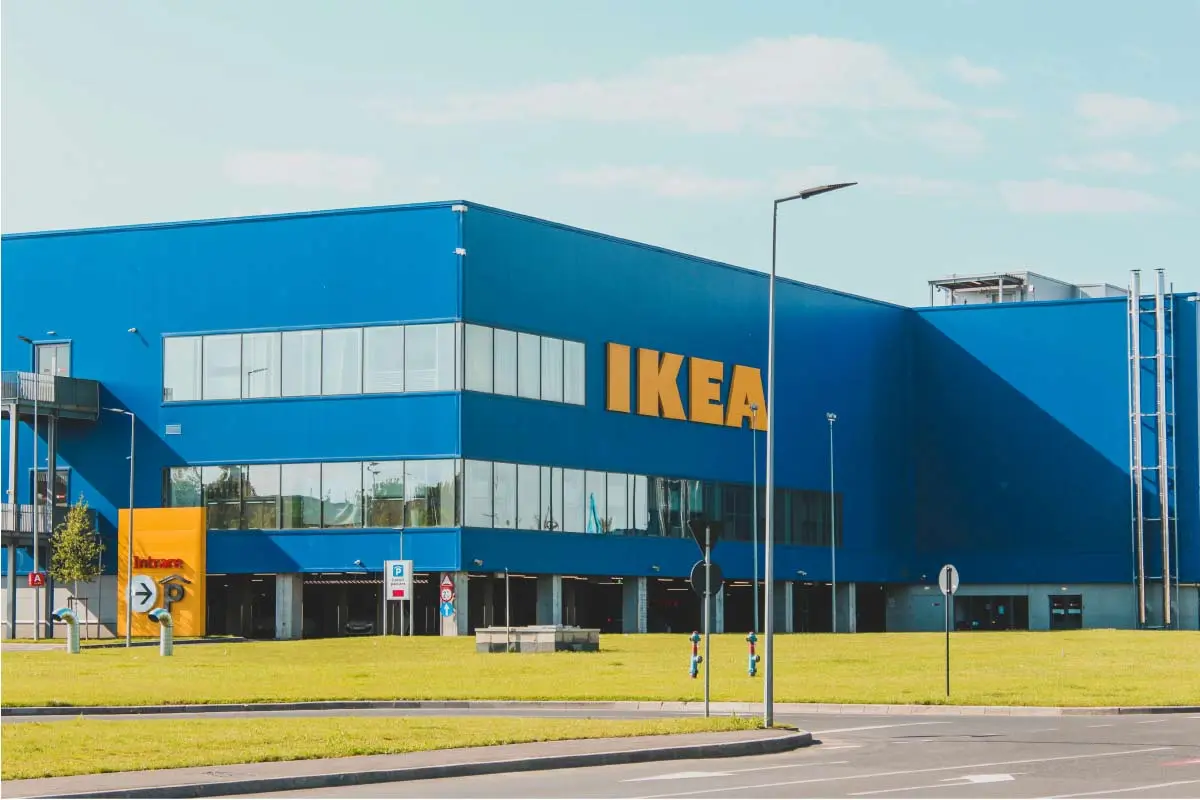
IKEA’s success rests on two calculated pillars: the way customers move through its stores and the way prices are constructed with discipline.
Spatial Strategy
IKEA stores follow a guided pathway that directs customers through staged room displays. This controlled flow increases product visibility and encourages shoppers to imagine items within realistic home settings, often reflecting compact urban living. Accessories are positioned along the route to prompt spontaneous purchases. In-store restaurants extend visit duration, increasing overall engagement. The layout operates as a calculated behavioral strategy shaped by retail psychology.
Pricing Strategy
Price defines IKEA’s core identity:
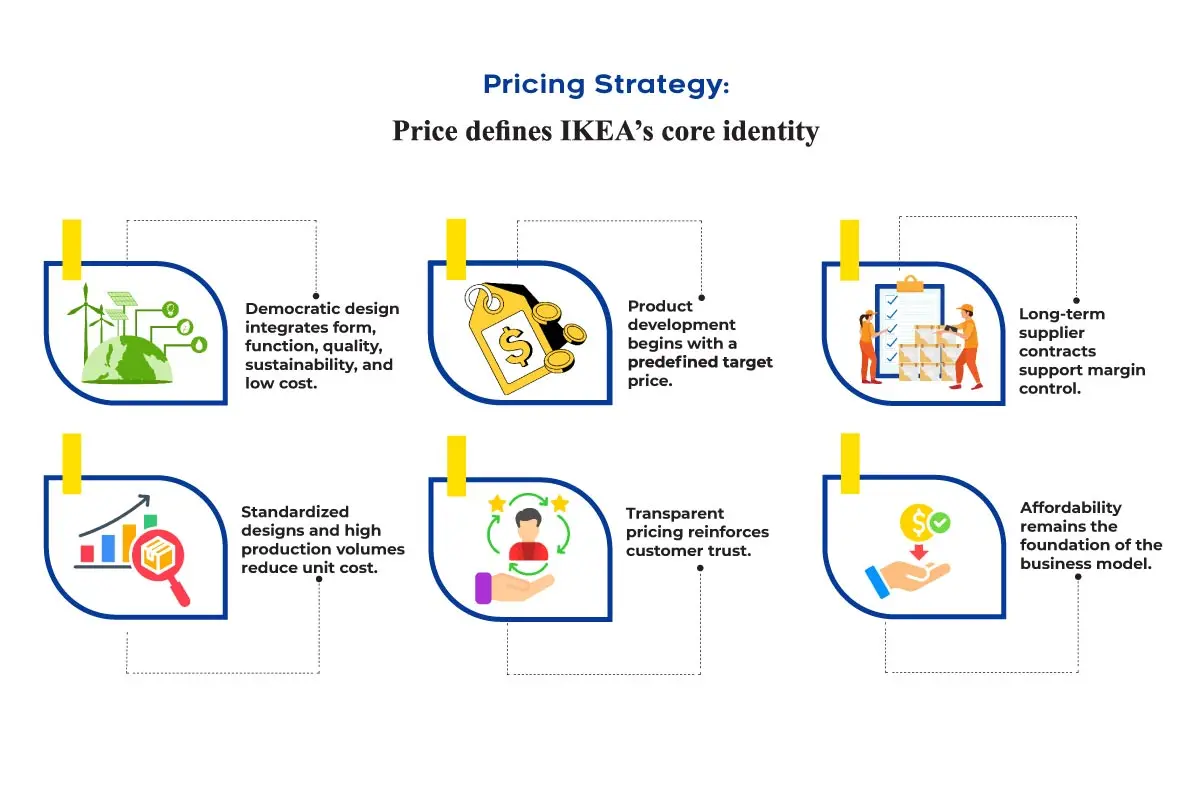
- Democratic design integrates form, function, quality, sustainability, and low cost.
- Product development begins with a predefined target price.
- Long-term supplier contracts support margin control.
- Standardized designs and high production volumes reduce unit cost.
- Transparent pricing reinforces customer trust.
- Affordability remains the foundation of the business model.
This alignment of store design and pricing philosophy naturally leads to the question of why sustainability forms a core pillar of IKEA’s brand identity.
Why Is Sustainability Tied to Brand Identity?
Sustainability at IKEA functions as a structured business principle embedded within daily operations.
- Commitment: Environmental and social responsibility remain long-term priorities guided by defined standards and accountability systems.
- Action: Certified sourcing, renewable material targets, energy-efficient operations, and furniture buy-back programs shape practical implementation.
- Outcome: These efforts support cost discipline, public responsibility, and sustained customer trust within global markets.
Through this structured approach, sustainability becomes a core component of IKEA’s long-term business credibility.
Market Analysis: Where Does IKEA Compete?
IKEA competes within dynamic markets shaped by urban demand, digital disruption, and price awareness.
Global Market Context
The home furnishings sector is highly competitive, influenced by compact urban housing and rising apartment living. Online platforms enable quick comparisons and convenient purchasing. Middle-income consumers remain price-conscious. Digital-first brands and local manufacturers compete through customization and faster delivery, increasing competitive pressure.
Indian Market Context
India serves as both a sourcing base and a growth market. Expanding cities increase demand for functional, affordable furniture. Smaller store formats suit local buying habits. However, infrastructure limitations and supply chain complexity require careful coordination and cost control.
In this competitive setting, IKEA must align global scale with local adaptability to sustain its market position.
SWOT Analysis: Current Strategic Standing
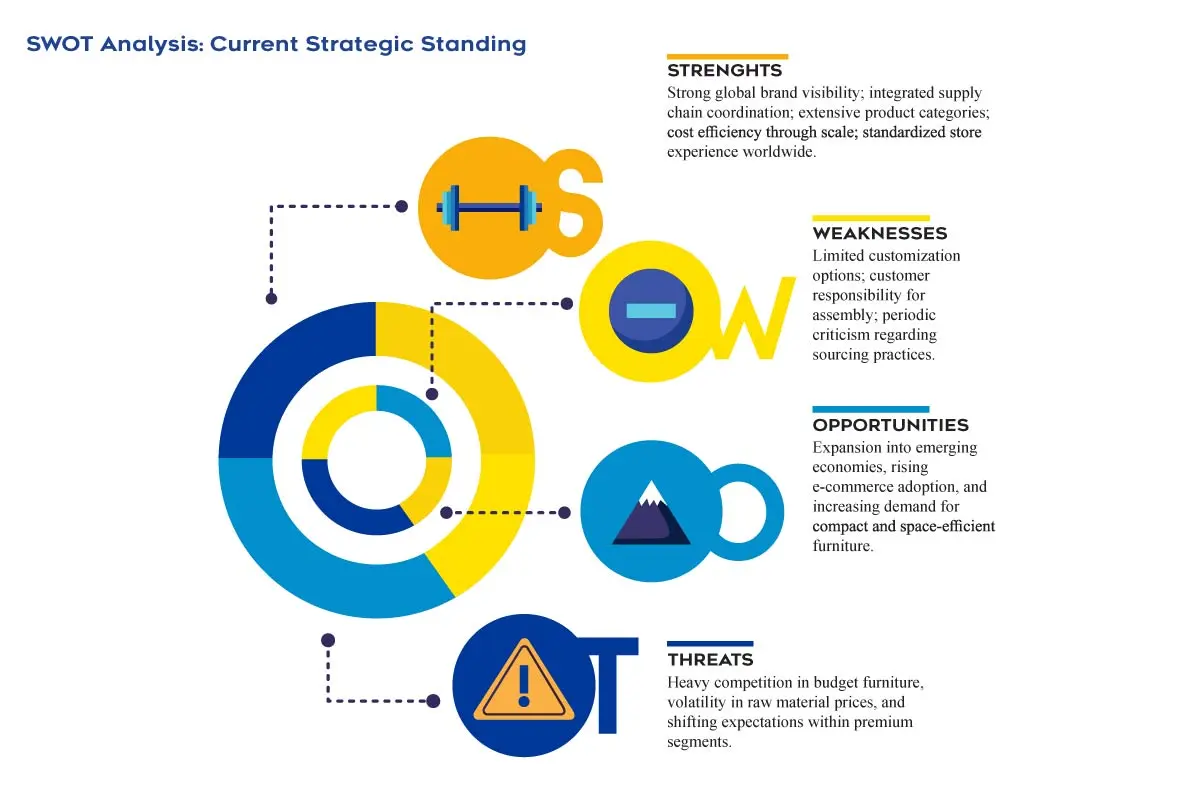
IKEA’s strategic position can be understood through a structured evaluation of its internal capabilities and external environment.
| Factor | Strategic Position |
| Strengths | Strong global brand visibility; integrated supply chain coordination; extensive product categories; cost efficiency through scale; standardized store experience worldwide. |
| Weaknesses | Limited customization options; customer responsibility for assembly; periodic criticism regarding sourcing practices. |
| Opportunities | Expansion into emerging economies, rising e-commerce adoption, and increasing demand for compact and space-efficient furniture. |
| Threats | Heavy competition in budget furniture, volatility in raw material prices, and shifting expectations within premium segments. |
This assessment presents IKEA as structurally strong, yet attentive to competitive and operational pressures.
Strategic Pillars Behind IKEA’s Success
This structure organizes IKEA’s key strategies into distinct pillars, showing how design simplicity, sourcing, retail experience, local adaptation, digital tools, and controlled expansion work together to sustain its market position.
- Cost Leadership: Achieved through design simplicity, standardized components, and efficient production, enabling affordable pricing.
- Sourcing Partnerships: Large-scale, long-term supplier relationships secure volume advantages and reliable material supply.
- Experiential Retail: Immersive store layouts encourage exploration, extended visits, and engagement with staged room setups.
- Local Adaptation: Product assortments reflect cultural preferences, urban living needs, and regional space constraints.
- Digital Integration: Augmented reality tools, online platforms, and omnichannel services improve customer experience and decision-making.
- Controlled Expansion: Market growth follows careful evaluation to ensure operational readiness and brand consistency.
Combined, these strategic pillars create a cohesive system that keeps IKEA competitive while ensuring affordability, engaging customer experiences, and consistent operations across markets.
Conclusion
IKEA demonstrates how a clear vision, disciplined operations, and customer-focused innovation can create a global retail powerhouse. Its flat-pack model, guided store experiences, and cost-conscious product design make functional home furnishings accessible to many. Sustainability and responsible sourcing are embedded in daily operations, reinforcing credibility and long-term accountability.
Strategic use of local adaptation, digital tools, and controlled expansion allows IKEA to respond to diverse markets while maintaining consistency. By aligning operational efficiency, pricing, and customer experience, IKEA illustrates a business model where design, strategy, and social responsibility work together, securing its position as a leader in the global home furnishings industry.
Read More: MR. DIY: How a One-Stop Shop Became a Global Retail Powerhouse