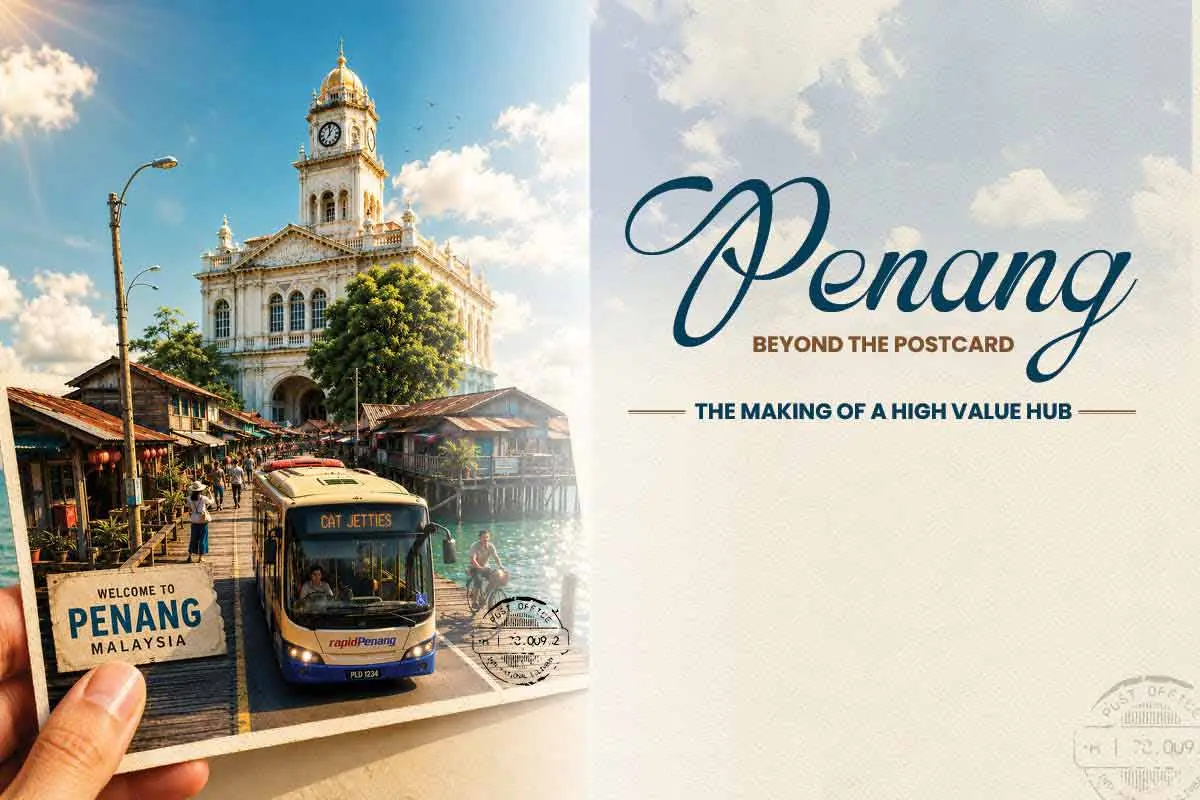
Few places in Southeast Asia pack as much economic weight into such a small space as Penang. This island state brings together semiconductor plants, UNESCO-listed heritage streets, advanced medical centres, and popular beach resorts within a compact area. Long recognised as a manufacturing hub, Penang is now seeking a new identity as a destination for high-value investment and premium tourism.
Its economic contribution far exceeds what its modest size would suggest, making Penang one of Malaysia’s most important growth centres at a pivotal moment in its development.
History and culture: Where centuries still speak

Penang’s character has been shaped by centuries of trade, migration, and cultural exchange across the Indian Ocean.
Ancient trading crossroads: Penang’s story is closely tied to Kedah, among the Malay Peninsula’s oldest trading centres. Indian merchants arrived centuries ago, introducing religious beliefs and cultural practices that left lasting marks on local society. Later, Arab and Indian Muslim traders played an important role in spreading Islam across the region.
A culture shaped by many communities: Malay, Chinese, Indian, Peranakan, and Eurasian communities gradually formed Penang’s distinctive identity. Their shared influence appears in cuisine, language, festivals, clothing, and everyday customs.
Heritage that lives on: George Town, a UNESCO World Heritage Site, is celebrated for historic streets, temples, clan houses, and colonial buildings. Museums, heritage trails, and cultural festivals preserve this history while supporting tourism and small businesses.
Today, this rich heritage remains central to Penang’s identity and continues to attract visitors seeking experiences rooted in history and tradition.
Penang’s economic story: A small state with big ambitions
Penang’s economic success rests on an unusual combination of industrial depth, service sector strength, and an ability to outperform expectations despite its small size.
| Indicator | Why It Matters |
| Around 7.6% of Malaysia’s GDP | A remarkable contribution for a state with a limited land area. |
| GDP per capita above the national average | Reflects high productivity and significant economic value creation. |
| Manufacturing and services contribute over 90% of output | Shows the importance of industry alongside modern service activities. |
Why the economy stays resilient:
- Electronics manufacturing remains a major economic pillar.
- Tourism, healthcare, logistics, finance, and business services provide additional sources of income.
- This diversified structure helps Penang weather fluctuations in global markets.
Challenge box: What comes next?
- Rising labour costs are increasing operating expenses.
- Engineering and technology talent shortages remain a concern.
- Global trade tensions and supply chain uncertainty create fresh risks.
- Future growth will depend increasingly on innovation, research, and advanced industries.
How the state responds to these challenges will play a crucial role in determining its next chapter as one of Malaysia’s leading economic centres.
Silicon Island: Why investors choose Penang?
The state has established itself as Malaysia’s leading electrical and electronics hub, supported by a dense network of multinational firms, suppliers, universities, and research facilities. The state contributes significantly to national exports and occupies an important position within global semiconductor supply chains.
Growth engine 1: Advanced industry
- Semiconductor manufacturing remains the backbone of Penang’s economy.
- Investment opportunities are expanding in chip packaging, automation systems, and precision engineering.
- Companies increasingly seek specialised manufacturing capabilities and higher value production.
Growth engine 2: Knowledge-based services
- AI analytics is emerging as a promising segment.
- Integrated circuit design activities continue to expand.
- Shared service centres are using Penang as a regional operating base.
Growth engine 3: Logistics expansion
- The Penang International Logistics Aeropark is opening new business opportunities.
- Demand for smart warehousing and modern logistics facilities continues to increase.
Infrastructure spotlight:
- Mutiara Line LRT: Expected to improve urban mobility.
- Silicon Island: Planned as a future technology and economic zone.
- Digital readiness: Strong digital infrastructure and extensive 5G coverage support business activity.
This structure feels more dynamic and magazine-like while avoiding the repetitive table format used in earlier sections.
Beyond factories: Sectors gaining momentum
While electronics remain central to Penang’s economy, several emerging sectors are creating new avenues for investment and long-term growth.
Healthcare hub:
Penang has built a strong reputation as a regional medical tourism destination. Patients from Indonesia, Singapore, and other Asian markets continue to seek treatment in the state’s private hospitals.
Experiential tourism:
Seberang Perai is attracting attention through river cruises, cultural tours, and rural experiences that support local communities and small enterprises.
Technology meets agriculture:
Smart farming initiatives are improving efficiency across agricultural activities. Aquaculture is expanding, while paddy cultivation continues to record high productivity levels.
Property and construction opportunities:
Industrial parks in Batu Kawan are attracting fresh investment. Affordable housing projects remain important as urbanisation continues. Demand is also rising for green buildings and specialised cleanroom facilities linked to advanced manufacturing activities.
Together, these sectors are broadening Penang’s economic base and reducing reliance on manufacturing alone.
Tourism as an economic pillar: More than beaches and street food
Big picture
Tourism remains a major contributor to Malaysia’s GDP, supporting employment across hospitality, transport, retail, and healthcare. Penang stands among the country’s most visited urban destinations, attracting both domestic and international travellers.
The Penang visitor experience:

| Experience | Key Attractions |
| Heritage Journey | George Town, UNESCO World Heritage Site, Clan Jetties, historic temples, and colonial architecture |
| Nature Escape | Penang Hill, The Habitat, beaches, Penang National Park |
| Culinary Discovery | Hawker centres, street food trails, traditional cafés |
Who benefits when visitors spend in Penang?
- Hotels and resorts
- Restaurants and hawker stalls
- Transport operators
- Local artisans and craft businesses
- Retail shops and markets
- Tour operators and guides
Result: Tourism spending circulates widely through the local economy, supporting thousands of businesses and jobs.
The next frontier for Penang’s economy
Rising wages mean low operating costs can no longer serve as Penang’s main competitive edge. Other regional economies are also competing for international investment, making differentiation increasingly important.
Key priorities:

| Focus Area | Why It Matters |
| Workforce upskilling | Higher-value industries require advanced technical capabilities. |
| Talent retention | Keeping skilled professionals is essential for sustained growth. |
| Research and development | Greater investment in research can support new technologies and products. |
| Innovation by local firms | Businesses need to expand into design, innovation, and intellectual property creation. |
Towards a knowledge economy:
Policymakers are exploring the creation of a specialised technology finance ecosystem to support innovative companies. Penang also has significant potential to attract venture capital and expand startup activity by building on its established semiconductor expertise.
Conclusion: A small state with a big future
Penang’s story is one of remarkable concentration. Within a compact territory, it combines industrial capability, cultural richness, tourism appeal, and growing knowledge-based industries. Its success has long rested on manufacturing, yet its future will depend on innovation, skilled talent, and the ability to create higher-value activities.
Heritage streets, semiconductor plants, hospitals, and emerging technology ventures together give Penang a distinctive economic character. As competition across Asia intensifies, the state’s greatest advantage may lie in its ability to balance tradition with ambition and remain far larger than its geography suggests.