The world of money and investing feels a little crazy right now. We’re dealing with higher interest rates, prices that just won’t seem to go down (sticky inflation), big stock market boosts thanks to AI technology, and confusing global events.
In this environment, you need a smart way to invest. The best approach is to have a diversified investment portfolio.
Think of it like this: Don’t put all your eggs in one basket!
A disciplined approach to diversification is simply a practical way to manage risk. By spreading your money across different types of investments (not just one stock, one sector, or one country), you prevent a big loss in one area from sinking your whole plan. It helps smooth out your returns over the long run, protecting your money while still letting it grow as the market changes between 2025 and 2026.
This guide will walk you through easy steps to build and manage a smart portfolio that fits your personal goals.
What Is an Investment Portfolio?
Think of your investment portfolio as your personal treasure chest of money-making tools.
It’s a collection of all the different financial “things” you own – like company stocks (shares), government or corporate bonds (loans you make), cash, and other assets.
Why You Need One?
The main goal of this collection is two-fold:
- Grow your wealth over time.
- Protect your money from sudden market crashes.
The way you mix and match these assets determines how much risk you take and how much return you can expect.
The Key to Success: Blending Strategies
A great portfolio isn’t just a random assortment; it’s a strategy tailored to you.
Investors use different approaches:
- Growth: This is for aggressive investors who want high returns and are okay with higher risk. They focus on fast-growing companies (like new tech).
- Income: This is for stability. The focus is on assets that pay regular cash (like dividends or interest), generating cash flow rather than just big price jumps.
- Value: This is for opportunistic investors. They look for good assets that the market is temporarily overlooking or underpricing.
Most successful investors use a blend of all three to create a strong, diversified investment portfolio that offers growth, stability, and smart entry points.
For a more technical deep dive into portfolio types and strategies, you can refer to this guide: Corporate Finance Institute – Investment Portfolio
Why You Can’t Ignore Diversification Today?
Diversification simply means: don’t tie your success to just one thing.
It’s the smart move to spread your investments across different areas:
- Different Asset Types: Stocks, bonds, cash, and other investments.
- Different Industries: Tech, healthcare, energy, etc.
- Different Locations: Your home country and markets overseas.
The point is that the movements of these investments are not all linked. When one part of your portfolio goes down, another part might stay steady or even go up. This gives you a much smoother ride overall.
Why It’s Crucial Now (2025–2026)?
Right now, the market is tricky:
- Interest rates are high, which is good for bonds but tough for many stocks.
- We’ve seen huge rallies in just a few areas, like AI tech stocks. It’s tempting to just pile money there, but relying on just a few dominant names is risky.
- Global events and the risk of a recession mean that any single country or industry could face a sudden downturn.
The Big Benefits of a Strong Portfolio

A well-constructed, diversified investment portfolio gives you three key advantages:
- Smoother Returns: You avoid wild ups and downs, leading to a more consistent climb toward your goals.
- Reduces “Blow-Up” Risk: A disaster in one investment won’t ruin your entire financial future.
- Improves Success: By balancing assets meant for growth with ones meant for defense, your portfolio becomes flexible enough to survive the bad times and still capture gains during the good times.
Step 1: Know Yourself
Before you invest any money, you need to answer a few basic questions about your own financial life.
1. What’s Your Goal?
- Why are you saving? (Retirement decades away? A house down payment in five years? College tuition?)
- How long are you investing for? (This is your time horizon.) If you have 10+ years, you can afford to take more risk, because you have time to recover from downturns. If your goal is soon, you need to be more conservative.
2. How Much Risk Can You Handle?
This is where people often confuse two things:
- Risk Tolerance (Emotional): How you feel when the market drops. Can you sleep easily if your portfolio falls by 20%?
- Risk Capacity (Financial): Your actual ability to absorb a loss without destroying your future. If you have low savings or unstable income, your capacity to handle a loss is low, even if you are emotionally comfortable with high risk. Capacity should always be the deciding factor.
The Outcome
Your answers immediately shape your diversified investment portfolio:
- Long Time Horizon/High Capacity: You lean toward a growth portfolio (more stocks) to maximize long-term wealth.
- Short Time Horizon/Low Capacity: You lean toward an income portfolio (more bonds/cash flow) for stability and safety.
Most people use a blended approach: growth for the main engine, income for stability, and some smart value buys when the market offers a bargain. This ensures your diversified investment portfolio is truly built for your life.
Step 2: Decide Your Asset Mix (Asset Allocation)
This is the most important decision you will make! Asset allocation simply means figuring out how you divide your total investment money among the main types of assets. This decision matters more than picking individual stocks.
Here are the four main building blocks of a diversified investment portfolio:
| Asset Type | What It Is | Role in Your Portfolio |
| Stocks (Equities) | Owning a small piece of a company. | Growth Engine: Highest potential for long-term profit, but the most volatile (lots of short-term ups and downs). |
| Bonds (Fixed Income) | Lending money to a company or government. | Stability and Income: Less volatile than stocks. They pay regular interest and act as a cushion when stocks fall. They look especially attractive in today’s higher-rate environment (2025–2026). |
| Cash & Equivalents | Savings, money market funds. | Safety and Liquidity: The shock absorber. Provides immediate access to funds and earns modest, safe returns. |
| Alternatives | Real estate, gold, commodities. | Extra Diversification: These assets often move differently than stocks and bonds, which can help protect value during high inflation or market crashes. |
The Right Mix
Your final mix – like “60% Stocks, 30% Bonds, 10% Cash” – is based entirely on your goals and risk profile (from Step 1):
- Young Investor (Long Time Horizon): You might lean heavily toward Stocks (e.g., 80%) for maximum growth.
- Near Retirement (Short Time Horizon): You will lean heavily toward Bonds and Cash (e.g., 50% or more) for safety and income.
The key is to set an allocation that works for your life, not what headlines or neighbors suggest.
Step 3: Diversify Within Each Asset
You’ve decided on your stock/bond split (Step 2). Now, you must spread that money around. This is what makes your diversified investment portfolio truly strong:
1. For Your Stocks (Equities)
You can’t just buy a lot of the same thing! Spread your stock money across:
- Industries: Own Tech, Healthcare, Energy, etc. If one sector drops, others can hold steady.
- Company Sizes: Mix Large-Cap (stable giants) with Small-Cap (higher growth, riskier).
- Geographies: Look Globally. Don’t just buy stocks in your home country; include developed (Europe) and emerging markets (India, Brazil) to capture worldwide growth.
2. For Your Bonds
Bonds are not all the same, either!
- Mix Lengths: Balance Short-Term Bonds (safer) with Long-Term Bonds (higher yields, more sensitive to rate changes).
- Mix Issuers: Balance safe Government Bonds with slightly riskier Corporate Bonds.
3. For Alternatives (Real Estate, Gold, etc.)

These assets (5–15% of your portfolio) move independently of stocks and bonds, which is great for diversification.
- Real Estate provides income and hedges inflation. For strategies, see this guide: Strategies to Expand Real Estate Portfolio.
- Commodities (like gold) can stabilize your portfolio during market stress.
The Core-Satellite Model
Most smart investors use this split:
- Core (80–90%): Broad, low-cost index funds for stability.
- Satellite (10–20%): Smaller allocations for personal bets, specific sectors, or alternatives.
This structure ensures your small, high-conviction ideas won’t derail your entire long-term plan.
Step 4: Choose Your Investing Styles
In Step 2, you decided on the mix (stocks vs. bonds). Now, for Step 4, you decide the flavour of those assets. The best diversified investment portfolio blends three core styles.
| Style | Focus | What It Buys | Risk/Reward |
| Growth | Price Increase (Appreciation) | Fast-growing, innovative companies (e.g., AI tech). | Highest potential returns, but very volatile. |
| Income | Regular Cash Payments (Cash Flow) | Dividend stocks, high-quality bonds, REITs. | Less volatile, great for retirees needing steady cash. |
| Value | Bargains (Buying Underpriced Assets) | Established companies that the market currently ignores. | Requires patience; aims for big gains when the market catches up. |
Blending for Resilience
Instead of picking just one style, successful investors layer all three. This makes your portfolio strong because:
- Growth catches the upside when the economy is good.
- Income adds stability and cash flow during tough times.
- Value lets you find smart deals when others panic.
Your final blend – for example, more Growth (70%) if you are young, or more Income (50%) if you are near retirement – ensures your diversified investment portfolio matches your personal goals.
Step 5: Choosing Your Investment Tools
You know what to buy (stocks, bonds). Now, here’s how to buy them to build your diversified investment portfolio:
1. Ready-Made Baskets (Recommended Core)
- Tool: Index Funds and ETFs.
- What They Are: Like buying one low-cost basket that holds hundreds of stocks (or bonds). They track a major index like the S&P 500.
- Verdict: This is the easiest, cheapest, and safest way to get instant diversification. They should make up the Core (70-85%) of your portfolio.
2. Direct Ownership (Small, Satellite Bets)
- Tool: Buying individual stocks and bonds yourself.
- Verdict: Gives you control but requires a ton of time and expertise. Best used only for Satellite (15-30%) positions, your small, personal bets.
A Final Warning: Don’t Speculate
The goal is investing (a thoughtful, long-term plan), not speculation (betting on short-term price moves).
Avoid treating the market like a casino, as speculative activities like day trading and chasing “hot” trends rarely work for long-term wealth building. For a stark look at high-risk betting, see this example of a live sports betting platform: Live Sports Betting Example.
The secret to a successful diversified investment portfolio is patience and discipline, not making the most trades.
Step 6: Your Simple Action Plan

Building your diversified investment portfolio is a step-by-step project. Here is the roadmap:
1. Know Your Starting Point
- Inventory: List all your assets (what you own) and liabilities (what you owe). You need to know exactly where you stand.
2. Define Your Target Mix
- Set a Goal: Write down your specific allocation target, like “60% Stocks, 30% Bonds, 10% Cash.” This is your guiding principle.
3. Choose Your Core Funds
- Keep it Simple: Select a few (5–10 max) low-cost, broad Index Funds or ETFs for your main allocations (e.g., a US stock fund, an international stock fund, and a bond fund).
4. Identify Satellites (Optional)
- Small Bets: If you want specific themes (like AI) or individual stocks, keep these small – 15% to 20% of the total portfolio maximum.
5. Start Investing
- Lump Sum: Invest it immediately, or phase it in over 6–12 months (SIP/dollar-cost averaging) if you are nervous.
- Regular Savings: Automate monthly transfers to build discipline.
6. Set Guardrails
- Rules: Decide when you will rebalance (e.g., annually) and set clear limits on how much you’ll allow in any one stock or sector.
7. Execute and Stick to It
- Action: Open your account, buy the funds, and automate your savings. The real secret to a successful diversified investment portfolio is the patience and discipline to stick to your plan for years, regardless of market headlines.
Maintain, Monitor, and Rebalance
Building your diversified investment portfolio is just the start. The secret to success is sticking with it and controlling your emotions when markets get scary.
Why Rebalancing is Essential?
Markets change your plan for you! If stocks surge, your original 60% stock allocation might accidentally become 70%, making your portfolio too risky.
Rebalancing fixes this. It means you:
- Sell some of your successful assets (selling high).
- Buy more of your underperforming assets (buying low).
This keeps your portfolio aligned with your original, comfortable risk level.
You can rebalance by:
- Time-Based: Once a year, on a set date (e.g., every January 1st).
- Threshold-Based: Only when an asset class drifts too far (e.g., stocks go above 65%).
Beat the Panic
The hardest part is psychology. When the market crashes, the urge to panic and sell is huge.
- Resist: Your plan was built for the long term. Short-term drops don’t change your 20-year goal.
- Automate: Set up automatic monthly investments to remove emotion.
- Refocus: See market drops not as catastrophes, but as discounts: chances to buy assets cheaper when you rebalance.
- Remember Your “Why”: Focus on your retirement or house goal, not the daily price of stocks.
The winners are the ones who make a good plan and stay patient. Time and compounding will do the rest.
Common Diversification Mistakes to Avoid
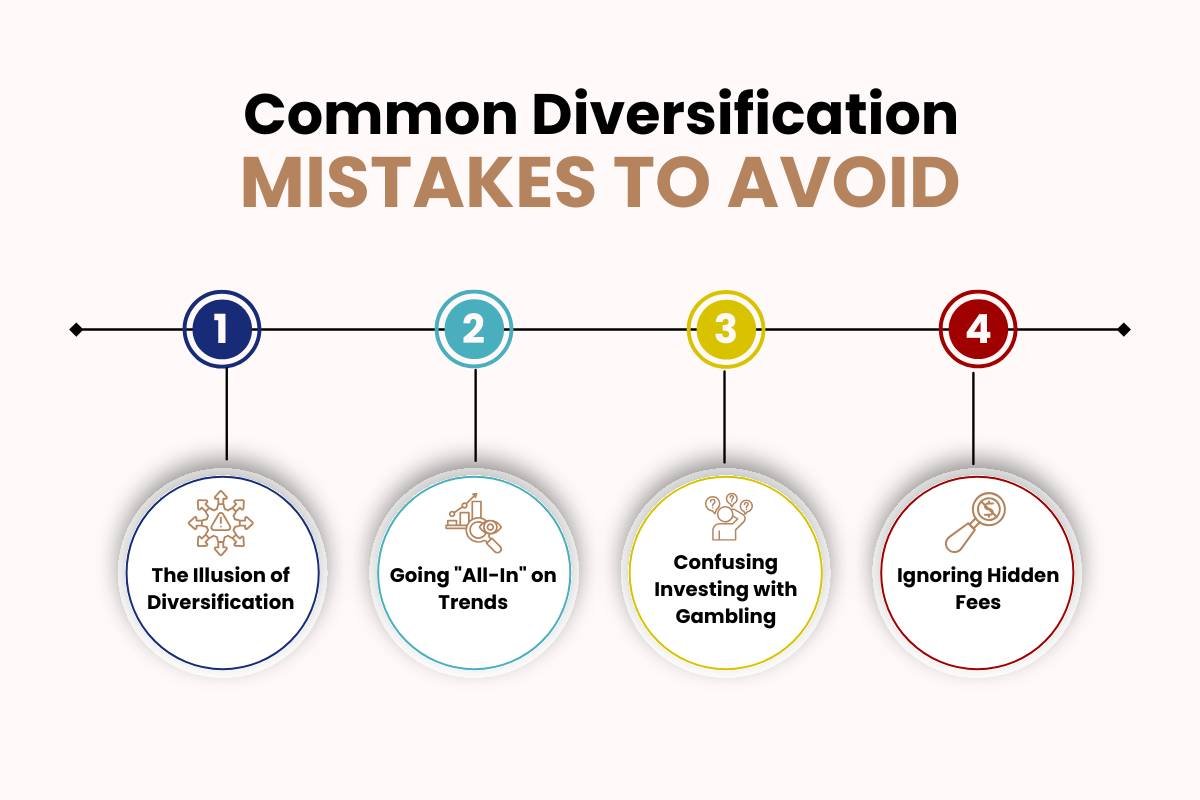
Even with a good plan, people make simple errors that secretly hurt their diversified investment portfolio. Here’s how to stay safe:
1. The Illusion of Diversification
- The Trap: Thinking you’re diversified because you own many funds, when in reality, they all hold the same major stocks (like owning 10 boxes, but all 10 are full of the same brand of cereal).
- The Solution: Use tools to check for overlap. True diversification means your assets move independently of each other.
2. Going “All-In” on Trends
- The Trap: Putting too much money (e.g., 30% or more) into one hot theme (like AI) or one country. When that trend reverses, your whole portfolio takes a massive hit.
- The Solution: Treat trends as small “satellite” bets (10-20% max) and make sure you allocate at least 20-30% of your stocks internationally to reduce home-country risk.
3. Confusing Investing with Gambling
- The Trap: Day trading, chasing tips, or using complex strategies. This is pure speculation, not the patient, long-term investing needed to build a successful portfolio.
- The Solution: Stick to your 10-year plan. Investing is slow, steady wealth building; speculation is fast, high-risk betting.
4. Ignoring Hidden Fees
- The Trap: Fees and taxes are silent killers. A 1.5% annual fund fee can destroy a huge chunk of your wealth over decades.
- The Solution: Demand low costs. Aim for fees (expense ratios) under 0.20% for your core holdings and use tax-efficient funds (like Index ETFs) to protect your long-term returns.
By avoiding these pitfalls, you give your diversified investment portfolio the best chance to succeed over time.
Final Takeaways
Building a diversified investment portfolio isn’t about being a market genius or picking the next winning stock. It’s about combining common sense with strong discipline. The successful long-term investor focuses on five simple things: knowing their goals, making a balanced plan that matches their risk tolerance, choosing low-cost funds, automating their contributions, and being patient. They understand that investing is a marathon – compounding steadily over decades is what truly creates lasting wealth, not jumping in and out of hot trends or panicking during a market correction.
A Quick, Important Note: Please remember that this guide is for educational purposes only. It is not personalized financial, investment, or tax advice. Your unique situation—including your income, goals, and tax rules—is different from everyone else’s. Before you make any significant investment decisions, you must talk to a qualified financial advisor or tax professional who can give you advice tailored specifically to your complete financial picture. All investments carry risk, including the possibility of losing money.
Sources –
- https://corporatefinanceinstitute.com/resources/career-map/sell-side/capital-markets/investment-portfolio/
- https://investor.vanguard.com/investor-resources-education/portfolio-management/diversifying-your-portfolio
- https://www.home.saxo/en-sg/learn/guides/diversification/how-to-build-a-diversified-portfolio-in-5-1-easy-steps