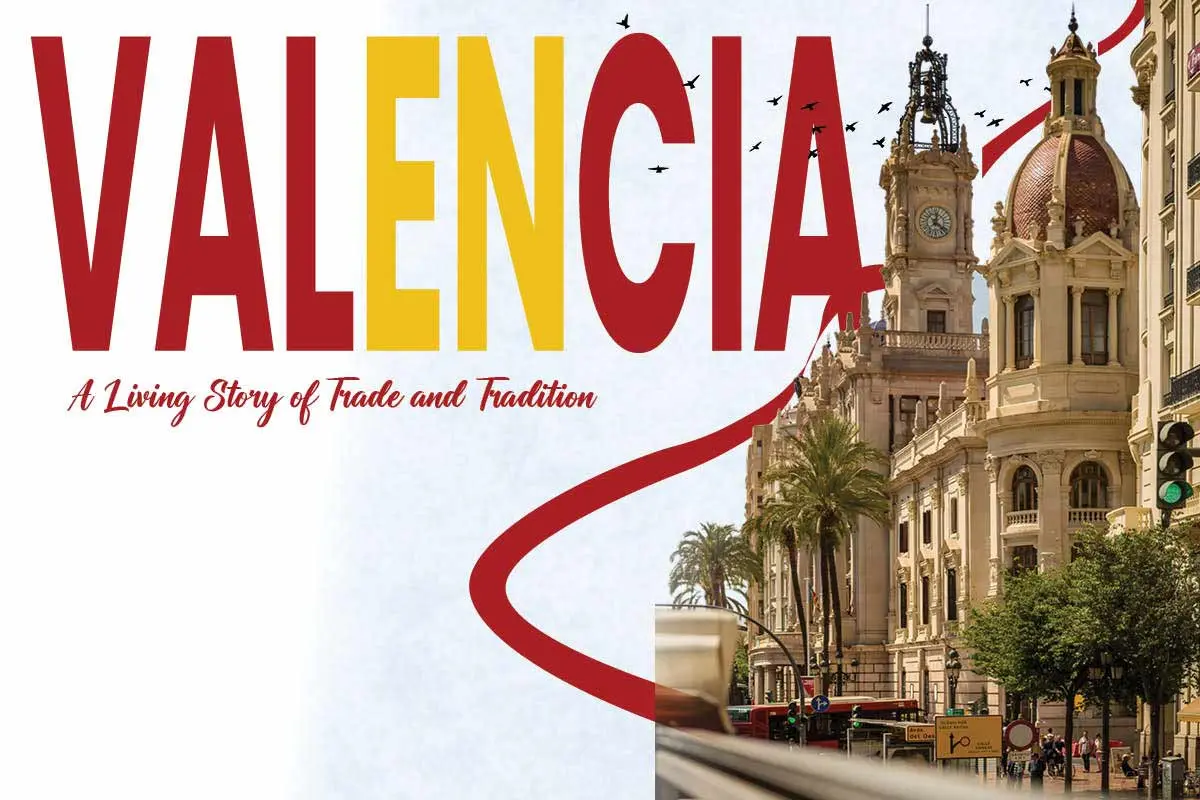
Early morning light spills over Valencia’s tiled rooftops as market shutters rise and trams hum past weathered facades. The city faces the Mediterranean on Spain’s eastern coast and serves as the capital of the Valencian Community, with a population of about 825,948 based on recent INE data. It stands as Spain’s third-largest city, reflecting its national importance. Its cultural significance is further recognised through UNESCO listings that highlight its historical and civic heritage.
Its port ranks among the busiest in the Mediterranean by container traffic. Valencia carries a trading legacy shaped by silk, ceramics, and maritime exchange. Today, it holds a key place in Spain’s economy, with tourism activity, citrus exports, expanding logistics networks, and a growing technology sector contributing to national GDP.
Layers of time and tradition

Valencia was established as the Roman colony Valentia Edetanorum in 138 BCE. It later prospered under Moorish rule, which shaped its urban form and agricultural systems. The city was reconquered by James I of Aragon in 1238, marking a shift toward Christian governance and new architectural influences.
During the late medieval period, Valencia gained prominence through the silk trade. La Lonja de la Seda stands as a lasting symbol of this era, where merchants once negotiated deals that linked the city with wider European markets.
Cultural traditions continue to reflect this layered past. The Fallas Festival transforms the city each year with towering sculptures, crafted with detail and humour, before they are set alight in public gatherings.
Food culture remains central to daily life. Paella, rooted in local rice fields and fresh produce, reflects the connection between agriculture and cuisine. These historical and cultural elements continue to shape Valencia’s identity and public life today.
Global heritage footprint
Valencia holds recognition on UNESCO’s global lists due to its cultural and historical significance. La Lonja de la Seda was inscribed as a World Heritage Site in 1996, highlighting its importance within the city’s commercial history.
Constructed during the late fifteenth century, the structure stands as a key example of late Gothic civic architecture, noted for its scale and detailed design. Its grand hall reflects the organized nature of trade during that period.
UNESCO recognition is based on what it defines as exceptional universal value. In this case, emphasis lies on architectural quality and Valencia’s role within wider trade networks.
Additional recognition extends to the Water Tribunal of Valencia and the Fallas Festival under cultural heritage listings. These elements reinforce Valencia’s presence within global cultural heritage frameworks.
Pulse of the economy

Valencia’s economy rests on a mix of trade, industry, agriculture, and services, each contributing to steady economic activity across the region.
Trade and port activity:
Valencia contributes significantly to Spain’s economic output through a diversified base. The Port of Valencia ranks among the busiest in the Mediterranean and handles a large share of Spain’s container traffic. It acts as a key gateway for exports such as ceramics, textiles, and agricultural goods.
Industrial production:
Industry remains central to the regional economy. Manufacturing clusters include automotive production, food processing, and chemical industries. Logistics and supply chain firms operate at scale due to strong port connectivity.
Agricultural output:
Agriculture adds another layer to economic activity. The surrounding region produces citrus fruits, especially oranges, which are closely tied to Valencia’s identity. This sector supports domestic consumption and export markets.
Tourism and services:
Tourism plays a growing role in economic activity. Visitors are drawn to architecture, cuisine, and festivals. Spending in hospitality, retail, and transport contributes directly to local income generation.
Growth and investment trends:
Recent outlooks suggest stable growth in the Valencian Community. Public investment in infrastructure and urban projects supports business activity. Innovation hubs and startup ecosystems are gaining attention, particularly in digital services and green energy.
Overall economic contribution:
These sectors create a balanced economic system. Valencia remains a key contributor to Spain’s GDP through trade, production, and services. Port traffic exceeds five million TEUs annually, while the region accounts for about 10% of national industrial output. Small and medium enterprises support employment across sectors, ensuring steady economic activity.
This combination of sectors sustains Valencia’s position as a stable and significant contributor to Spain’s overall economic output.
Engines behind regional Output
The Valencian Community ranks among Spain’s largest regional economies, with Valencia city acting as a central node for production and services. Its economic contribution reflects a mix of export activity, industrial output, and service-based income.
Exports form a major pillar of regional GDP. Goods pass through the Port of Valencia toward global markets, supporting Spain’s external trade performance. Products such as ceramics, machinery, and agricultural goods contribute to export value.
The service sector provides consistent revenue across the region. Tourism, finance, and urban commerce generate steady income through visitor spending and local demand. Hospitality, retail, and transport sectors benefit from this flow of activity.
Manufacturing supports economic continuity through regular output. Industrial zones around the city maintain supply chains and employ across multiple sectors, including automotive and food production.
Economic outlooks indicate moderate growth supported by consumption and investment. Infrastructure upgrades improve efficiency and attract business interest in logistics and technology.
Valencia’s GDP contribution rests on sectoral balance. This structure supports resilience during economic shifts while maintaining its role within Spain’s broader economy.
Don’t miss: Córdoba: The Jewel of Southern Spain
Experiences across the city

Valencia presents a mix of historic depth and contemporary design, offering experiences that reflect its character.
- The City of Arts and Sciences captures attention with its striking structure and interactive exhibits. It represents the city’s modern outlook and interest in science and culture.
- The Valencia Cathedral stands in the old town and reflects layers of architectural history. Its presence continues to shape the city’s cultural and religious life.
- The Turia Gardens stretches across the city, offering open green space for walking, cycling, and daily recreation. It forms a central part of urban life.
- Along the coast, Malvarrosa Beach provides a relaxed setting by the Mediterranean, where visitors and residents gather.
Each location reveals a distinct side of Valencia, linking heritage, environment, and everyday experience.
Essence of local life

Valencia’s identity is reflected through everyday traditions, food, and shared cultural practices.
| Element | Key Feature | Cultural Significance |
| Cuisine | Paella | Reflects local agriculture and traditional cooking methods |
| Festivals | Fallas Festival | Brings community gatherings and supports local commerce |
| Craft Traditions | Ceramics and silk | Represents historic trade links and artistic heritage |
| Markets | Central Market of Valencia | Highlights fresh produce and daily food culture |
Culture in Valencia is visible in ordinary moments across the city.
Conclusion
Valencia holds a distinct place where history meets everyday life in a natural rhythm. Ancient roots, cultural traditions, and recognised heritage shape its identity, while steady economic activity supports its role within Spain. Streets, markets, and public spaces reflect this connection in visible ways. The city offers a sense of continuity through time, where past influences remain present in daily routines. Valencia stands as a place defined by character, shaped through experience, and sustained by its people and environment.
Thanks for reading
see next
“What Makes Cales de Mallorca A Perfect Getaway Destination?“