The Zara Success Story, from a single Spanish store to one of the world’s most recognisable fashion brands, is a story of customer responsiveness, operational agility and supply-chain innovation.
Rather than depending entirely on long-range forecasts, Zara developed a model that allows it to monitor demand, adjust its product offering and move merchandise through its stores and digital channels quickly. That approach has made speed an important part of its competitive advantage, but speed alone does not explain Zara’s success.
The more important factor is how the company connects customer information, design, production, inventory management, logistics, stores, and technology.
Today, Zara is also evolving beyond the traditional fast-fashion model. RFID-enabled inventory management, automated logistics, artificial intelligence, and Zara Pre-Owned are becoming increasingly important as the brand responds to changing consumer expectations and the industry’s sustainability challenges.
The Evolution of Zara
Zara opened its first store in A Coruña, Galicia, Spain, in 1975. The business was founded by Amancio Ortega, who had already gained experience in textile manufacturing before launching the retail concept. This marked the beginning of the Zara success story, which would eventually evolve into a global fashion phenomenon.
Zara’s early proposition centred on bringing fashionable clothing to customers at accessible prices. Its expansion across Spain was followed by international growth, eventually turning the brand into the flagship concept of the Inditex Group.
Inditex was established in 1985 as the holding company, providing the organisational structure for a more integrated fashion business spanning design, sourcing, manufacturing, logistics, distribution and retail.
Over the following decades, Zara expanded across Europe, the Americas, Asia and other international markets. Its growth was supported not only by opening stores but by developing an operating model designed around continuous product renewal and customer responsiveness.
Inditex has historically described its business model as flexible, integrated and customer-oriented. Its stores and online platforms generate information about customer demand, while its supply chain is designed to respond to changing commercial decisions.
Inditex’s Scale in 2025
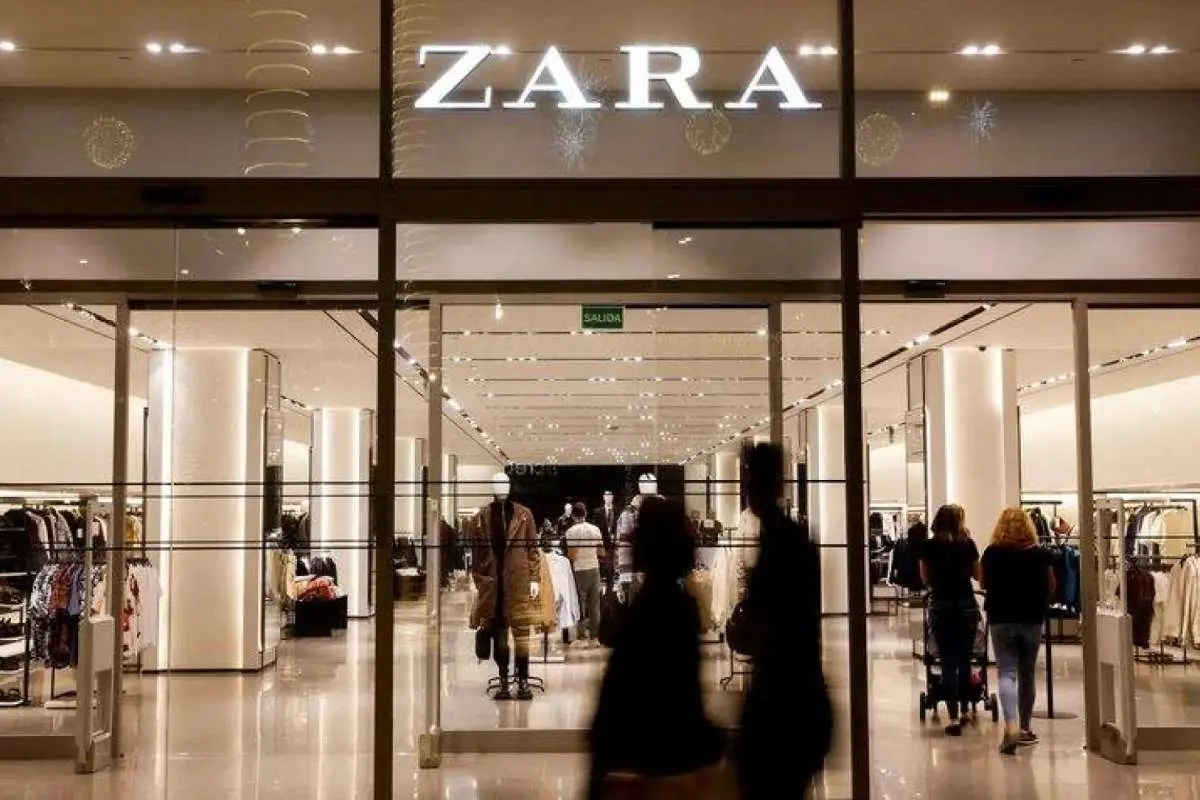
Zara is part of the wider Inditex Group, which also operates brands including Pull&Bear, Massimo Dutti, Bershka, Stradivarius, Oysho, Zara Home and Lefties.
The group’s latest reported figures show how far the business has grown since Zara’s first store opened, adding significant scale to the Zara success story.
In fiscal 2025, Inditex generated €39.9 billion in revenue, up 3.2% year over year. Net profit reached €6.2 billion. At the close of the fiscal year, the group operated 5,460 stores across 97 markets, while employing more than 163,000 people.
The store figure is particularly revealing. Inditex’s strategy is no longer simply about opening as many stores as possible. The group reported that sales had increased 22% over three years while its number of stores had declined by 6%, with net retail space increasing by 6%. This reflects a broader focus on larger, more productive stores, digital integration and retail optimisation.
The numbers therefore tell a larger story: Zara’s competitive advantage increasingly depends on quality of operations rather than sheer physical expansion.
What Makes Zara’s Brand Strategy Different?
Zara’s success is often summarised as “fast fashion.” However, that description only captures one part of the business model.
Its competitive advantage is built around several interconnected capabilities.
1. Customer-Led Fashion
One of the defining characteristics of the Zara success story is its focus on listening to customers.
Traditional fashion retailers often have to make significant decisions months before products reach consumers. Zara developed a more responsive approach in which information from stores, sales activity, and customer interactions can help inform product and commercial decisions.
Inditex has historically described customer contact as an important source of information for its brands. Store information can be communicated to design and commercial teams, helping the business update collections and respond to demand.
This does not mean customers literally design Zara’s clothes. Instead, customer behaviour becomes a source of real-time market intelligence.
The process can be simplified as:
Customer signals → demand analysis → design and commercial decisions → targeted production → distribution → customer response.
The feedback loop allows Zara to make decisions closer to actual demand rather than relying entirely on predictions made far in advance.
2. Speed as a Competitive Advantage
Speed is one of Zara’s most recognisable characteristics.
But the strategic advantage is not simply producing clothing quickly. It is about shortening the time between identifying a demand signal and responding to it.
Inditex’s historical reporting describes a model based on continuous product renewal, frequent store deliveries, and daily information from stores.
This creates a fundamental difference from a traditional seasonal retail system.
A simplified version looks like this:
Traditional approach:
Forecast demand → commit to production → wait for manufacturing → distribute → sell
Zara’s agile approach:
Observe demand → interpret signals → produce selectively → distribute quickly → monitor response → adjust
The second approach does not eliminate forecasting. Instead, it reduces the business’s dependence on forecasting alone.
That distinction is critical in an industry where consumer preferences can change quickly.
3. RFID Gives Zara Greater Inventory Visibility
Technology is one of the less visible but highly important components of the Zara success story.
Inditex introduced radio-frequency identification (RFID) technology across Zara to identify individual garments and improve inventory management. RFID allows each tagged item to be identified using radio-frequency signals, making it easier for store teams to know what merchandise is available and where it is located.
The technology has become an important part of Zara’s inventory infrastructure.
Instead of relying solely on manual stock checks, RFID can help employees locate products across different areas of a store and improve the accuracy and speed of inventory processes.
Inditex’s reporting also describes RFID alongside its Integrated Stock Management System (SINT), which helps merge inventory management across its brands and allows staff to locate items regardless of where they are held.
How RFID Can Help Reduce Dead Stock: RFID does not magically eliminate unsold inventory. Its value comes from better visibility and faster decision-making.
The process can work like this:
RFID tag → item-level visibility → more accurate stock information → faster identification of slow-moving or misplaced products → better replenishment and redistribution decisions → lower risk of unnecessary inventory accumulation
For example, if a particular item is selling quickly in one location but moving slowly in another, better inventory visibility can help the business identify the imbalance and make more informed allocation or replenishment decisions.
That is particularly important for fashion because inventory loses value when it remains relevant for a shorter period.
The objective is therefore not simply to “track clothes.” It is to make inventory more visible, more accessible, and more actionable.
4. AI and Automated Logistics Are Taking Agility Further
Zara’s next stage of operational evolution is an important part of the Zara success story, combining its established supply-chain infrastructure with automation, data and artificial intelligence.
Inditex has continued investing in logistics infrastructure and technological capabilities. Its 2025 annual report highlights ongoing investment in logistics and technology, while the group’s leadership has also pointed to artificial intelligence as an increasingly important factor in logistics and retail operations.
The company has also invested heavily in automated logistics. In 2026, Inditex leadership highlighted an investment programme of around €1.8 billion in automation, alongside the increasing use of AI in logistics.
The strategic purpose is broader than simply reducing manual work.
How Automation and AI Support Inventory Efficiency
An increasingly automated supply chain can help coordinate:
- Demand signals
- Inventory availability
- Warehouse operations
- Product sorting
- Order fulfilment
- Store replenishment
- Online orders
- Distribution decisions
When combined with RFID and integrated inventory systems, these technologies can provide a more complete picture of what products exist, where they are, and where demand is emerging.
That can help reduce the risk of dead stock by enabling faster and more informed decisions about allocation, replenishment and fulfilment.
However, it is important not to overstate the technology. Publicly available evidence supports Inditex’s investment in AI, automation, RFID and logistics technology, but it does not establish that AI alone eliminates Zara’s dead stock.
A better description is that AI and automation strengthen the infrastructure that allows Zara to manage inventory more intelligently and respond more efficiently to demand.
Traditional Retail Model vs Zara Agile Supply Chain
The difference between Zara and a traditional fashion retail model becomes clearer when the two approaches are placed side by side.
| Area | Traditional Retail Model | Zara’s Agile Supply Chain |
| Demand planning | Relies heavily on forecasts made months ahead | Combines forecasting with ongoing customer and sales signals |
| Product development | Often follows longer seasonal cycles | Designed around shorter and more responsive cycles |
| Production | Larger commitments can be made before demand is fully known | Uses selective production and the ability to adjust based on demand |
| Inventory visibility | May depend more heavily on conventional stock systems | RFID and integrated inventory systems provide item-level visibility |
| Logistics | Primarily moves products according to planned schedules | Designed to respond flexibly to commercial requirements |
| Store replenishment | Often driven by predetermined allocations | Can respond more dynamically to demand and inventory information |
| Unsold inventory risk | Greater exposure when forecasts are inaccurate | Smaller initial commitments and faster feedback can reduce exposure |
| Product refresh | Often tied closely to seasonal collections | Frequent assortment changes |
| Customer feedback | Can have a longer path into product decisions | Store and digital information can feed commercial decisions |
| Technology | Often supports individual parts of the retail process. | Increasingly integrated across inventory, stores, logistics and digital channels |
| Business objective | Predict demand accurately | Combine prediction with rapid response. |
The key difference is simple: Traditional retail tries to predict demand far in advance. Zara’s model tries to predict where necessary while also building the ability to respond when the prediction is wrong.
That flexibility is at the heart of Zara’s competitive advantage.
5. Smaller Production Runs Help Manage Inventory Risk
A key element of the Zara success story is its emphasis on controlling the quantity of selected products produced initially.
The logic is straightforward.
If a retailer produces a very large quantity of a product before knowing how customers will respond, a weak-performing style can create excess inventory and eventually require markdowns.
Smaller initial commitments can reduce that exposure.
When a product performs well, the business can respond to demand. When it performs poorly, the financial and inventory exposure may be more limited.
This creates a strategic balance:
Lower initial commitment → observe demand → increase supply where justified → limit exposure to weak products
Limited availability can also create a sense of urgency among shoppers. However, describing this as “fake scarcity” is misleading. It is better understood as a combination of inventory discipline and controlled product availability.
6. Frequent Product Refreshes Encourage Repeat Visits
Zara’s strategy also depends on continuously refreshing its assortment.
Inditex has historically described frequent deliveries and constant collection renewal as important parts of its model.
This creates a different customer psychology from traditional retail.
When consumers know that products change regularly, delaying a purchase can carry a risk: the product may not be available later.
That can encourage customers to visit stores and digital channels more frequently.
The strategy therefore creates a connection between:
Fresh assortment → customer curiosity → more visits → more opportunities to purchase → new customer data
The cycle then feeds back into the company’s broader customer-led model.
7. An Integrated Supply Chain Supports the Brand Promise
Zara’s brand strategy would be difficult to replicate without the operational infrastructure behind it.
The company operates across multiple stages of the value chain, including:
- Design
- Sourcing
- Manufacturing
- Inventory management
- Logistics
- Distribution
- Stores
- E-commerce
Inditex has described its logistics system as flexible enough to adapt to commercial decisions. Its reporting also notes the use of RFID and integrated stock management to connect inventory across its brands.
This integration is an important part of the Zara success story because speed in one part of the business is useless if another part creates delays.
Faster design decisions have limited value if production cannot adapt. Faster production has limited value if logistics cannot distribute products efficiently. And efficient logistics cannot solve the problem if the business does not know what customers want.
Zara’s advantage therefore comes from coordination across the entire system.
How Zara Is Rethinking Sustainable Fashion
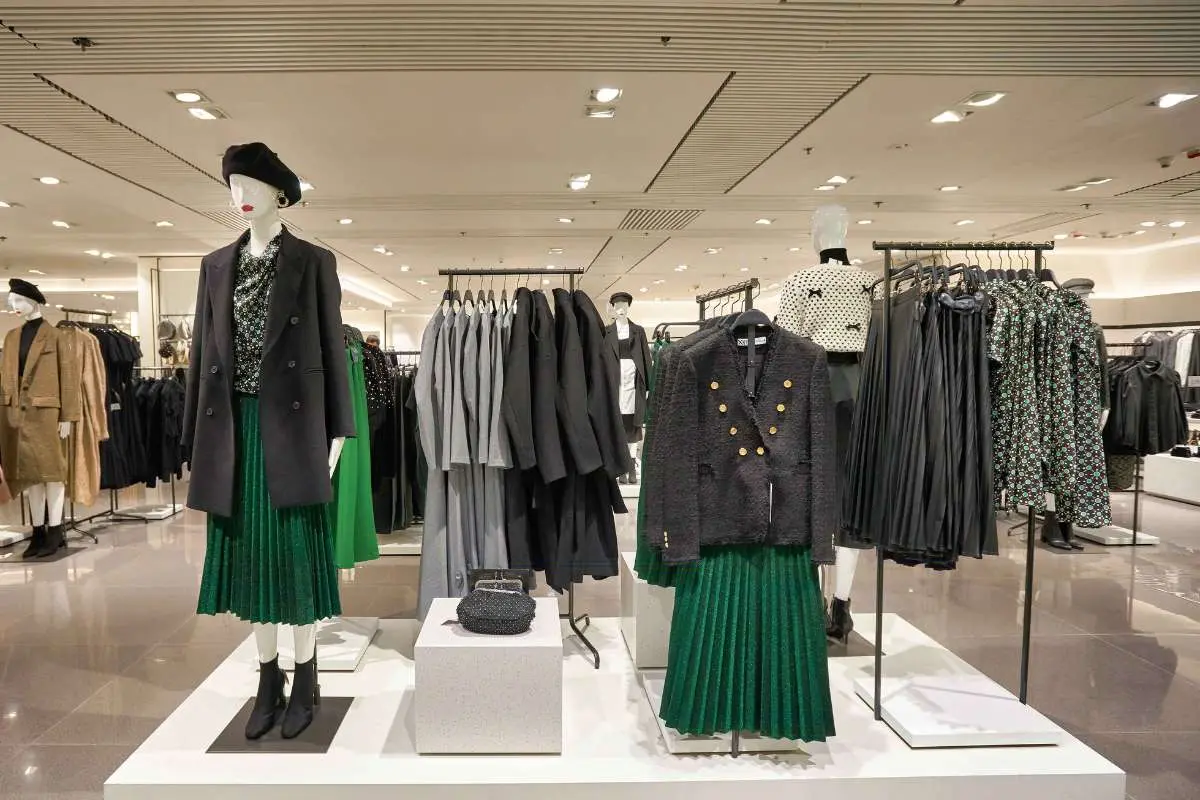
Zara’s traditional business model has also faced an increasingly important question: Can a high-frequency fashion model become more sustainable?
The answer is not straightforward.
Fast fashion has faced criticism over resource consumption, waste, emissions, and the environmental impact associated with producing and consuming clothing at high frequency. Zara and Inditex therefore face the challenge of improving the environmental performance of their operations without abandoning the responsiveness that has historically defined their model.
Inditex’s latest reporting shows that sustainability has become a significant part of its strategy.
In 2025:
- 88% of the fibres used in Inditex products qualified as lower-impact fibres
- 47% of fibres came from recycled materials
- Relative water consumption in the supply chain was reduced by 26% compared with 2020
- Emissions from the group’s own direct operations were reduced by 88%
- 98% of shipping operations used alternative fuels during the final 2025 campaign
These are Inditex-reported figures and should be viewed as part of the company’s stated sustainability progress rather than evidence that fast fashion has become inherently sustainable.
The bigger strategic shift is toward lower-impact materials, more efficient operations, circularity, and longer product use.
How Zara Pre-Owned Is Changing the Future of Fashion Resale
One of the clearest examples of the Zara success story evolving toward circularity is Zara Pre-Owned.
The platform allows customers to repair, resell, or donate used Zara garments, creating a mechanism for extending the useful life of products beyond their first owner. Zara currently lists its Pre-Owned services in India, while Inditex reported that its circularity services were operating in 17 markets at the end of 2025.
The initiative is strategically important because it moves Zara into the circular economy and recommerce space rather than focusing exclusively on the sale of new products.
The model can be visualised as:
New Zara product → customer ownership → repair / resale / donation → extended product life
This creates several potential benefits.
- Longer Product Lifecycles: Repair services can help customers continue using garments rather than replacing them immediately.
- Secondary-Market Participation: Resale gives existing Zara garments another route to reach consumers after their first ownership cycle.
- Customer Engagement: A branded resale and repair platform keeps customers connected to Zara beyond the original purchase.
- Circularity: Extending the life of existing garments can support the broader goal of reducing the need for entirely new products.
Zara launched its Pre-Owned service in the UK in 2022, initially allowing customers to repair, resell, or donate previously purchased garments.
The expansion of the platform shows that resale is no longer simply a niche sustainability experiment. It is becoming part of Zara’s broader relationship with customers and the product lifecycle.
At the same time, resale should not be presented as a complete solution to fashion’s environmental challenges. Extending garment life is useful, but the overall environmental impact of fashion also depends on how much is produced, how long products are used, what materials are used, and how garments are ultimately processed.
Zara’s Brand Value Extends Beyond Fast Fashion
Zara’s operational model has translated into significant global brand recognition, becoming a key part of the Zara success story.
Interbrand’s Best Global Brands 2025 ranking valued Zara at $19.4 billion, placing it 41st among the world’s most valuable brands.
The significance of Zara’s brand value is not simply its position in a ranking.
It demonstrates how operational capabilities can become part of a consumer-facing brand proposition.
Customers do not necessarily see Zara’s RFID systems, logistics infrastructure, or inventory algorithms. But they experience the consequences:
- New products arrive frequently
- Stores feel constantly refreshed
- Popular products can be replenished
- Online and physical channels work together
- Product availability can be checked more easily
- The shopping experience changes continuously
In other words, the supply chain becomes part of the customer experience.
The Challenges Facing Zara’s Model
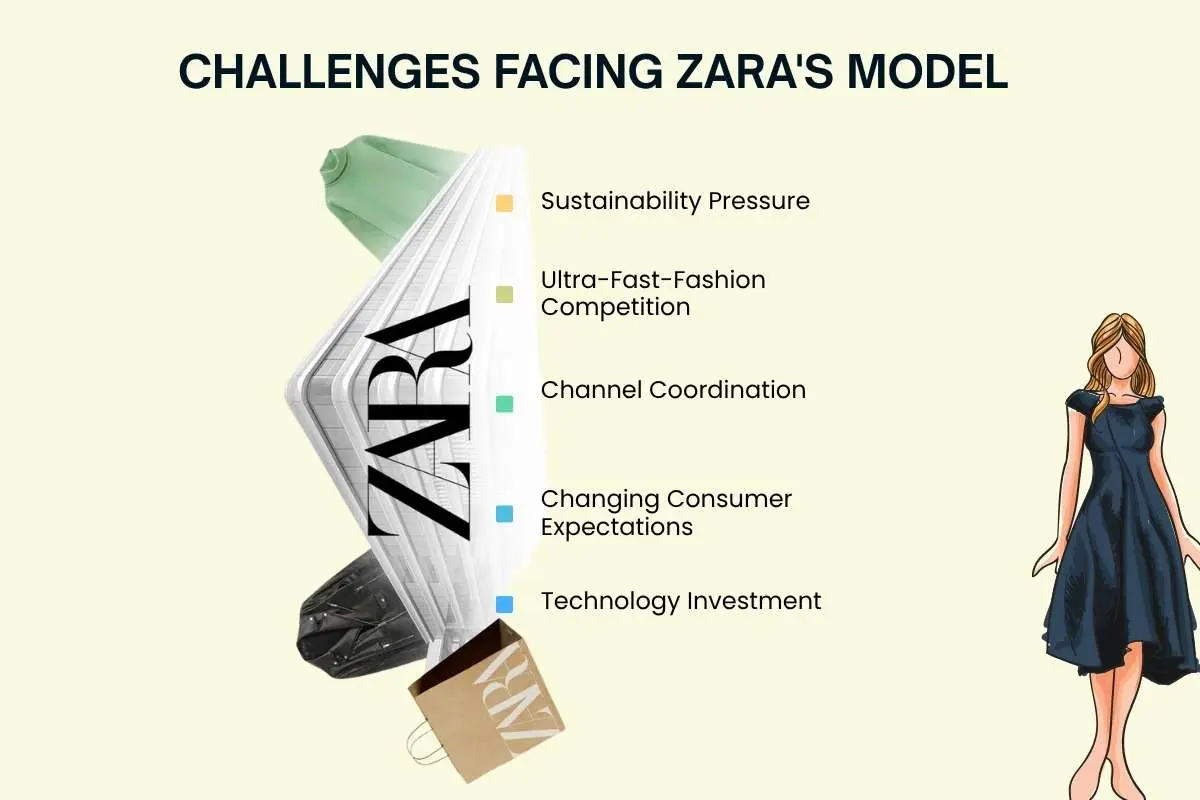
Zara’s strategy is powerful, but it is not without challenges.
- Sustainability Pressure: The fast-fashion model remains under scrutiny because of its relationship with high-frequency consumption and resource use.
- Ultra-Fast-Fashion Competition: Digital-first competitors have pushed speed and price competition even further, forcing Zara to differentiate through design, experience, quality, brand equity, and operational capabilities rather than speed alone.
- Supply-Chain Complexity: A globally integrated system requires substantial investment in technology, logistics, and infrastructure.
- Changing Consumer Expectations: Consumers increasingly expect brands to offer not only fashionable products but also transparency, durability, responsible sourcing, and circular options.
- Technology Investment: RFID, automation, AI, and digital retail systems can improve efficiency, but they require significant capital investment and sophisticated operational capabilities.
These challenges make Zara’s next stage particularly interesting.
Its future advantage may depend less on simply being faster than competitors and more on being smarter, more responsive, and more efficient.
What Businesses Can Learn From Zara’s Brand Strategy
Zara’s strategy offers lessons far beyond fashion retail.
- Listen Before You Build: Customer feedback should not simply be collected. It should influence product and business decisions.
- Make Speed a System: Being fast occasionally is not a sustainable advantage. Businesses should build processes that allow them to respond consistently.
- Use Data to Improve Inventory Decisions: Real-time inventory visibility can help businesses identify demand patterns, allocate products more effectively, and reduce unnecessary stock.
- Test Before Scaling: Smaller initial commitments can allow businesses to evaluate demand before making larger investments.
- Connect Technology With Operations: Technology creates the greatest value when it connects different parts of the business rather than operating as an isolated tool.
Conclusion:
Zara’s competitive advantage does not come from speed alone.
Its real strength lies in connecting customer intelligence, agile production, RFID-enabled inventory visibility, automated logistics, AI, frequent product refreshes, and an increasingly circular customer journey into one interconnected business model.
From a single store in Spain in 1975 to a global fashion brand operating within an Inditex group that generated €39.9 billion in revenue in 2025, the Zara success story demonstrates how operational capabilities can become a core component of brand strategy.
The next phase of Zara’s evolution is already underway. RFID and integrated inventory systems are improving visibility. Automation and AI are reshaping logistics. Digital platforms are connecting customers with products in new ways. And Zara Pre-Owned is extending the brand’s relationship with garments beyond their first sale.
The central lesson is therefore bigger than fast fashion.
A powerful brand is not built only through advertising, design, or visual identity. It is built when the entire organisation can understand what customers value, respond quickly, and deliver that value efficiently while adapting to the environmental and social expectations shaping the next generation of consumers.
FAQs:
1. What is Zara’s brand strategy?
Zara’s brand strategy combines customer insight, agile supply chains, rapid product cycles, technology-driven inventory management, and frequent assortment changes.
2. How does Zara use RFID?
RFID enables individual garments to be identified and tracked, improving inventory visibility and helping store teams locate products more efficiently.
3. Does Zara use AI in its supply chain?
The Zara success story is increasingly being shaped by Inditex’s investment in AI and automated logistics to improve operational efficiency and strengthen its supply chain. The company has also highlighted significant investment in logistics automation.
4. How does Zara reduce inventory risk?
Zara combines customer and sales information, smaller production commitments, frequent replenishment, RFID-enabled inventory visibility, and an integrated supply chain to respond more closely to demand.
5. What is Zara Pre-Owned?
Zara Pre-Owned is a circularity platform that allows customers in participating markets to repair, resell, or donate used Zara garments.