Why is cybersecurity for manufacturing important today? Learn how modern factories face new threats due to increased connectivity.
Cybersecurity for manufacturing refers to the systems, processes, and practices used to protect connected production environments from digital threats that can disrupt operations. This article explains why manufacturing is a key target for cyberattacks and how to respond to cyber incidents while maintaining operational continuity.
A single production line rarely fails because of a broken machine anymore. More often, it starts with something far less visible.
A delayed system update.
A connected device that was never secured properly.
A network entry point no one thought much about at the time.
In modern factories, every machine is part of a larger digital web that keeps production moving. The same connectivity that improves speed and precision also opens new doors for disruption. That is where cybersecurity for manufacturing becomes critical, not as a background safeguard, but as a core layer that protects operations from silent threats that can halt everything without warning.
Cybersecurity for manufacturing: why does it matter?
According to IBM’s X-Force Threat Intelligence Index, manufacturing remains the most targeted industry for cyberattacks.
Manufacturing runs on connected systems. Machines, software, and control units work together. Networks keep everything in sync. This setup improves speed, but it also creates more entry points for attackers.
Attackers target manufacturing for one reason. Disruption causes immediate damage. A single shutdown can stop production for hours. Losses build fast, and supply chains feel the impact at once. Factories often rely on older systems. Many of them were never built for cyber threats. They miss updates and lack strong controls. Attackers scan for these weak spots and use them to get inside.
Smart factories have expanded risk further. IoT devices, cloud systems, and industrial controls now connect operations. Each connection adds a new exposure point. One weak link can affect the entire system. Take, for example, when Jaguar Land Rover faced a cyber incident that disrupted parts of its manufacturing operations in 2025. It showed how a single weakness can slow production at scale.
Cyberattacks here do more than steal data. Attackers can stop machines or change settings. They can even damage physical equipment. This creates safety risks and financial loss at the same time.
1. Ransomware Attacks: Attackers lock systems and block access. Production stops almost instantly. Companies face pressure to pay due to rising downtime costs.
2. Phishing Attacks: Fake emails trick employees into clicking links. One click can expose login details. Attackers then move deeper into the system.
3. Supply Chain Attacks: Attackers target vendors and partners first. They use trusted links to enter the main network. This makes the attack harder to detect.
4. Industrial Espionage: Sensitive data like designs and formulas are stolen. Competitors or state actors may use it. This weakens long-term business growth.
5. Insider Threats: Employees or contractors misuse access rights. Some act with intent, others make mistakes. Even small actions can expose key systems.
6. Unpatched Vulnerabilities: Outdated software creates clear gaps. Attackers scan for these openings constantly. They act fast before fixes are applied.
7. IoT and OT Vulnerabilities: Many connected devices lack strong security. Industrial systems were not built for open networks. Attackers exploit these weak points to gain control.
8. Denial of Service Attacks: Attackers flood systems with traffic. This slows operations or shuts them down. Production delays follow quickly.
9. Weak Access Controls: Poor passwords and excess permissions create risk. Attackers use stolen credentials to move across systems. This can expose multiple layers of the network.
Cybersecurity for manufacturing: a simple framework

Manufacturing environments need a clear structure for security. Random tools and scattered controls do not work. A strong framework connects systems, people, and processes under one plan. It helps teams act fast and stay consistent.
This framework focuses on five core layers. Each layer builds on the next. Together, they create a system that can prevent, detect, and respond to threats.
Manufacturing environments need structure, not scattered controls. A clear framework of cybersecurity for manufacturing connects systems, people, and processes under one plan. It helps teams act fast and reduce gaps.
This framework uses five layers. Each layer solves a specific problem. Together, they create a system that can prevent, detect, and respond to threats.
1. Asset visibility and risk mapping
You cannot protect unknown systems. Many factories still lack full visibility across IT, OT, and connected devices. This creates gaps that attackers use.
Start by building a complete asset inventory. Map machines, control systems, software, and all connections. Track how data moves across systems and identify which assets impact production. Once visibility improves, rank assets by risk. Focus first on systems that can stop production or expose sensitive data. This keeps efforts aligned with business impact.
2. Network segmentation and access control
Flat networks allow attackers to move freely. One breach can spread across the entire system. Segmentation limits this movement.
Separate IT and OT environments. Isolate critical systems from general networks. Control how data flows between segments using strict rules. Access control strengthens this layer. Give users only the access they need. Limit admin rights and review permissions often. Strong authentication adds another barrier for attackers.
3. Continuous monitoring and threat detection
Prevention alone is not enough. Teams need real-time visibility to catch threats early. Monitor network traffic, user activity, and system behavior. Detect unusual patterns such as unknown logins or abnormal data flow. Use alerts to flag risks as they appear.
Automation improves speed here. Security tools scan large data sets and highlight threats quickly. This allows faster response and reduces damage.
4. Patch management and system hardening
Unpatched systems create easy entry points. Attackers often target known weaknesses first. A good framework of cybersecurity for manufacturing has a regular patch schedule. Update systems on time and test changes before rollout. Fix critical issues first to reduce immediate risk.
Harden systems to reduce exposure. Remove unused services, close open ports, and replace default credentials. Keep configurations tight and controlled.
5. Backup, recovery, and resilience planning
No system stays safe all the time. Cybersecurity for manufacturing also relies on recovery planning and ensures that operations continue during an attack. Maintain regular backups of critical data. Store them in secure and isolated locations. Test recovery steps to avoid delays during real incidents.
Build resilience beyond backups. Prepare teams for manual operations if needed. Clear response plans help reduce downtime and confusion.
How does this framework work?
Each layer supports the next. Visibility guides control. Segmentation limits spread. Monitoring detects threats early. Patching reduces risk, and recovery ensures continuity.
This structure makes cybersecurity for manufacturing easier to manage and scale.
What is the role of employee awareness in cybersecurity for manufacturing?
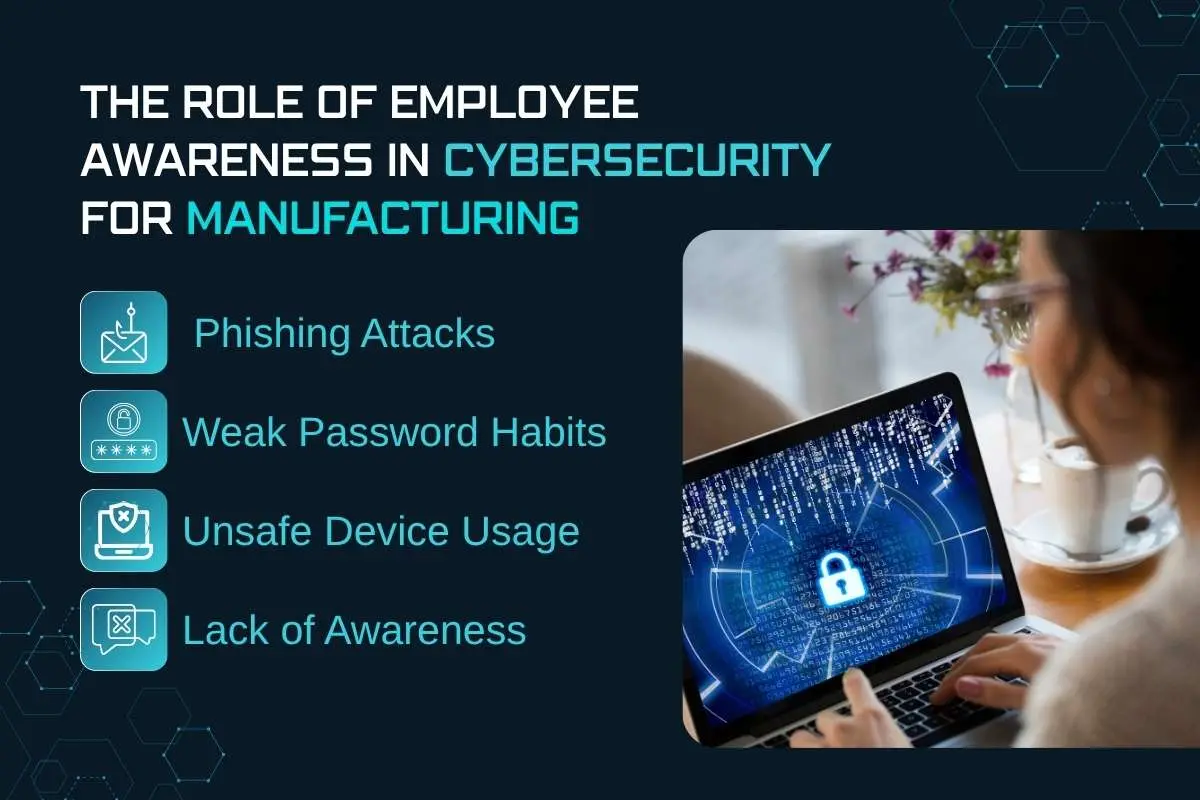
Technology alone cannot secure a factory. Employees interact with systems every day. So, one wrong action can expose the entire network. Most cybeattacks begin with human error, such as phishing clicks, weak passwords, or unsafe device use. Attackers rely on this behavior because it is easier than breaking secure systems.
Where do employees create risks?
Employees work across systems, machines, and networks. This gives them access, but it also creates exposure.
1. Phishing Attacks: Employees often receive emails that appear real but contain hidden threats. A single click on a malicious link can expose login credentials or install malware inside the system.
2. Weak Password Habits: Many users reuse passwords or choose simple ones. Attackers can guess or steal these credentials, which allows quick and easy access to critical systems.
3. Unsafe Device Usage: Connecting unknown USB drives or using unsecured networks can introduce malware. These actions may seem small, but they can affect entire production systems.
4. Lack of Awareness: Most risks come from limited knowledge, not intent. Without proper training, employees may fail to recognize threats or respond in time.
Conclusion:
Today, using cybersecurity for manufacturing has become a reliable and solid way of running operations every day. When protection is built into systems from the start, production becomes more stable, downtime is reduced, and there are no interruptions while making decisions.
The shift is subtle but powerful. Instead of constantly fixing issues, teams focus on maintaining flow. That consistency is what keeps output steady and businesses competitive in an environment where even a short disruption can have a lasting impact.
FAQs
1. Why is cybersecurity for manufacturing critical today?
It is crucial because connected systems increase exposure to risks that can disrupt operations.
2. What are the most common threats faced by manufacturers?
Phishing attacks, ransomware, and unsecured connected devices.
3. How can manufacturers improve their security posture?
By securing networks, training employees, and regularly updating systems.