A hospital in Houston cut after-hours clinician work by 33% after rolling out ambient AI documentation across its ambulatory and inpatient network. The AI didn’t do anything extraordinary. It simply reduced the amount of time doctors spent typing the same information twice.
Such results came from a vendor that understood how clinical documentation works inside Epic (which fields matter, which workflows break under pressure, and where HIPAA controls need to sit in the stack). In cases like this, the model’s only part of the story.
However, right now, many firms pitch “custom AI healthcare development.” Some have spent years building inside real clinical environments. Others updated their messaging recently and now sound similar on paper.
This list’s meant to separate these two groups. The best custom AI healthcare development companies in this article have verifiable Clutch ratings, active compliance coverage, and at least one documented clinical outcome from a real production deployment.
The best custom AI healthcare development companies in this list
- Relevant Software (FHIR-native GenAI, 30% charting reduction).
- ScienceSoft (regulated AI, SaMD, 18 years in healthcare IT).
- TATEEDA Global (agentic AI for legacy clinical systems).
- Diceus (EHR/EMR and hospital management).
- BotsCrew (generative AI for patient communication).
- Arkenea (healthcare-exclusive EHR builds).
- Glorium Technologies (ISO 13485 medical device software).
Why the vendor choice matters more than the model?
By late 2025, 63% of U.S. physicians said they were using AI tools in practice, up from 47% just 9 months earlier. At that point, the question wasn’t whether AI belonged in clinical workflows anymore. It did. The harder part now is whether the vendor building the system has addressed what happens after launch: when prior authorizations stall, an EHR integration fails mid-shift, or a compliance review finds a weak point in how patient data moves through the stack.
That’s where many vendors fall short. They can show polished demos, strong model outputs, and broad AI claims. Some have even shipped healthcare pilots. But it’s not the same as production, and in healthcare, that gap doesn’t stay hidden for long.
The vendors worth shortlisting in 2026 are the ones that can speak in specifics. They can explain which EHR standards they used, what broke during integration, how they handled PHI across cloud services, and what changed once real users started relying on the system. That usually means they’ve done it before.
How we evaluated the best custom AI healthcare development companies for this list?
Clutch rating and review volume were the starting point, not the whole decision. A 4.9 from three clients means something very different from a 4.9 from thirty-one. We looked at both the score and the evidence supporting it.
Next, we checked compliance posture based on verified credentials. HIPAA readiness and BAA execution were treated as baseline. Certifications like ISO 27001 and ISO 13485 helped narrow the list further, especially for companies working on medical software and regulated healthcare systems.
We also looked for documented clinical outcomes. This meant specific numbers tied to real deployments, such as reduced charting time, lower readmission rates, or faster prior authorization processing. Companies that could only offer general testimonials or talk about communication quality didn’t make the cut.
Finally, we checked the EHR integration track record. “We support FHIR” was not enough. We looked for evidence of which EHR systems the vendor had integrated with, which API versions they used, which health systems they worked with, and what the integration required in practice.
Top 7 custom AI healthcare development companies at a glance
Each company below covers a different part of the clinical AI stack. Relevant Software and TATEEDA Global focus on AI built into existing EHR environments. ScienceSoft and Glorium Technologies are better fits for regulated AI projects that include FDA or medical device requirements. BotsCrew focuses on patient-facing AI. Arkenea works only in healthcare. Diceus is a strong option for larger multi-site organizations that need EHR or hospital management systems rebuilt from the ground up.
The table below compares each vendor by their specialization, compliance, perfect fit, and average hourly rate:
| Company | Core AI expertise | Best for | Regulatory and compliance | Avg. hourly rate |
| Relevant Software | FHIR-native GenAI, EHR integration, clinical workflow AI, GenAI documentation | Health systems and Fortune 500 healthcare orgs needing production-ready clinical AI | HIPAA, GDPR, ISO 27001, BAA | $50–$99/hr |
| ScienceSoft | Predictive modeling, SaMD, ML diagnostics, clinical data analytics | Enterprise healthcare with FDA or CE submission requirements | HIPAA, HITECH, GDPR, FDA, ISO 13485, ISO 27001 | $50–$99/hr |
| TATEEDA Global | PEV multi-agent AI, prior auth automation, care coordination, legacy system AI | Health systems adding AI to existing EHR infrastructure without full rebuilds | HIPAA, PHI protection | $50–$99/hr |
| Diceus | EHR/EMR systems, hospital management platforms, enterprise AI integration | Multi-site health networks across EU and North America replacing legacy clinical platforms | HIPAA, GDPR | $25–$49/hr |
| BotsCrew | Conversational GenAI, LLM agents, patient triage and scheduling automation | Providers automating patient-facing workflows across 30+ production deployments | HIPAA-compliant conversational agents | $50–$99/hr |
| Arkenea | Custom medical software, EHR/EMR AI, predictive analytics, generative AI workflows | Regulatory-heavy healthtech startups and ambulatory clinics | HIPAA, HITRUST, FDA, IEC 62304 | $50–$99/hr |
| Glorium Technologies | Medical device software, CogniAgent AI platform, real-time clinical monitoring | MedTech companies and health systems with medical device compliance requirements | ISO 13485, ISO 27001, ISO 9001, HIPAA, GDPR, FDA | $50–$99/hr |
1. Relevant Software: FHIR-Native GenAI with documented clinical outcomes
Relevant Software is one of the best custom AI healthcare development companies for organizations that need clinical AI built directly into live EHR environments. With delivery hubs in Poland and Spain, the firm works with hospitals, care networks, and healthtech startups across the U.S. It holds a 4.9/5 Clutch rating based on 31 verified reviews, a 92% senior engineer ratio, 96% employee retention, and a reported 98% customer satisfaction score. Clients include AstraZeneca and Fortune 500 health systems.
Verified results from Clutch reviews include a 40% increase in user engagement within three months for one U.S. client and a 25% year-over-year net profit improvement for another. In 2025, the company shipped a GenAI summarization tool that reduced post-visit charting time by 30% without disrupting existing documentation workflows.
Its technical stack includes native FHIR R4 and HL7 v2/v3 integration, specialty-specific EHR templates aligned to ONC and CMS requirements, and agentic AI pipelines for prior authorization and care coordination. The firm reports having completed 200+ projects over 12 years. BAA execution, HIPAA/GDPR architecture review, and ISO 27001 alignment are confirmed before development begins.
Why choose relevant software?
- You need AI embedded directly into EHR workflows (including FHIR R4, HL7, Epic, or Cerner), not built beside them.
- You want a partner with verified references from Fortune 500 healthcare companies and 200+ completed projects.
- Your compliance team needs alignment with HIPAA, GDPR, and ISO 27001 before development starts.
2. ScienceSoft: Regulated multi-specialty AI with 18 years in healthcare IT
ScienceSoft is a U.S.-headquartered IT consulting and software development company with offices across Finland, Poland, Latvia, the UAE, and Saudi Arabia. Founded in 1989, the company employs 750 specialists and has spent 18 years focused on healthcare IT, with a portfolio of 100+ medical projects. Clients include PerkinElmer, Baxter, and Child Mind Institute. Its healthcare work covers SaMD products, AI-powered diagnostic tools, clinical decision support platforms, EHR systems, and telehealth infrastructure.
ScienceSoft reports that ML models in medical applications can achieve up to 99% accuracy in documented production deployments. Its teams also include regulatory consultants who support FDA submissions and CE marking. In early 2026, the company became a finalist at the HTN Now Awards for its HIPAA-compliant voice AI scheduling assistant for hospitals and outpatient clinics, and it was named one of The Healthcare Technology Report’s Top 25 Healthcare Software Companies of 2025.
Why choose ScienceSoft?
- Your project involves FDA submission, CE marking, or SaMD classification, and needs regulatory consultants on the vendor side.
- You need ML models measured against clinical accuracy standards, not general-purpose benchmarks.
- You want a long-term engineering partner with deep healthcare experience and strong multi-year client retention.
3. TATEEDA Global: Agentic AI for clinical workflows without the forced rebuild
TATEEDA Global is a healthtech firm focused on multi-agent AI systems for clinical operations, medical billing, PHI handling, and care coordination. Its Planner-Executor-Verifier (PEV) architecture supports clinical documentation, prior authorization, billing follow-up, and patient outreach inside existing systems, without replacing the underlying EHR or hospital management platform.
In a documented case study, TATEEDA helped a U.S. healthcare software company deliver a compliance-driven clinical assessment release in 6 weeks, rather than the originally estimated 24. Beyond delivery speed, the company adds AI-enhanced patient portals, remote monitoring layers, and analytics pipelines on top of the systems that health organizations already use.
Why choose TATEEDA Global
- You need AI agents built into existing EHR, billing, and care coordination workflows, not a separate system beside them.
- Your project includes prior authorization automation, ambient documentation, or remote monitoring with compliance guardrails.
- You want a partner with documented delivery results, including 4x-faster release timelines for regulated clinical software.
4. Diceus: EHR, EMR, and hospital management systems for multi-site networks
Diceus is headquartered in Vienna, Austria, with teams across Poland, Lithuania, Denmark, the UAE, Ukraine, and the U.S. Founded in 2011, the company has completed 120+ projects across healthcare, insurance, and banking, and employs 250 full-time professionals, including certified developers, test engineers, and business analysts. Its healthcare work focuses on EHR and EMR development, hospital management systems, medical CRM and ERP platforms, and system integration for health networks across Europe and North America.
The firm holds Microsoft and Oracle Partner status and supports HIPAA and GDPR compliance for healthcare projects that span multiple jurisdictions. Diceus also builds data warehousing and business intelligence layers on top of clinical platforms, making it a fit for organizations that need both a rebuilt EHR and the reporting systems that support it. Its hourly rate of $25–$49 makes it a cost-effective option for large EHR replacement programs.
Why choose Diceus
- Your project involves EHR or EMR replacement across a multi-site health network in Europe or North America.
- You need a Microsoft- or Oracle-certified partner with proven system integration experience.
- Your budget favors a lower-rate Eastern European team for a long-term clinical platform rebuild.
5. BotsCrew: Generative AI agents for patient communication at scale
BotsCrew is a San Francisco-based generative AI company with delivery centers in Ukraine. It holds a 4.8/5 Clutch rating across 39 verified reviews. Clutch named it a Top Generative AI company in 2024 and 2025, while G2 recognized it as a High Performer in the same period. One of its best-known references is a GPT-powered internal agent built for the Red Cross that handles 65% of repetitive internal queries. Across 30+ production GenAI deployments, its AI assistants have reached 90%+ accuracy, with company-wide client adoption above 30%.
In healthcare, the company focuses on patient-facing automation (triage bots, scheduling agents, appointment management systems, and clinical support chatbots that integrate with existing care platforms through APIs). Engagements start with a discovery phase covering KPIs, timelines, NDA, and HIPAA/GDPR sign-off, and cost estimates before development begins. The company also reports an average response time of under one hour across client inquiries.
Why choose BotsCrew
- You need production-ready generative AI for patient triage, scheduling, or appointment automation.
- You’re at the MVP stage and want structured discovery with clear KPIs before development starts.
- You want a verified GenAI specialist with 30+ production deployments and a named enterprise reference.
6. Arkenea: Healthcare-exclusive AI for EHR and EMR builds
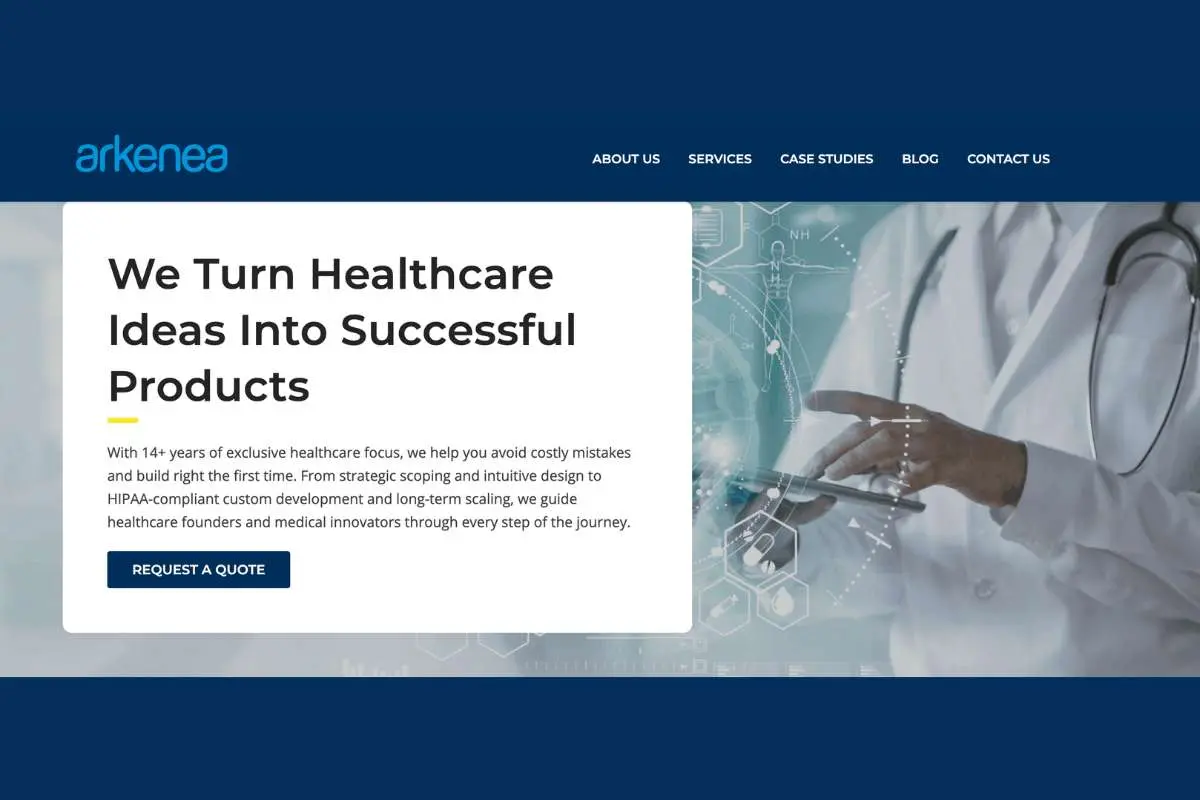
Arkenea is a healthcare-only software development firm with 14 years of experience working in the clinical space. Its work includes AI-powered EHR and EMR development, custom clinical record systems, telemedicine platforms, remote patient monitoring tools, and AI integrations for existing provider systems. Compliance coverage includes HIPAA, HITRUST, FDA, and IEC 62304, and its integration experience spans Epic, Cerner, and Athenahealth across HL7 and FHIR standards.
The company holds a 4.9/5 Clutch rating across 14 verified reviews and has delivered for healthcare startups, ambulatory practices, and regulatory-heavy digital health companies working through FDA requirements. The minimum project size is $50,000, and hourly rates range from $50–$99. Because the team works only in healthcare, clinical data models, EHR API limits, and regulatory workflows are part of the baseline.
Why choose Arkenea
- You’re building a custom AI-powered EHR, EMR, or telemedicine platform in a regulated clinical environment.
- You need a team that already works with HIPAA, HITRUST, FDA, and IEC 62304.
- You want developers who work only in healthcare, not across unrelated industries.
7. Glorium Technologies: ISO 13485-Certified AI for medical devices and clinical platforms
Glorium Technologies is headquartered in Princeton, New Jersey, with development centers in the U.S., Poland, Ukraine, and Cyprus. Over 14+ years, the company has delivered 150+ healthcare products, reports 99% client satisfaction, and employs about 200 specialists, with 80% at the senior level. Its compliance stack includes ISO 13485 for medical device software quality management, as well as ISO 27001, ISO 9001, HIPAA, GDPR, and FDA frameworks.
Its proprietary CogniAgent AI platform provides no-code cognitive automation for triage routing, appointment scheduling, and clinical documentation within HIPAA-compliant limits. The company’s broader AI work includes medical imaging, IoMT device connectivity, and AI-assisted diagnostics for MedTech clients. Glorium Technologies has also been named to the IAOP Global Outsourcing 100 for 2023–2025, appeared on the Clutch Top 1000 Global Service Providers list in 2022–2024, and received Inc. 5000 recognition for 2020–2023.
Why choose Glorium Technologies
- Your project includes medical device software and requires a vendor with ISO 13485 certification.
- You need an AI platform like CogniAgent to automate clinical workflows without building everything from scratch.
- Your compliance needs span ISO 13485, ISO 27001, HIPAA, GDPR, and FDA requirements, and you want a single vendor that can cover them all.
Questions to ask any vendor before signing
- Which EHR systems have you integrated with in the last 12 months, and which API versions did you use?
- Can you share a case study with a specific clinical outcome metric, not just client satisfaction scores?
- When does BAA execution happen in your process: before scoping or after?
- What is your standard process for HIPAA breach notification, and is any part of it automated?
- Have your AI models been tested against clinical accuracy benchmarks, or only general-purpose ones?
Final thoughts
The difference between a true healthcare AI vendor and a general software company with a few clients in the domain comes down to real delivery experience: architecture, depth of compliance, and clinical results. Relevant Software, ScienceSoft, TATEEDA Global, Diceus, BotsCrew, Arkenea, and Glorium Technologies bring documented production work in healthcare.
The next step is to compare them against your specific use case, EHR environment, and compliance requirements before building a shortlist.