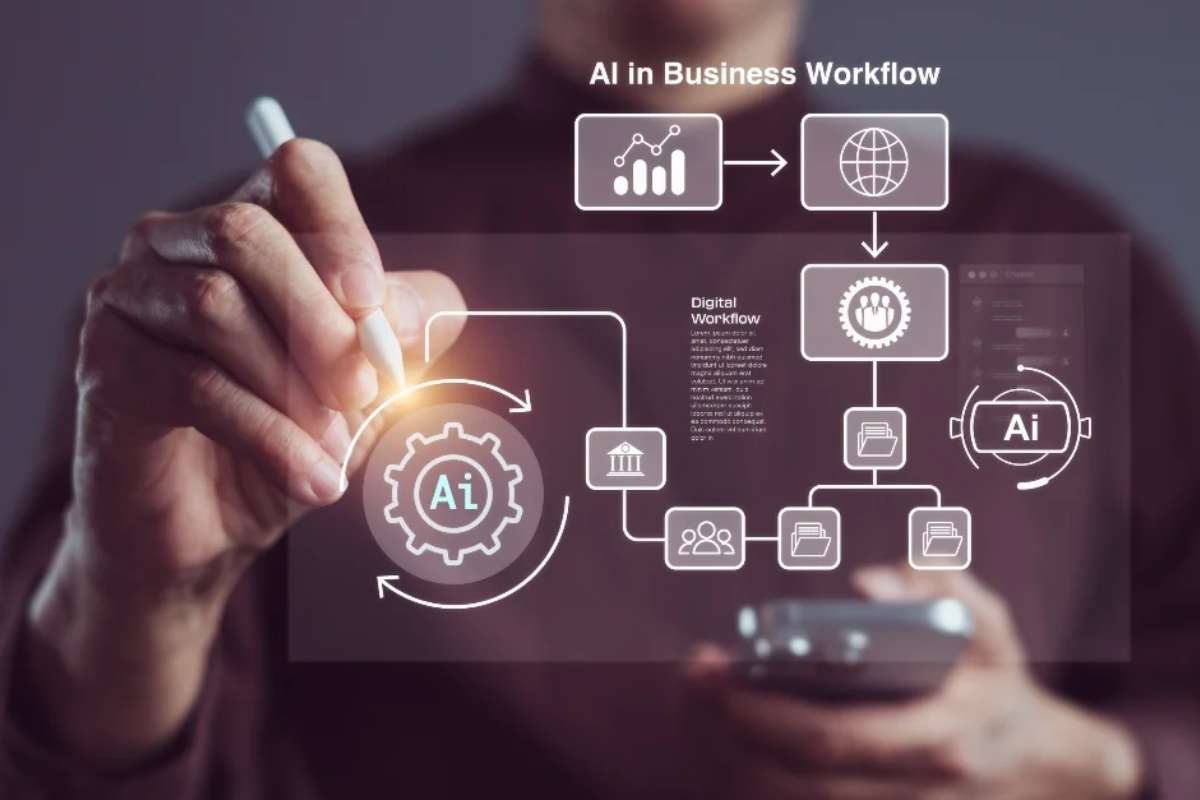
In 2025, we reached a tipping point where 88% of organizations were using AI to manage at least one core aspect of their work. This shift has moved from a “nice-to-have” experiment to a foundational requirement for staying relevant. These applications of artificial intelligence have moved from being futuristic experiments to the very foundation of how we communicate and create.
The numbers tell a compelling story of this new era: companies adopting these tools are seeing productivity jumps as high as 40%. It isn’t just about speed; it is about creating a workspace where people focus on big ideas while systems manage the routine. These six specific applications of artificial intelligence have officially become mandatory for success.
The 6 Real-World Applications of Artificial Intelligence Powering Modern Economies:
We live in a time where human intelligence works together with artificial intelligence to improve workflow and the last product.
In this blog, we will explore the applications of AI across six different sectors and examine how these technologies are making a positive impact. Here’s what you need to know:
1. Healthcare
In 2026, healthcare has moved past simple digitization. The market, predicted to be valued at over $61.2 billion, is driven by a shift from reactive treatment to proactive, remote management.
Diagnostics & Imaging: AI-powered systems are core components of the diagnostic team. By using remote monitoring and predictive imaging for chronic care patients, hospitals have achieved a 20-50% reduction in readmissions.
Hybrid Teams: We are seeing the rise of “Hybrid Human-AI” medical teams. These collaborations ensure that while AI handles the rapid scanning of thousands of data points, human doctors provide the empathetic oversight and complex decision-making required for patient wellness.
2. Education

The classroom of 2026 is unrecognizable compared to a decade ago, thanks to the applications of artificial intelligence. With 92% of students now using AI (a massive jump from 66% in 2024), the technology has become a standard “creative thought partner.”
Student Success: Approximately 95% of students utilize tools like ChatGPT to enhance their grades. AI is primarily used to explain complex concepts, summarize dense articles, and brainstorm research ideas.
Teacher Integration: AI technology is supercharging educators. With 65% of teachers integrating AI into their workflows, they can now generate personalized lesson plans for 30+ unique student needs simultaneously, effectively tackling the “one-size-fits-all” problem of the past.
3. Finance
Gartner’s prediction has come true: by 2026, 90% of finance functions will have deployed at least one AI-enabled solution. The sector has moved from “tactical mode” to enterprise-wide adoption.
Banking Profits: Generative AI adds between $200 billion and $340 billion in annual global banking profits. It is achieved through hyper-automated underwriting, real-time risk analytics, and invisible payment systems.
Security: As deepfake fraud attempts surged by over 2,000%, trust became a competitive advantage. Modern banks now use behavioral biometrics and AI-driven fraud detection to cut losses in a market growing at a 30% to 40% CAGR.
4. Retail

Retailers in 2026 have mastered the art of “Hyperpersonalization.” The goal of every seller is to make every interaction feel intentional rather than random. And they obviously use AI for it.
The Shopping Journey: By using AI to predict needs before they are articulated, retailers have cut the average customer journey by one-third while significantly lifting click-through rates.
Agentic Retail: With the rise of “Agentic AI,” systems autonomously recommend products but also handle the logistics of reordering and subscription management. It has driven annual AI spending in the sector to a staggering $31.12 billion in 2024.
5. Manufacturing
Manufacturing has reached the “Industrial 5.0” phase. It is the phase where AI not only assists but also orchestrates entire production ecosystems. Artificial Intelligence as a service is changing the sector, indefinitely.
Predictive Maintenance: This is still the “crown jewel” of industrial AI, capturing a significant portion of the market share. With the ability to forecast equipment failures weeks in advance, companies are seeing a 300% ROI on these investments.
Physical AI: Roughly 22% of firms now employ a mix of agentic AI and physical robots. These systems autonomously manage routine production decisions. They allow the human workforce to focus on engineering and high-level strategy.
6. Workforce

The final, and perhaps most critical, application of artificial intelligence is the evolution of the workforce itself. In 2026, AI is the primary driver of margin gains because it has redefined “productivity.”
The Productivity Jump: Across all sectors, the focus is on the “Human-Machine Learning Loop.” It is a collaborative cycle where AI handles data-heavy tasks, freeing humans to use their unique creative and strategic strengths.
Bridging the Gap: While the technology is ready, the human element is catching up. Organizations are now treating “AI Literacy” as a core skill, ensuring that the 40% productivity gains seen by early adopters become the standard for the entire global economy.
Market Outlook of AI and Growth Drivers
Now that we have seen the applications of artificial intelligence, let’s talk about the market. According to Statista, the global AI market stands at approximately $244-391B in 2025, with forecasts projecting explosive growth to $827B-$3.5T by 2030-2033 at CAGRs of 27-36%.
Growth Drivers
- Infrastructure: AI spending hits $1.5T (2025) to $2T (2026), led by services ($283B), servers ($268B), semis ($209B).
- Sectors: Software/services dominate; Asia-Pacific fastest at 34.7% CAGR.
- Investments: $500B+ in capex by AI firms in 2026 alone.
Conclusion
As we move through 2026, it is clear that these applications of artificial intelligence are the central nervous system of the modern economy, whether we talk about classrooms where every student has a personal tutor or factories that predict their own repairs. The focus has shifted from “if” a company should use AI to “how fast” they can master it.
Success means moving away from the fear of automation and toward the potential of human-AI collaboration. As these systems continue to evolve, the most successful organizations will be those that apply artificial intelligence to enhance human creativity and empathy, not replace it. The future belongs to the businesses that act today to secure their place in the automated space.
FAQs
1. What are the primary ethical concerns surrounding these AI applications?
The most urgent concerns in 2026 involve algorithmic bias and transparency. For instance, healthcare AI may inadvertently prioritize certain demographics based on biased data, while “black box” financial models can make critical credit decisions without offering a clear, human-understandable explanation.
2. Is the widespread adoption of AI harming the environment?
Yes, the environmental footprint is significant. By 2026, data centers are expected to consume nearly 1,050 terawatt-hours of electricity globally. Training and running these models require massive amounts of water for cooling and contribute to rising electronic waste from specialized hardware.
3. How do these applications handle data privacy and security risks?
Organizations are shifting to “AI-aware” security frameworks to combat threats like prompt injection and data exfiltration. Compliance with global laws like GDPR is now automated, using encryption and data anonymization to ensure sensitive information isn’t exposed during model training or usage.