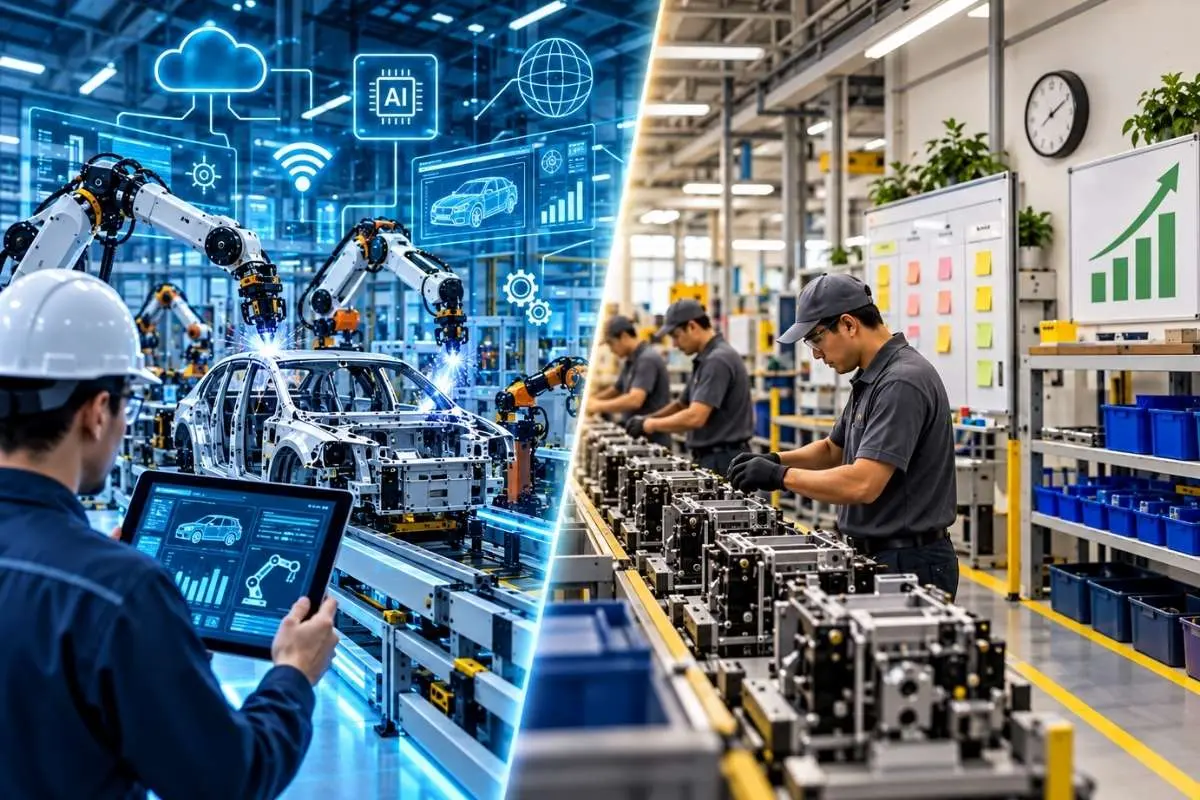
A good laser welding system has to work outside the demonstration room. Joint fit-up changes, operators work from awkward positions, and the machine may need to move between stainless, carbon steel, and aluminum jobs during the same week.
That is why I would compare laser welding equipment manufacturers on more than output power. Cooling, gun weight, process flexibility, safety, service, and realistic material capability all matter. Dynalasers takes a compact air-cooled approach with its S, M, and D Series.
7 laser welding equipment manufacturers compared
| Manufacturer | Representative System | Power | Main Strength | Typical Use |
| Dynalasers | S / M / D Series | 700–1800W | Compact air-cooled platforms | Flexible fabrication |
| IPG Photonics | LightWELD | 1000–2000W | Established fiber laser platform | Industrial welding |
| Miller | OptX | 1000 / 2000W | Integrated welding ecosystem | Production shops |
| JASIC | LS Series | 1500 / 2000W | Welding-focused product range | Regular fabrication |
| SENFENG | Handheld Laser Welder | Multiple options | Broad industrial laser portfolio | General metalworking |
| GWEIKE | Handheld Laser Welder | Multiple options | Wide equipment selection | Workshop fabrication |
| xTool | MetalFab | 800 / 1200W | Compact multi-process approach | Light fabrication |
The table shows why there is no useful “ideal wattage” for every shop. Some buyers specifically search for a 2000w laser welding machine manufacturer, while others rarely weld material that requires that output.
For mixed fabrication, carrying extra power, size, and cooling capacity that is seldom used may not improve productivity. This is where the Dynalasers range takes a different direction.
Where dynalasers fits in a fabrication shop
Dynalasers laser welding solution builds its current welding platforms around air cooling. Removing the conventional water chiller reduces the footprint and avoids coolant-related maintenance.
More importantly, the product range is split by workload. The S Series emphasizes portability, the M Series covers mixed daily fabrication, and the D Series provides more output for regular workshop use.
Across suitable models and process conditions, the range covers approximately 1–7 mm stainless steel and 1–5.5 mm aluminum.
I would treat these as application ranges rather than guaranteed limits. Material grade, joint geometry, gap, travel speed, focus, shielding gas, and filler wire can change the usable thickness considerably.
Dynalasers M series for mixed daily work

The M Series is the range I would start with for a fabrication shop that rarely makes the same part all day.
M models provide approximately 800W, 1200W, and 1800W, while machine weight stays below roughly 37 kg, 42 kg, and 45 kg respectively.
Depending on configuration, the same platform can handle welding, cleaning, and light handheld cutting. That can be useful during repair work. A component may need oxide removed before welding or a small trimming operation before final fit-up.
The important point is not having more functions on a specification sheet. It is avoiding unnecessary equipment changes during short, varied jobs.
Typical applications include:
- stainless enclosures and cabinets;
- frames and brackets;
- sheet-metal assemblies;
- aluminum fabrication;
- machinery repair;
- short production runs.
For shops comparing a fiber laser welding machine supplier, this type of workload is worth explaining before requesting a quotation.
Dynalasers D series for higher-output workshop welding
The D Series is more appropriate when thicker material appears regularly rather than occasionally.
Its 1200W and 1800W configurations weigh approximately 41 kg and 43 kg. This keeps the system relatively compact while providing more process margin for stainless steel, carbon steel, and aluminum.
The D Series also carries CE-MD certification and uses a safety architecture designed to ISO 13849 PL-e.
That matters in production. Handheld fiber laser welding is still a high-power laser process, regardless of how small the cabinet becomes. Interlocks, restricted access, eye protection, fume extraction, and operator procedures should be considered before installation.
When evaluating a precision laser welding machine factory, I would put safety documentation on the same checklist as welding performance.
Dynalasers S series for portable work
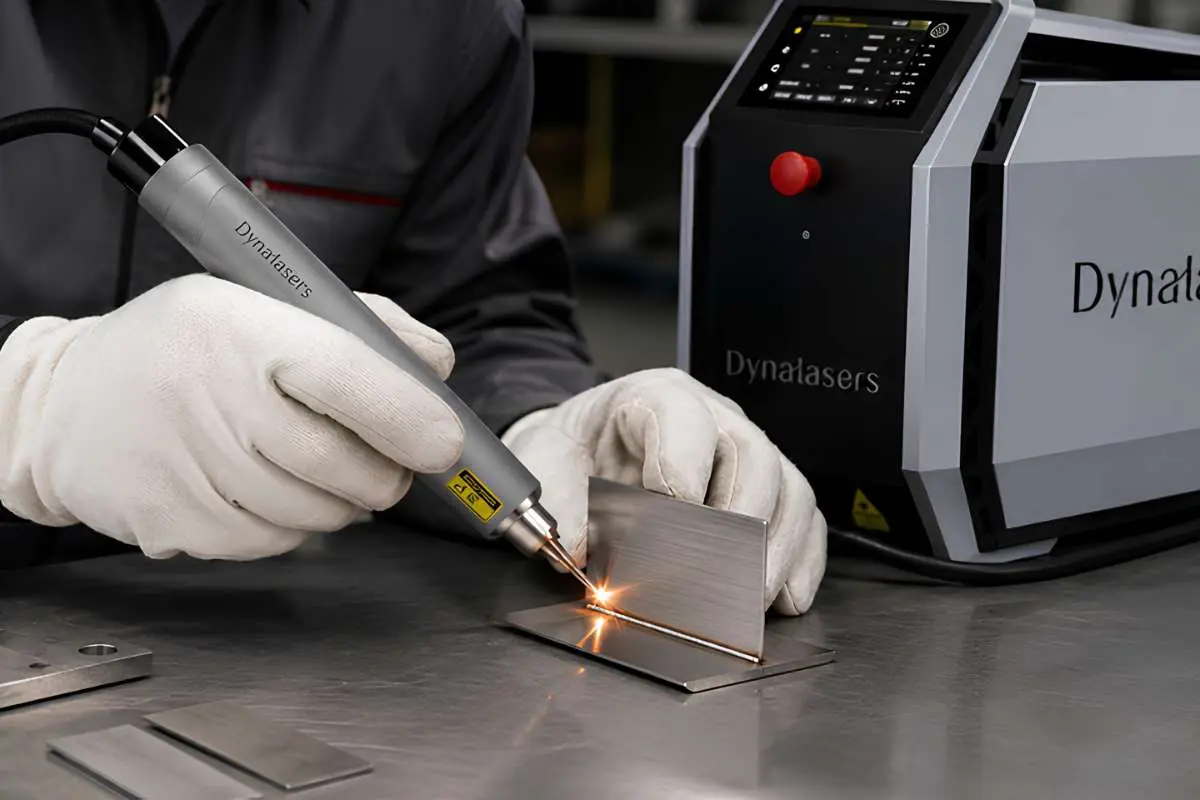
The S30 is designed around mobility rather than maximum penetration.
It provides 700W output while weighing less than 21 kg. That makes it more practical for maintenance, thin-sheet work, compact workshops, and applications where the welder needs to move frequently.
It also supports continuous, burst, and pulse modes.
This is a good example of why equipment should be matched to normal production rather than the largest possible job. A shop mostly welding thin sheet may gain more from a machine that is easy to reposition than from unused 1800W or 2000W capacity.
What actually controls weld quality?
Power gets most of the attention because it is easy to compare. In practice, several less obvious variables often determine whether the weld is repeatable.
Joint gap is one of them. Laser welding generally rewards consistent fit-up. Filler wire can provide additional tolerance, but it does not turn a poorly fitted assembly into a stable process.
I would also watch:
- travel speed, because it changes energy input per unit length;
- focus position, which affects how energy reaches the joint;
- wobble settings, which influence bead width and gap tolerance;
- wire position and feed rate, especially on joints needing filler;
- shielding gas coverage, which affects oxidation and appearance;
- surface condition, because oil, oxide, and contamination can destabilize the result.
This is where an experienced laser welding machine supplier provides more value than simply recommending the next-highest power level.
A 0.48 kg welding gun is not a minor detail
Dynalasers uses a handheld welding gun weighing approximately 0.48 kg.
On a ten-second demonstration seam, that specification means very little. During several hours of welding around frames, cabinets, or larger assemblies, it becomes more relevant.
Operator fatigue can change gun angle, travel speed, stand-off, and wire position. If the process is genuinely handheld, ergonomics is part of process stability.
This is something I would compare when reviewing the top manufacturers of industrial fiber laser welding machines, particularly if operators will use the equipment for long periods rather than occasional repair work.
Do you actually need 2000W?

Not necessarily.
A 2000W platform can provide useful additional capacity for thicker material and higher-throughput applications. But choosing between 1200W, 1800W, and 2000W should be based on normal production thickness, not the highest number available.
For example, a shop regularly welding relatively thin stainless assemblies may gain little from moving to 2000W if 1200W or 1800W already provides a stable process window.
I would start with three questions:
- What thickness accounts for most production?
- How often does the maximum thickness actually appear?
- What travel speed and penetration are required at that thickness?
These answers are more useful than assuming a 2000w laser welding machine manufacturer automatically offers the best fit.
Test the actual joint before ordering
A supplier sample made from two perfectly prepared flat coupons is useful, but it is not production.
Send representative parts when possible. Include the actual alloy, thickness, joint geometry, expected gap, filler requirements, and required penetration.
For an important joint, I would also ask for a cross-section or suitable mechanical test. A clean top bead can hide inadequate penetration or incomplete fusion.
Service should be checked at the same time. Dynalasers uses a self-developed laser source and provides a two-year source warranty. Buyers should also confirm availability of protective lenses, nozzles, wire-feeder components, and technical support.
A small spare part with a long delivery time can stop a welding cell just as effectively as a major failure.
FAQs
1. Can a handheld laser welder replace TIG for every job?
No. Laser welding can be very effective on suitable sheet-metal and fabrication work, but joint access, fit-up, material, qualification requirements, and production conditions may still favor TIG or another established process.
2. How important is part fixturing for laser welding?
Very important when repeatability matters. Stable fixtures help control joint position and gap, reducing the amount of variation the operator or process must absorb.
3. Should welding samples be tested destructively?
For structural or quality-critical joints, visual inspection alone may not be enough. Cross-sections, bend tests, tensile tests, or other appropriate methods can reveal defects that are not visible from the surface.
4. What should be stocked with a new laser welder?
Protective lenses and nozzles are sensible starting points. For production use, also check recommended welding-head and wire-feeder wear parts and their normal replacement intervals.
Conclusion
Comparing laser welding equipment manufacturers is easier when the normal production joint comes first and machine wattage comes second.
Dynalasers covers different fabrication needs with its air-cooled S, M, and D Series, ranging from a sub-21 kg portable system to 1800W workshop models. For a production purchase, the final decision should still come from welding representative parts and verifying the finished joint under realistic conditions.