Two terms, one very crowded factory floor
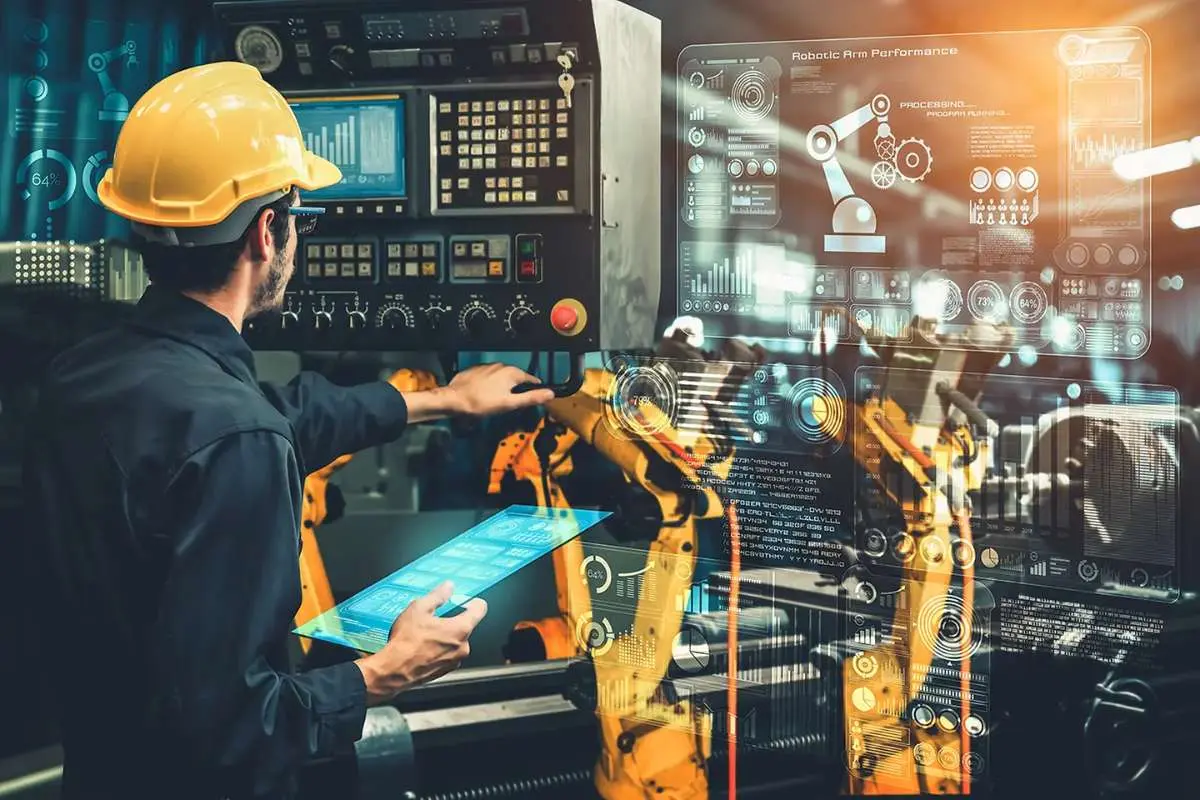
Walk into a modern factory, and you may hear Industry 4.0, smart manufacturing, IIoT, digital twins, automation, and a few more terms before you’ve even reached the production line. They all sound similar, and yes, they are connected. But they do not mean exactly the same thing.
So, when it comes to Industry 4.0 vs smart manufacturing, why do manufacturers use both terms if they are so closely related? The answer comes down mainly to scope and application, not two competing manufacturing strategies.
Industry 4.0 describes the wider shift toward connected, digital industry, while smart manufacturing focuses more closely on how those ideas improve manufacturing operations.
In other words, there is no need to make two similar terms fight for the same parking spot. They have different places to go.
What does Industry 4.0 actually mean?
Industry 4.0 is the Fourth Industrial Revolution, built around a simple idea: connect machines, people, data, and systems so they can work together more intelligently. It follows earlier shifts driven by steam power, electricity, and computer-based automation.
In practice, that can mean:
- Connected operations: Machines and systems share information instead of working in isolation.
- Smarter technology: IIoT, AI, analytics, robotics, and cyber-physical systems help collect data and act on it.
- Wider integration: Digital systems can connect production with product development, supply chains and other business operations.
That wider scope is what matters when looking at Industry 4.0 vs smart manufacturing. Industry 4.0 is the bigger umbrella, with smart manufacturing technologies forming an important part of it. NIST specifically notes that Industry 4.0 encompasses IIoT and smart manufacturing while bringing physical production together with digital technologies.
So, what makes smart manufacturing different?
Smart manufacturing brings the conversation closer to the factory floor. Instead of looking at the whole industrial ecosystem, it focuses on how manufacturing systems collect information, connect operations, and use data to make better decisions.
That can include:
- Real-time data: Teams can see what is happening as production runs.
- IT and OT integration: Business systems and shop-floor equipment can share useful information.
- Connected equipment: Machines can send and receive data instead of operating as isolated islands.
- Better visibility: Production teams get a clearer view of performance, quality, and process conditions.
- Smarter decisions: Data can support automated or assisted decisions and help teams spot issues sooner.
This is where Industry 4.0 vs smart manufacturing becomes easier to understand. Smart manufacturing turns many of the broader ideas behind Industry 4.0 into practical manufacturing improvements. A smart manufacturing process is not simply one with more sensors or software. The technology has to help people understand what is happening and improve how the work gets done.
NIST describes smart manufacturing as connected systems that bring IT and OT together, allowing information to move across the manufacturing environment.
Industry 4.0 vs smart manufacturing: where do they overlap?
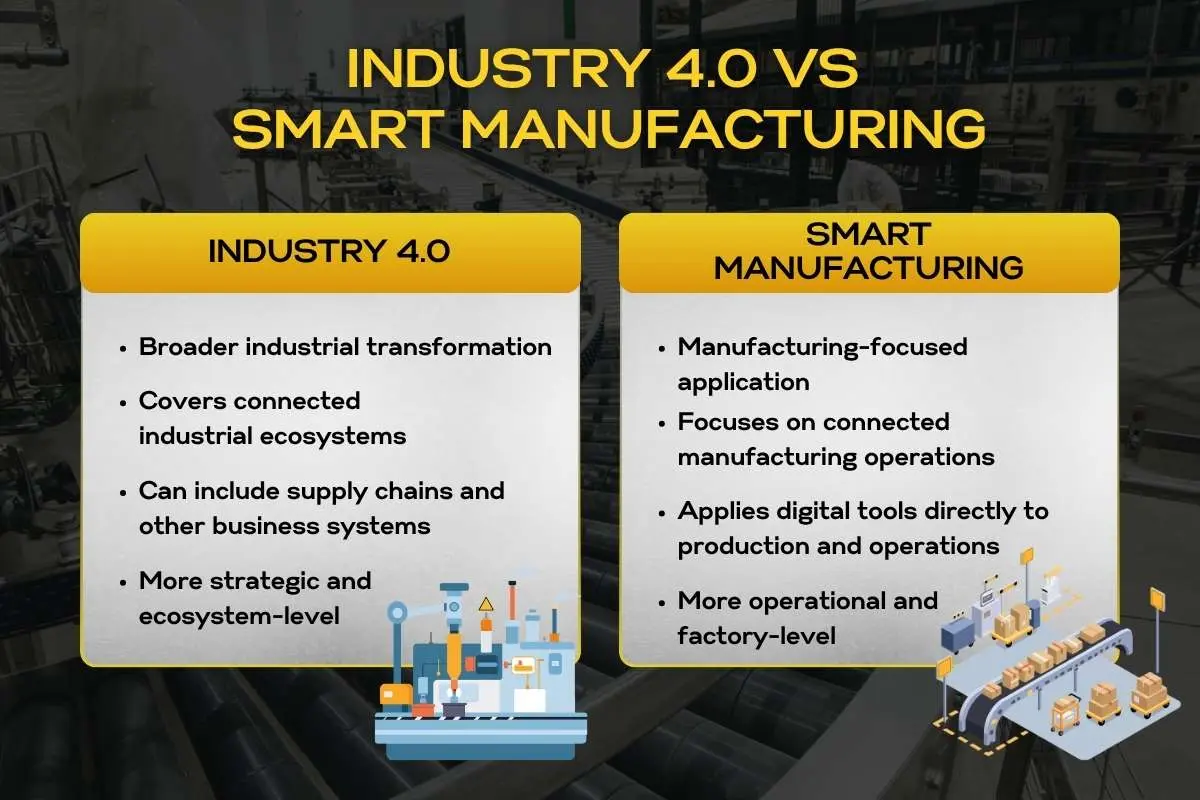
The two terms overlap because they use many of the same technologies, but they look at them from slightly different angles.
| Industry 4.0 | Smart manufacturing |
| Broader industrial transformation | Manufacturing-focused application |
| Covers connected industrial ecosystems | Focuses on connected manufacturing operations |
| Can include supply chains and other business systems | Applies digital tools directly to production and operations |
| More strategic and ecosystem-level | More operational and factory-level |
A manufacturer using connected sensors, analytics, robotics, AI, and digital twins could reasonably describe its work as both Industry 4.0 and smart manufacturing. That is where the confusion starts. NIST itself describes Industry 4.0 as encompassing IIoT and smart manufacturing, while smart manufacturing focuses on using digital technologies and advanced manufacturing capabilities to improve how manufacturing systems operate.
In simple terms: Think of Industry 4.0 as the bigger map and smart manufacturing as a major part of the journey through it. Even technologies such as a digital twin (What is a digital twin) can sit comfortably in both conversations, depending on whether you’re discussing the wider digital ecosystem or its use on the factory floor.
That is the key distinction in Industry 4.0 vs smart manufacturing: they are closely connected, but one describes the broader transformation while the other puts more focus on manufacturing itself.
Smart manufacturing vs traditional manufacturing: what really changes?
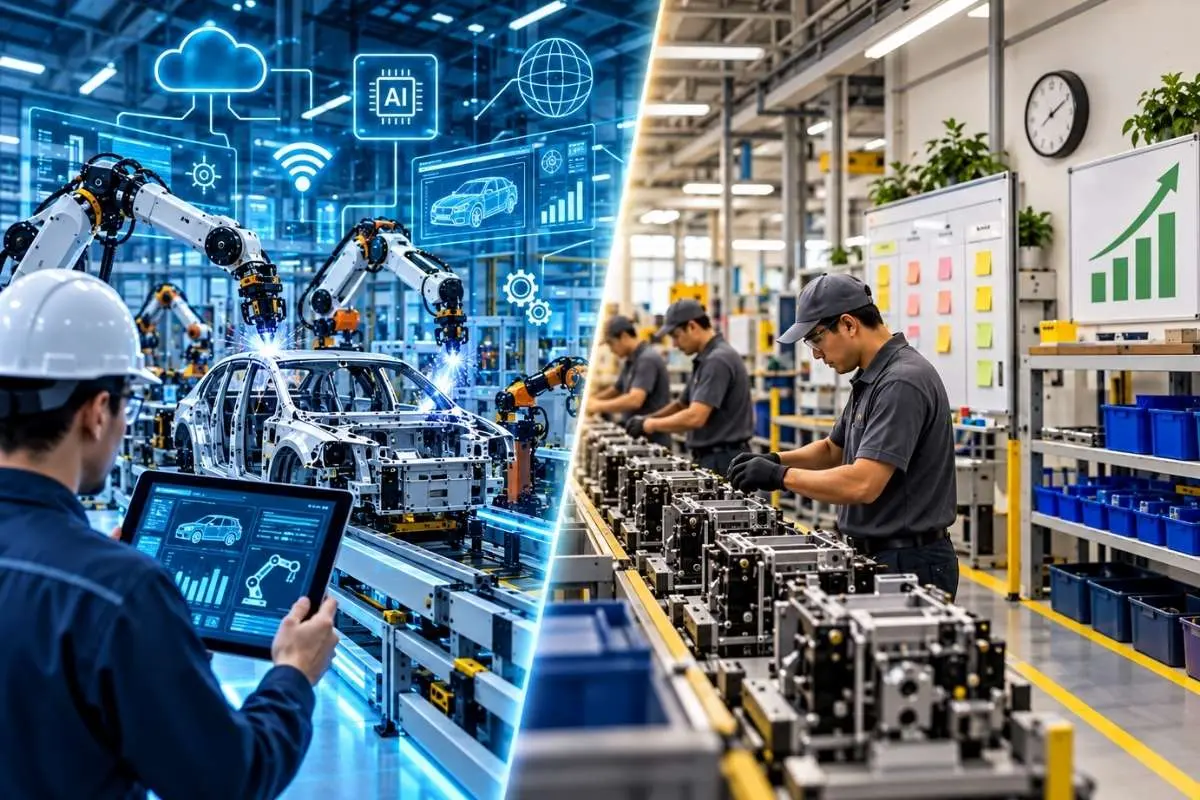
Traditional manufacturing is not automatically outdated. Many factories still rely on systems and processes that work perfectly well. The bigger difference is how easily information moves and how quickly teams can act on it.
| Traditional approach | Smart approach |
| Information may sit in separate systems | Machines and systems share data |
| Problems are often found after they happen | Production conditions can be monitored closer to real time |
| Decisions rely more on manual reporting | Teams can spot patterns earlier |
| Equipment data may be difficult to access | Operational data is easier to use |
This is one practical expression of the wider shift behind Industry 4.0 vs smart manufacturing. The goal is not to replace every old system with something shiny and expensive. It is to make useful information easier to see and act on.
That also makes smart manufacturing metrics important. A factory needs clear measures to tell whether better connectivity is actually improving output, quality, downtime, or other results. Many manufacturers, in reality, will sit somewhere between the two approaches, gradually connecting processes rather than flipping a giant digital switch overnight.
Smart manufacturing vs lean manufacturing: are they competing ideas?
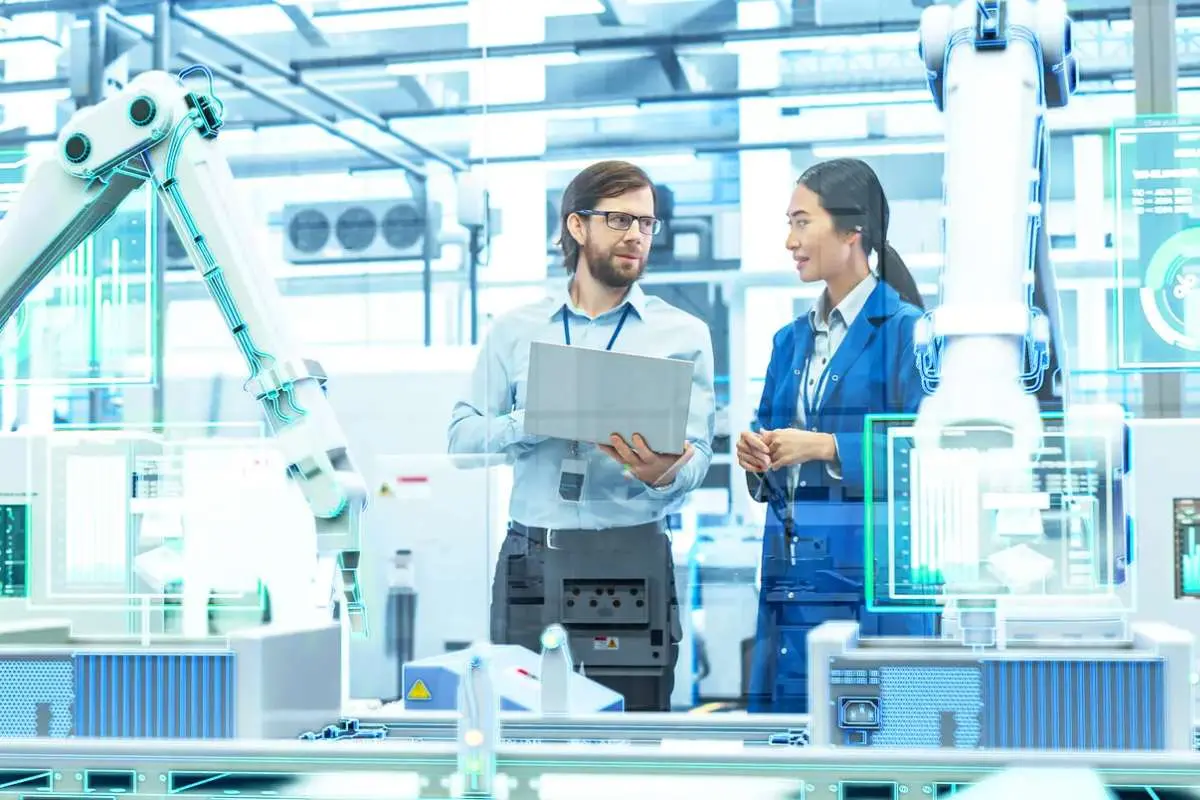
No. Going digital does not mean throwing lean manufacturing out the window. In fact, the two can work rather well together.
Lean manufacturing focuses on reducing waste, improving flow, and making processes more efficient. Smart manufacturing can strengthen those efforts by giving teams better information about what is happening on the shop floor.
| Lean asks | Smart manufacturing helps answer |
| Where is waste occurring? | When and where does it happen? |
| What is slowing production? | What conditions are causing the slowdown? |
| How can the process improve? | What does the production data reveal? |
For example, a lean team may know that a machine is creating a bottleneck. Connected systems can help show when, why and under what conditions that bottleneck appears.
That distinction matters in Industry 4.0 vs smart manufacturing discussions. Industry 4.0 technologies can support lean practices, but they do not replace the people and thinking behind them. A dashboard cannot fix a bad process simply because it has a very impressive dashboard.
This is the practical overlap explored in smart manufacturing vs lean manufacturing: technology provides better visibility, while lean provides the discipline to act on it.
Where do technologies, tools and data fit into the picture?
This is where Industry 4.0 starts looking less like a big concept and more like an actual factory. The technology stack can include sensors and IIoT, automation and robotics, cloud and edge computing, analytics, AI and machine learning, and digital twins.
But technology alone does not make a factory smart. The real value comes from how well the technology connects to a process and helps someone make a better decision. A sensor collecting data nobody uses is not exactly a digital transformation. It is an expensive way to gather numbers.
That is an important point in Industry 4.0 vs smart manufacturing. The same technology can serve a wider Industry 4.0 strategy or solve a specific manufacturing problem.
For example, Deloitte’s 2025 survey of 600 executives from large U.S. manufacturers found reported average gains of 10% to 20% in production output, 7% to 20% in employee productivity, and 10% to 15% in unlocked capacity from smart manufacturing initiatives. These are survey findings, not guaranteed results.
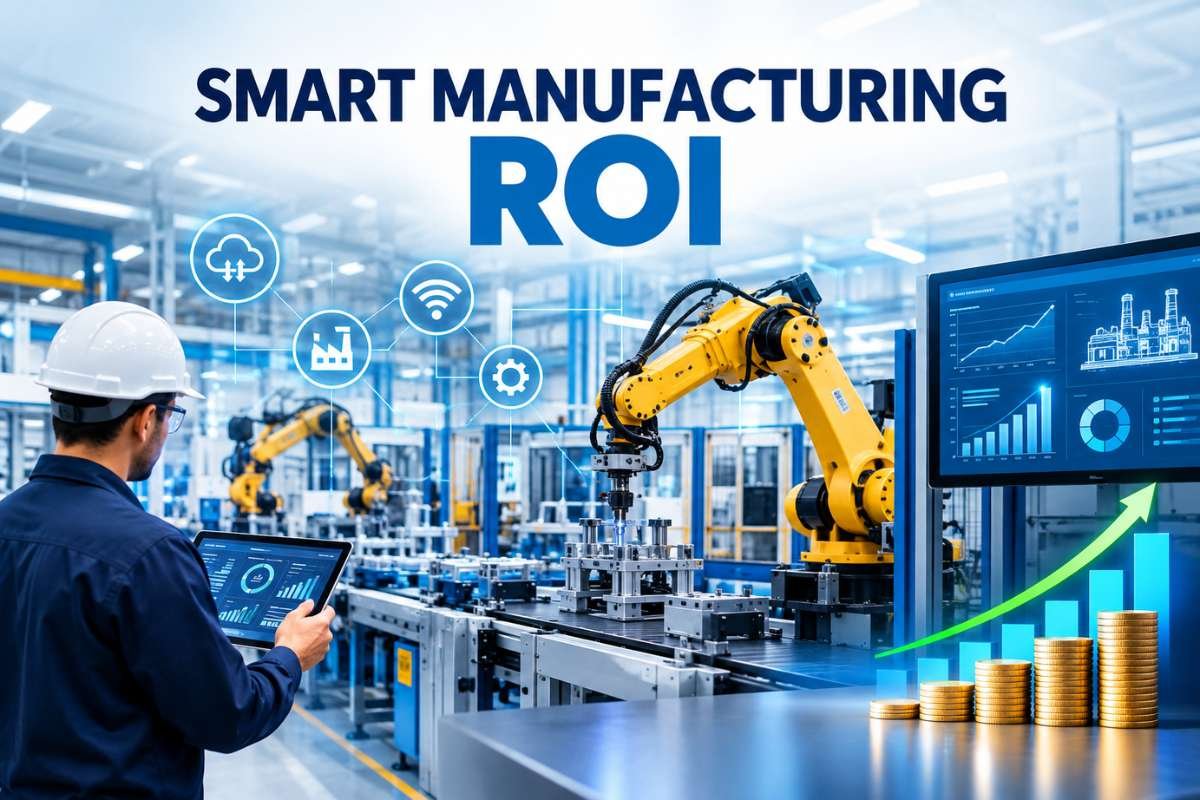
That is why smart manufacturing ROI matters: the right question is not “What technology can we buy?” but “What useful result can it help us achieve?”
Which approach should a manufacturer actually focus on?
The answer depends on what you are trying to change. Before choosing a technology, ask three simple questions:
- Are you looking at the wider digital transformation of the business? Industry 4.0 gives you the broader framework.
- Are you trying to improve factory operations with connected data and technology? Smart manufacturing is the more useful lens.
- Are you deciding what to implement next? Start with the manufacturing problem, then choose the technology that can address it.
You also do not need to adopt the entire Industry 4.0 universe in one go. Smaller manufacturers can start with a focused problem and build from there. That makes smart manufacturing for small businesses a practical path rather than a race to collect every new piece of technology.
In the Industry 4.0 vs smart manufacturing debate, the better choice is therefore the one that matches your goal, not the one with the fancier label.
What can manufacturers learn from companies already doing this?
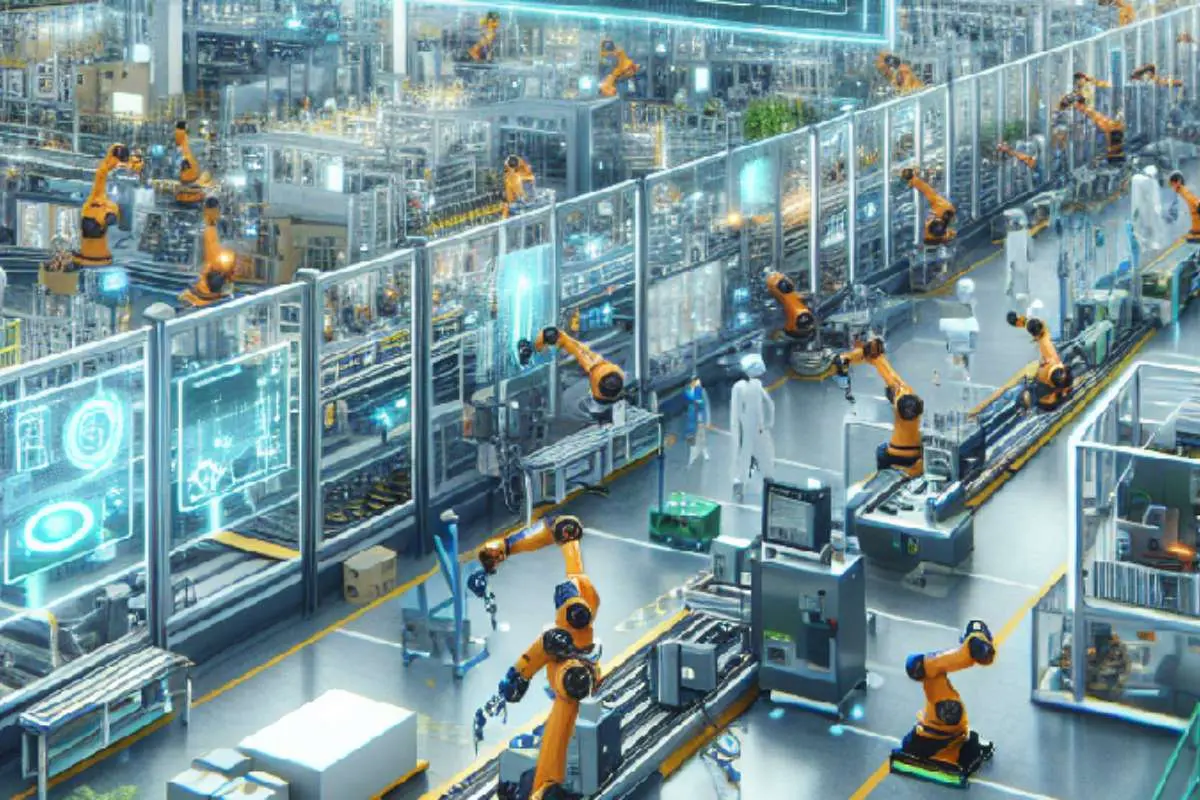
The distinction is already playing out in real factories. In September 2025, the World Economic Forum’s Global Lighthouse Network reached 201 manufacturing facilities and value chains, showing how widely digital technologies are being applied at scale.
But the lesson is not to copy the biggest factory in the room. It is to understand which problem the technology solved and why it worked. That is the useful thinking behind companies doing smart manufacturing right. The technology may differ, but the approach stays familiar: find the problem, connect the right data, improve the process, then scale what works.
Conclusion: The difference is useful, but the factory problem matters more
By now, the distinction should feel a little less confusing. Industry 4.0 is the broader transformation of industry, while smart manufacturing puts many of those connected technologies, data, and systems to work inside manufacturing.
If you’re trying to understand the big picture, Industry 4.0 gives you the map. If you’re trying to improve what happens on the factory floor, smart manufacturing gives you the more useful lens.
That is the practical takeaway from Industry 4.0 vs smart manufacturing. You do not need to pick a side. You need to understand what each term covers and, more importantly, what your factory actually needs.
For a deeper look at the bigger picture, our Smart Manufacturing guide brings the technologies, processes, benefits, and implementation considerations together.
And if someone starts pitching a €500,000 digital transformation because your production report takes two hours to compile, perhaps start with the report.
FAQ: Industry 4.0 vs Smart Manufacturing
1. Is Industry 4.0 the same as smart manufacturing?
No. Industry 4.0 is broader, while smart manufacturing focuses specifically on applying connected technologies to improve manufacturing operations.
2. What is the main goal of Industry 4.0?
Industry 4.0 aims to connect people, machines, data, and systems to create more intelligent, flexible, and responsive industrial operations.
3. What is the main benefit of smart manufacturing?
Smart manufacturing helps factories use real-time data and connected systems to improve efficiency, quality, visibility, and decision-making.
4. Can a manufacturer adopt smart manufacturing without becoming fully Industry 4.0?
Yes. Manufacturers can introduce targeted smart technologies to solve specific production problems without transforming every part of the business.
5. Which should a manufacturer implement first, Industry 4.0 or smart manufacturing?
Start with the manufacturing problem. Then choose the technologies and systems that can solve it, rather than adopting technology for its own sake.