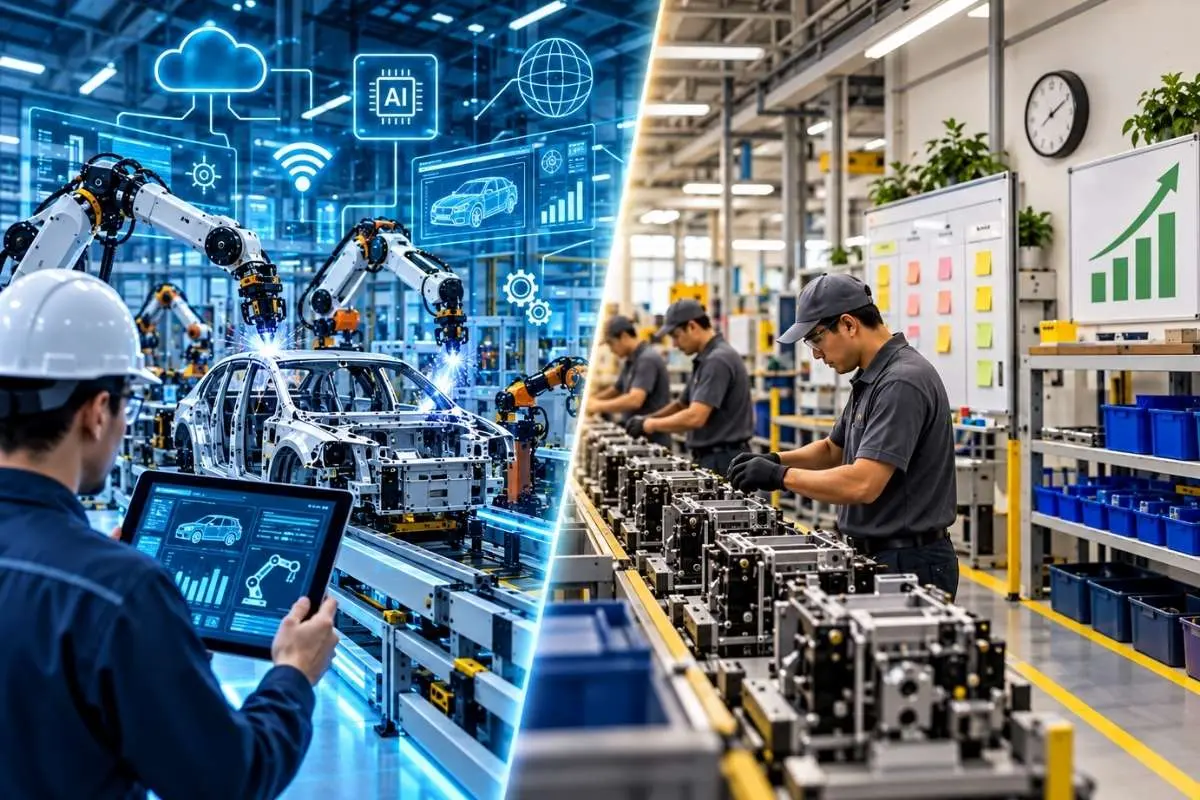
Two manufacturing philosophies, one factory
If you are weighing lean and smart manufacturing, it can feel like you need to pick a team. Do you focus on cutting waste and improving flow, or connecting machines, collecting data, and automating decisions? The better question is simpler: what problem are you trying to solve?
Lean manufacturing focuses on making processes more efficient by removing waste and improving how work flows. Smart manufacturing vs lean manufacturing is not really about choosing one over the other. Smart manufacturing uses connected technology, data, and systems to help a factory see problems and respond faster. The two overlap, but they are not interchangeable. A factory can have impressive technology and messy processes, or strong lean practices that become even more useful with better data.
Smart manufacturing and lean manufacturing differ mainly in approach. Lean focuses on reducing waste and improving processes, while smart manufacturing uses connected technology, data, and automation to make manufacturing more visible, responsive, and efficient.
What actually separates smart manufacturing from lean manufacturing?
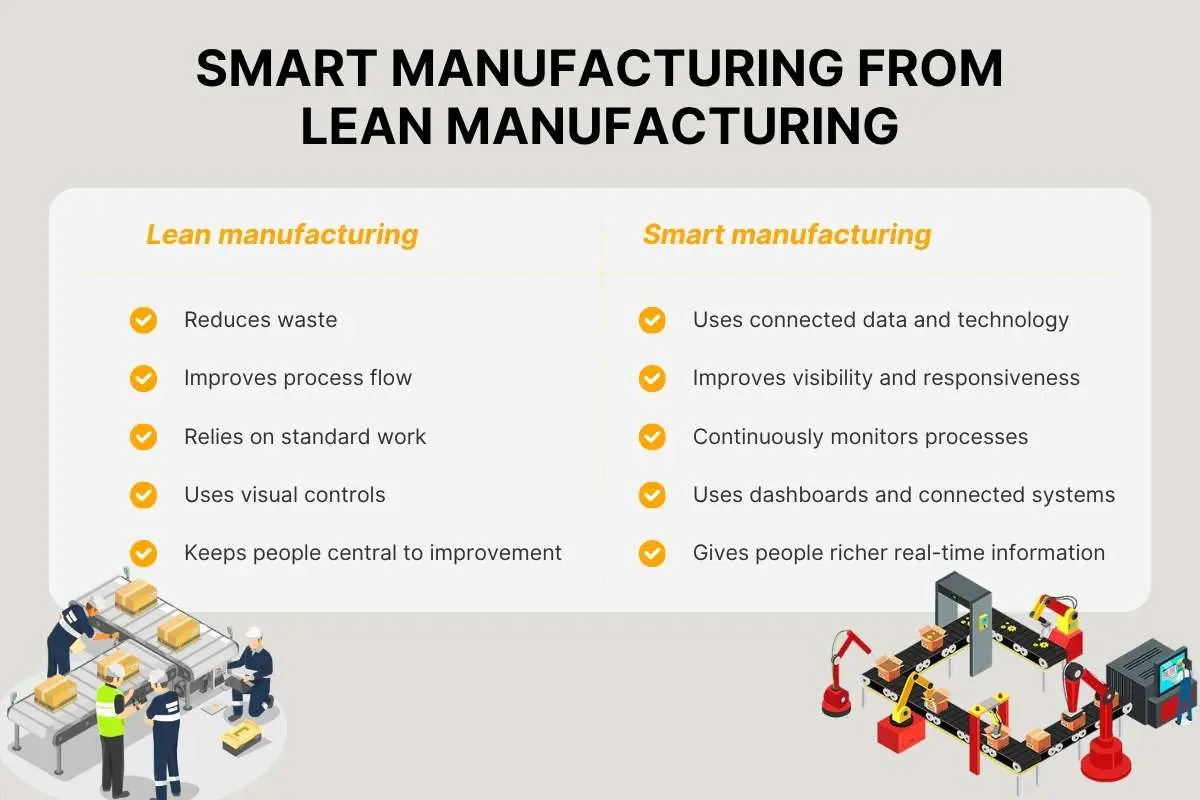
The easiest way to separate the two is to look at what each one tries to improve. Lean manufacturing starts with the process. It looks for wasted time, excess movement, unnecessary inventory, defects, and other friction that gets in the way of smooth production.
Smart manufacturing starts with visibility. It connects machines, systems, and data so teams can understand what is happening and respond faster.
| Lean manufacturing | Smart manufacturing |
| Reduces waste | Uses connected data and technology |
| Improves process flow | Improves visibility and responsiveness |
| Relies on standard work | Continuously monitors processes |
| Uses visual controls | Uses dashboards and connected systems |
| Keeps people central to improvement | Gives people richer real-time information |
So, smart manufacturing vs lean manufacturing is not simply a technology-versus-process debate. Lean asks, “Why are we wasting time, material, or effort?” Smart manufacturing asks, “Can we see what is happening quickly enough to act?”
That distinction also separates both approaches from smart manufacturing vs traditional manufacturing, where the bigger shift is from disconnected operations toward connected, data-driven production. The strongest factories ask both questions.
Lean manufacturing starts with the process, not the software
Lean starts with one simple question: where is the waste?
It focuses on:
- Identifying waste
- Improving process flow
- Standardizing work
- Continuous improvement
- Pull-based production
- Employee involvement
- Finding root causes
And no, none of this requires a digital factory.
Say operators spend five minutes every hour looking for tools. Buying software to track those tools might help, but first ask why the tools keep getting misplaced. Better storage or clearer standard work could solve the problem just as well.
That is important when comparing smart manufacturing vs lean manufacturing. Technology can make a weak process faster without making it better. A strong smart manufacturing process starts by understanding the work, then uses technology where it can improve the result.
Where smart manufacturing gives lean a much better set of eyes
Lean can tell you where the process is struggling. Smart manufacturing can help you see when, why and how often it happens.
That extra visibility can come from:
- Sensors tracking machine conditions
- Production systems exposing bottlenecks
- Connected quality data revealing defect patterns
- Dashboards showing performance across shifts
- Automation handling repetitive tasks
For example, a lean team may already know that one machine causes recurring delays. Connected data can show whether those delays happen during certain shifts, production runs or machine conditions. Suddenly, the problem has a pattern, not just a complaint.
That is where smart manufacturing vs lean manufacturing becomes less about choosing sides. The right smart manufacturing technologies can give lean teams better information without replacing the people doing the improvement work.
Deloitte’s 2025 survey found that 57% of surveyed manufacturers were using cloud computing and 57% were using data analytics at the facility or network level.
As Thomas Dose of BMW put it, “We must ask ourselves, are we building smart factories, or just data factories?”
The point is not to collect more data. It is to make better decisions with it.
Which approach improves efficiency, quality and downtime?
The answer depends on the problem. Both approaches can improve performance, but they get there differently.
Efficiency
Lean tackles waste such as waiting, unnecessary movement, overproduction and excess inventory.
Smart manufacturing can help teams spot those losses faster by turning production data into a clearer picture of where time and resources are going.
Quality
Lean focuses on consistent processes and finding root causes. Connected quality data can add another layer by showing where defects occur and whether patterns are emerging.
Downtime
Lean can improve maintenance workflows and standardize responses. Smart manufacturing can add machine-level data to help teams spot warning signs earlier.
For example, if one machine keeps stopping, lean may help uncover the process issue. With the right data, smart manufacturing vs lean manufacturing becomes less of a choice and more of a combined approach to reduce downtime with smart manufacturing.
Deloitte estimates that poor maintenance strategies can reduce a plant’s productive capacity by 5% to 20%.
The real test is not how many initiatives you launch. Use smart manufacturing metrics to see whether efficiency, quality or uptime actually improved.
What happens when companies choose technology before fixing the waste?
Buying a dashboard before deciding what the dashboard needs to tell you is a surprisingly expensive way to discover that dashboards exist.
Technology can solve real factory problems, but it cannot decide which problems are worth solving. That is where lean thinking helps.
| Common mistake | What goes wrong |
| Automating a bad process | The same waste happens faster |
| Collecting unused data | More information, no better decisions |
| Tracking too many metrics | Teams lose sight of what matters |
| Buying disconnected tools | Data gets trapped in separate systems |
| Treating technology as the strategy | The tool becomes the goal |
| Ignoring operators | Useful shop-floor knowledge gets missed |
This is one reason smart manufacturing vs lean manufacturing should not be treated as a technology contest. Lean helps identify the waste and define the improvement. Smart manufacturing can then make that improvement easier to monitor and scale.
The same works in reverse. If a factory relies entirely on manual observation, it may eventually miss problems that real-time data could reveal.
Avoiding these smart manufacturing mistakes starts with a simple rule: fix the process first, then digitize what is worth improving.
So, should manufacturers prioritize lean or smart manufacturing?
There is no universal winner. The better starting point depends on what is holding your factory back.
Prioritize lean first if:
- Processes are inconsistent
- Waste is poorly understood
- Standard work is weak
- The same problems keep returning
- Teams lack a common improvement method
Consider smart manufacturing earlier if:
- Useful data already exists but is fragmented
- Equipment is hard to monitor manually
- Downtime is costly
- Production is complex or highly variable
- Faster visibility could improve decisions
Combine them when:
- The process is stable enough to measure
- Teams know which problems matter
- Technology can strengthen an existing workflow
- Results can be measured clearly
The investment should follow the problem, not the excitement around a new tool. That is the basic idea behind smart manufacturing ROI: define the expected business gain before buying the technology.
A useful benchmark: The World Economic Forum’s Global Lighthouse Network has documented manufacturers achieving an average 30% to 50% improvement in productivity through Fourth Industrial Revolution technologies alongside broader operational changes.
So, when weighing smart manufacturing vs lean manufacturing, start with the factory’s biggest constraint. Then decide which approach can remove it.
The strongest factories do not pick a side
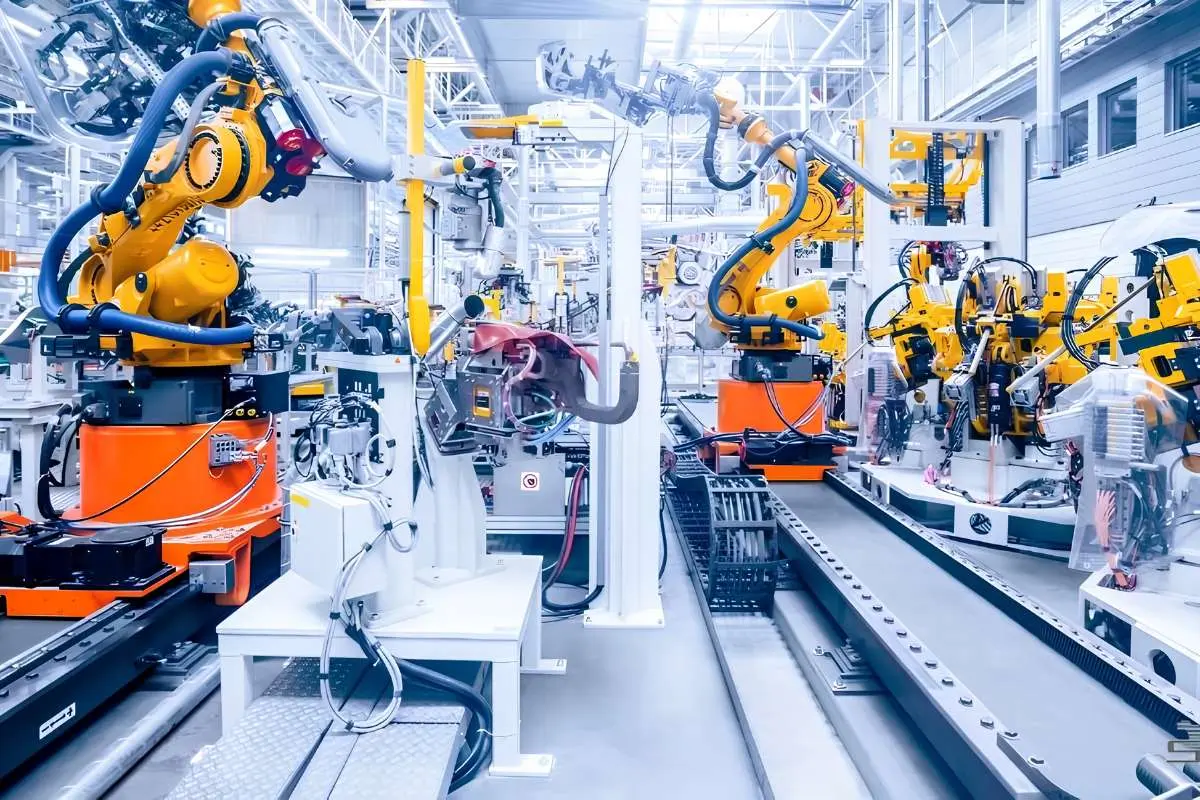
The strongest approach is often a simple sequence:
- Lean identifies the waste.
- Smart manufacturing exposes the pattern.
- Lean improves the process.
- Smart manufacturing monitors the result.
- Lean builds the discipline.
- Smart manufacturing scales the visibility.
Consider a factory dealing with recurring downtime on one production line. A lean team can map the process, find the causes and standardize the response. Once that foundation is in place, connected machine data can show when the problem starts, how often it happens and whether warning signs appear beforehand.
That is why smart manufacturing for small businesses can follow the same principle, even without a massive technology budget. Start with the problem, then add the simplest useful tool.
Ultimately, smart manufacturing vs lean manufacturing is not really a battle between technology and process. They work at different levels, and together, they can make improvements easier to find, measure and sustain.
Conclusion: Start with the problem, then decide what deserves technology
Lean manufacturing is about improving how work gets done. It helps teams reduce waste, improve flow and build better processes. Smart manufacturing takes a different route, using connected technology, data and systems to improve visibility and support faster decisions.
Neither approach needs to win.
They work particularly well together when technology is applied to a problem the team already understands. Lean can help define the problem and improve the process. Smart manufacturing can then make that process easier to monitor, measure and improve over time.
So, where should you start? If the process is messy, fix the process first. If the process works but is difficult to see, measure or control, smart technology may be the logical next step.
A factory does not get extra points for being digital. It gets results for solving problems.
FAQs
1. Is lean manufacturing still relevant in smart factories?
Yes. Lean principles help smart factories focus technology on real process problems instead of collecting data without a clear purpose.
2. Can a factory use lean manufacturing without Industry 4.0?
Absolutely. Lean manufacturing can improve processes using standard work, visual controls, employee involvement and continuous improvement without advanced technology.
3. Does smart manufacturing replace lean manufacturing?
No. Smart manufacturing adds connected technology and data, while lean provides methods for improving processes and reducing waste.
4. Which is cheaper in smart manufacturing vs lean manufacturing?
Lean manufacturing usually requires less technology investment, while smart manufacturing can require spending on sensors, software, connectivity and integration.
5. How can manufacturers combine lean and smart manufacturing?
Start with a clear process problem, improve the process using lean principles, then apply technology where better data or automation can strengthen the improvement.